Showing posts with label Schreiber. Show all posts

04 November 2017

Schreiber in June 1993 & Van Horne Writes re: an "Inspired Idiot"


This post centres on Schreiber and Lake Superior and also features some of Van Horne's correspondence about the line along the lake.

Casting about for a series of photos which had definitely never seen the light of day, I found some. 

By June 1993 my job was getting stressful enough that I gave up my ailing hand-fired Yashica in favour of an automatic point and shoot - as my spouse just reminded me - "so that my whole vacation [wouldn't] be spent thinking about photography!!".

... Well, I hope I had a good vacation.

*  *  *

The view below, from Schreiber's east, was probably taken during the mid-1970s (a guess).


from: Geology and Scenery, North Shore of Lake Superior; EG Pye; 1969; Ontario Department of Mines.

We'll be travelling from west to east for this post and the photo below was taken near Dublin with the nearest Lake Superior feature being Mozakama ('Kama') Bay. We are looking timetable west toward the Red Rock and Nipigon area. You can get a very similar (better!) image using Google maps in 2017, but on the internet my 1993 photos would probably be given the prestigious 'vintage' label.

As we pass the map of the area's geology, above, you might note that probably the most challenging running occurs over the purple area - the 'Coldwell alkaline complex' - including the ruling grades in both directions for the Heron Bay subdivision.


Near Dublin - The small plastic fisheye lens darkens the edges of the photos.


Above is my 'big' contribution to Schreiber's local oral history.

During the first few months of 1977, I remember seeing uniformed train crew members (as opposed to engine crew) from The Canadian trudging through the snow to this hotel. The hotel above can be seen to the right of the 'barn shaped' roof of the old arena in the postcard above.

Passenger train crew worked over multiple subdivisions while all engine crews covered one ... as the nature of their duties was quite different. Because Schreiber was the 'home' terminal for most of us, the company didn't maintain a bunkhouse here as it did at our objective terminals at White River and Thunder Bay. So this hotel was the company-designated rest location for just a few employees.

Between 1909 and 1967, a 110 bed ('railroad') YMCA provided accommodation for itinerant railroaders (and other travellers) in Schreiber ... and similar YMCAs performed this function at many other division points across Canada.

After the end of steam, as new technologies displaced workers in many traditional trades and professions, there was less need to house workers from out of town at every division point. The evolution of collective agreements between the company and running trades employees led to standardized company-maintained private room accommodation in special modular buildings at objective terminals.

At Schreiber in the late 1970s, bumped (lower seniority) running trades employees (eg. from Thunder Bay) ... and out of town trainees 'coming on brake' found our own motel rooms from within the local inventory. With an ongoing mill expansion at Terrace Bay, it was a seller's market and weekly rates were priced accordingly. Overlooking Schreiber's scenic wooded gully, and at the far end of the motel's water pipes, I never, ever had hot water in my $306/week (corrected for inflation to 2017 dollars) room.

While I'm at it, neither did my room have a phone. Consequently I participated in a historic, vanishing railway procedure - being called for duty in person by a yard office caller, instead of by phone. I slept quite well during those days, but then came the dreaded knock on the door in the middle of the night, telling me I was ordered for the Paper Train.

Happily, Rolly solicited me as his upstairs tenant after our first memorable round trip together to White River.


Scotia Street, looking 'west'.

To me, this seems to be Schreiber's traditional main commercial street. A modern argument could be made for the Trans-Canada. Considering the importance of the George Stephen's Bank of Montreal in CPR history, you won't be surprised that the Bank of Montreal had branches near the terminals at Schreiber and White River. The blue bank building is just beyond the former medical centre brick building on the corner.


I blew into town at about the same time in the season as Charlie, above.
The view above looks east.
I think smoke jacks of the roundhouse are visible at the right edge of the photo.


Continuing in June 1993 ...
The yard switchers are getting bigger and bigger.
A little Alco did the work in 1977 and it also powered a quick turn to Terrace Bay.
The wooden caboose on the latter job still used kerosene markers.

The car shop above must be very quiet in 1993.

It's not because the carmen are all out of town with
the Thunder Bay auxiliary at another 'affair'.
They are simply gone from Schreiber.


Engineering buildings west of the station are gone now in 2017.


Here are a few views of Schreiber station in 1993.
The impressive communication wire arms are all gone in 2017.
... as are the dispatchers and the divisional staff from the second floor.

I wonder who kept the shoebox-sized container with all the
tiny skeins of yarn for the trainees' colour sense tests?
What colour is this ... ?

In 1993, you could still fit a piece of plywood in the back of a pickup truck.


The train inspection light is still there.
The lead for Superintendent Small's business car is gone.
The sputtering of a van generator no longer cues the tailend crew to swing aboard.


*  *  *

Moving east from Schreiber.


I think this is Black Fox Lake - to the north of the highway?
There are countless silent and intriguing lakes shaped by glacial action and erosion.


I think this is Ripple Lake living up to its name.
We had stopped for some stock shots of this favourite location
and a westbound was kind enough to pass by.
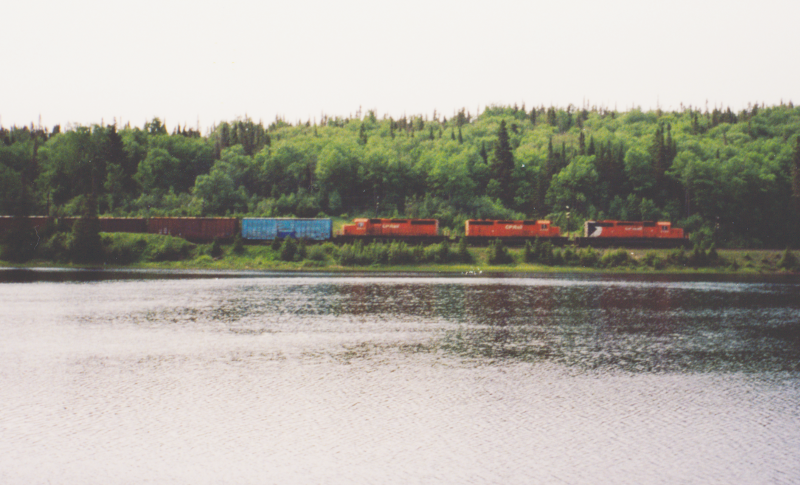


*  *  *


A dramatic location to see an eastbound is at the crossing at the top of the hill at Neys.
After my Ripple Lake luck I can't complain that I can only do a study of the track.

The heavy use of rail anchors prevents the rails from being clawed downhill
under the wheels of eastbound power climbing the ruling grade.

Descending trains complying with the permanent 30 mph slow order
on the high curving bridge over the Little Pic River at the foot of this hill,
will also tug on the rail anchors ...

In the 'old days' eight hot wheel treads on each car grasped at the rails.

Today, probably, 'ideally' from the Company Perspective ...
most of the resisting adhesion occurs only at the locomotive wheel treads
and dissipates through the electrical grids of the dynamic brakes.

... less work for the carmen to worry about.

*  *  *

About a century earlier ...


from: Thunder Bay District 1821-1892, A Collection of Documents; ed:Elizabeth Arthur; 1973; University of Toronto Press.

A substitute for masonry is seen below.
When finances permitted, in keeping with pioneer railway practice,
the gap below was filled by dropping stone from cars stopped on the trestle.

The telegraph poles are artfully canted off the south side of the trestle.
Notice how light the rail is.


Inwood (the address above) is near Petrolia in southern Ontario


from: Thunder Bay District 1821-1892, A Collection of Documents; ed:Elizabeth Arthur; 1973; University of Toronto Press.

... later that year ...

from: Thunder Bay District 1821-1892, A Collection of Documents; ed:Elizabeth Arthur; 1973; University of Toronto Press.
*  *  *

Finally, this modern Oakman postcard can be dated with some precision ...


The Schreiber [railway] Underpass (lower left) opened on September 1, 1965.
I was excited to find a commemorative highball glass from this event
at an antique store we visited somewhere.

Action Red was introduced in 1968 and not a trace of it can be seen in the yard,
or on Number 1's equipment.

As a final bit of historical trivia ...
Above: I think Rolly and Theresa's green roof (surrounded by trees)
can be seen beyond the underpass
and immediately beyond the two low Catholic church buildings.

He purchased it from an engineer by the name of A. McCorkill.
In the 1930s Mr McCorkill may have begun his railway career as a telegrapher.


A further enlargement of the station buildings and yard appears below.


15 September 2016

Schreiber Yard in June 1987


Most of our vacation time in Schreiber was spent visiting. We usually stopped in Schreiber while on our way to or from Manitoba. So: little time could be allocated to documenting what was going on in Schreiber's yard. I generally had one chance on the way in, or while leaving.

This 'failure to document' was a consequence of the prevalent view among professional running trades people of the time.

Apparently, even for those who had 'cinder-dust in their blood' (a CNR quote), when you were off work, and particularly after you retired ... you were expected to have much better ways to spend your time than hanging around the railway's equipment. The farther away you were, the healthier you were seen to be. To hang around was kind of 'sick' or sad. However, we can all think of notable, celebrated exceptions to this viewpoint - there were professional railroaders who preserved images and knowledge of railway operations and processes. 

... At one point, without even thinking to ask, while out seeing the other sights of Schreiber on a fine sunny day, I once stopped our car at the Schreiber platform (typical vacation behaviour) and Rolly seemed to shrink into the passenger seat a little. He said it was the first time he had been at the tracks since his retirement months earlier. The fact that Schreiber had been a small, thoroughbred railway town probably made it more difficult for someone to casually and anonymously have a close-up look at the new power, etc.

I am thankful that I experienced Schreiber when it still had all the divisional staff there, and when almost everything and everyone in town had some kind of direct link to the railway business. It is probably that unique railway 'company community' - a historical loss - that I regret not being able to document better.


Here are a few photos I was able to grab around the Schreiber yard in a few stolen moments of time.


Before oil company contractors were hired to refuel power with tank trucks, the work was kept in-house. 
Here is a CP diesel fuel tank car at the Schreiber fuel rack.


Here is a suspiciously-round spot. We are looking toward the east end of the yard. You can see how the original 1880s line had to be built in cooperation with the low hills of the Canadian Shield. The right of way was precious enough, that the 'telegraph line' came in over the hills.


The yard switcher keeps the turntable in place for potential use by the next shift.


Tie cars stand in front of the car barn. I am guessing that the add-on section contained larger tools, equipment and offices. I remember seeing a carbody lifted off its trucks through the windows during the early months of 1977. When there was a derailment, the carmen would all leave town to attend to it - usually the Thunder Bay Auxiliary would be attendance as well.

Gulls, facing their nearby inland sea, would perch on the peak of the carbarn roof - to provide that white 'hi-liting'.


Power secured in the yard.


Power from the never-photographed end.


From the station platform we get a look at some Maintenance of Way equipment. As you can see, sand is used now and then to get trains moving. That concrete pad may have once supported a standpipe for topping up the tenders of through passenger trains ... or a steam connection to keep the Superintendent's business car warm on its stub track.


More tie cars and the carbarn from the station side. I think that is some kind of bridge truss in the distance.


Here is the east end of the yard - sometimes photographed by corporate photographers.

*  *  *

Below is a passenger train timetable of the 'Greater Schreiber Area' from the grim, wartime winter of 1943.
Here are some of my guesses about the stops made on the Heron Bay Sub (White River to Schreiber) by Trains 1 and 2.

  • Marathon (then Peninsula) was only a flag stop before the eponymous company built its pulp mill there.
  • Angler and Neys were scheduled stops so military staff could arrive and depart, and so 'guests' of the King could arrive at the German, etc prisoner of war facilities located there.
  • Jack Fish was important as a coal port during the shipping season and coal dumped in the cleared area near the current siding there was distributed along the Algoma Division during the winter. The regular stop also served the community which had become established around the railway facilities. And most importantly, a large concrete coaling tower was used to refill tenders on passing trains.

from: CPR public timetable Nov 28, 1943


27 January 2015

Other Categories of Railway Workers


from: CNR Keeping Track, photo circa 1963

What do the railroaders above have in common with those at Schreiber?
Almost everything.


When I went to work in Schreiber in early 1977, I saw it almost at the end of its special status as a 'railway town'. 

It still had a car shop and some locomotive maintenance capacity. The divisional offices and superintendent were located there. Significant local resource-based industries were served by daily train assignments and this, in turn, required yard switching assignments.

The local offices organized crew assignments - drawing from the east and west pools, and the spareboards. Yard office staff called crews by telephone or in person. Car control functions; payroll; and even colour sense and vision tests were performed locally. Physicals required as a condition of hiring were done in Schreiber. Engineers upset about the way traffic was handled could climb the stairs after their run and have a talk with the train dispatcher responsible.

Schreiber had the 'highest per-capita income in the province of Ontario' - as we were told in the classroom. This was mainly because the running trades employees - long known as 'the aristocrats of labour' - were based in Schreiber.

My brief encounters with clerks, yard office staff, office managers and middle managers - both at Schreiber and White River - are the most fondly remembered. Some of my fellow running trades employees were intolerant of peers of other ethnic origins working with them in the running trades. Some were particularly scornful of any ideas coming from other railway companies.

'If I wanted to clean switches, I would have hired on as a sectionman!' was a quote which went with a 'not my job' refusal to work story - proudly recounted by a running trades employee which I remember being told. 

As Rolly Martin started out as a sectionman (on another! road) and as an ashpitman - not starting as a member of the 'elite' running trades which I had arrived in town to become - he tended to have a little more perspective about the nature of railway work than some of the other characters I had to deal with. 

Division Superintendent Small (a former locomotive engineer) told us we might get laid off, but that we should take temporary work on a maintenance of way gang if that happened - to get 'the big picture' of the railway. 


Years later, I found a book which helps preserve and explain 'the big picture' of life in small towns such as Schreiber and White River - which were railway towns first and foremost, for the better part of a century. 

When doing sociological studies, it is a serious business to maintain confidentiality. In this book, there are no clues suggesting which railways or communities were studied. Of course, personal interview data was also kept in strict confidence.


The following pages come from Minetown, Milltown, Railtown - Life in Canadian communities of single industry; Rex A Lucas; 1971; University of Toronto Press.


The author's approach as a sociologist in this book:

.. 'begins with an individual, his hopes, fears, problems, solutions and the habitual associations of his daily round of life. After informal chats or formal interviews with many individuals, the sociologist begins to see persistent patterns, some shared by all, others shared by certain respondents. During the course of the interviews it becomes clear that some respondents think that their problems are personal, unshared, and not understood by others, but other perceptive respondents are aware that many share the same difficulties because they see them as arising from a common source in their place of work, their community, or their nation. The sociologist has the advantage of listening to more people in more communities than any one respondent; this enables him to locate patterns about which many individuals are unaware. The accumulated advantages are even greater if, as in this study, the sociologist is able to undertake all of the interviewing, rather than relegating the work to others.'

'The first patterns for this book were found after interviewing many people in Railtown, Ontario.'

[ ... ]

'These patterns were confirmed in interviews and in questionnaire replies from a much wider range of communities of single industry throughout Canada. It is these common patterns, intrinsic as they are in communities of single industry and with a population of under 30,000, that I have chosen to report here.' 


The local railway hierarchy begins with:
  1. Officials
  2. Running Trades
  3. Operators and Dispatchers

Dispatchers Paul Pelto and Barlow Howard pose at the new Schreiber Division CTC board in early 1968.
The boards would go live and this 511 mile territory would be operated through them before the end of the year.
from: CPR Spanner, April 1968


Above: 'the changing role of the fireman' ..

A story in the Quebec Chronicle Telegraph from May 10, 1968 gives a few details. It was written almost a decade after steam locomotives were removed from regular service on the CNR and CPR and almost two decades after serious 'dieselization' began.


05 December 2014

A Tour of the CPR Heron Bay Sub in 1986, Part 2 of 2

Featuring the Photographs of Eric D. Gagnon
My brother went west by train in 1986. One important project of this trip was to drive the backroads and to document the vanishing wooden country grain elevators in Saskatchewan. In addition, on his way around Lake Superior, he photographed the Heron Bay and Nipigon subs in great detail for me. He spent at least five or six hours shooting out the tailend of The Canadian and recording the location particulars for each photo.

Continuing west, we have departed from Marathon - 'Peninsula' on this 1915 map of telegraph stations. We will be travelling through the most rugged section of the Heron Bay Subdivision - much of it built along the shore of the Lake Superior on solid rock.


The westbound Canadian has travelled down the long grade from White River, to near lake level at Marathon (Peninsula). 

As the following 1973 Haulage Capacity data shows, the ruling grade (underlined) Eastbound is considered to be beyond Middleton, and the ruling grade Westbound is considered to be beyond Marathon.


Variables used for the calculation of equivalent tonnage (the mass to be moved) and haulage capacity (the power available to move the mass) over a subdivision include:
  • tare - the weight of the cars when empty
  • contents - the weight of freight in the cars
  • train resistance - curvature and grades - 20% is 'medium'.
  • temperature - Very cold temperatures increase rolling resistance.
  • for the direction of travel: the lowest grade coefficient on the subdivision, e.g. 1.70
  • tonnage rating of the various units in the locomotive consist
  • reducing the tonnage rating if locomotives have traction motors cut out.
  • state of the rail - dry, wet, frosted, snow-covered - It affects locomotive traction: the power at the rail.

By using the data above, and performing a few calculations using a pencil and paper, yard office staff could balance the haulage capacity of the locomotives (power) with the equivalent tonnage of the train (mass) to ensure that any freight train could be pulled over the subdivision successfully, and without wasting power.

Most of the 'advertised' freights, working on schedules promoted to shippers, used an easier 'horsepower per ton' formula. With the flexibility provided by Centralized Traffic Control (CTC) there was no need to put these schedules in the actual employee timetable.

Looking at the posted train line-up at the Schreiber yard office, Rolly would sometimes view the locomotive numbers and the tonnage listed for a particular train and dismissively state "That's a drag". Most crew members would know when a low priority freight train's power was barely enough to pull the tonnage over the subdivision.

Heron Bay Subdivision from 'west' of Marathon to Red Sucker Tunnel


Near mile 69, Heron Bay Sub
With the morning sun still low on the horizon, The Canadian in 1986 edges along its 100 year old ledge - blasted into the cliffs along Lake Superior.

Near mile 71, Heron Bay Sub.
Rock slide fence 'protects' the track when these wires are broken by rock tumbling down from the cut above. Signals protecting the susceptible zone of track are reset from 'proceed' to an indication warning that the train must be prepared to stop short of an obstruction on the track. In the past, rock watchmen were employed to walk these remote sections of the track on a regular basis, particularly before passenger trains were due.

Red Sucker Tunnel mile 71.6

Heron Bay Subdivision from Mink Tunnel to Neys

Mink Tunnel, Mile 73 Heron Bay Sub
Mink Tunnel in the spring of 1885; from: Van Horne's Road; Omer Lavallee; 1981; Railfare Books
The rock structure containing Mink Tunnel was left as a buttress to the rock formation along which the line had been blasted. This view toward the head of Mink Harbour (and Mink Creek) shows the original type of wooden trestle used to bridge across low areas of new construction. These gaps would eventually be filled by dumping rock from loaded cars positioned on the trestle itself. The idea with Canadian wilderness railways was generally to build a functioning through line first .. then worry about 'improvements' such as 'filling' trestles when more money was available. Trestles might last for a couple of decades before they would need replacement - so they provided a good stop-gap for railway builders during Canada's railway boom.
Mink Tunnel postcard, late 1940s
This gharishly colourized old postcard (I toned it down) shows the results of 60 years of improvements to the line. The trestle has been filled and Mink Creek is no longer naturally emptying into Lake Superior.

Notice the wooden 'telltale' to the left of the track and just outside the tunnel - a statutory warning of an approaching restricted clearance to any crew members working on the car roof walkways. A fringe of knotted ropes dangling from the hangman's assembly was designed to strike and warn the rooftop crew member on a moving train so they could flatten themselves on the roof before the obstruction was reached. Particularly in dense fog or at night these devices had the potential to save lives.

In our picture above, the railway management and train crew have detrained and are watching to see if the photographer will break his neck .. the former are standing at the Mink Tunnel sign. Meanwhile, the lake breezes are blowing back the steam from the popped safety valves on the locomotive as it stands with a hot fire.


Before portable radios became common in the 1970s, switching 'commands' had to be relayed by hand or lantern signal to the engine crew. In a screen cap from the safety training film 'Why Risk Your Life?' on YouTube, a Great Northern crew in the 1940s shows how roof walks were often used during switching operations.

East switch Coldwell, with Echo Lake at the left.
Looking at the switch points, you can see that the dispatcher in Schreiber is putting my brother's train into the siding at Coldwell. For a number of reasons this is my favourite station on the line.

Coldwell siding and back track, mile 74.7
Eastbound freight at Coldwell: Locomotives 6013 5001 4743 at 0715hr.
Running its way down the steep hill from Neys, this freight is twisting and turning its way through Coldwell and its descent will continue until it almost reaches lake level near Mink Tunnel. It is a lot easier to stop and start The Canadian than this guy. The engineer's wave indicates no problems spotted with our train.

Heron Bay Sub, Neys to Ripple
Obsolete railway station names are not published in the employee timetable ... but they are sometimes used because of tradition (e.g. use by older employees) or because they identify an important point on the railway. While 'Ripple' has no remarkable features, 'Neys' represents the crest of a significant grade in both directions.

Bridge over the Little Pic River, mile 81
Ever since railway operations began, the Heron Bay Subdivision has been cursed by this bridge located on a 30 mph curve ... and for eastbounds ... an immediate trip up the ruling grade for the subdivision. My brother is starting to fight the morning sun shining directly into his lens. But I have included this photo to show how abruptly the grade starts. Trains can't take a decent run at the ruling grade.

This was once the location for 'great heroics' by some spareboard headend trainmen (the most junior crew members imaginable). A defective diesel unit on an eastbound might shut itself down - thus reducing the haulage capacity of the locomotive consist - we studied 'power' at the beginning of the post. To help deal with this, the engineer would curse, pray ... and then show the lowly trainman how to take the trailing locomotive off 'isolate', how to restart it, etc. What else would he do with his time? Once brought back to life, the revived unit might only work for part of the way up the hill, but that might be all the help the engineer needed to avoid a stall or doubling his train.

Every time I was asked to do this on an eastbound, it was always necessary to travel along the icy locomotive running boards and over the inadequate lurching steps between the locomotives while travelling over this bridge. As always, the final instructions were "Be careful and hold on!".

Little Pic River Bridge mile 81, Heron Bay Sub.
1985 timetable for the Heron Bay Subdivision


Heron Bay Subdivision, Ripple to Steel
East switch at Steel


Bridge at mile 94.8 Heron Bay Sub over the Steel River
Heron Bay Sub from Steel River to Moberley Bay

East switch Jackfish

Jackfish siding, and back track containing boarding cars. "New Yards"

Jack Fish was a major CPR depot for bituminous coal for locomotives. The coal was brought to the Jackfish harbour from Pennsylvania by lake freighter. The coaling dock to unload ships near mile 99.9 was in service from 1895 until 1948.

This open area above (today's Jackfish at mile 98.2) was known as the New Yards where coal was stored in cars or stockpiled for the winter. This yard was expanded during both World Wars and could hold 600,000 tons at its peak capacity. (information from: A History of Jackfish; Jeanne Marcella; 1989; Terrace Bay Public Library)

Jackfish as seen from Tunnel Bay, looking toward Lake Superior, c1890. The coal dock has not yet been built.
from Van Horne's Road; Omer Lavallee; 1981; Railfare Books

Jackfish Tunnel mile 101.8
Jackfish Tunnel c1950, postcard.
Like the previous Mink Tunnel postcard, the train is stopped, and the photographer has scaled the rocks. This time the telltale is made of steel, probably with a dangling fringe of durable aluminum rods.

The Last Spike Monument at mile 102.7 in 1935 and the crew which built it.
from: A History of Jackfish; Jeanne Marcella; 1989; Terrace Bay Public Library
The cairn reads - all upper case: 
Driving the Last Spike 
between 
Montreal & Winnipeg 
May 16th 1885 
was re-enacted here 
by veterans and some 
original participants 
May 16th 1935.

Lavallee goes into greater detail if you are interested.


Mile 103.7 Heron Bay Sub
As we follow along, the headend of the Canadian is starting its way around Moberley Bay. At Moberley Bay in the late 1970s - even on the coldest winter day - the cab became full of the choking sulphurous stench from the waste being poured into the Lake Superior from the Terrace Bay plant. 

The bay provided an attractive view of long freight trains during the era of vans (cabooses) as the headend and tailend crews could usually see each other across the bay ... moving in opposite directions. I remember an engineer of the PAT train walking across the cab to admire his train early on a beautiful sunny morning. The salutation "OK around the bay, Extra xxxx west!" was usually made at this point by the headend. 

Heron Bay Sub, Moberley Bay to Terrace Bay.

Terrace Bay station and yard.
The sun is causing my brother grief, but you can see the raised TERRACE BAY lettering on the lower level of the station building.

Black River bridge mile 110.5
The Terrace Bay station is still in sight beyond the extra-tall absolute signal.

East switch Schreiber. Home again.


In 1939, King George VI and Queen Elizabeth (later the 'Queen Mother') crossed Canada by rail and also visited the US and Newfoundland to rally support for the coming conflict in Europe. This ring-bound book contained standard CPR and CNR public relations photos and descriptions for souvenir presentation to key participants and also for press use.

While the Heron Bay subdivision sees intermodal, crude oil and grain traffic today, it has played many different roles in its past history.

For the record, the Royal Train was scheduled to be in Schreiber 1325-1335hr Tuesday, May 23 - just enough time for a crew change and a brake test. You can find photos showing that there were royal walkabouts at both White River and Schreiber.