It's great to see a station beautifully restored and put to good use!
Hudson Village Theatre website
We can all name favourite railway stations which have gone beyond the state shown in my 1994 photos below.
Visiting with my cousin and his wife, and a point and shoot camera, the future of the station didn't look good.
Inspired by recent museum experience, I worked to document all aspects of the station.
Above: As you'll see, this is a time-honoured photographic location.
A number of stations had added verandahs for the resident agents and their families. The added freight shed probably reflected the expanding industrial and commercial importance of the area and perhaps the mail-order catalogue business (in Canada, it was Eaton's).
 |
| from: Golden Jubilee, 1869-1919: 1919; T Eaton Co. |
Above, looking timetable west at Hudson, below is timetable east.
* * *
 |
| from: Historic Hudson, Part II; Roderick L Hodgson; 1993; Hudson Historical Society. |
The view above is from circa 1900.
Notice the old-style train order signal.
I believe the black and white object to the right of the tracks is a wooden switchstand.
I think I have seen Historic Hudson (see photo caption) in readable form on the internet - perhaps on the historical society's website.
The book's three interesting sections cover the history of Hudson's fire department, the local railway history and the natural ice harvesting business.
LC Gagnon took this photo of Number 1 at Hudson, circa 1961.
On a typically hot Hudson-visiting day, it shows the operation of the locomotive air conditioning.
However, this engine is ready for anything in winter. It's got the pilot-plow and roof-mounted bars to break hanging masses of ice in tunnels before they damage the dome cars.
The two-beam, overhead nighttime scenery light was one of the initial '1950s-style' attractions of the Canadian. It could have been used to advantage along Lake Superior's shores and in the western mountains. The light appliance is mounted behind the horns and between the icicle bars.
... My distant past experience was that VIA (in contrast) often shooed passengers out of the Park dome at night - using 'liquor regulations' as a 'reason' (not that I'm bitter, or anything).
Originally, LC Gagnon photographed the Canadian at the Como crossing, however, with a 1962 VW Beetle we were all able to attend the daily event at Hudson.
* * *
In June 1961 (before the car) this would have been one of my first encounters with The Canadian (Number 1). During this period, a trip to Montreal West was the source of many wonders. It was an MTC bus ride from our home in Lachine. It had the giant Elmhurst Dairy cow heads (3-D models). There was a tower-based grade crossing protection operator - because of the frequent stopping and starting of passenger trains on or near the crossing circuit.
In the evening, passenger trains would create a flurry of activity. All the tracks were accessible, so we could cross the timbers to another platform if a train was expected there. Passengers and their friends or family gathered on the various platforms and the baggage personnel would be straining to move the wagons loaded with suitcases and trunks for placement in the trains' baggage cars.
It didn't mean much to me at the time, but there was also an interlocking tower at Westminster Avenue - which is preserved today.
Providing better colour than the defective Ektachrome slides of 1961, are the two views, above and below, from September 1968.
The whole thing about seeing Number 1 at Montreal West was that it was only about 13 minutes out of its terminal at Windsor Station. It was predictable and dependable.
And Hudson was reached when the train was only 32 miles into its run, so it made an exciting break in our visits to Como.
... My maternal grandmother retained the family's cottage on the Ottawa River at Como after her spouse's death - I never met my grandfather. He had been in the Railway Construction Corps from April 1915 (he would have graduated as a civil engineer in 1916 had he stayed in McGill) and finally got back from military service in Europe in 1919. After living in Lachine, my mother's parents moved to Valois and my grandfather commuted by train to his job at Stelco in east-end Lachine from there.
However, visiting at Como was my mother seeing her mother and remembering good times at the cottage and there were no 'railway war stories' of any kind. So, when 1430hr rolled around we were getting excited about going to Hudson for 15hr to see the Canadian - leaving my mother and my grandmother in peace for a while.
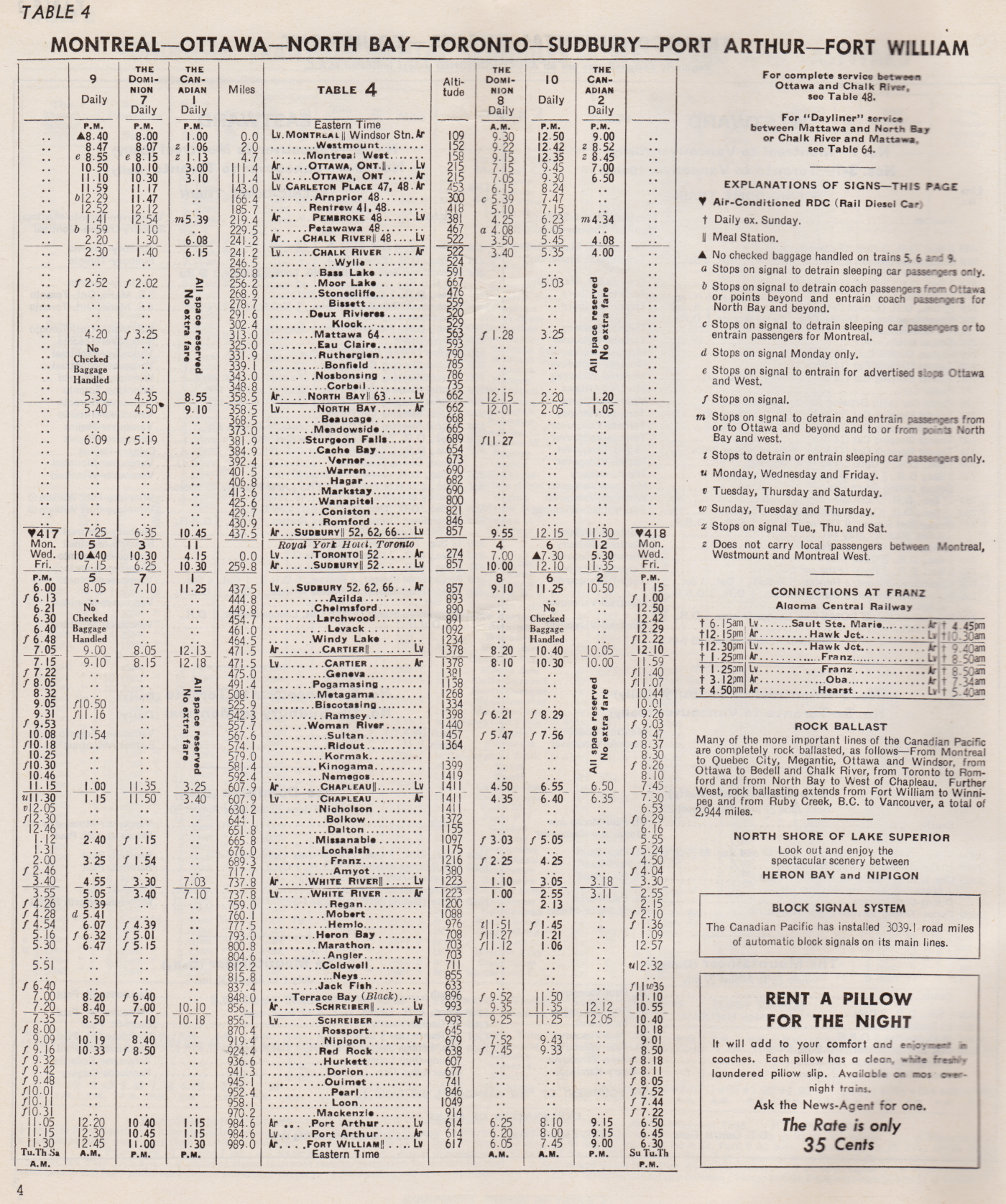
Here's the timetable ...
 |
| CPR public timetable, April 1958. |
Give yourself 100 bonus points if you - like I - doubted my claim of seeing the Canadian at 15hr at Hudson. Wasn't it was scheduled to be in Ottawa by then?
Back then, the railways had some kind of 'attitude' about changing their clocks twice per year.
... I mean, they made such a big deal of fiddling with official Standard Clocks every day with the Official Time Signal ... and whenever operating employees showed up for work. What's two more annual fiddlings, considering how much railroaders liked playing with their timepieces every time they had an excuse to do so?
... So you'll notice that the summer timetable above says 'Eastern Time' not 'Eastern Daylight Saving Time'. If we were serious railway passengers we'd be happy to make the necessary conversions every single time we looked at an April to October timetable. Canadians may live in EDST for half the year, but the CPR is a serious organization which uses only Standard Time!
* * *
You have Mike Gammon and Jim Christie to thank for the maps below. I guess Mike found this website, told Jim, and then Jim passed it on to me. It has a collection of historical, digitized Canadian topographic maps of Ontario.
I've joined two maps below 1909/1910 and skewed them counter-clockwise so the railway line runs across the screen better. At the right side is Vaudreuil (Dorion, if you prefer) which is located past the western tip of Montreal Island (and Ile Perrot). Continuing westward, you pass Como. My grandmother's place should be immediately west of the river-side sawmill (SM) ... in case young family members are looking in. And west the track goes ... to Hudson, Rigaud and Ottawa.
Bonus: You can see the track providing CPR 'commuter' service to Point Fortune (notice the wye) with the ferry across to Carillon. To the west of Carillon is the Carillon and Grenville Railway.
Half of our paternal side comes from just north of St Andrew's (East) - just so everyone can get into the picture.
Below is the same April 1958 public timetable. Make sure you convert to Daylight Saving, eh?
Before the development the highway system and the 'necessity' of owning an auto, you can see how many trains Vaudreuil hosted. Hudson saw more passenger trains in a day than many large Canadian cities see in 2023.
 |
| CPR public timetable, April 1958. |
* * *
The map from 1945 (above) is kind of neat for what it shows. You can see the Hudson station positioned on the south side of the track exactly midway between the two roads which lead from Hudson to the river's edge. On those spurs are the two natural ice companies which harvested ice from the Ottawa River.
Below is a YouTube link featuring amateur film of the whole process, including the CPR siding and the switching necessary to begin the region-wide distribution of the ice.
Jim Christie and I had some interesting correspondence about these operations. He discovered old advertisements and articles from an Ottawa ice company which promoted artificial ice as being healthier. Today, we might think of the environmental efficiency and elegance of harvesting winter ice and using it for home ice boxes, railway refrigerator cars, etc.
However, as Jim discovered, there were all sorts of problems with water-borne diseases in those days which were linked to the Ottawa River and this (and affordable mechanical refrigeration) eventually contributed to the end of ice harvesting on the Ottawa.
Here are a couple of his discoveries:
* * *
Like The Canadian through Hudson!
The employee timetable from April 1958 shows ABS operating from Vaudreuil to Rigaud, and passenger trains being limited to 50 MPH on curves.
Above, the Canadian is shown in July 1961.
Coming along this stretch of tangent track,
the front of the lead unit would flash repeatedly as it came into the sunlight
and out of the shadows of the mature trackside trees.
There would be a great deal of whistling for the numerous level crossings.
In its wake the train would draw paper litter and other light items from the right-of-way.
... Occasionally, when someone in my family wanted to describe something or someone (eg. a high school vice principal) approaching and departing with a great deal of speed, effect and consequence, we'd finish the description saying 'with bits of scrap paper blowing behind them - like the Canadian through Hudson'.
 |
| Google Earth, 2023 image looking timetable east. |
* * *
Here's another hot day in June 1966 with the family quarters upstairs being ventilated.
The sun is reflecting off the lead unit and there is lots of diesel smoke in the air.
The train is whistling as it fully occupies that crossing and there is another crossing behind the camera.

The train blasts by in a cloud of its own hot haze.

In the front seat, my sister has had enough of the whistling!