Showing posts with label 1990s. Show all posts

03 January 2026

CPR 1995 Smiths Falls

The following were all ending their years of service at about the same time: 35mm film, shops processing and printing it well, and my manual 35mm camera equipment. In 1995, I generally left my old camera and lenses at home and used a new 35mm point and shoot camera which was probably better suited to birthday parties than rolling stock. 

On this particular day, probably in late April 1995, there was a remarkable (for us, coming from run-thru Kingston) procession of trains which we could actually contemplate as they came to the Smiths Falls bottleneck, waited for traffic to clear, and went through their crew changes. 

The bravado of parking in the Superintendent's base-of-scrap-rail-labelled personalized spot was really the sad recognition that there probably had not been a superintendent in Smiths Falls for some time. 


Two trains, two railways, one track. 
Two VIA trains nod to each other as they take their turns on the CP Brockville Sub.


*  *  *


I think most of these people are train crew - waiting for their trains to arrive.


*  *  *

Closer to home at Mile 183, CN Kingston Sub.
An eastbound slag train takes its time as it will follow
a preceding VIA train crossing to the south track at Queens.


I had started a longer 'essay' on the evolution of photography from Ektachrome slides, to 35mm, to our much better smartphone era.

However, people like KillerBee on YouTube have more eloquently expressed what I was working on. Every coast-to-coast-to-gulf mega-railway can be supervised, and every feature of it can be micro-managed, by a solitary ailing old guy, dressed in sweats, and watching a room full of high definition monitors. The locally commanded armies of workers of the individual railway regions, which existed decades ago ... have been homogenized into a technologically impressive and efficient, but boring, monolithic machine.

Taking, storing, documenting, and reproducing high-quality photos has never been easier. But as one commenter to KillerBee's video noted as a generality: Going to the tracks to photograph 'the same engine on every train' really makes the exercise seem pointless. 


25 April 2025

Editorial Cartoons 1962-1995 (and 1849)

Littering, driving while drunk and Nazis. It seemed for a while that *'we' were finished with these things - that people knew better. 

* 'We' represents my narrow view of humanity - not all 8 billion people on Earth.

What we learn from studying history is that there are always 'reservoirs' of various ideas and behaviours. 

Like measles, almost any idea or behaviour can return with some force.

People will sometimes violate norms, and break rules and laws. Others may choose to follow the behaviour.

This is probably because human nature and the human condition are the same down through history.
This is probably why we still quote the ancient Greeks, Romans and Sun Tzu.

*  *  *

Recently, I strongly identified with the protest sign which said: 

I can't believe I still have to protest this sh** !

I once complained that 'our' work to start a local tourist railway was really hard. 
My interlocutor was a key officer of a very successful tourist railway: "It's always hard" was his reply.

*  *  *

I had an quick, easy blog topic lined up ... 

However, we are in the midst of a lot of political and societal turmoil - particularly this week with a general election. We are also the proverbial mouse which sleeps with an elephant - affected by its every twitch and grunt. 

I own 8 second-hand books of editorial cartoons. 

Rather than tacking a single cartoon onto my planned railway post, I thought it would be more appropriate to leaf through all 8 books and find cartoons which address some of the subjects which are in the news today.

Back in the heyday of the professional editorial cartoon, readers might have 1-3 newspapers to choose from in their town or city. They might choose their paper based on its labour or business editorial slant, or its features and special-interest columnists (like a weekly cooking, history or gardening column ... or a weekend magazine insert). 

Readers could have a subscription delivered to their door (and deal with a 'paper boy' ... paying them in cash at the door every week at dinner time). They could use coins and obtain a single copy from a box (eg. after a big election or trainwreck). They could go to a newsstand and buy papers from other cities and countries.

Newspapers were often seen as documentary records of current events. Unlike TV news, they were relatively permanent. Journalistic rigour required errors to be followed with retractions or corrections ... in writing in a subsequent edition. 

Newspapers were generally filled with factual information. Opinions were limited to a couple of editorial pages. One would also find letters to the editor on these pages - i.e. a reader would sit down and write or type a letter, and physically mail it to the paper where it would be considered for publication. The name and address (the true identity) of the writer was required for publication.

The editorial cartoon was a often bit of 'candy' for the readers. A clever cartoonist would come up with a unique perspective on an issue ... and use their artistic skills and insight to convey their unique funny, satirical or profound perspective about a topic. 

*  *  *

In our society during our lifetimes, we witness our laws and social customs change. ... and these 'lock in' (we believe) progress. For example, the law may spell out human rights ... however true acceptance and reasonable adaptive behaviours by most people may take longer to develop across society. 

... In reality, over time, we may find that we're never really finished with a given topic.

For example: littering, driving while drunk, Nazis. 

A real nightmare: Nazis who are driving drunk and littering !!!

... It does sometimes feel that we are like Sisyphus when it comes to making lasting progress here in northern North America. 

Whether it's Canadian national defence, the capacity of humans to destroy virtually all life on the planet, the state of our educational institutions, or our relations with the United States ... we are not the first Canadians to be confronted with these subjects and the challenges they create.

It may be comforting to realize that this moment does not necessarily represent 'the worst it has ever been!' ... as the social media clickbait 'news bot headlines' distract us from the more difficult work of searching for, and calmly reflecting on, the facts around us. We aren't alone - people in our history have had to deal with similar problems in the past.

*  *  *

I was particularly pleased that the last cartoon I found and selected ... depicted a political phenomenon which was apparently influential with some voters during our current election - over 175 years after that editorial cartoon was first published.

*  *  *

It's always hard.

The work to preserve and maintain a healthy democracy is never complete.

Humans are never at 'the end of history'.

*  *  *

EDITORIAL CARTOONS


from: 11th Annual Collection of Norris; Len Norris; 1962; Vancouver Sun.  


*  *  *

from: Cartoons by Macpherson, Volume 3; Duncan Macpherson; 1963; Toronto Star.


Today, we are concerned that unchecked human-induced climate change will continue to cause species extinctions, and will eventually make areas of the planet uninhabitable and kill millions of people if nothing is done.

In the early 1960s, the US and the USSR were the most prominent testers of hydrogen bombs in the atmosphere. Children of my generation were having their baby teeth solicited by researchers so they could be tested for radioactive strontium. Many have thyroid conditions from childhood absorption of radioactive iodine. Both were products of nuclear testing.

Eventually, President Kennedy and Premier Khrushchev signed the first agreement to stop atmospheric testing. Britain also signed, France did not. 

*  *  *


*  *  *

from: Canadian Rail, CRHA; cartoons by Doug Wright 1964-68 for the Montreal Star.


Continuing with the nuclear threat. By the mid-1960s, it was pointless to consider the construction of urban fallout shelters and to continue the famous 'duck and cover' drills for school children. Urban evacuation in the event of attack would not have been realistic. The warheads on missiles from the USSR were simply too powerful, and the missile guidance systems were too imprecise, to hit their exact targets - such as a city centre.

Below, is a newspaper graphic showing the impact of a medium-sized weapon on Montreal. The dark shading denotes the area of primary economic importance. An air-burst weapon would have been used on a city (to destroy buildings) and Mount Royal would probably have shielded some areas to the west from the radiation and shock wave at the moment of detonation. The rings indicate the distance from Ground Zero in miles.

Nuclear weapons were continually talked about in the press (i.e. as 'The Bomb'). On the radio in the 1960s, I heard an announcer comment that the smoke coming off a big refinery fire made things look like eastern Montreal had 'received a megaton'.

Today, even more countries have an even greater selection of nuclear weapon types and delivery systems. Pakistan and India now menace each other with submarine-launched nuclear missiles - forcing them into a 'launch on warning' guarantee of mutual destruction. Non-nuclear nations are musing about developing their own to protect themselves if the United States withdraws its 'nuclear umbrella', eg. from Europe, Taiwan, Japan etc.

Canada made significant contributions to the development of the atomic weapons of World War 2 and could have created a serviceable little atomic arsenal just as fast as Britain and France did. However, without delusions of imperial greatness, Canada stayed out of that madness. 

Although the risk is now probably greater, people aren't very nuclear-literate these days.

from: Canada and the Cold War; Whitaker & Hewitt; 2003; James Lorimer & Co.


This is at my childhood trainwatching spot at the CPR commuter station at the top of 40th Avenue, Lachine.


*  *  *

from The Barron Book; 1972; Toronto Star.


*  *  *

Macpherson Editorial Cartoons 1979; Duncan Macpherson; 1979; Toronto Star.


There was no particular event at this point in history.
Yuri Andropov had come up with the novel idea of 'treating' dissenters in mental hospitals.

'Kremlinologists' were always trying to determine who was in or out of favour.
The cartoonist employs a traditional Soviet version of Ockham's Razor.

*  *  *

from: Roschkov Editorial Cartoons; Vic Roschkov; 1979; Prentice-Hall.


Above: Leonid Brezhnev, leader of the Soviet Union.


Above: Prime Minister Pierre Trudeau

Below: Prime Minister Joe Clark and probably Robert de Cotret, Minister of Industry, Trade and Commerce.


*  *  *

from: Drawing Bones, My 15 Years of Cartooning Brian Mulroney; Terry Mosher; 1991; Key Porter Books.


*  *  *

from: Portfoolio 11 - The Year's Best Editorial Cartoons; Ed: Guy Badeaux; 1995; Macmillan Canada.


*  *  *

originally from: Punch; 1849; The Grip Publishing.

reprinted in: A Caricature History of Canadian Politics; JW Bengough; 1886 (reprint 1974); Grip (Peter Martin Associates).


The Brother Jonathan character originally personified New England. 

For the general purposes of representing the United States, he was gradually replaced by Uncle Sam,
... sometime during/after the War of 1812.


05 July 2024

Riding the Rails, Heritage Park, Calgary, 1990

 ... but it's a dry heat!

It was early August and we were driving to Calgary in three days in a 1989 Volkswagen Fox with no air conditioning. After leaving Brandon that morning, we had our planned 'shower stop' at Swift Current where it was 30 degrees C with a strong wind. And then it got hot. 


Near Walsh, Alberta at 16hr it was 35 degrees Celsius. I took this photo as a salute to everyone who had ever been in Palliser's Triangle in this kind of weather. 
And to celebrate the fact that we were having this authentic 'Canadian experience'.

*  *  *

Calgary, Heritage Park


A striking sight at Heritage Park was CPR 5931, built by MLW in 1949.
Were it not for the streetlights growing from the tender, this would be a sure winner in any railway photo contest!
Here are a few things they hid under the semi-streamlining ...

I will not store my priceless artifact out in the weather ...

*  *  *


A 1989-built replica of a Calgary streetcar.

Weather report: The weather was quite pleasant in Calgary.

*  *  *


CPR 76 was originally a Langdon and Shepard official car. 
It was at Craigellachie in both 1885 and 1985. 
Someone's always got to pretend he's Van Horne, eh?

*  *  *


While Upper Canada Village reflects life in Canada circa 1867, Heritage Park shows life in the west as fossil fuels and western agricultural settlement were in their ascendency. For those of us interested in the recent history of industrialization, Heritage Park is probably more interesting. And, as you are already observing, there are more things which run on rails here.

The 2024 is an 0-6-0 which was originally built for the US Army in 1944 by Lima.
Kids can state that they've seen and ridden behind a real steam engine after visiting.

*  *  *


A 'country elevator' is another interesting piece of history which the park offers. The two artifact interpreters we encountered were both 75 years old and spoke with authority on their subjects. At the grain elevator, our host said he was from Woodrow, Saskatchewan (During a previous vacation, we had been to nearby Assiniboia). 

He also said that Swift Current water has a laxative effect because of all the minerals in it. 
We had consumed a whole jug of it after our Swift Current stop on the previous day.

We described our genuine Canadian experience in the heat of Palliser's Triangle and he uttered a supportive 'Bless your hearts.'

*  *  *


Speaking as an older person in 2024 I will say ... 'When I was a young man, we didn't have YouTube. We couldn't just "log on" through a "telephone modem" and see a 'hit and miss engine' working any time we wanted! So we had to take "still pictures" on "film" and have them "developed" if we wanted to remember what one of these engines was like!'

Our real interpreter said these engines (which often powered remote country elevators) were initially run with kerosene and water - until kerosene became too expensive, and then gasoline was substituted as a fuel.

*  *  *

from: Canadian Farm Year Book; 1913; The Farm Press Ltd.

Here are a few advertisements from that era for similar engines.

I've been promoting this film this week ...


*  *  *

After posting, Jim Christie found the instruction manual
for the operation of this particular type of engine
and where and how to install one ...


*  *  *


Of course there are many photos featuring the train!


And then we went to the oil derrick.


Once again, a 75-year-old interpreter does a great job telling us about the artifacts. In this case, this was the type of 'steam-driven pile driver' drill that he worked on when he started in the oil business in the 1930s. It would take 2 years to drill 6000 feet. 

I did a quick check ... in some cases, this depth can be drilled in 7-10 days today. But, of course, it depends on many variables.

As part of his interpretation of 'the human experience' of being a roughneck, he held a 15-pound sledge hammer vertically in his outstretched arm. Then he slowly brought the hammer's head down to touch his nose with it.

Oil, The History of Canada's Oil & Gas Industry; Ed Gould; 1976; Hancock House.

Imperial Oil's Leduc No 1 in February 1947
just before it 'blew in'.

An oil deposit which becomes a 'gusher' 
because of natural gas pressure
'blows in' when the deposit is tapped.

No smoking, please.

*  *  *


A simulated shallow-draft steamboat gives visitors the experience of another important form of transportation used on the lakes and rivers of western Canada. You can spot a couple of details showing the CPR 'branding' of the boat.

from: Canadian Pacific, The Story of the Famous Shipping Line; George Musk; 1981; David & Charles, UK.

CPR's 800-ton Moyie worked on Kootenay Lake from 1898 until 1956.

*  *  *


And, of course, another photo of the train!


13 May 2023

CPR 1960s 'Like The Canadian Through Hudson!'


It's great to see a station beautifully restored and put to good use!

Hudson Village Theatre website


We can all name favourite railway stations which have gone beyond the state shown in my 1994 photos below.


Visiting with my cousin and his wife, and a point and shoot camera, the future of the station didn't look good. 
Inspired by recent museum experience, I worked to document all aspects of the station.


Above: As you'll see, this is a time-honoured photographic location.


A number of stations had added verandahs for the resident agents and their families. The added freight shed probably reflected the expanding industrial and commercial importance of the area and perhaps the mail-order catalogue business (in Canada, it was Eaton's).

from: Golden Jubilee, 1869-1919: 1919; T Eaton Co.


Above, looking timetable west at Hudson, below is timetable east.


*  *  *

from: Historic Hudson, Part II; Roderick L Hodgson; 1993; Hudson Historical Society.
The view above is from circa 1900. 
Notice the old-style train order signal. 
I believe the black and white object to the right of the tracks is a wooden switchstand.

I think I have seen Historic Hudson (see photo caption) in readable form on the internet - perhaps on the historical society's website.

The book's three interesting sections cover the history of Hudson's fire department, the local railway history and the natural ice harvesting business.

LC Gagnon took this photo of Number 1 at Hudson, circa 1961.
On a typically hot Hudson-visiting day, it shows the operation of the locomotive air conditioning.

However, this engine is ready for anything in winter. It's got the pilot-plow and roof-mounted bars to break hanging masses of ice in tunnels before they damage the dome cars. 

The two-beam, overhead nighttime scenery light was one of the initial '1950s-style' attractions of the Canadian. It could have been used to advantage along Lake Superior's shores and in the western mountains. The light appliance is mounted behind the horns and between the icicle bars. 

... My distant past experience was that VIA (in contrast) often shooed passengers out of the Park dome at night - using 'liquor regulations' as a 'reason' (not that I'm bitter, or anything). 

Originally, LC Gagnon photographed the Canadian at the Como crossing, however, with a 1962 VW Beetle we were all able to attend the daily event at Hudson. 

*  *  *


In June 1961 (before the car) this would have been one of my first encounters with The Canadian (Number 1). During this period, a trip to Montreal West was the source of many wonders. It was an MTC bus ride from our home in Lachine. It had the giant Elmhurst Dairy cow heads (3-D models). There was a tower-based grade crossing protection operator - because of the frequent stopping and starting of passenger trains on or near the crossing circuit. 

In the evening, passenger trains would create a flurry of activity. All the tracks were accessible, so we could cross the timbers to another platform if a train was expected there. Passengers and their friends or family gathered on the various platforms and the baggage personnel would be straining to move the wagons loaded with suitcases and trunks for placement in the trains' baggage cars. 

It didn't mean much to me at the time, but there was also an interlocking tower at Westminster Avenue - which is preserved today.


Providing better colour than the defective Ektachrome slides of 1961, are the two views, above and below, from September 1968.


The whole thing about seeing Number 1 at Montreal West was that it was only about 13 minutes out of its terminal at Windsor Station. It was predictable and dependable. 

And Hudson was reached when the train was only 32 miles into its run, so it made an exciting break in our visits to Como. 

... My maternal grandmother retained the family's cottage on the Ottawa River at Como after her spouse's death - I never met my grandfather. He had been in the Railway Construction Corps from April 1915 (he would have graduated as a civil engineer in 1916 had he stayed in McGill) and finally got back from military service in Europe in 1919. After living in Lachine, my mother's parents moved to Valois and my grandfather commuted by train to his job at Stelco in east-end Lachine from there. 

However, visiting at Como was my mother seeing her mother and remembering good times at the cottage and there were no 'railway war stories' of any kind. So, when 1430hr rolled around we were getting excited about going to Hudson for 15hr to see the Canadian - leaving my mother and my grandmother in peace for a while.

Here's the timetable ...

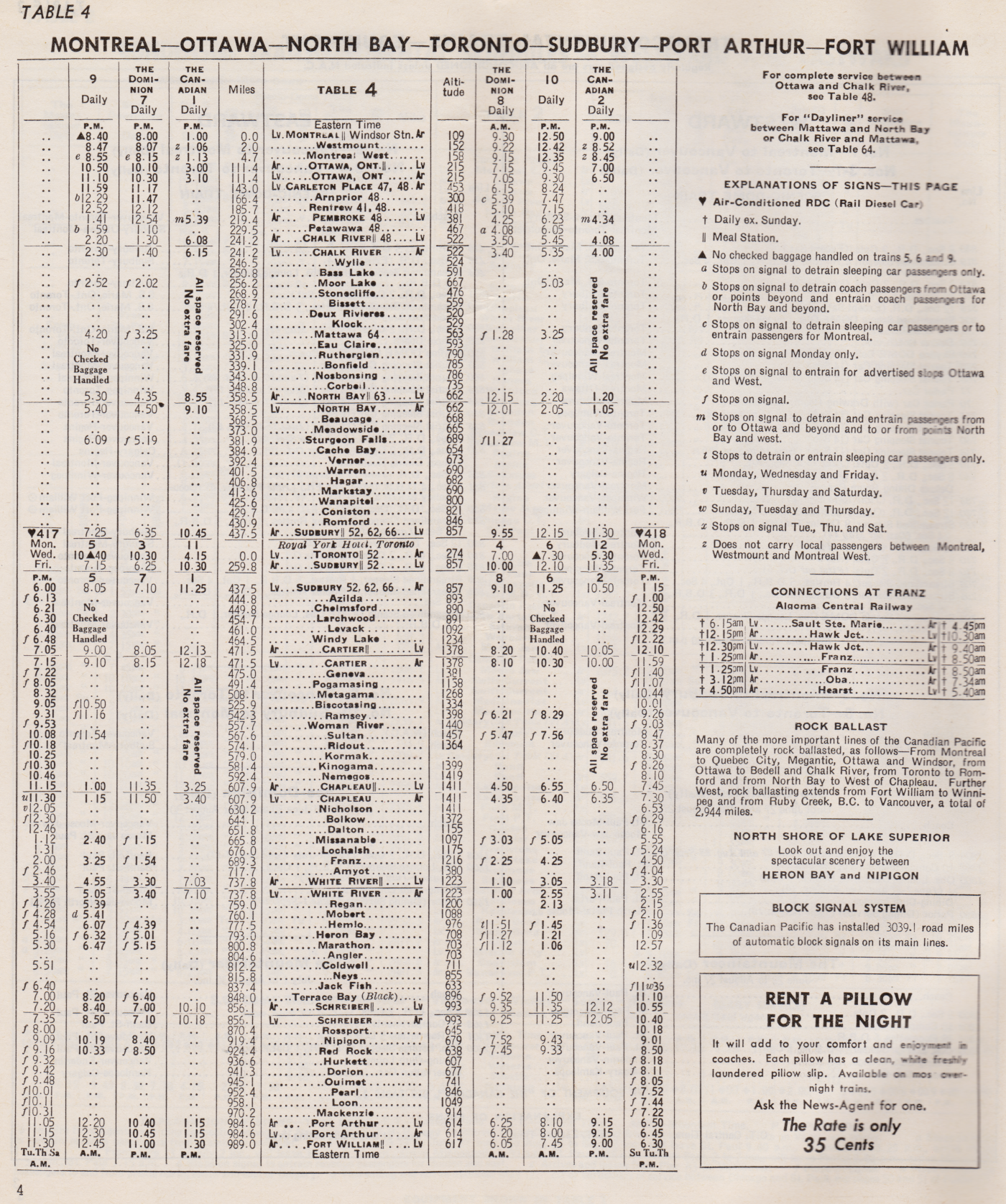
CPR public timetable, April 1958.

Give yourself 100 bonus points if you - like I - doubted my claim of seeing the Canadian at 15hr at Hudson. Wasn't it was scheduled to be in Ottawa by then?

Back then, the railways had some kind of 'attitude' about changing their clocks twice per year. 

... I mean, they made such a big deal of fiddling with official Standard Clocks every day with the Official Time Signal ... and whenever operating employees showed up for work. What's two more annual fiddlings, considering how much railroaders liked playing with their timepieces every time they had an excuse to do so?

... So you'll notice that the summer timetable above says 'Eastern Time' not 'Eastern Daylight Saving Time'. If we were serious railway passengers we'd be happy to make the necessary conversions every single time we looked at an April to October timetable. Canadians may live in EDST for half the year, but the CPR is a serious organization which uses only Standard Time!

*  *  *

You have Mike Gammon and Jim Christie to thank for the maps below. I guess Mike found this website, told Jim, and then Jim passed it on to me. It has a collection of historical, digitized Canadian topographic maps of Ontario.


I've joined two maps below 1909/1910 and skewed them counter-clockwise so the railway line runs across the screen better. At the right side is Vaudreuil (Dorion, if you prefer) which is located past the western tip of Montreal Island (and Ile Perrot). Continuing westward, you pass Como. My grandmother's place should be immediately west of the river-side sawmill (SM) ... in case young family members are looking in. And west the track goes ... to Hudson, Rigaud and Ottawa. 

Bonus: You can see the track providing CPR 'commuter' service to Point Fortune (notice the wye) with the ferry across to Carillon. To the west of Carillon is the Carillon and Grenville Railway.

Half of our paternal side comes from just north of St Andrew's (East) - just so everyone can get into the picture.


Below is the same April 1958 public timetable. Make sure you convert to Daylight Saving, eh? 

Before the development the highway system and the 'necessity' of owning an auto, you can see how many trains Vaudreuil hosted. Hudson saw more passenger trains in a day than many large Canadian cities see in 2023.

CPR public timetable, April 1958.

*  *  *


The map from 1945 (above) is kind of neat for what it shows. You can see the Hudson station positioned on the south side of the track exactly midway between the two roads which lead from Hudson to the river's edge. On those spurs are the two natural ice companies which harvested ice from the Ottawa River. 

Below is a YouTube link featuring amateur film of the whole process, including the CPR siding and the switching necessary to begin the region-wide distribution of the ice.


Jim Christie and I had some interesting correspondence about these operations. He discovered old advertisements and articles from an Ottawa ice company which promoted artificial ice as being healthier. Today, we might think of the environmental efficiency and elegance of harvesting winter ice and using it for home ice boxes, railway refrigerator cars, etc. 

However, as Jim discovered, there were all sorts of problems with water-borne diseases in those days which were linked to the Ottawa River and this (and affordable mechanical refrigeration) eventually contributed to the end of ice harvesting on the Ottawa. 

Here are a couple of his discoveries:


*  *  *

Like The Canadian through Hudson!

The employee timetable from April 1958 shows ABS operating from Vaudreuil to Rigaud, and passenger trains being limited to 50 MPH on curves. 


Above, the Canadian is shown in July 1961.

Coming along this stretch of tangent track, 
the front of the lead unit would flash repeatedly as it came into the sunlight 
and out of the shadows of the mature trackside trees.

There would be a great deal of whistling for the numerous level crossings.

In its wake the train would draw paper litter and other light items from the right-of-way.

... Occasionally, when someone in my family wanted to describe something or someone (eg. a high school vice principal) approaching and departing with a great deal of speed, effect and consequence, we'd finish the description saying 'with bits of scrap paper blowing behind them - like the Canadian through Hudson'.


Google Earth, 2023 image looking timetable east.


*  *  *

Here's another hot day in June 1966 with the family quarters upstairs being ventilated.
The sun is reflecting off the lead unit and there is lots of diesel smoke in the air.
The train is whistling as it fully occupies that crossing and there is another crossing behind the camera.


The train blasts by in a cloud of its own hot haze.

In the front seat, my sister has had enough of the whistling!