Showing posts with label locomotive. Show all posts

29 July 2022

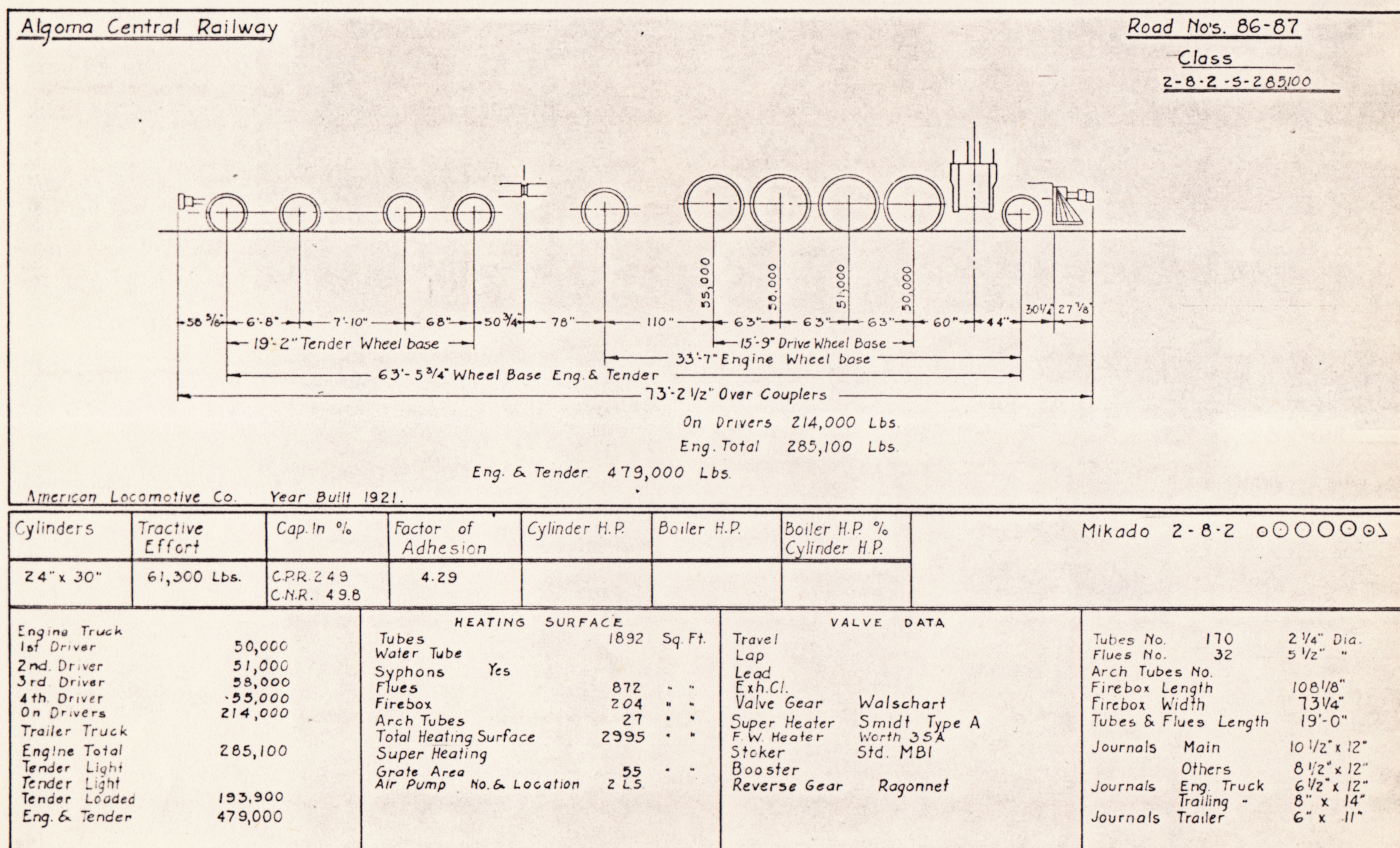
ACR 1950 Locomotive Side Elevations - Algoma Central and Algoma Eastern Railways


In 1980, LC Gagnon wrote to the Algoma Central, requesting data on some of its engines. Also in his files were a couple of circa 1950 articles from Railroad magazine on ACR operations. 


It isn't clear whether the diagrams were printed from microfilm or if they were photocopied to respond to my father's request. 
A typical unprocessed image appears below.


Atlas of Canada; 1915; Government of Canada.

The frail, old source atlas (above) is 27 inches by 18 inches when opened and balanced on a scanner. Please pardon the blurry gutter in the centre of the map.

You can see the Algoma Central and Algoma Eastern Railways in 1915. The territories deemed to be tributary to the various railway lines are shaded. Far to the right, you can see the Algoma Eastern running between Little Current and Sudbury - it was eventually absorbed into the CPR. 

At the end of this post are references to some of the excellent books already written by Dale Wilson (published by Nickel Belt Rails) about the railways in this area. 

Heading west annually to visit with Rolly and Theresa Martin in Schreiber and my aunt and uncle in Portage la Prairie ... we went on a number of the ACR excursions to the Agawa Canyon. We have also been to Michipicoten Harbour, Hawk Junction and Hearst. 

... However, I've never been an authority on the ACR and I defer to you the reader on any fact you may raise about the diagrams below. To the best of my ability, I have arranged the diagrams by railway: ACR, followed by AER. Within those two groupings, the diagrams are sorted by road number. Note that some of the engines changed owners during their operating lives.

My main focus is just to present all the diagrams which were generously compiled and sent to my father by a railway official ... in case they are interesting or helpful to people in the future.


*  *  *

Algoma Eastern Railway


To find out more about these railways, these books are excellent:


Algoma Eastern Railway; Dale Wilson; 1977; Nickel Belt Rails. ISBN 0-920356-00-1

The Algoma Central Railway Story; Dale Wilson; 1984; Nickel Belt Rails. ISBN 0-920356-05-2

Algoma Rails; Dale Wilson; 2009; Nickel Belt Rails. ISBN 0-920356-15-X


You can search for Nickel Belt Rails to find the latest books by Dale Wilson.


19 March 2022

1945 Introduction to Diesel Electrics


Here is another selection from the Scranton-based International Library correspondence course on diesels. A modern perspective (once explained to me) is that electric locomotives have the luxury of being extremely powerful (per unit of weight) because they don't have the burden of toting around their own generating facilities.

Here is a historical contrast. In the era of this book, published almost 80 years ago, steam locomotives and streetcars were the commonly-seen self-propelled rail vehicles. Consequently, the 'helpful perspective' you'll read below is that diesels are like streetcars. However, they don't require catenary, power stations and wayside electrical switching gear wherever they operate. 

History and more history.

While some of the actual technical operating details are very practical and probably too dry for your on-screen 'pleasure reading time', these books are quite interesting as historical documents. They were written at the dawn of a period of dynamic technological change on US and Canadian railways. Elsewhere, World War Two was ending in Europe and then Asia. People were leaving the armed services to return to civilian life. Automobiles and the new suburban housing developments would allow some urban workers to raise their families away from the industrial coal smoke of the cities. So a lot was changing as these books were published.

Who might order these self-instruction books? 

Often it would be highly-motivated workers. Train crew and shop staff would receive the compulsory railway company and/or manufacturer's training. In some cases, the material in these books might be prescribed, with a company-designed examination to follow. 

Beyond that, people seeking promotion were probably well-advised to demonstrate that they saw 'the big picture' - not just the well-worn career progression steps which others usually followed. This type of book offered a convenient after-work option for self-study - particularly in small railway settlements where there were few opportunities for specialized formal education.

Should I hitch my wagon to a diesel?

In the 1940s, there was probably a lot of skepticism among experienced employees whether diesels would ever do more than tow pretty streamliners. Would they ever be as powerful and reliable as steam freight locomotives? 

Some contemporary accounts describe experienced steam engineers having one over-the-road session with a company trainer (likely with a company supervisor also in the cab) during one of their scheduled passenger runs. After this they were proficient - that's how good diesels were! As clean and simple as driving a bus! Was it really this quick and easy to get employees converted to diesels?

First, anyone on a passenger run would have years, if not decades, of railway operating experience - including excellent knowledge of the physical characteristics of their piece of the railway.

Second, hauling a relatively light passenger train with a brand-new diesel, and a company rep at your elbow who saw to it that the power was babied - was not 'the railroad of the future' ...

Once the power was maintained by the railway's newly-trained shop staff ... the engineer (or fireman) would be expected to solve most problems if a diesel failed during a run. A persistent flashing light, an annoying deafening bell, a problem with brakes, pulling power or steam for train heat would be the responsibility of the engine crew. With new locomotive models, there might also be class-wide problems which would be revealed only after operational experience had been gained. In other words, the first edition operators manual might be of no help to the newly-fledged diesel hogger with a problem out on the road. At night. In a snowstorm. Etc.

Just enjoy today.

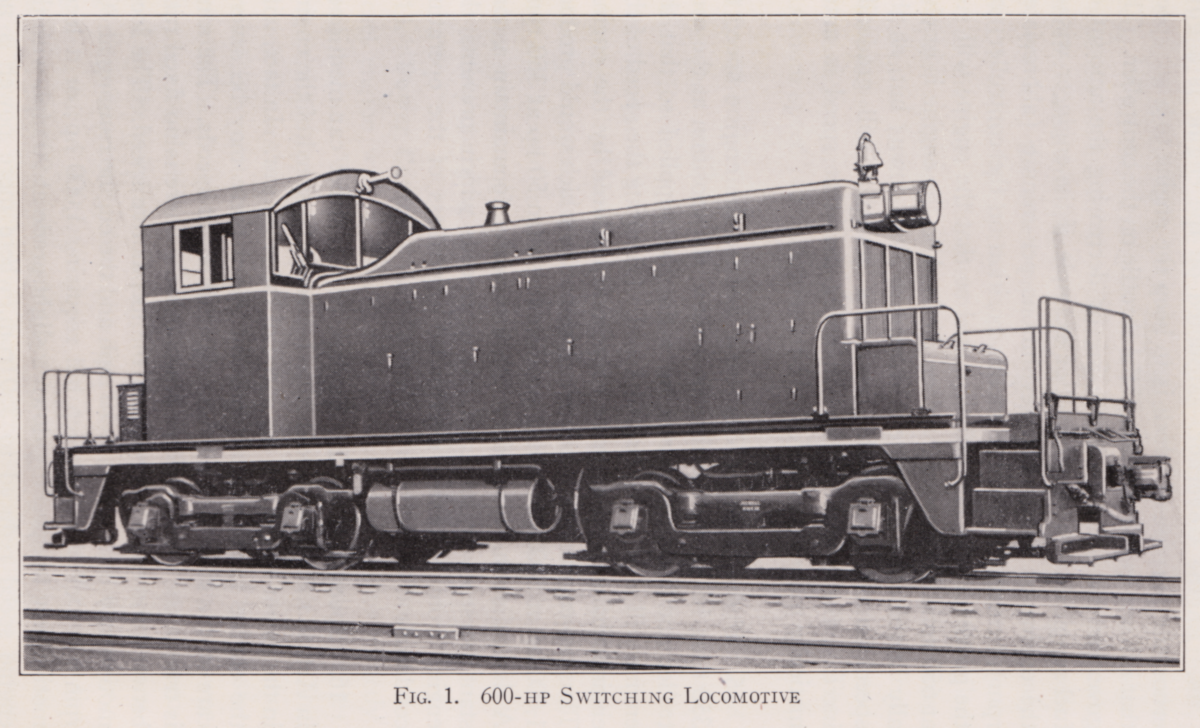
Fortunately, all of that stress is still in the future. Below, the reader is being given a nice general overview of some of the developmental history of internal combustion on the rails, the characteristics of the modern diesel-electric and a quick introduction to switch engines. 

Diesel switch engines operating within a yard are nice to start on, because 'there will always be someone around who can help you'. 

You hope.


The diagram below comes from another book in this series.


01 October 2021

DEVCO 216, GP38-2 built EMD 1979. Seen near Glace Bay NS in October,1980.

Caboose may be ex-NYC. DEVCO 216-219 had the ability to supply electricity at mines in emergencies.

08 April 2020

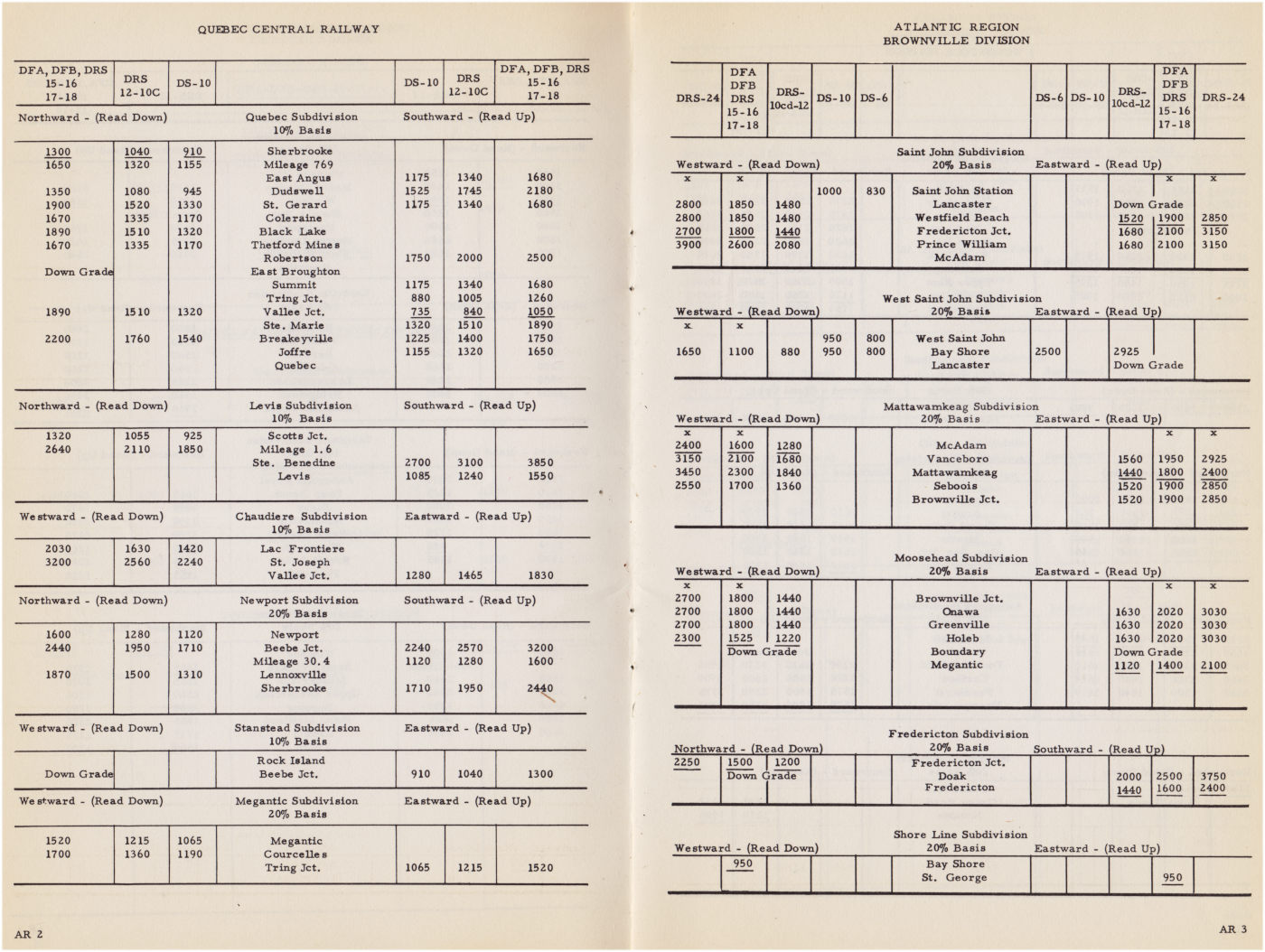
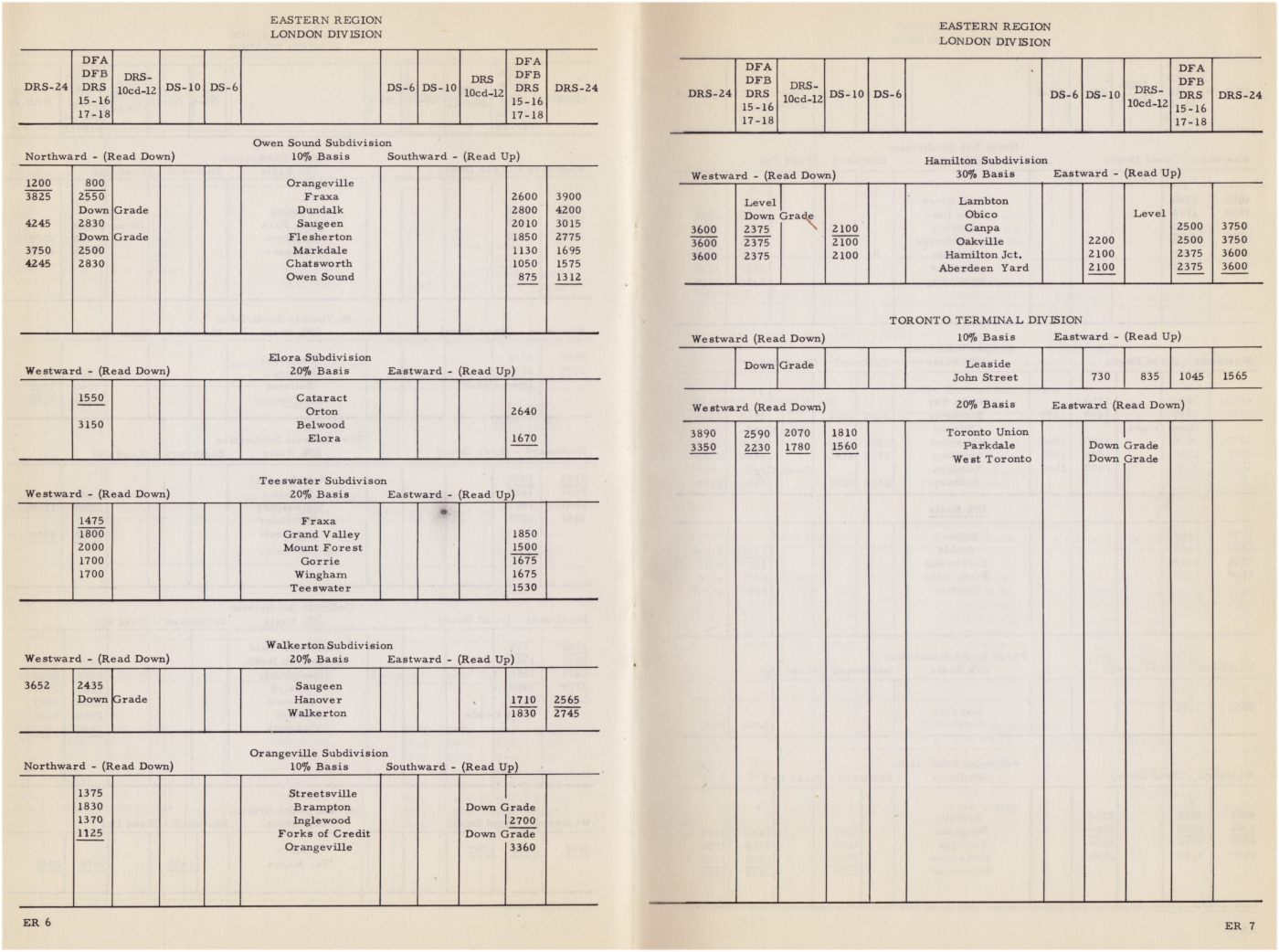
CPR 1962 Haulage Capacity, Atlantic & Eastern Regions


This post looks at the criteria for matching available locomotives to a given train (or vice versa) back in 1962. While computers would perform this work today, this booklet presents a method for using a pencil for the task. 

It is tempting to interpret the process involved, but the booklet explains the steps plainly. Key components behind the calculation are:
  • Car tare and car content weight.
  • Subdivision gradient values, especially the ruling grade (expressed in equivalent tons).
  • Condition of the rail (generally 'weather on the rail').

* Throughout the booklet the 4-digit numerical ratings 
(what a unit can pull, what power is required for a segment of line) 
are based on 'equivalent tons'. 

*  *  *

Not Included

The booklet does not consider particular cold weather phenomena including the ability to pump air through a trainline to fully charge it and release the brakes. Trains would sometimes be shortened to try to correct this. Obviously, this phenomenon would be independent of tonnage.

... Nor does it consider the additional power needed to overcome the increased viscosity of cold journal box oil when starting a train.


Steam Era Problem-Solving

The classic steam locomotive tactic of reversing to bunch coupler slack - in other words to start the train 'one car at a time' - would have been familiar to engineers in 1962. Almost all engineers of this era would have started their careers on steam.


As well, the time-consuming necessity of doubling a hill would be a employed when an engine lacked the ability to pull a train up a grade.

Steps:
  • Arrange any necessary protection for the rear of the train.
  • Inform the dispatcher of the delay at the earliest opportunity.
  • Secure the tail end of the train from movement.
  • Run the front end of the train to the top of the offending grade and secure it in a siding.
  • Arrange protection for the headend of the train.
  • Reverse the engine to the tailend of the train.
  • Call in the tailend flagman, if applicable. Burning fusee(s) would be left for protection.
  • Run the tailend up the hill to the siding.
  • Reassemble the train and (usually) clear in the siding.
  • Call in the flagman protecting the headend of the train. (Fusee, etc)
  • Be governed by the dispatcher's instructions ... now that your train's unexpected delay has given his 'chess board' a good shake. Until more important, delayed traffic gets by, you might have some spare time to enjoy in a picturesque woodland area! (Depending on the circumstances, the train might be able to continue under normal timetable and train order processes).
... Could you blame experienced engineers for sometimes operating above the speed limit to have enough momentum to get their train over a ruling grade?

In his early days as a steam era fireman, if locomotive sanders were inoperative or exhausted, Rolly was sometimes directed to walk alongside the power and throw any available trackside grit under the drivers.


In 1977, at the White River, Ontario yard office a similar book was still available for use. If it was necessary to assemble a local freight or a wayfreight there, yard office staff would perform the calculations before turning the switchlist/train consist over to the running trades crew ordered for the train.

In 1977, the 10%, 20%, 30% basis system shown below was used to help calculate 'wheelage' or train resistance. Grade, then curvature (with flanges binding on rails) are usually the key 'drags' on what a given power consist can pull.

Wheel tread to surface friction is a much bigger drag on traction for rubber-tired road vehicles than it is for railway equipment. Stopping a railed vehicle quickly 'feels' like locking a car's brakes on glare ice.


The CPR worked to replace the diesel manufacturers' model letters and numbers (a modern-ish example: SD40-2) with a company system, in which letters had the following general meanings. Most of you are already conversant with this system.

S - switcher  
Low horsepower - usually only suitable for yard switching, sometimes without MU capability.

RS - road switcher 
More powerful than a switcher and often used in multiple unit control (MU) configuration to pull trains. Often, the engineer could keep his head in the cab to observe hand or lantern signals during switching - through forward and rear-facing windows. These signals were often relayed (including from car roofwalks) by crew when the coupling location could not be seen directly. Radios were not commonly used by Canadian railways in 1962.

P - passenger
F - freight
A - usually a 'carbody' unit with a control cab (e.g. the 1800, seen below)
B - usually a 'carbody' unit without a control cab

H - hydraulic (transmission)

As you also probably realize: 15, 16, 17, 18, etc refers to unit horsepower in hundreds.


Locomotive images appearing below were collected by my father.


For the purposes of  'decoding' much of what the CPR was running in 1962, below, is a handy list
of units used (extinct on CPR by 1984) from the Trackside Guide 1984 - Bytown Railway Society.

The Road Numbers column (above), can be cross-referenced to the Final/Previous Number(s) columns (below).


LC Gagnon clipping, 1955, probably from Trains magazine.

CPR photo obtained by LC Gagnon.


Eastern Region


Dried sand is being loaded into the unit's sanding reservoir, above.

Canadian Pacific Spanner, January 1950.

*  *  *

Meanwhile on the CNR ...

At the same time in history - immediately after the complete elimination of steam locomotives - the CNR was publishing their diesel tonnage ratings in their employee timetables. Two facing pages are presented as a single image below. They come from this employee timetable.