Showing posts with label diesel-electric. Show all posts

19 March 2022

1945 Introduction to Diesel Electrics


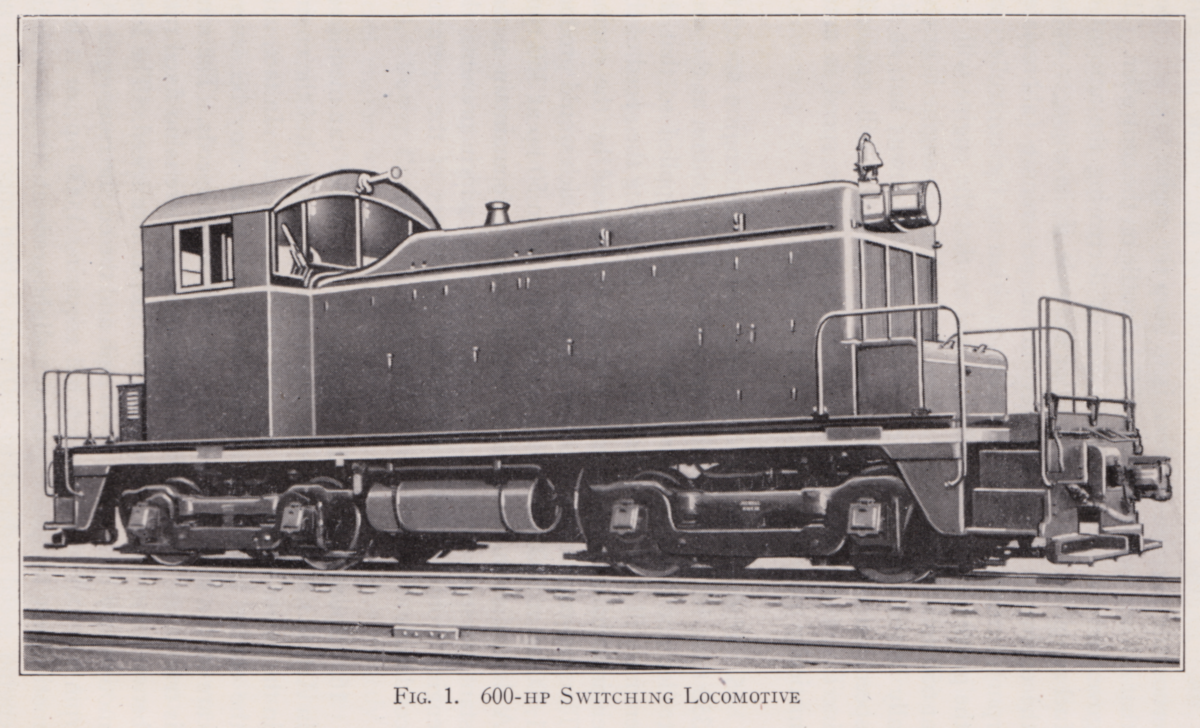
Here is another selection from the Scranton-based International Library correspondence course on diesels. A modern perspective (once explained to me) is that electric locomotives have the luxury of being extremely powerful (per unit of weight) because they don't have the burden of toting around their own generating facilities.

Here is a historical contrast. In the era of this book, published almost 80 years ago, steam locomotives and streetcars were the commonly-seen self-propelled rail vehicles. Consequently, the 'helpful perspective' you'll read below is that diesels are like streetcars. However, they don't require catenary, power stations and wayside electrical switching gear wherever they operate. 

History and more history.

While some of the actual technical operating details are very practical and probably too dry for your on-screen 'pleasure reading time', these books are quite interesting as historical documents. They were written at the dawn of a period of dynamic technological change on US and Canadian railways. Elsewhere, World War Two was ending in Europe and then Asia. People were leaving the armed services to return to civilian life. Automobiles and the new suburban housing developments would allow some urban workers to raise their families away from the industrial coal smoke of the cities. So a lot was changing as these books were published.

Who might order these self-instruction books? 

Often it would be highly-motivated workers. Train crew and shop staff would receive the compulsory railway company and/or manufacturer's training. In some cases, the material in these books might be prescribed, with a company-designed examination to follow. 

Beyond that, people seeking promotion were probably well-advised to demonstrate that they saw 'the big picture' - not just the well-worn career progression steps which others usually followed. This type of book offered a convenient after-work option for self-study - particularly in small railway settlements where there were few opportunities for specialized formal education.

Should I hitch my wagon to a diesel?

In the 1940s, there was probably a lot of skepticism among experienced employees whether diesels would ever do more than tow pretty streamliners. Would they ever be as powerful and reliable as steam freight locomotives? 

Some contemporary accounts describe experienced steam engineers having one over-the-road session with a company trainer (likely with a company supervisor also in the cab) during one of their scheduled passenger runs. After this they were proficient - that's how good diesels were! As clean and simple as driving a bus! Was it really this quick and easy to get employees converted to diesels?

First, anyone on a passenger run would have years, if not decades, of railway operating experience - including excellent knowledge of the physical characteristics of their piece of the railway.

Second, hauling a relatively light passenger train with a brand-new diesel, and a company rep at your elbow who saw to it that the power was babied - was not 'the railroad of the future' ...

Once the power was maintained by the railway's newly-trained shop staff ... the engineer (or fireman) would be expected to solve most problems if a diesel failed during a run. A persistent flashing light, an annoying deafening bell, a problem with brakes, pulling power or steam for train heat would be the responsibility of the engine crew. With new locomotive models, there might also be class-wide problems which would be revealed only after operational experience had been gained. In other words, the first edition operators manual might be of no help to the newly-fledged diesel hogger with a problem out on the road. At night. In a snowstorm. Etc.

Just enjoy today.

Fortunately, all of that stress is still in the future. Below, the reader is being given a nice general overview of some of the developmental history of internal combustion on the rails, the characteristics of the modern diesel-electric and a quick introduction to switch engines. 

Diesel switch engines operating within a yard are nice to start on, because 'there will always be someone around who can help you'. 

You hope.


The diagram below comes from another book in this series.


12 March 2022

1945, Diesel Locomotive Draft Gear


There were two different systems offered to retract the pilot coupler on early EMD cab units!
It seems likely that the Armstrong 85 Revolution Technology quickly yielded to a power-driven system (link at the end).

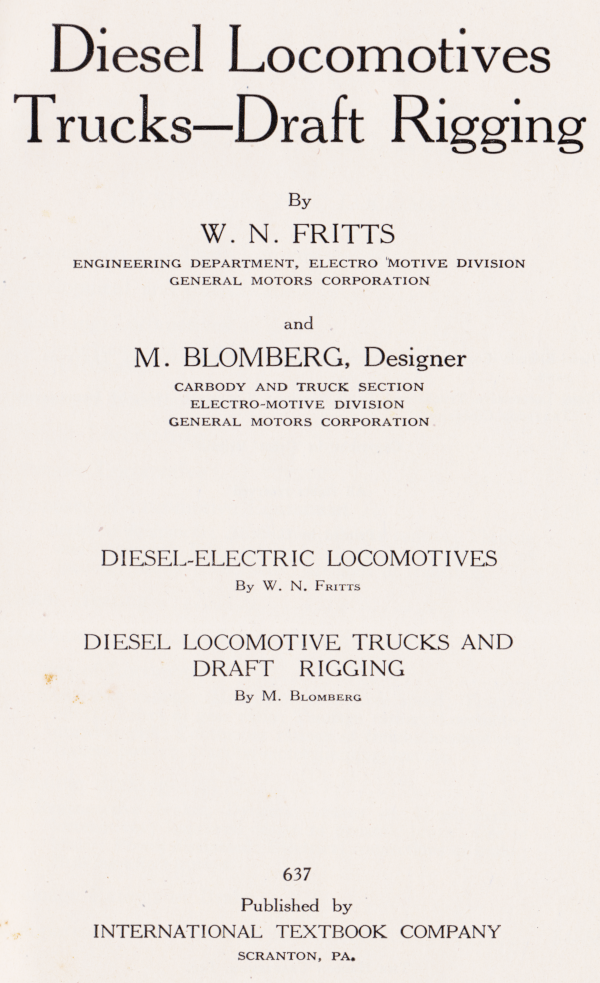
Thanks to a gift from my brother, Eric, of some classic International Textbook Company railway self-study texts ... this bit of railway trivia has resurfaced in 2022. 

In 1950 GM-EMD, Baldwin-Westinghouse, Alco-GE and Fairbanks-Morse all advertised diesel-electrics with streamlined pilots covering their front couplers. Can you imagine the fun of having to retrieve a snow and ice packed coupler from its pocket - midway through a run on a cold winter day? Surely this feature was never part of an order for a Canadian railway! You will find that answer below.


Yes, that Blomberg: Martin P Blomberg (1888-1966)
This textbook was published in 1945.


from: Locomotive Cyclopedia 1950-1952; Simmons-Boardman.


To see the power-driven pilot coupler system, just check out this older post.


25 January 2020

"A Strange World" - The 1965 Freedman Report on CNR 'Run-Throughs'


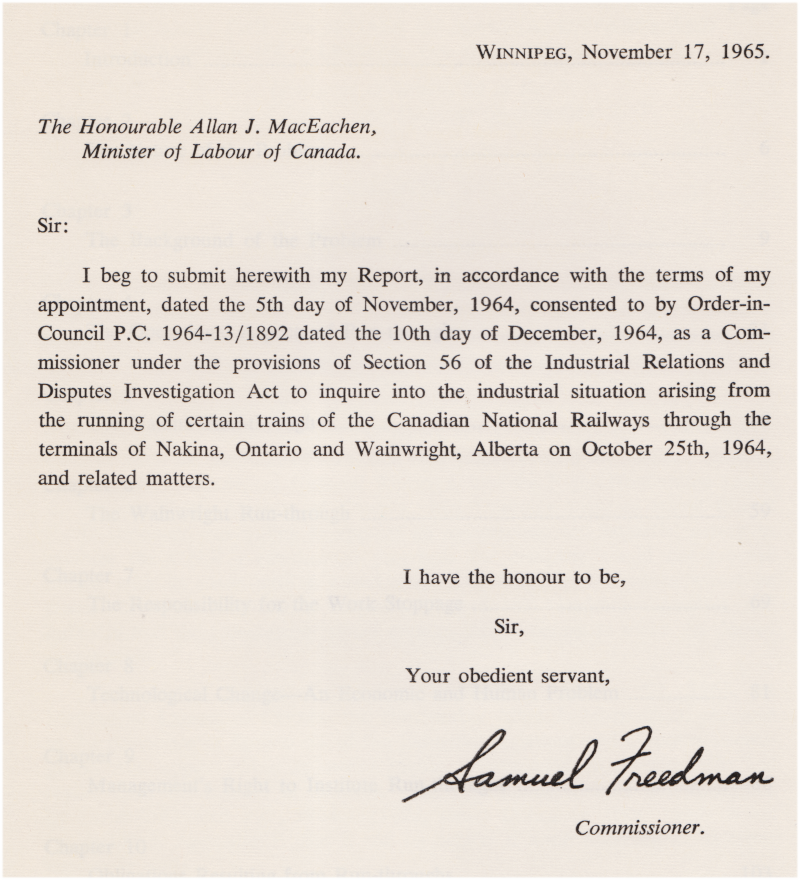
Here is a contemporary account, by a judge, of working conditions for running trades crews in the early 1960s. As the author notes, the actual collective agreements and arrangements use specialized language, customs, and vocabulary " ... this is a strange world ... ". I always like to find and post accurate contemporary non-specialist accounts to better describe the 'human experience' of railroading for a general audience.

After World War 2, new technologies were widely applied to Canadian railway operations. Key among them was the diesel-electric locomotive - which replaced the more labour-intensive steam locomotive.

Another was Centralized Traffic Control - which (generally, according to some) could enable a single main track to safely handle the traffic of two main tracks dispatched using the traditional 'time table and train order' system.

Computerized (teletype-style) waybilling and consist management systems enabled centrally-stored customer-linked data to be efficiently shared with multiple points on a railway. No longer were paper-schlepping and telegraphing/telephoning necessary to obtain updates on the status of shipments and train consists.

Fewer occupied station buildings, simpler locomotive shop facilities at most terminals, and (most importantly for the railways) fewer people were needed to support operations as the result of these new technologies.

Almost 60 years ago (as I post this) an experienced Manitoba judge was appointed to look into changes to Canadian railway operations pursuant to a labour action which interfered with the CNR's operations. You can find a page about his career on Wikipedia. While the rest of the report is interesting, the layperson's description of the running trades is probably the most valuable chapter to reproduce here.

Essentially, in late 1964 the CNR wanted to use efficiency gains from diesel locomotive technology to eliminate Nakina, Ontario and Wainwright, Alberta as crew change points. In the course of discussing the changes, the judge notes that the company contributed to the dispute because "[the workers had] the disquieting feeling that they were being exposed to a plan whose implications had not been fully examined."

In late October of 1964 over 700 running trades employees booked off sick on the Great Lakes Region. By 18hr on Saturday, October 24th, 1455 running trades employees booked off sick on the Mountain Region and 659 on the Prairie Region.


In May 1963, an eastbound CNR local freight passes 40th Avenue, Lachine, Quebec.
The CPR line appears in the distance.


Note: 

A Division was often formally defined as the portion of a railway assigned to the supervision of a Superintendent.

A Subdivision was often formally defined as the portion of a division designated by (employee) time table.

... And many subdivisions in timetables were about 125 miles in length. 

Whether a "division point" is where a Division is headquartered or where steam locomotive engine crews traditionally changed ... is something which could be passionately argued to infinity on the internet. I have not noticed that term in this report.


A morning CNR eastbound is seen at 48th Avenue, Lachine, Quebec in March 1961.
This photo was taken when the former Grand Trunk Railway line still ran along where today's Victoria street is found.
The 'get over the road' efficiency of diesel locomotives for fast run-through freight is illustrated well.


During my PSBGM Christmas holidays in December 1968,
a westbound CNR freight is seen from Lachine's 40th Avenue pedestrian overpass.
Wooden cabooses were still in use.


The largest paragraph above suggests that a prolonged period in the hole might be considered 'rest and relaxation'!

One should take care to determine whether crew members sitting in a siding for an hour or two are experiencing rest or fatigue.

... Variables such as time of day, previous hours of sleep and quality of sleep, time between trips,
noise, vibration, temperature, the requirement to remain consistently alert while on duty
might be considered here.


During an NRHA wayfreight fantrip to Ste Hyacinthe, Quebec in May 1964,
my father took this photo from the fan-coach/fan-openend-gondola car section of the train.
The camera is looking north, through the caboose, with the Victoria Bridge in the distance.


17 March 2018

GM EMD Locomotive Components & David P Morgan's Views from July 1965


Here is the final set of images from a GM EMD booklet I received in the late 1960s. If you arrived at this posting first, you can see links to all three posts on the Railway Technology page (just click the link in the right margin and find the Diesels, Second Generation heading).

In some cases, I have repeated and enlarged photographs so you can see more detail. 

Through the miracle of old books, below, you'll find a 1965 review by David P Morgan on this new generation of GM EMD locomotives.

Finally, I have cobbled together the text of a GM EMD advertisement which appeared a month later in Trains magazine. The ad was a large removable 'folder' of thick glossy paper. It included the small paragraphs of text I have included, offset by large blank expanses of white ... and highly colourized art of the new GM EMD power.


If Kapton (above) sounds familiar, you may recall its being implicated in air crashes. When subject to heat, vibration and/or environments near seawater, Kapton broke down and lost its insulating properties. In the Swissair Flight 111 crash, arcing to wires insulated by Kapton was implicated.


*  *  *

from: Trains; July 1965; Kalmbach Publishing.

*  *  *

Text of advertisement from: Trains; August 1965; Kalmbach Publishing


Text of advertisement from: Trains; August 1965; Kalmbach Publishing