Showing posts with label operating manual. Show all posts

19 March 2022

1945 Introduction to Diesel Electrics


Here is another selection from the Scranton-based International Library correspondence course on diesels. A modern perspective (once explained to me) is that electric locomotives have the luxury of being extremely powerful (per unit of weight) because they don't have the burden of toting around their own generating facilities.

Here is a historical contrast. In the era of this book, published almost 80 years ago, steam locomotives and streetcars were the commonly-seen self-propelled rail vehicles. Consequently, the 'helpful perspective' you'll read below is that diesels are like streetcars. However, they don't require catenary, power stations and wayside electrical switching gear wherever they operate. 

History and more history.

While some of the actual technical operating details are very practical and probably too dry for your on-screen 'pleasure reading time', these books are quite interesting as historical documents. They were written at the dawn of a period of dynamic technological change on US and Canadian railways. Elsewhere, World War Two was ending in Europe and then Asia. People were leaving the armed services to return to civilian life. Automobiles and the new suburban housing developments would allow some urban workers to raise their families away from the industrial coal smoke of the cities. So a lot was changing as these books were published.

Who might order these self-instruction books? 

Often it would be highly-motivated workers. Train crew and shop staff would receive the compulsory railway company and/or manufacturer's training. In some cases, the material in these books might be prescribed, with a company-designed examination to follow. 

Beyond that, people seeking promotion were probably well-advised to demonstrate that they saw 'the big picture' - not just the well-worn career progression steps which others usually followed. This type of book offered a convenient after-work option for self-study - particularly in small railway settlements where there were few opportunities for specialized formal education.

Should I hitch my wagon to a diesel?

In the 1940s, there was probably a lot of skepticism among experienced employees whether diesels would ever do more than tow pretty streamliners. Would they ever be as powerful and reliable as steam freight locomotives? 

Some contemporary accounts describe experienced steam engineers having one over-the-road session with a company trainer (likely with a company supervisor also in the cab) during one of their scheduled passenger runs. After this they were proficient - that's how good diesels were! As clean and simple as driving a bus! Was it really this quick and easy to get employees converted to diesels?

First, anyone on a passenger run would have years, if not decades, of railway operating experience - including excellent knowledge of the physical characteristics of their piece of the railway.

Second, hauling a relatively light passenger train with a brand-new diesel, and a company rep at your elbow who saw to it that the power was babied - was not 'the railroad of the future' ...

Once the power was maintained by the railway's newly-trained shop staff ... the engineer (or fireman) would be expected to solve most problems if a diesel failed during a run. A persistent flashing light, an annoying deafening bell, a problem with brakes, pulling power or steam for train heat would be the responsibility of the engine crew. With new locomotive models, there might also be class-wide problems which would be revealed only after operational experience had been gained. In other words, the first edition operators manual might be of no help to the newly-fledged diesel hogger with a problem out on the road. At night. In a snowstorm. Etc.

Just enjoy today.

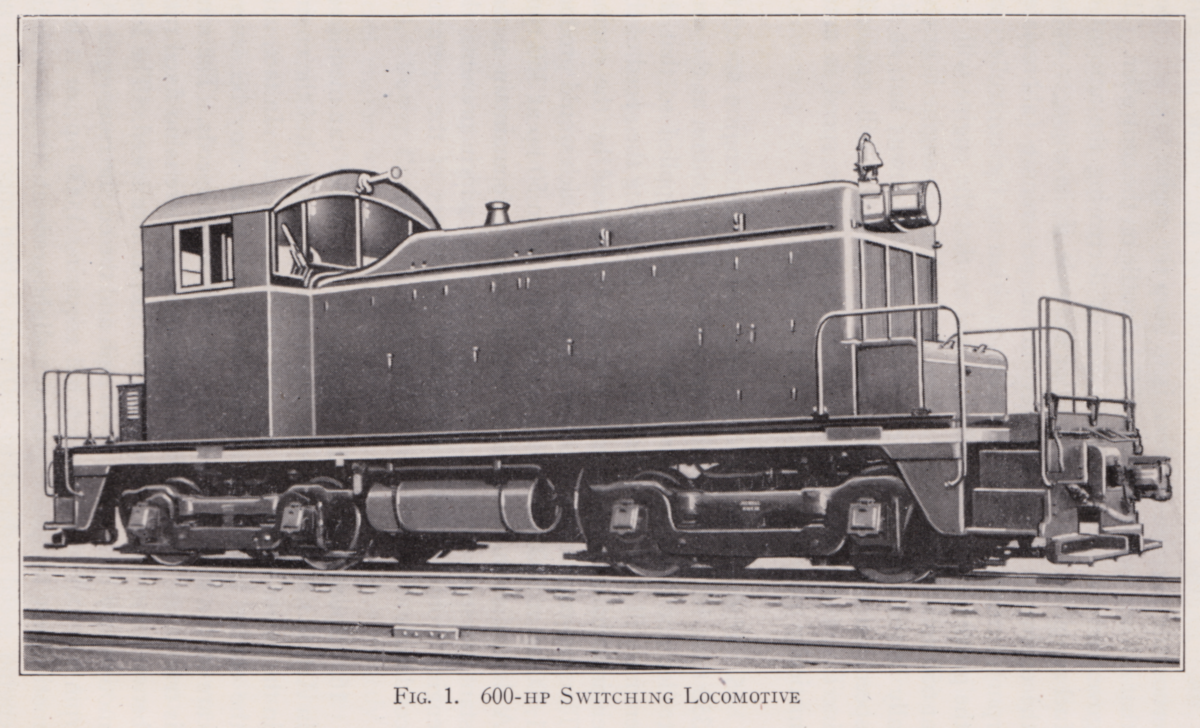
Fortunately, all of that stress is still in the future. Below, the reader is being given a nice general overview of some of the developmental history of internal combustion on the rails, the characteristics of the modern diesel-electric and a quick introduction to switch engines. 

Diesel switch engines operating within a yard are nice to start on, because 'there will always be someone around who can help you'. 

You hope.


The diagram below comes from another book in this series.


01 July 2020

GM EMD E7 Operating Manual, Part 3


Steam generator operation, electrical equipment, troubleshooting and truck removal are covered in this third and final installment of the E7 operating manual. The veteran hoggers and firemen must have been thrilled to have to learn how to 'make steam' all over again - using the complex steam generators.

The other two sections of this manual can be found in the index Railway Technology & Systems 04 (button above). This and other manuals can be found under the heading Diesels, The First Generation.

The loose-leaf binder holding this 70 year old manual would not open, so I used the expedient of scanning a two-page spread for most images.


The diagram above is shown at what you could call GoogleMax (the maximum image display size after it is uploaded to Google).
To make it possible to read the details, the diagram is split and presented in two halves below. 
Look for the overlap - which duplicates the 'fuel pumps' location at centre/bottom (above).


End of manual.

*  *  *

In the first part of this series, I explained the unlikely
north shore of Lake Superior provenance of my particular E7 manual.
E7 locomotives were not purchased by Canadian railways.

Here are the sales figures for some of the EMD E-units.

The Second Diesel Spotter's Guide; Jerry A Pinkepank; 1980; Kalmbach. 

*  *  *

Early Trains magazines were surprisingly non-specific when it came to nailing down the builders' models of diesel locomotives in articles and photo captions ... at least by today's standards. An E7 was used on the GM Train of Tomorrow. The latter has an excellent, detailed article on Wikipedia.

from: Trains magazine; July 1947; Kalmbach.

*  *  *


My father attended (he won it through a Montreal Star competition) a teacher's summer course and travelled to Syracuse University in July 1961. The course was on the use of newspapers as teaching aids in the classroom. He travelled to Syracuse, New York by bus because we didn't own a car and also because the bus got him there conveniently.


My father 'happened' to visit the Syracuse station and took this slide of the DeWitt Clinton (a named train) westbound. An E8 leads and perhaps there is an E7 trailing. With 4000 horsepower for what looks like mainly mail and express, they probably got over the road quite efficiently.

09 June 2020

GM EMD E7 Operating Manual, Part 2


This post includes sections on locomotive operation, cooling system, lubricating oil system and the fuel oil system. It concludes with a couple of contemporary photos of the E7 in operation - including a B unit.

Many of the locomotive engineers reading this manual might only have experience with steam locomotive operation. So the technical writers of this manual carefully and clearly explain procedures and principles. It may be my imagination, but it seems that this reference is written more in good, clear English than in technical jargon. 

During the steam era, courses in railway technology and theory were published - most notably by the International Textbook Company of Scranton, Pennsylvania. And appliances, such as feedwater heaters, injectors and mechanical stokers had their own manufacturers' operating manuals. In contrast, diesel locomotives seem to have been the first type of motive power with complete operating manuals written by the manufacturer and specific to a particular model.

When an experienced steam locomotive engineer was first introduced to a diesel-electric and its simpler labelled controls, accounts sometimes stated that the engineer could be successfully operating the unit after only one training session over the road. 

... However, 'driving' a new unit with simpler controls was distinct from being able to trouble-shoot it if it failed on the road ... or knowing that it couldn't be operated through water above the couplers - as sometimes occurred with steam engines!


*  *  *

Here are a couple of contemporary photos of E7 locomotives in operation.
Notice that in both cases the 'hydro-pneumatic retractable draft gear' 
(see Part 1)  has been used to hide the front coupler.

from: Trains; September 1949; Kalmbach.

from: Trains; June 1949, Kalmbach.

The final segment of the manual is here: