Showing posts with label Algoma Central Railway. Show all posts

06 December 2025

CPR 1972 in the Official Guide. Includes from Algoma Central to White Pass & Yukon

In this post, many of the railways are illustrated with published photos from this era, or earlier. 

... Some of the large format 'trains of Canada' books which sold in bookstores (such as Coles or WH Smith) for $10-20 in the 1980s offer interesting views of some of the more obscure railways. 

... Known in our household as 'Books by the Pound' these 10 x 12 inch books were about an inch or more thick and often contained public relations department photos which must have been incredibly cheap to use. Photos were often enlarged to span the gutter ... to help pad the book up to the necessary one inch thickness. 

... Often they were printed in Hong Kong or other exotic locations. A little bit of text written by a generalist who knew something about railways was added. Thus you had an affordable book which was suitable as a gift to 'someone who likes trains'. Laypersons understandably believed that train books were train books. 

Not included: Single-railway books (which included rosters or timetables) and which were written by authors who had researched the history of a particular railway in depth would rise above this broad class. Mika, Railfare and Boston Mills-type books would definitely not be defined as 'Books by the Pound'.

To be unusually reasonable with this post, I stopped before illustrating ALL of the Canadian railways listed in the Official Guide pages. I did think that the inclusion of photos might make this post less dry. Hopefully some of the photos will make some readers curious about railway companies (and there are many) which they never saw in operation.

As an example of extinct operations, the Canadian Pacific entry lists many railway and transportation subsidiaries, and facilities, which have since been spun off or shut down. As in the case with the previous CNR 1972 Official Guide post, CPR lists their 10 hotels (and 2 'motor hotels'). 


from: Encyclopedia of North American Railroads; Aaron E Klein; 1985; Bison.

The Canadian at Morant's Curve, undated, but probably late-1950s.
Notice the three stop-gap coaches with clerestories.


from: Great Trains of the World; PB Whitehouse; 1975; Hamlyn.

Dominion Atlantic Railway at Kentville, Nova Scotia, September 1972.


from: Canadian Pacific Railway; Patrick C Dorin; 1974; Superior Publishing.

Undated photo of Esquimalt & Nanaimo Train 1 at Nanaimo.


from: Ribbons of Steel; Ena Schneider; 1989; Detselig Enterprises.

Undated view of Northern Alberta Railways Train 76 near Venice on the Lac la Biche Sub.

In the early days, I believe the NAR was essential in the delivery of the dimensional loads needed to begin bitumen sands mining and upgrading. I think three of those loads are visible in this consist. 

If you sometimes enjoy virtual visits to locations via Google maps, you will find that the Venice Heritage Park has a really interesting school photo from Halloween 1932. Their Heritage Park website (accessible from the map side panel) outlines the development of Venice and neighbouring Hylo.

Going along the tracks to Lac la Biche, you'll find their museum has a 1:48 model of the two-stack Empress of France on display.


from: Algoma Central Railway; OS Nock; 1975; A&C Black.

Undated view of the Algoma Central yard at Sault Ste Marie, with the steel mill in the background.

British professional engineer OS Nock (1905-1994) created quite a number of high-quality books on railway subjects.
He seemed to have a special interest in the railways of Canada.


from: Great Trains of the World; PB Whitehouse; 1975; Hamlyn.

Toronto, Hamilton & Buffalo eastbound freight at Niagara Falls, September 1972.
(This photo has an 'odd presentation' in the book.)

[Page 431 displays US railroads.]


from: The Ontario Northland Railway; Patrick C Dorin; 1987; Superior.

Ontario Northland work extra departing south from Temagami, June 1980.


from: Illustrated Treasury of MLW-Alco to Bombardier Locomotives; James W Kerr; 1983; DPA-LTA.

Builder's photo, 1950, RS2.


from: 150 Years of Canadian Railroads; Bernard Fitzsimons; 1984; Royce.

Undated photo of Cartier Railway unit ore train for Port Cartier.


from: Railways of Canada; OS Nock; 1973; A&C Black.

PGE freight descending 2% grade in Fraser River canyon between Kelly Lake and Lillooet, undated.

[Mexican railways and various US shortlines occupy the intervening pages.]


from: Trains; November 1964; Kalmbach.

Undated photo at Skagway, Alaska.


08 November 2024

ACR 1947 Maintenance of Way Documents

Ditto stencils and pencil on newsprint were used by the Algoma Central Railway's Maintenance of Way officials to document staffing changes, caution against unsafe practices and to convey work assignments. 

As you will observe, the common thread in most of these items is that they mentioned Rolly Martin during his brief maintenance of way career with the ACR.

As obsolete as a steam locomotive or a maintenance of way 'speeder' ... Ditto stencils were a mainstay of school teachers before affordable photocopying. 

The stencil was inserted in a typewriter (to produce the copies seen below) and the hammers struck a thin purple 'carbon' sheet (or the message/image could be written/drawn using a normal pen), leaving a residue of purple letters on the back sheet of sturdy white paper

After removing the top carbon sheet, the stencil's upper edge was clipped onto the drum of the Ditto machine. The drum was rotated by hand (or electrically) to bring the sturdy paper with purple letters residue into contact with a light coating of alcohol, and then a sheet of copy paper. With each drum rotation, the alcohol enabled a small amount of the 'purple substance' to be transferred to a single sheet of paper ... making one copy. After running off 200 or so copies - which became fainter and fainter - the purple carbon residue was depleted and another stencil had to be prepared from scratch.

In the 1960s, 'freshly' copied Ditto handouts were treasured by some students for their distinctive alcohol smell. Probably composed of neuro-toxic methyl alcohol and other chemicals, Ditto solution probably decreased our collective IQ by a point with each 'fresh' exposure.

> At LC Gagnon's retirement, I think it was a student gift presenter who joked that they should mount a plaque dedicated to him by the Ditto machine. Over the years, he was a big believer in concisely documenting the key points, themes or ideas to remember for his English and History students using this technology. 


To the best of my knowledge, GV Martin (Section Foreman, Brient, above) was not related to Rolly Martin.

To find the Algoma Central Railway stations mentioned on these documents, here is a link to Rolly's employee timetable:


Author Dale Wilson (Nickel Belt Rails) was a great researcher/interpreter of Canadian railway history. 
As he mentions in Algoma Rails (2009; Nickel Belt Rails) AM Wilson (the undersigned, above) was his father.

*  *  *

from: Algoma Central Railway; OS Nock; 1975; A&C Black.

The ACR as Rolly Martin would have seen it - Engine 81 is northbound at Hawk Junction in 1950.


LC Gagnon wrote to the ACR for steam locomotive information and the side elevations are posted here:


*  *  *


With modern metallurgy and rolling techniques, the piped rail is probably as extinct as the Ditto machine.
An 85 year old definition is reproduced below ...

from: Maintenance of Way, Rules & Instructions; 1939; Canadian National Railways.

*  *  *


As 'telegraph' (telephone/telecom/code line) poles were equally spaced ... 
they made convenient distance measuring tools for precisely locating trackside features or for calculating flagging distances. 

*  *  *


from: Algoma Central Railway; OS Nock; 1975; A&C Black.

Undated photograph of the enginehouse at Hawk Junction. The Algoma Central was completely dieselized by the end of 1952.

*  *  *


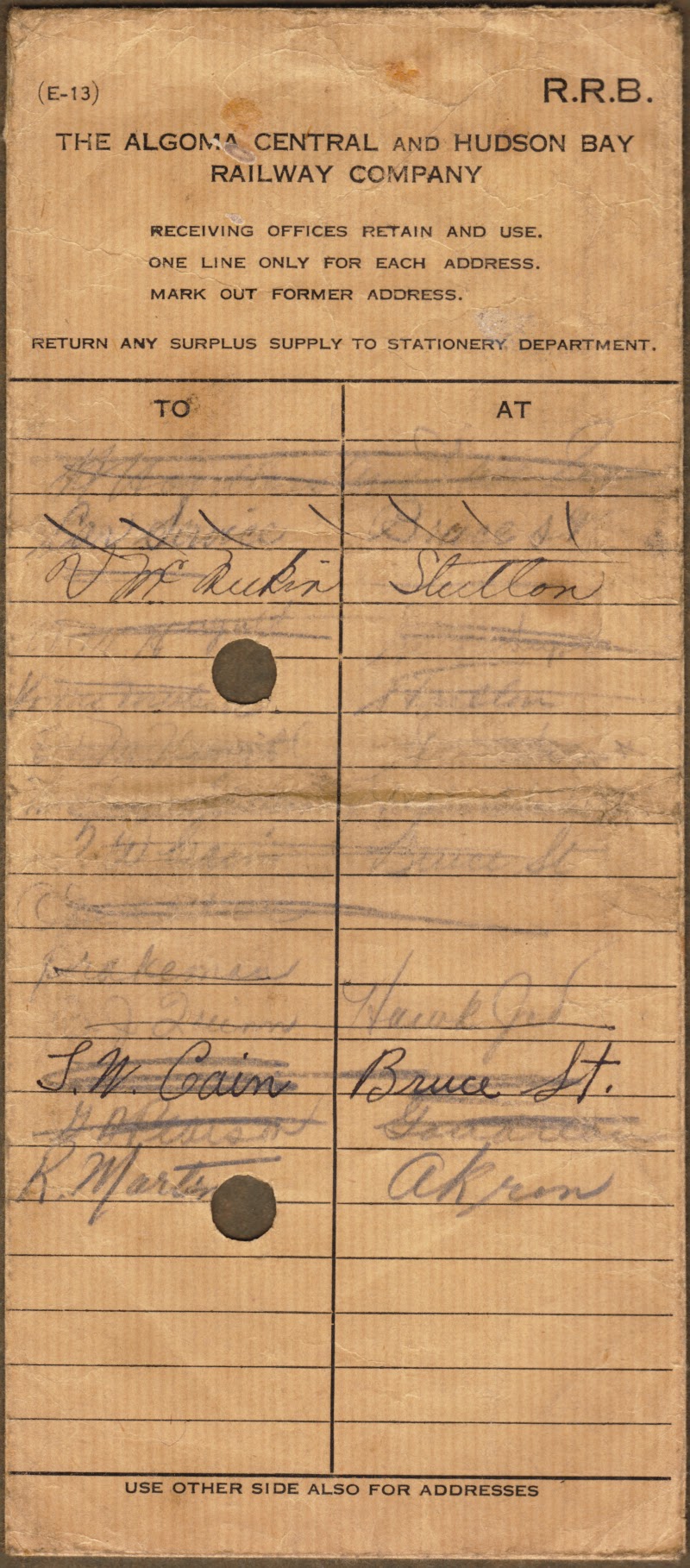
This 4 x 9.5 inch interdepartmental mail envelope was probably used to send the two newsprint-based (above) instructions to Rolly.


01 November 2024

ACR 1947 Algoma Central Railway Employee Timetable

Rolly Martin Country is encompassed on the geological map included in this post.

This employee timetable came from Rolly Martin. For a brief time, he worked as a sectionman on the Algoma Central. As he gave the timetable to me with a mass of other railway publications during one of our vacation visits, I didn't get a chance to ask if the other pages were culled during or after his service with the ACR. At any rate, the most important operating pages survived.

Of particular interest to me is the Michipicoten Subdivision. On different vacations, we travelled to both Hawk Junction and Michipicoten Harbour. 

Here are a few photos: Hawk Junction in 1991

Having a farm boy's practical experience with applied mechanics and good physical strength, Rolly told me a few times that he once single-handedly changed a rail out on the Michipicoten Sub. 

How? 

I suspect that this was an emergency repair and thus it was permissible to leave the defective rail on the ties and between the rails ... until other sectionmen were available to heave it clear of the track. So the replacement rail would be levered 'normally' off the side of the handcar - outside of the rails.

(If it was mandatory that the defective rail be cleared from the track area by Rolly, I've guessed that chaining the end of the replacement rail and levering the handcar out from under it might have worked. Then the defective rail could be levered off the end of the ties and down the ballast ... and the replacement levered from the centre of the track into place.)


from: Geology & Scenery, North Shore of Lake Superior; EG Pye; 1969; Ontario Department of Mines.
To make things more interesting, I chose this map to show the line of the Algoma Central Railway. The map includes the Heron Bay and Nipigon Subs of the CPR. Except for a brief period working out of Lambton, this map encompasses all of the railway lines of Rolly's railway career ... Rolly Martin Country.

*  *  *


I don't think there was anything special about their 'Hayes Derails' - it was just a commercial product which one applied using a switch stand, or flopped onto the rail manually. Perhaps, in that culture a 'derail' evoked a fancy split-rail design as is seen on British railways and railways built during the Colonial period (India, Pakistan, etc).

Notice the 'ring codes' for various stations on the dispatcher/operators 'party line' telephone throughout this timetable.

*  *  *

from: Algoma Central Railway; OS Nock; 1975; A & C Black Ltd.

Above is Hawk Junction (undated photo), looking timetable north. Beyond the yard tracks, you can see the main line swinging to the right of the photo. The Michipicoten Sub cutoff is the track climbing to the left of the main line. 

*  *  *


from: Altitudes in Canada; James White; 1915; Commission of Conservation, Canada.

This mileage and elevation data could be used to draw a rough profile of the Michipicoten Sub.

*  *  *

from: Algoma Central Railway; OS Nock; 1975; A & C Black Ltd.

Michipicoten Harbour handled different bulk commodities during different periods of its existence. A 2024 check via Google Maps suggests that the main dock is still used for some bulk commodities transported by road. The most typical bulk commodities would have been iron ore from the nearby Helen Mine and coal. The undated image above shows the 'new' coal bridge - this coal stockpiling area eventually became considerably longer. You can also see dredging activity in the harbour.

Before this modern coal bridge operation was built, a wooden pier with gravity hoppers below was used to load ships. OS Nock's caption suggests that that wooden dock was in place between 1900 and 1939. 

I think you can see the 'runaway' track curling around that grove of trees beyond the coal bridge (see the Michipicoten footnote paragraph above: "A terminal brake test as provided ... "). As the movement backed down the grade to the harbour, the tailend brakeman would have kept the SAFETY SWITCH lined for that track until the engineer whistled that he was in control of the movement. 

This failsafe process was followed on the CPR's original Big Hill near Field. In 2024 on YouTube there is a British-built railway location in Pakistan requiring a full stop ... before a switchtender will emerge from his shack and line the main line switch away from a spectacular steep runaway track ... for the main line.

*  *  *

from: Algoma Central Railway; OS Nock; 1975; A & C Black Ltd.

For me, this is the most charming and interesting image of the set. This is Brient - timetable east is to the right. It was the terminal for 'unit trains' operating to the dock at Michipicoten Harbour. You can see a coaling tower and a water tower. An engine occupies the tail of the wye. A small shop area with stockpiles of spare parts can be seen with its own stub track near the west leg of the wye.

While the features of Brient are no longer visible on the satellite images of Google Maps, the underlying basic map still shows the wye and tracks there (below). 

Notice on the map below, that the track I suspect as being the 'runaway track' at Michipicoten is tangent with the main track ... while the dock is shown on a diverging route.


The rest of the timetable is shown below.

Notice all the forest fire precautions ...