Showing posts with label history. Show all posts

02 September 2017

Canadian Railway Schedules in 1868


Here are most of the Canadian railways as they presented themselves in print in 1868 - essentially at the time of Confederation. At this point there were other railways used by mines and in various industrial applications, and some railways were simply not included in this guide. For the sake of having them all in one place (in case that is helpful to you) here they are. 

This reprint was made from a microfilm of the sole copy of this guide in existence. This particular copy of the reprint was submerged for a period of time in a liquid of some sort ... so now the pages resist lying flat on the scanner. 

These tables are handy for calculating the average speed on particular routes, levels of service and the connections made with other railways and water transportation. There are notes on some of the tables specifying which city's solar time is used as the basis for the schedules ... as standard time and time zones were not yet in use.

A few photos are included to illustrate the relatively primitive railway technologies employed during this period.


from: A Locomotive Engineer's Album; George B Abdill; 1965; Bonanza Books.
Engine 55, Adam Brown, of the Great Western Railway.
Built by the Canada Works, Birkenhead, England.
Shown in 1870 after its conversion to a 4-4-0.


from: Railways; C Hamilton Ellis; 1974; Peebles Press.
Great Western Railway (Canada) sleeping car, no date.
Three tiers of berths on the left, with regular coach seats on the right.


from: A Locomotive Engineer's Album; George B Abdill; 1965; Bonanza Books.
September 13, 1870 at Fergus, Ontario during the opening of the Wellington, Grey and Bruce.
The locomotive is the ... Adam Brown.
Notice how light the rail is.


08 August 2016

BLE 1911 The Standard Code

What would happen if commercial airlines flew around the skies with each using its own rules? 

In the early days of the industry, that's exactly what they would have done.

This post will look at a letter sent to the Brotherhood of Locomotive Engineers Journal in April 1911, regarding the risks of not using a 'standard code'. The letter is by WH Morris of Division 236. Today Division 236 is based in Vancouver, Washington.

The Era in History

This first image was taken within a decade of the letter, showing motive power built at about that time.

from: The Northern Pacific, Main Street of the Northwest; Charles R Wood; 1968; Superior Publishing.
Engineer Walt Stevens and fireman AC Larson in Northern Pacific Mikado 1693, built in 1910.
Each is posing with a hand on a control. The photo was probably taken with flash powder.

This is a letter which was written by an engineer probably working for a subsidiary of the Union Pacific. He is spending a good part of his time running on Northern Pacific rails .

I can give you a few contemporary illustrations of the work, using Northern Pacific equipment on that same line from that same time. So that is what you will see.

*  *  *

The Letter


All of the railroads mentioned above are listed in the Statistics of Railways in the United States; 1909; Interstate Commerce Commission. The shortest is 57 miles long. The Oregon-Washington is a Union Pacific subsidiary. The trackage described is shown in public timetables as part of the UP's main routes - although much of it is actually Northern Pacific track. Maps and timetables follow ...
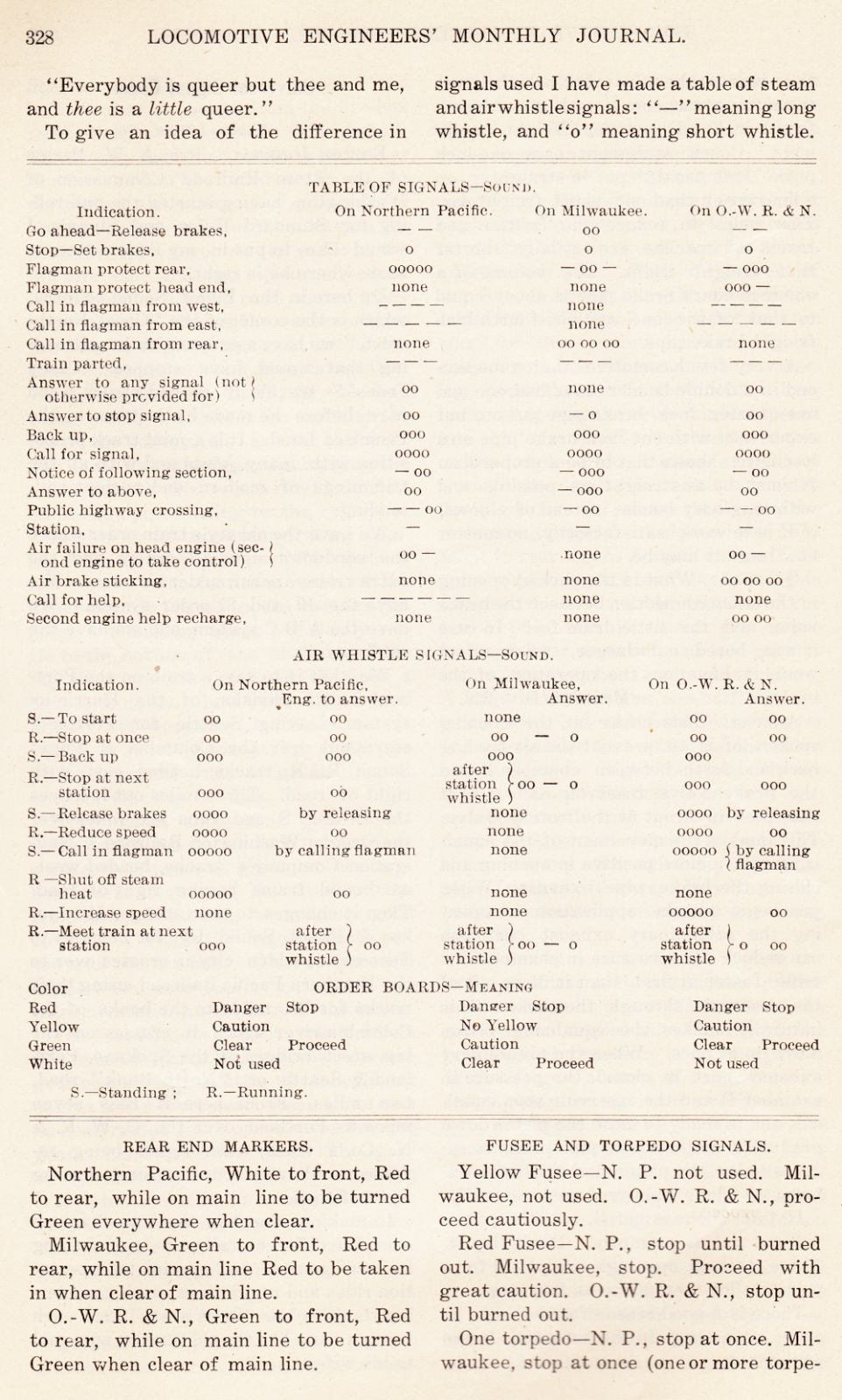


This is a professional journal which often hashes out questions and problems with operating rules. The 'Train Rules - Standard Code' column follows the letter.

*  *  *

The Territory Described

The map below (from 1928) shows the section of track described between Seattle, Washington and Portland, Oregon. This map seems to support the idea that the Great Northern, Union Pacific and Northern Pacific all operated trains over the same section of the latter's main line.


from: 1928 Handy Railroad Atlas of the United States; Rand McNally - Kalmbach reprint.

Looking at the Northern Pacific (1911) and Union Pacific (1910) public timetables which follow, you'll see many of the same station names used. You'll also notice that the passenger trains used the same series of numbers - 3xx. The train numbers dovetail with no duplication between the railroads.

It seems likely that the Northern Pacific employee timetable would display these trains side by side.

Northern Pacific Railway 1911 public timetable on archive.org


Union Pacific public timetable 1910 on archive.org

*  *  *

from: The Northern Pacific, Main Street of the Northwest; Charles R Wood; 1968; Superior Publishing.
The photo above shows a Northern Pacific freight crew at the beginning or end of the day at Auburn, Washington in 1912. There are many details to enjoy, but notice the backup whistle on the caboose's rear platform.

*  *  *

The Standard Code

The Standard Code of The Association of American Railroads of 1940 is a four inch by six inch book which is almost two inches thick. It includes the progression of operating, block signal and interlocking rules put forward by committees of the Association between 1889 and 1938. The oldest version of any given rule ... is following by its next version ... and finally ending with the current version.

I could never imagine myself out flagging as a new brakeman, on multi-track territory at night, and correctly identifying when I, myself am getting whistled back ... it's the stuff of nightmares ... so let's look at the whistle signals on the page at the right instead ...

You can see that the Standard Code of 1940 includes the whistle signals used in 1906. Most people would recognize the 14 (l) whistle signal used at public grade crossings. Notice that it ends with a short sound in this version of the rules.


On the next pages comes the 1915 version of the whistle signals and our 14(l) is still the same. 

The letter from Brother Morris to the BLE also raises the lack of consistency regarding the rules for the use of torpedoes. (A 'torpedo' was an 'explosive charge' - long before it was an explosive charge propelled under water at an enemy ship.)

Starting with Rule 15 of 1887, above, and continuing on the pages below, you can see that the use of torpedoes gave them a lot of work ... After trying one procedure, there were problems or accidents and this caused a review of the process to try to improve it. 

In 1928, they decided to avoid placing torpedoes where the general public was nearby. While this may have been to prevent tampering with life-saving warnings ... you can imagine it may also have been because of injuries sustained by bystanders which caused this rule to be modified. 


Bell cord signals! Before radios, a dedicated air pressure line was used by the passenger train conductor to signal the engine. Before this air line, there was the bell cord. 

The bell cord was strung on the outside of the full length of the passenger train. Pulling on the cord was supposed to ring a bell in the engine cab. Keep in mind that compressed air on a train didn't become common before the air brake was widely in use. 

In February 1874, a passenger train westbound from London, Ontario caught fire ... and because the bell cord had not been connected (for practical reasons) ... the train couldn't be stopped immediately, and ten people burned to death or died later of their injuries. As usual, there were many other contributing factors - movable kerosene lighting inside wooden coaches, just as one example.

Again, you can see how the rule evolved over successive reviews by the successive committees.


To sum up: Brother Morris had a good point that problems are created when crews are forced to operate over territories such as his where there is such a diversity of rules to cover the same general process. There was good justification for a 'Standard Code' and for railroads to adopt approved, standardized rules. 
*  *  *

from: The Northern Pacific, Main Street of the Northwest; Charles R Wood; 1968; Superior Publishing.
In 1912, at Yakima, Washington (shown at the east side of the map above) an eastbound NP passenger train has overtaken an eastbound freight. Most of the splintered wood you see was the caboose. We can probably think of ten possible rules violations which may have caused this problem, including some not involving anyone on these trains.

As humans will always make mistakes and will always forget things from time to time, it is a good idea to eliminate unnecessary confusion by making necessary rules simpler.

*  *  *

From the same edition of the Journal (some bound sets of these can also be seen on archive.org) comes a letter about efforts to change a railroad practice which increased the probability of crews making mistakes and forgetting things ... long hours and inadequate rest.


*  *  *

Canadian Content


*  *  *

Finally ...
Making Money from Endorsements and Advertising


24 March 2016

Hotbox!


This post looks at how a typical boxcar, during the first century or so of North American railways, carried over 40 tons of weight on the 8 outer ends of its axles. The post is intended to provide background for a subsequent post on the CPR's booklet of instructions to carmen and running trades employees, issued during World War Two.


Below are two simplified wheelsets. The axle stubs protruding through the wheels are known as 'journals' - to be more specific, the journals are the turning surfaces which actually bear weight.

The journal, the metal bearing resting on it, a lubrication system, and other bits are housed in a 'journal box'. An overheating journal/bearing set was generally known as a 'hotbox'.

from: Freight Car Repairs; 1985; Canadian National Railways.

After 1963, permanently sealed and lubricated roller bearing systems replaced 'plain bearings' on new cars manufactured for interchange between railroads in order to meet AAR standards. I saw some plain bearing ballast/slag/ore cars used only for company service which survived into the 1990s on the CNR.
Notice that as technology progresses, a more descriptive name must be created for the original version to differentiate it from recent inventions. For example, what was once known as 'a telephone' is currently 'a landline phone' because newer technologies can now be used to transmit two-way voice communication. 
I doubt that Isaac Babbitt (1799-1862) et al said: 
Let's design a "plain bearing" now, because in the future I want to invent a "fancy bearing"!
*  *  *

from: Freight Car Repairs; 1985; Canadian National Railways.

Here is a photo of a burnt-off journal. This could occur if a 'hotbox' was not seen (or heard, or smelled) in time by crew members watching their relatively short train from the headend and tailend. While a hot, smoking bearing might be easy to sense on a summer day with the caboose windows open ... it would generally be harder to detect at night during a raging blizzard.

Considering the example above, this is what could go wrong after a failure: Instead of the journal carrying part of the car's weight, that weight will be dragging directly on the track structure. If the truck assembly breaks down further and/or if the dragging equipment hits an object such as crossing timbers or a switch - a derailment would be likely to occur.

*  *  *

from: The Model Railroader Cyclopedia, Sixth Edition; AC Kalmbach; 1950; Kalmbach Publishing.
Above, the top truck is generally referred to as an 'archbar truck' today - for obvious reasons. It was manufactured by bolting together mainly forged or rolled parts. But in railroad service, some of these bolted bits might eventually work loose and the truck might disintegrate, causing a derailment. 

Circa 1900, William P Bettendorf (1857-1910) invented the single-casting truck side frame (above) which literally bears his name.

*  *  *

from: Freight Car Repairs; 1985; Canadian National Railways.
If you have visited a railway museum where they offer novelty rides on small unsprung maintenance of way trailers pulled by a track speeder ... you will know first-hand how utterly harsh and bone-jarring steel wheels on steel rails are. If only to help protect the freight, the carbody and the track structure, it really makes sense to have some kind of shock absorbing system between the load and the rails.

On the diagram above, the weight of the boxcar body and its load rests on the centre plate (1) which is part of that truck bolster (7) which spans the two truck side frames. Going around curves or on uneven track, the body may tilt a little and place some weight on one or both of the two side bearings (6).

The truck bolster rests on sets of springs (2). This is the end of the cushy 'sprung' part of the boxcar ...

The truck side frames (3) - such as those which were invented by William Bettendorf - hold the bottoms of the springs. The side frame eventually transfers the weight to a bearing which sits on the journal. So it's solid metal on metal from the bottom of the springs to the rail. 

*  *  *

from: Freight Car Repairs; 1985; Canadian National Railways.
The diagram above looks at the end of a cutaway journal box as seen from the side of the track.

The black perimeter represents the cast truck side frame. 

Working down from the top, you have: 
  • the wedge (an inverted 'U' shape)
  • the bearing and its babbitt lining, 
  • a thin layer of oil (4), 
  • the journal (round - 3) and 
  • the lubricator or packing or 'waste' ... partially submerged in oil (1).

In 1839, Isaac Babbitt began inventing alloys which could be used to line bearings to make them more efficient. Our bearing itself is cast out of brass - sometimes railway bearings are referred to as 'brasses'. On a microscopic level, the 'babbitt' lining the bearing is an alloy of hard metal crystals held within a softer metal. The soft metal wears away a little but the hard crystals stay put and bear the load.

*  *  *

Babbitts in the Movies

The Train; 1964; John Frankenheimer; United Artists.
This movie illuminates so many aspects of railway technology, processes and physics that it should be owned by all. The roughness and simplicity in this sequence helps show why railways embraced the practical advantages of babbitt lined brasses for decades. (But we should acknowledge that the movie makes it look a lot easier than it probably was)

... After a locomotive lubricator is sabotaged to foil the Nazis, its bearings must be repaired by casting new babbitts onto them. Above, Burt Lancaster (doing his own stunts in the movie) ladles the molten babbitt alloy into a mould set around 'the brass' to be repaired. You can see some of the 'white metal' flowing out of the form at the lower right corner as it purges air from the mould.


The Train; 1964; John Frankenheimer; United Artists.
The mould and wedges are knocked off the hot casting. You can see an example of the finished product fitted into the locomotive siderod in the background. In the foreground is the brass with its new lining and flash which must be knocked and filed off. At the right, the metal block which looks like a food can was the part of the form which was used to cast the journal shape into the babbitt in the mould.


The Train; 1964; John Frankenheimer; United Artists.
Finally, the half-bearing is fitted into the siderod, the quality of the fit is checked by feel, and any remaining grit is removed by hand.
This is a 360 degree siderod bearing/babbitt, while our freight car brasses just sit on top of a journal.


*  *  *

... Getting back to the freight car journal box ...

from: Freight Car Repairs; 1985; Canadian National Railways.
The turning journal picks up a coating of oil from the lubricator fabric in the journal (oil) well. The oil reduces the friction on those hard-working hard crystals in the babbitt alloy - the oil travels among the crystals via the little spaces where the soft babbitt metal wore away. The oil carries away some of the heat produced at the point where the babbitt and journal rub against each other.

*  *  *


from: The Science of Railways, Cars; Marshall M Kirkman; 1908; The World Railway Publishing Co.
Above, right, is the journal box as seen from the front with the wedge and bearing - similar to the diagram showing the packing and oil seen previously.

Above, left, is a cross-section of a journal box - along the axle centre.The journal box door is to the left. The journal area is clearly seen. Sitting on the journal is the bearing. Between the bearing and the top of the journal box is the wedge. At the left end of the axle its 'collar' prevents the bearing from sliding off the journal toward the journal box door.

Notice that the axle makes no contact with the back of the journal box where it enters - above and below the 2 1/2" notation.

This rear seal area was a classic problem area for journal boxes in regular service, as oil would be lost out the back and splatter onto the wheel, while dirt and grit would enter the journal through the defective rear seal in exchange ... But there must have been reasons for this looseness, don't you think?

Just considering our narrow focus on the bearing ...

If a jack were placed under the journal box (remember it is part of the truck side frame), it would take the car weight off this wedge and bearing. Using a tool (for safety in case the jack slipped) ... the wedge and then the bearing could be removed.

If a car bearing was poorly lubricated and/or worn down and overheating on a train, in some cases, the simplicity of the plain bearing system enabled an operating crew to remove the defective bearing and replace it with a new one. The caboose carried these supplies and 'car oil' too.

*  *  *

from: Kettle Valley Line, Trains and Travel Magazine; article/photo: W Gibson Kennedy; October 1951. Collection of LCGagnon.
Photo caption:

"No 3609 pulls out of Carmi with two flat cars of road-building equipment, a tank car, and a caboose. The crew had discovered a hotbox on one of the flat cars, jacked up the truck and changed the brass with only 15 minutes' delay."


19 March 2016

How to Travel by Train


This particular undated booklet was probably issued in the late 1950s. It was published by the Association of American Railroads, based on an earlier edition by American Car and Foundry - a builder of passenger cars, among other things.

In 31 pages, it tried to cajole the freedom loving, car driving public back into long distance sealed traintubes. Its target audience was probably affluent white adults of the 1950s - whose only parentally-arranged childhood railroad trip had resulted in a coal cinder in the eye.

Above, in the illustration, there seems to be a steam trainline leak under the locomotive pilot. 
Below, the bearing on the leading axle of the coach seems to be experiencing a 'hotbox'. 


Keep reading ... 'On the train, one is safer than in his own home' ...


The train statistics above are interesting to consider half a century later. 


How could a society be so familiar with road travel that travel by rail was a mystery?

In considering 'history' ... the answer seems to be that rail passengers had only been borrowed from the road for about six generations.


from: Railways Then and Now; OS Nock; 1975; Crown Publishers.

First Class carriages of the Liverpool and Manchester Railway, 1830
Many features of road travel can be seen:

* Each passenger car is composed of three mail coach bodies mounted on a platform.
* A vestigial driver rides the first 'coach' in the position usually occupied by the driver of horses.
* Baggage is carried on the roof.
* Coaches display the company's name, with the centre coach body bearing a unique and jaunty name.


from: Railways Then and Now; OS Nock; 1975; Crown Publishers.

At the red tailend, on the mail coach, proper, rides the post office guard in a red coat. He is probably equipped with a standard issue brass 'post horn' which he will sound on the approach to the next station - the fore-runner of the Rule 14 (m) of The Standard Code of the AAR.

What is missing above is the practice of allowing British mail coach passengers to also ride outside the coach, i.e. on its roof.

Meanwhile in the United States ...


from: The First Quarter-Century of Steam Locomotives in North America; Smith Hempstone Oliver; 1956; Smithsonian Institution.

... I spoke too soon.
The Americans are riding 'outside' at this same point in rail history.

['So-called Atlantic' = another engine's frame with many historically-incorrect modifications which were not on the 1832 prototype]


Here is the cover artwork of the 1950s booklet.
Every single person is smiling.