Showing posts with label Brotherhood of Locomotive Engineers. Show all posts

07 June 2025

GTR 1918 Schedule ('labour contract') for Engineers & Firemen


This interesting document describes the working conditions for wartime engine crews over a century ago. Unlike typical collective agreements, it is not issued over the signatures of representatives for both management and labour. 

A note on the title page mentions the United States Railroad Administration. This is a bit of a mystery to me. The USRA was set up in 1917 to efficiently coordinate the war effort of the very numerous and geographically diverse American railroads. 

... However, the wartime (in Canada: 1914-1918) Canadian labour agreements between the Grand Trunk and the BLE and BLF would have been negotiated through their pre-existing arrangements. It is possible that the GTR agreed to employ the American 'schedule' for the sake of ensuring labour peace. It was a tumultuous period in Canadian railway history. 

A bit of historical background follows ... 

The Brotherhood of Locomotive Engineers was founded in Detroit in 1863 and the Brotherhood of Locomotive Firemen began in 1873 in Port Jervis, New York. These fraternal organizations initially offered mutual life and disability insurance for members ... during a period when government social programs for workers did not exist.

With the BLE present in Canada in 1865, the next logical step was for it to begin negotiating better working conditions for its members. 

In 1875, an economic depression was occurring and Grand Trunk Railway management implemented comprehensive cost cutting measures. It laid off over 600 employees and put in place significant cuts in pay. The BLE called a strike on 29 December 1876 which lasted for 4 days. The government of Prime Minister Alexander Mackenzie declined to intervene. 

At this point, the BLE had the full attention of the Grand Trunk. Among other conditions required to call off the strike, the BLE proposed a two-tiered wage schedule for engineers ... with less-senior employees receiving lower pay. Presumably, this resulted in some preservation of pay levels for the more senior employees. 

Why might the union have suggested a two-tiered pay structure? There was probably no arrangement for railway pensions in this era, so senior workers probably worked until they became disabled for continued employment, or died ... or they depended on their extended families, or their own life savings after their careers ended. 

Unlike two-tiered pay scales advocated by corporations today ... which are intended to permanently eliminate the higher rate through senior worker attrition ... the union may have expected the lower paid workers would later regain the higher wage level after the economic slump had ended.

With the conclusion of the strike in 1877, the BLE had achieved the first union contract in Canada for railway workers. The BLF followed the BLE into Canada after this successful negotiation.

*  *  *

Forty years later ... With the Grand Trunk's absentee (UK-based) board of directors and its ill-fated Grant Trunk Pacific Railway expansion ... the stage was being set for it to default on its Government of Canada loans in 1919. 

In Canada, this was happening during a period of significant labour discontent ... as the financial and social disruption of the Great War overshadowed the preservation or advancement of worker compensation and protections in Canada.

Of coincidental historical interest ... is the fact that the publication date is exactly one week before the beginning of Canada's famous Last Hundred Days offensive of the Great War.

*  *  *


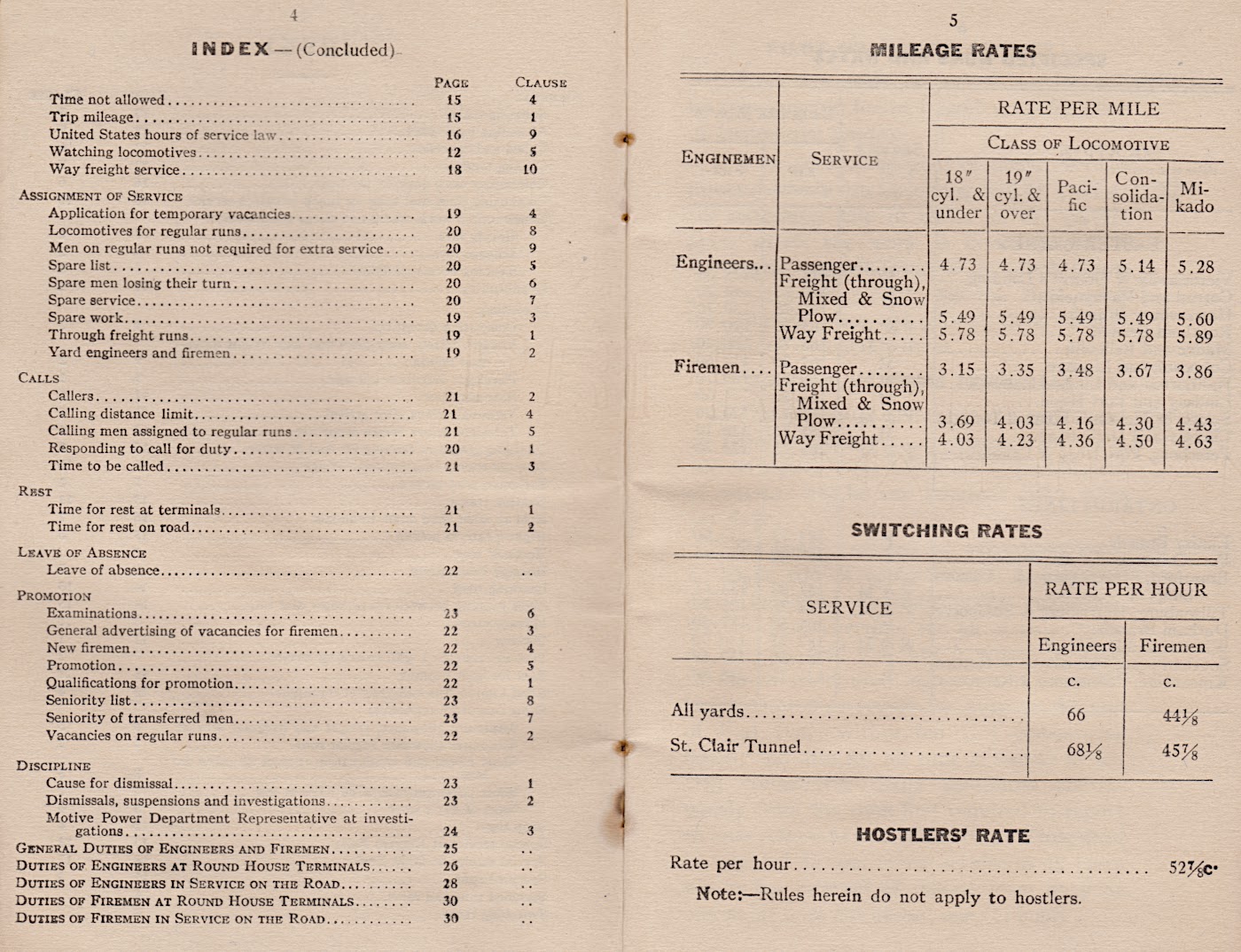
At $00.0549 cents per mile in 1918 ...

an engineer would be paid $1.0431 per mile in 2025 dollars.
... or $104.31 (mileage calculation only) for a standard 8 hour/100 mile day in 2025 dollars.


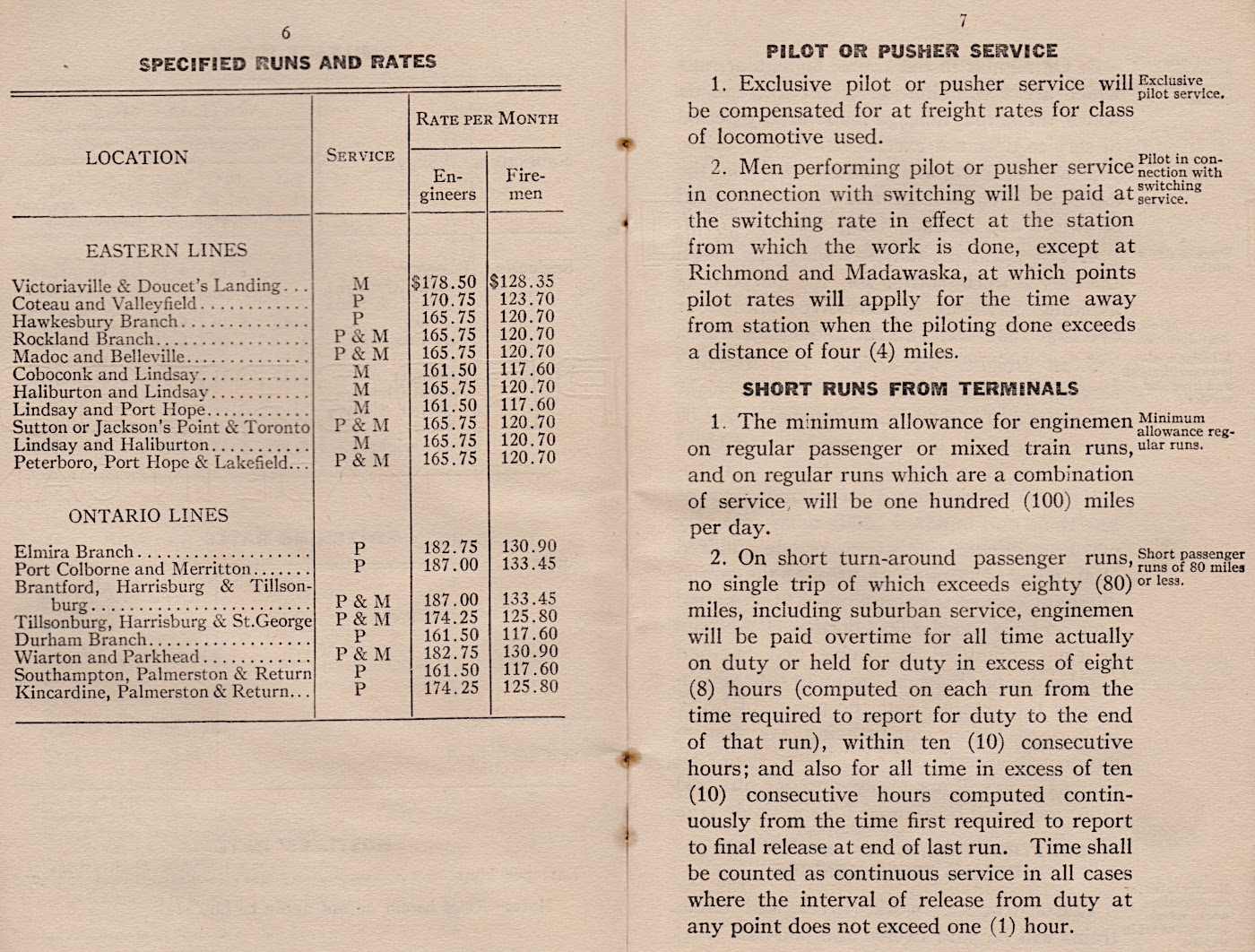
At the top rate of $187 per month in 1918, an engineer would earn ...

$3553 per month, or $42,636 per year in 2025 dollars.

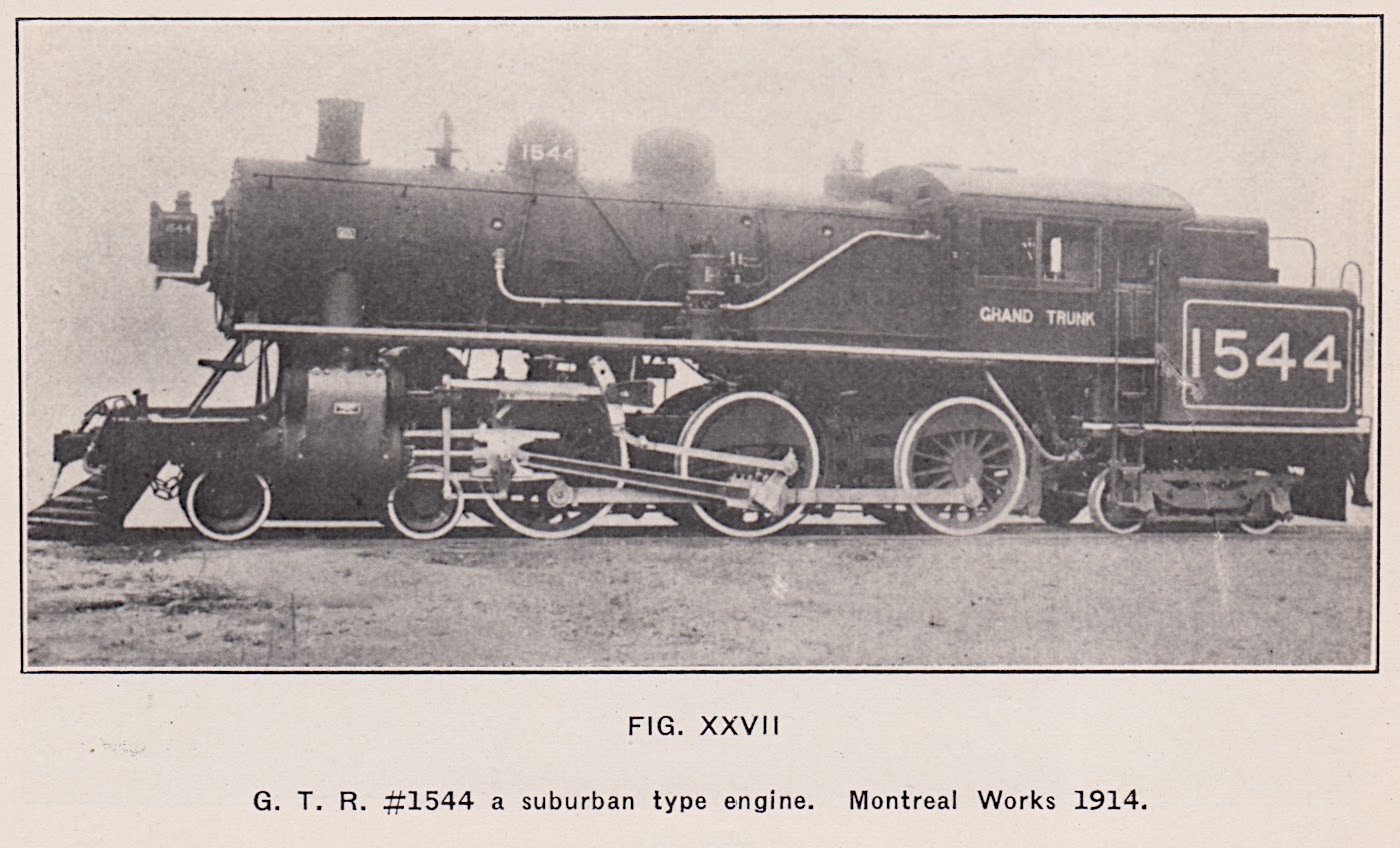
I'm guessing that passenger and mixed service on these secondary lines
often involved slow running and a lot of stops and switching en route.

... Paying a monthly rate eliminated the many compensation calculations provided for in this booklet.

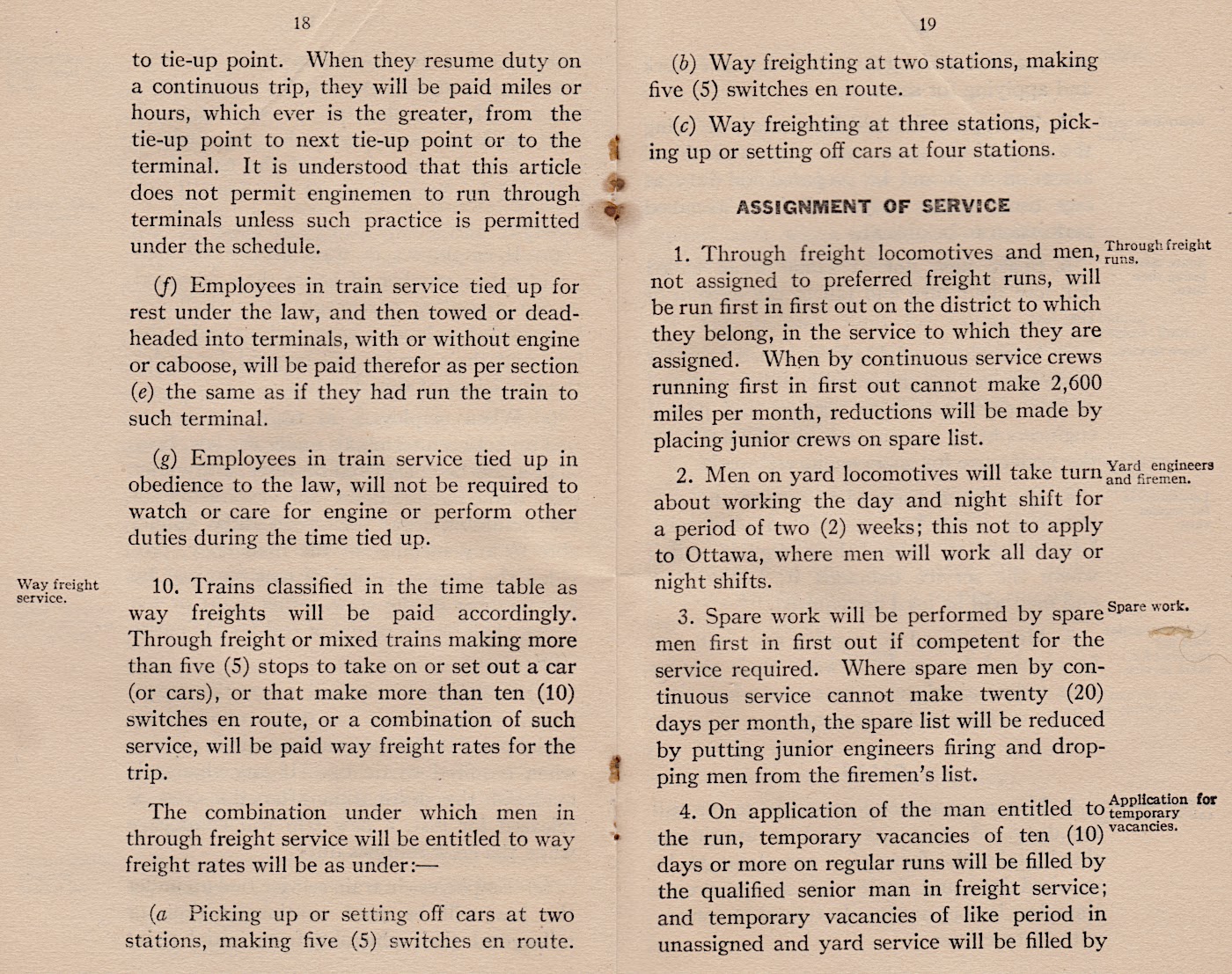
While minute-by-minute crew supervision would be easy for mainline trains ...
the monthly rate probably eliminated a lot of management time and energy watching employees 
and/or later dealing with pay disputes 
(eg. how many switching moves had been made at a remote location on a given date).


Unused, undated postcard.


from: Railroad History, Autumn 1982; ed: Robert C Post; Railway & Historical Society.

GTR engine 113 at Lewiston, Maine in 1912 ... on the line to Portland, Maine.
Built by Baldwin in 1912.
Later CNR 5043 (1923), scrapped 1961. 
With a safety valve lifted, the fireman refills the tender.


from: Railroad History, Autumn 1982; ed: Robert C Post; Railway & Historical Society.

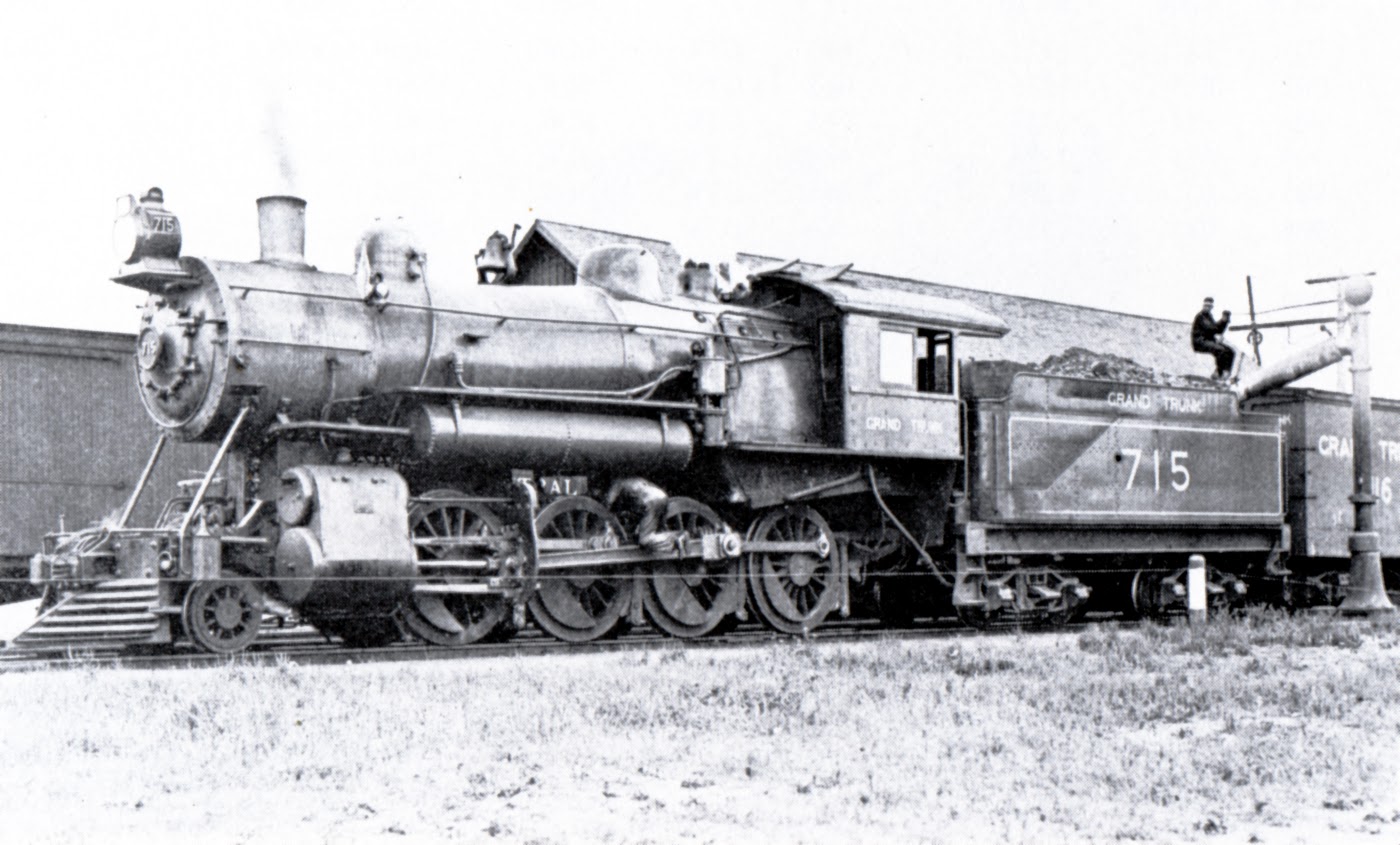
GTR engine 715 - date and location unknown.
Built by Alco in 1907.
Later CNR 2573 (1923), scrapped 1958. 
The fireman refills the tender as the engineer inspects the running gear.

Both Engine 113 and Engine 715 seem to have non-electric headlights.
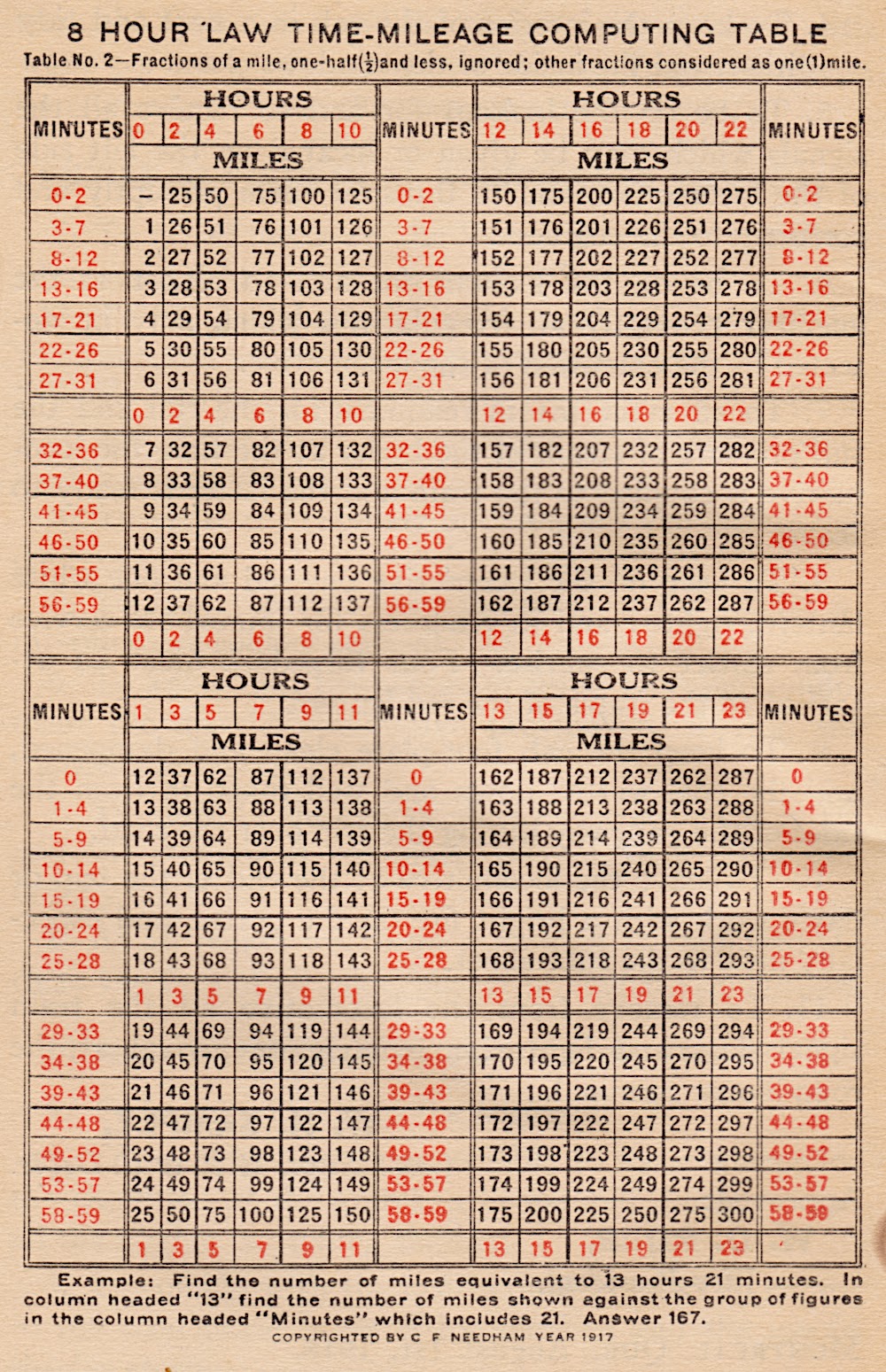
(extra work for the engineer ... Clause 17, below)


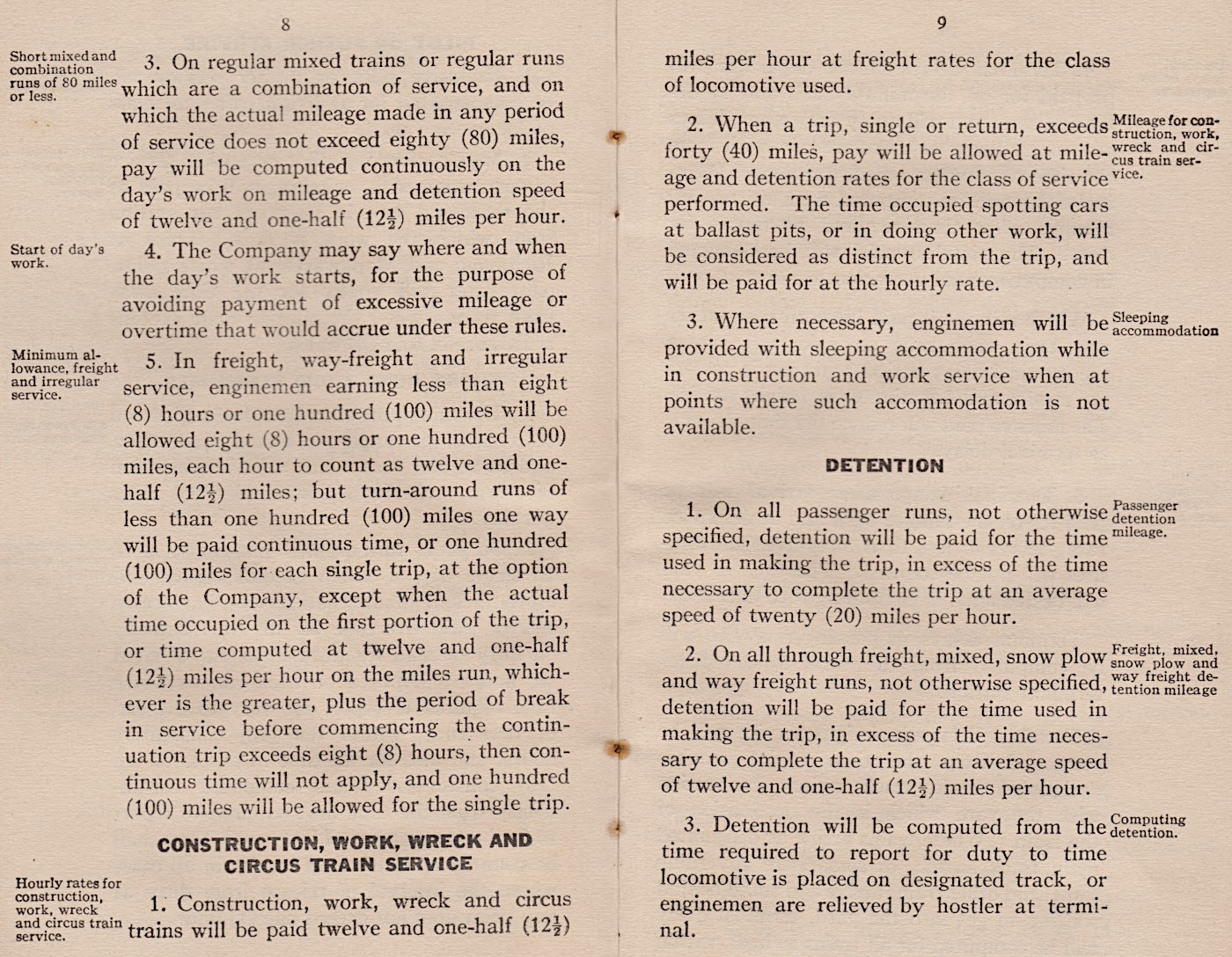
To make this table less intimidating, just remember that the 'standard day' is 8 hours = 100 miles.
Everything else flows from that basic equivalence. 


from: Bulletin No 25, May 1931; ed: Charles E Fisher; Railway & Historical Society.

... later CNR 49.
Donated to the CRHA in 1960.


18 November 2020

1949 US Diesel Emergency Board Report (Firemen), Diesel Ads and an RDC-1 Control Stand

Here are old diesel ads from circa 1950 and commentary on the Diesel Emergency Board report. The latter comes from a November 1949 edition of the Brotherhood of Locomotive Firemen and Enginemen's Magazine.

The technological changes which accompanied the introduction diesel-electric locomotives in the US and Canada enabled railway companies to slash their operating staff, shop staff and semi-skilled labour. 

Diesels pulled more freight, farther, in longer trains, with less maintenance than steam locomotives. A system of coaling and watering facilities could be replaced with fewer simpler facilities to pump diesel oil. 

With the ability to connect the pneumatic and electrical systems of the locomotives, a string of diesel units could be operated by a single engineer. So fewer engineer-hours were needed to move a railway's traffic over the course of a year.

Steam Locomotive Fireman

A fireman was essentially an 'engineer in training' whose job it was to keep steam up through the skillful management of (usually) coal and water before and during a trip. The fireman replenished the locomotive tender with these items as needed, and performed mundane tasks associated with engine operation. As visibility was extremely restricted along the 'barrel' of the locomotive, and often obstructed by swirling smoke and steam, the fireman often assisted the engineer by 'having an eye' for signals and other significant trackside features.

An experienced fireman would have steam built up before the engineer opened the throttle wider to ascend a grade. In cities and during station stops, the fireman would avoid producing unacceptable amounts of smoke. 

Steam would be built up to allow a passenger train to smartly 'get out of town'. However, the fireman would avoid having excess steam lift the main safety valve while at the station. The resulting thunderous roar would annoy the traveling public. Correspondence courses likened lifting the main safety valve to throwing a scoop of coal onto the roadbed - the energy from the coal was being wasted.

A memory for which seemingly identical engines within a given class steamed better or worse was often within the fireman's repertoire. Rolly Martin could generally say whether he had worked on a given engine or not.

Additional firing skills included knowing how to prevent cheap, bad coal from clinkering the movable grates in the firebox. 

And, of course, the most fundamental job of the fireman was to always watch the boiler water level sight glass to ensure that the firebox crown sheet was covered to prevent a boiler explosion. As was the case for other duties of the fireman, the knowledge of the railway line profile was essential: On downgrades, the water would flow forward within the boiler and in extreme cases this could subject the crown sheet to becoming uncovered ... with the risk that it would be melted by the fire ... causing that pesky aforementioned boiler explosion business.

versus ... Diesel Locomotive Fireman (aka 'Helper')

Early diesel road switchers provided better smoke-free forward visibility for engineers and full carbody 'cab unit' diesels offered superb forward visibility. The engineer didn't need a fireman's eyes, because brakemen could be trained and assigned the task of looking out. Diesel fuel was topped up by shop staff and fuel pumps responded almost instantly to the engineer's opening of the throttle. 

'Keeping steam up' for passenger train heat was a link to the fireman's traditional work, but many steam generator functions could often be controlled from the diesel cab. And railway management was busily seeking relief from regulatory requirements to operate many passenger trains as it was.

So that left locomotive troubleshooting while a train was on the move as the single function which a fireman-helper could perform ... if they were trained for it. However, if the train was stopped, the engineer could deal with any diesel issues.

... but did management actually want the engineer stalling the train on the ruling grade and then fiddling around in the engine room? Did management mind if the main line was blocked as the crew 'doubled' their train up a hill as the traffic got backed up in front and behind?

In the defence of the fireman-helper - railway management probably had an overly optimistic view that diesel locomotives could operate as reliably as the family automobile - particularly when units from different manufacturers were mated in a long MU'd locomotive consist.

Exploiting their new 'productivity tools', railways were running more trains faster to meet the postwar boom in traffic. Would all this fast-paced 'action' compromise safety ... and wouldn't operations be safer if an already trained steam-experienced fireman kept the engineer company in the cab? 

... Some of these 1950-era routes still operated under more traditional traffic control processes. Extra train engineers, as they 'helped themselves' over the subdivision, had to calculate their probable speed ahead, the distance to the next appropriate siding and their clearing time. As they kept an eye out, and 'drove' with good train-handling technique ... they also had to do mental calculations involving the intricacies of the rules; timetable; scheduled trains - on time or late; slow orders; and the movements of other extra trains.

While a short 44 tonner wayfreight or a Budd car consist (both are mentioned), might make it possible for a conductor to watch over the engineer's shoulder and consult as necessary ...

One could make the case for a fireman-helper to remain available somewhere in the locomotive consist in complex, or high-speed, or non-ABS territories - particularly on passenger trains.

... But a diesel-powered 3x weekly mixed train on a rural subdivision could not justify the soothing presence of a vestigial fireman on board.


(That's the best resolution possible for all those crests.)

*  *  *

It seems probable that this Emergency Board Report resulted from a Presidential (Harry Truman) directive under the Railroad Labor Act. To prevent a nation-wide disruption of transportation, a Board could be convened and this would prevent both labour and management from exercising their rights (strike, lockout, etc) for a period of something like 60 days until the Board reported its findings. I have read that this Board received a time extension because of all the evidence given.

As the firemen were spending good money on their union dues, the Brotherhood's analysis is appropriately critical of the Board report. As a historical artifact, this article is interesting because it documents many of the operating conditions experienced by the running trades as dieselization swept across the US and later Canada.


*  *  *

The following advertisements appeared in Trains magazine - November 1949 to March 1950.


from: Trains; November 1949; Kalmbach Publishing.

08 August 2016

BLE 1911 The Standard Code

What would happen if commercial airlines flew around the skies with each using its own rules? 

In the early days of the industry, that's exactly what they would have done.

This post will look at a letter sent to the Brotherhood of Locomotive Engineers Journal in April 1911, regarding the risks of not using a 'standard code'. The letter is by WH Morris of Division 236. Today Division 236 is based in Vancouver, Washington.

The Era in History

This first image was taken within a decade of the letter, showing motive power built at about that time.

from: The Northern Pacific, Main Street of the Northwest; Charles R Wood; 1968; Superior Publishing.
Engineer Walt Stevens and fireman AC Larson in Northern Pacific Mikado 1693, built in 1910.
Each is posing with a hand on a control. The photo was probably taken with flash powder.

This is a letter which was written by an engineer probably working for a subsidiary of the Union Pacific. He is spending a good part of his time running on Northern Pacific rails .

I can give you a few contemporary illustrations of the work, using Northern Pacific equipment on that same line from that same time. So that is what you will see.

*  *  *

The Letter


All of the railroads mentioned above are listed in the Statistics of Railways in the United States; 1909; Interstate Commerce Commission. The shortest is 57 miles long. The Oregon-Washington is a Union Pacific subsidiary. The trackage described is shown in public timetables as part of the UP's main routes - although much of it is actually Northern Pacific track. Maps and timetables follow ...


This is a professional journal which often hashes out questions and problems with operating rules. The 'Train Rules - Standard Code' column follows the letter.

*  *  *

The Territory Described

The map below (from 1928) shows the section of track described between Seattle, Washington and Portland, Oregon. This map seems to support the idea that the Great Northern, Union Pacific and Northern Pacific all operated trains over the same section of the latter's main line.


from: 1928 Handy Railroad Atlas of the United States; Rand McNally - Kalmbach reprint.

Looking at the Northern Pacific (1911) and Union Pacific (1910) public timetables which follow, you'll see many of the same station names used. You'll also notice that the passenger trains used the same series of numbers - 3xx. The train numbers dovetail with no duplication between the railroads.

It seems likely that the Northern Pacific employee timetable would display these trains side by side.

Northern Pacific Railway 1911 public timetable on archive.org


Union Pacific public timetable 1910 on archive.org

*  *  *

from: The Northern Pacific, Main Street of the Northwest; Charles R Wood; 1968; Superior Publishing.
The photo above shows a Northern Pacific freight crew at the beginning or end of the day at Auburn, Washington in 1912. There are many details to enjoy, but notice the backup whistle on the caboose's rear platform.

*  *  *

The Standard Code

The Standard Code of The Association of American Railroads of 1940 is a four inch by six inch book which is almost two inches thick. It includes the progression of operating, block signal and interlocking rules put forward by committees of the Association between 1889 and 1938. The oldest version of any given rule ... is following by its next version ... and finally ending with the current version.

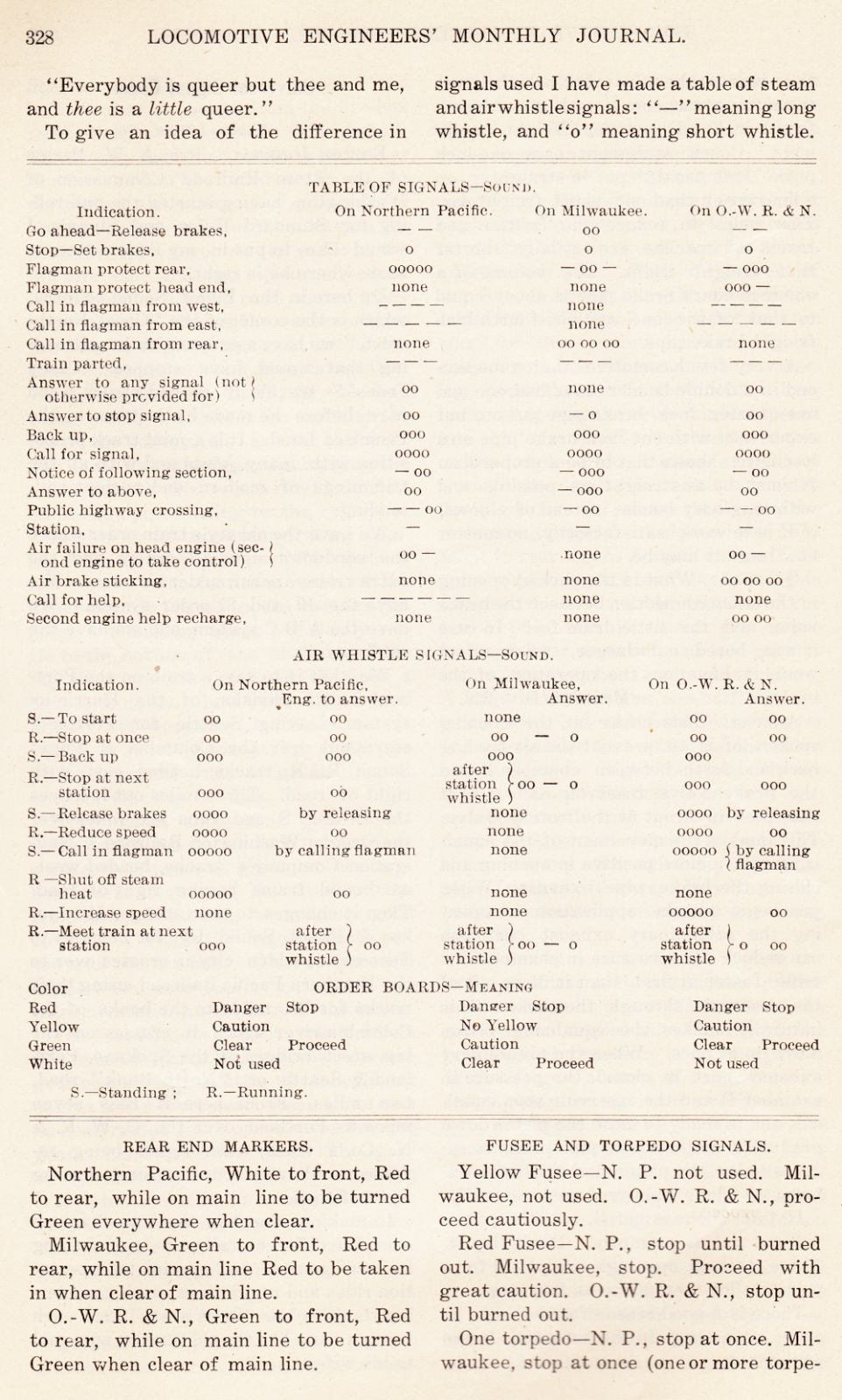
I could never imagine myself out flagging as a new brakeman, on multi-track territory at night, and correctly identifying when I, myself am getting whistled back ... it's the stuff of nightmares ... so let's look at the whistle signals on the page at the right instead ...

You can see that the Standard Code of 1940 includes the whistle signals used in 1906. Most people would recognize the 14 (l) whistle signal used at public grade crossings. Notice that it ends with a short sound in this version of the rules.


On the next pages comes the 1915 version of the whistle signals and our 14(l) is still the same. 

The letter from Brother Morris to the BLE also raises the lack of consistency regarding the rules for the use of torpedoes. (A 'torpedo' was an 'explosive charge' - long before it was an explosive charge propelled under water at an enemy ship.)

Starting with Rule 15 of 1887, above, and continuing on the pages below, you can see that the use of torpedoes gave them a lot of work ... After trying one procedure, there were problems or accidents and this caused a review of the process to try to improve it. 

In 1928, they decided to avoid placing torpedoes where the general public was nearby. While this may have been to prevent tampering with life-saving warnings ... you can imagine it may also have been because of injuries sustained by bystanders which caused this rule to be modified. 


Bell cord signals! Before radios, a dedicated air pressure line was used by the passenger train conductor to signal the engine. Before this air line, there was the bell cord. 

The bell cord was strung on the outside of the full length of the passenger train. Pulling on the cord was supposed to ring a bell in the engine cab. Keep in mind that compressed air on a train didn't become common before the air brake was widely in use. 

In February 1874, a passenger train westbound from London, Ontario caught fire ... and because the bell cord had not been connected (for practical reasons) ... the train couldn't be stopped immediately, and ten people burned to death or died later of their injuries. As usual, there were many other contributing factors - movable kerosene lighting inside wooden coaches, just as one example.

Again, you can see how the rule evolved over successive reviews by the successive committees.


To sum up: Brother Morris had a good point that problems are created when crews are forced to operate over territories such as his where there is such a diversity of rules to cover the same general process. There was good justification for a 'Standard Code' and for railroads to adopt approved, standardized rules. 
*  *  *

from: The Northern Pacific, Main Street of the Northwest; Charles R Wood; 1968; Superior Publishing.
In 1912, at Yakima, Washington (shown at the east side of the map above) an eastbound NP passenger train has overtaken an eastbound freight. Most of the splintered wood you see was the caboose. We can probably think of ten possible rules violations which may have caused this problem, including some not involving anyone on these trains.

As humans will always make mistakes and will always forget things from time to time, it is a good idea to eliminate unnecessary confusion by making necessary rules simpler.

*  *  *

From the same edition of the Journal (some bound sets of these can also be seen on archive.org) comes a letter about efforts to change a railroad practice which increased the probability of crews making mistakes and forgetting things ... long hours and inadequate rest.


*  *  *

Canadian Content


*  *  *

Finally ...
Making Money from Endorsements and Advertising