Showing posts with label locomotive fireman. Show all posts

15 November 2024

CPR 1948 Rolly Martin's Student Trips as Fireman

Don't waste coal, don't clinker the fire, anticipate grades and train acceleration needs to ensure there is adequate potential energy in the boiler to meet the demands of the engineer.

With the knowledge of basic science, these key principles of firing are easy to understand. 

However, to be able to consistently achieve these goals on steam locomotives with different characteristics, coal of variable quality, the array of valves mounted on the boiler backhead, and the tools at hand ... required knowledge and skills which the student fireman was expected to pick up quickly. 

from: The 5137; David Plowden; Trains, Sep 1961; Kalmbach.

Just after the end of Canadian steam, Trains magazine printed a short photo essay of an engine from the same class as the one on which Rolly took his first student trip. The 5137 photos were taken between Brownville Jct, Maine and Megantic, Quebec.

*  *  *


Rolly had Algoma Central maintenance of way experience and Schreiber roundhouse experience, before taking his student trips to qualify as a fireman. Unlike trainmen on trial trips in 1977, I think these trips were probably done on the candidate's own time - without pay. 

These six trips probably represent three round trips taken on the Heron Bay and Nipigon Subdivisions with six different crews. The student might choose to have a shorter turnaround time at White River or Fort William than the assigned crews. The student would also benefit from learning from six different engine crews (engineman + fireman). In some cases, the engine crews would be happy not to have a student with them on the return trip.

I had always imagined that this document represented Rolly firing by hand. However, in checking Lavallee's Canadian Pacific Steam Locomotives, I believe that all of these individual engines had mechanical stokers. (Note: While these devices are often referred to as 'automatic' stokers, they certainly did not work 'with little or no direct human control'.)

Although it would have been a lot of heavy work, hand firing would have been easier to master than being confronted with the controls shown below ...

from: The 5137; David Plowden; Trains, Sep 1961; Kalmbach.

As was often the case in steam locomotives, nothing is labelled in the photo above. Recently we've interpreted this historical fact by inventing a mythical hard-bitten engineer's statement: 'If you don't know what those valves do, you don't belong in my cab!'

The 5100-clast engine had an HT-1 stoker and the 5400-class engines had HT stokers, as shown below.

from: Locomotive Cyclopedia; 1950-1952; Simmons-Boardman. 

The stoker was just a steam-powered auger which transported coal from a channel in the bottom of the tender. Over this channel in the tender are 'slide plates' - mentioned in the booklet reproduced below - which prevent all of those tons of coal from pressing down at once and jamming or breaking the auger. 

Once the coal reaches the distributing table (16, above) it is positioned in the firebox by adjustable jets of steam operating in different directions. 

Right off the bat, the student had to learn how to run the auger to avoid starving or smothering the fire, and how to control those steam jets to evenly spread the coal on the grates.

A steam locomotive cab was an extremely noisy workplace (the banging and rattling of the stoker didn't help) and 'instruction' on the road would consist of shouted advice or commands at key moments. 


A builder's photo of one of Rolly's locomotives is shown above.
The builder's plate is enlarged for any CLC fans.

*  *  *

Although some would see it as anathematic to present a CNR-titled booklet on firing ... in a blog post featuring CPR power ... the same firing challenges were shared by the engine crews of both roads.

In the booklet below the 'Hand Firing' section is considerably longer than the 'Stoker Firing' section. 

With hand firing, you could get a good look at your fire when you opened the butterfly doors ... and choose exactly where to place your scoop of coal (albeit on a rocking, lurching engine). 

The evolving disadvantage of the finely-tuned craft of hand firing ... was that the fireboxes were getting longer, wider, and hungrier all the time - as steam locomotives became larger and more powerful. With all the rocking, and lurching ... and shovelling literally tons of coal during a trip ... they had reached the limit of human endurance for a single person working on a standard 100+ mile trip.

So with newer locomotives they took away the butterfly doors and installed a steam-powered auger to move the coal into the firebox opening. This made any hand firing into the remaining 'hole' more difficult. Student firemen also had to develop a mental picture of how turning those valves would place their coal exactly where it was needed on the firebox grates.


from: Canada Year Book; 1948; Government of Canada.


from: The 5137; David Plowden; Trains, Sep 1961; Kalmbach.


In this undated photo the freshly-coaled 5146, 5162 and 2819 are lugging freight up the hill from Hochelaga.


(Montreal Railway Landmarks File: Église catholique Nativité-de-la-Sainte-Vierge, Ontario/St Germain Streets)

18 November 2020

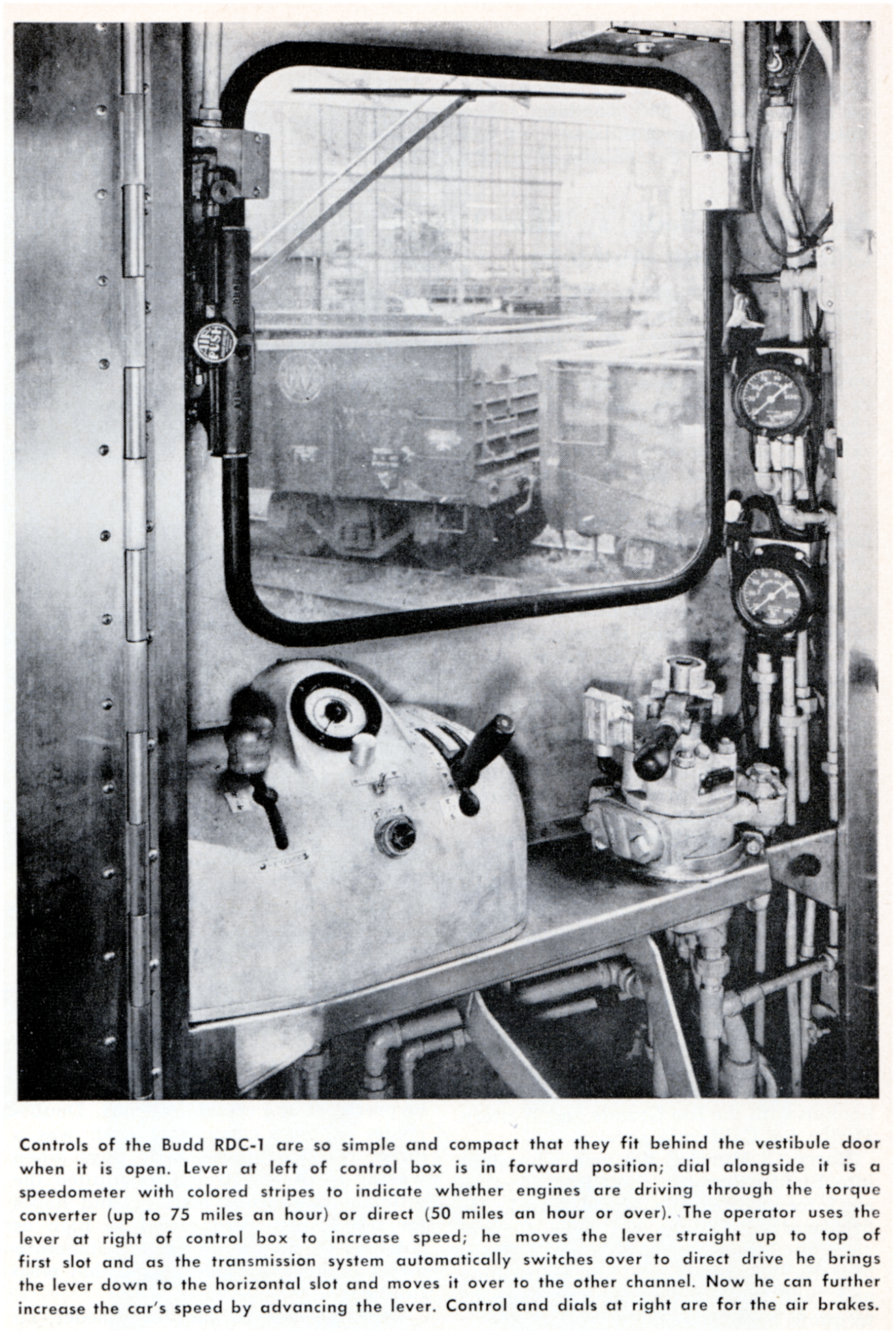
1949 US Diesel Emergency Board Report (Firemen), Diesel Ads and an RDC-1 Control Stand

Here are old diesel ads from circa 1950 and commentary on the Diesel Emergency Board report. The latter comes from a November 1949 edition of the Brotherhood of Locomotive Firemen and Enginemen's Magazine.

The technological changes which accompanied the introduction diesel-electric locomotives in the US and Canada enabled railway companies to slash their operating staff, shop staff and semi-skilled labour. 

Diesels pulled more freight, farther, in longer trains, with less maintenance than steam locomotives. A system of coaling and watering facilities could be replaced with fewer simpler facilities to pump diesel oil. 

With the ability to connect the pneumatic and electrical systems of the locomotives, a string of diesel units could be operated by a single engineer. So fewer engineer-hours were needed to move a railway's traffic over the course of a year.

Steam Locomotive Fireman

A fireman was essentially an 'engineer in training' whose job it was to keep steam up through the skillful management of (usually) coal and water before and during a trip. The fireman replenished the locomotive tender with these items as needed, and performed mundane tasks associated with engine operation. As visibility was extremely restricted along the 'barrel' of the locomotive, and often obstructed by swirling smoke and steam, the fireman often assisted the engineer by 'having an eye' for signals and other significant trackside features.

An experienced fireman would have steam built up before the engineer opened the throttle wider to ascend a grade. In cities and during station stops, the fireman would avoid producing unacceptable amounts of smoke. 

Steam would be built up to allow a passenger train to smartly 'get out of town'. However, the fireman would avoid having excess steam lift the main safety valve while at the station. The resulting thunderous roar would annoy the traveling public. Correspondence courses likened lifting the main safety valve to throwing a scoop of coal onto the roadbed - the energy from the coal was being wasted.

A memory for which seemingly identical engines within a given class steamed better or worse was often within the fireman's repertoire. Rolly Martin could generally say whether he had worked on a given engine or not.

Additional firing skills included knowing how to prevent cheap, bad coal from clinkering the movable grates in the firebox. 

And, of course, the most fundamental job of the fireman was to always watch the boiler water level sight glass to ensure that the firebox crown sheet was covered to prevent a boiler explosion. As was the case for other duties of the fireman, the knowledge of the railway line profile was essential: On downgrades, the water would flow forward within the boiler and in extreme cases this could subject the crown sheet to becoming uncovered ... with the risk that it would be melted by the fire ... causing that pesky aforementioned boiler explosion business.

versus ... Diesel Locomotive Fireman (aka 'Helper')

Early diesel road switchers provided better smoke-free forward visibility for engineers and full carbody 'cab unit' diesels offered superb forward visibility. The engineer didn't need a fireman's eyes, because brakemen could be trained and assigned the task of looking out. Diesel fuel was topped up by shop staff and fuel pumps responded almost instantly to the engineer's opening of the throttle. 

'Keeping steam up' for passenger train heat was a link to the fireman's traditional work, but many steam generator functions could often be controlled from the diesel cab. And railway management was busily seeking relief from regulatory requirements to operate many passenger trains as it was.

So that left locomotive troubleshooting while a train was on the move as the single function which a fireman-helper could perform ... if they were trained for it. However, if the train was stopped, the engineer could deal with any diesel issues.

... but did management actually want the engineer stalling the train on the ruling grade and then fiddling around in the engine room? Did management mind if the main line was blocked as the crew 'doubled' their train up a hill as the traffic got backed up in front and behind?

In the defence of the fireman-helper - railway management probably had an overly optimistic view that diesel locomotives could operate as reliably as the family automobile - particularly when units from different manufacturers were mated in a long MU'd locomotive consist.

Exploiting their new 'productivity tools', railways were running more trains faster to meet the postwar boom in traffic. Would all this fast-paced 'action' compromise safety ... and wouldn't operations be safer if an already trained steam-experienced fireman kept the engineer company in the cab? 

... Some of these 1950-era routes still operated under more traditional traffic control processes. Extra train engineers, as they 'helped themselves' over the subdivision, had to calculate their probable speed ahead, the distance to the next appropriate siding and their clearing time. As they kept an eye out, and 'drove' with good train-handling technique ... they also had to do mental calculations involving the intricacies of the rules; timetable; scheduled trains - on time or late; slow orders; and the movements of other extra trains.

While a short 44 tonner wayfreight or a Budd car consist (both are mentioned), might make it possible for a conductor to watch over the engineer's shoulder and consult as necessary ...

One could make the case for a fireman-helper to remain available somewhere in the locomotive consist in complex, or high-speed, or non-ABS territories - particularly on passenger trains.

... But a diesel-powered 3x weekly mixed train on a rural subdivision could not justify the soothing presence of a vestigial fireman on board.


(That's the best resolution possible for all those crests.)

*  *  *

It seems probable that this Emergency Board Report resulted from a Presidential (Harry Truman) directive under the Railroad Labor Act. To prevent a nation-wide disruption of transportation, a Board could be convened and this would prevent both labour and management from exercising their rights (strike, lockout, etc) for a period of something like 60 days until the Board reported its findings. I have read that this Board received a time extension because of all the evidence given.

As the firemen were spending good money on their union dues, the Brotherhood's analysis is appropriately critical of the Board report. As a historical artifact, this article is interesting because it documents many of the operating conditions experienced by the running trades as dieselization swept across the US and later Canada.


*  *  *

The following advertisements appeared in Trains magazine - November 1949 to March 1950.


from: Trains; November 1949; Kalmbach Publishing.

06 May 2017

Mechanical Stokers


... There never was a John Henry-style duel between a locomotive fireman and 'the steam stoker'.


In July 1991, these photos were taken inside the cab of Manitoba's Prairie Dog Central's 4-4-0 steam locomotive ... which was of 1882 Dübs and Company, Glasgow, Scotland construction. During the Grosse Isle stop, they were kind enough to give passengers some time in the cab and I was rushing so the photos don't fit exactly together. Looking at the top photo, we can reflect on the idea that - like old cars before the 1970s - you can pretty much figure out what function each piece of technology here does. Notice the ever-present cotton waste tucked between the throttle and the backhead. 

... Probably, most features shown here were not on the original locomotive as delivered: coal fuel, the flagging kit, the red patented circular valve handles, air brakes, anything electric, the type of sight glasses used - most of these items improved safety or crew efficiency. Certainly, there would have been a 'tallow' pot on the shelf over the firebox door to lubricate the running gear at stops.


On a nice summer day such as this, it would be an agreeable job to perform most of the 1890s-era fireman's duties ... including correctly spotting fuel in the firebox. With a railway-wide coal logistics system established, coal would be the preferred fuel. To ensure the most efficient use of coal, you'd spread it evenly over the grates, and you'd anticipate the engineer's demands for steam. When not stoking or surveying your fire, you'd also keep the firebox closed. 

Back then, your branch line train would be slowly rocking its way along its appointed schedule. 

... However, the serious railroading - which paid the business's bills and produced a profit - was being done with larger and larger engines hauling longer trains faster. The technological race was to evaporate more and more water into hotter and higher pressure steam - and to wring as much energy as possible from that steam before it was exhausted out the stack. 

One of the lessons of the Industrial Revolution was that machines do many things better than people. Some fireboxes would soon be longer than a fireman could effectively throw the coal ... and many a firebox, on a hard-working engine, would soon burn coal faster than a human fireman with a shovel could be expected to supply it.

*  *  *

A Common Example

from: The Iron Horse, An Illustrated History; Henry B Comstock; 1993; Greenberg.
A year after our Dübs 4-4-0 was built, this singular engine came into the world. El Gobernador, built in-house by the Central Pacific, required the strengthening of the railroad's trestles before it could go out on the road. It never did operate far from Sacramento, where its rigid wheelbase was periodically brought out and operated on mainly tangent track as a curiosity. A rarity in prototype, I found photographs of this engine in many of my 'generic railway books' of bookstore origin.

For illustrative purposes related to our story on the necessity of mechanical stokers - this coal-burning engine often required two firemen. Even so, it was suggested that 'all of Hell couldn't keep her hot'.

*  *  *

The first mention of mechanical stokers I found was circa 1900.
The reference refers to stationary steam engines, such as those used in power plants.

from: Maxims and Instructions for the Boiler Room; N Hawkins; 1897, 1903; Theo. Audel & Co New York.

I haven't tried writing to the American Stoker Company for the 'breaking news' image of the latest stoker design. 

In the image shown - guessing - I think the coal would travel through either the triangular or circular opening outside the firebox ... and emerge from the rectangle with all the perforations inside the firebox. The coal would be allowed to bake off and burn its valuable methane before it was pushed and blown out of the rectangle.

As the text suggests, the [stationary] steam engine fireman will be able to spend his time and energy more profitably elsewhere. 

In its North American railway application, mechanical stokers will free the fireman to spend more time doing things like being the second 'lookout' on the track ahead for wayside signals, other rail movements and obstructions on the road ahead.
However, in places like Britain ... shorter coal-powered trains would dart around on perfect permanent ways between urban centres well into the North American diesel age - fired by hand. One reference commented that right up to the end of steam, large European engines requiring coal stokers usually used machinery of American design.
In circa 1900 Canada, heavy trains, often of commodities, were dealing with grades which were not economically engineered-away. With this need to produce steam 'in bulk', stokers would be very desirable to have in larger engines.

*  *  *

As a generality, it seems that 1920-1925 marked the point when reliable mechanical stokers were commonly available for North American steam locomotives.

Manufacturers' manuals didn't exist for specific steam locomotives 'brands'. Self-study through correspondence courses was one well-developed option for engine crew training and advancement. As well, your railway would conduct your apprenticeship and examine you in writing or orally before promotion to key functions. 

However, patented locomotive sub-systems usually came with their own instruction manuals.


*  *  *

Duplex Stokers

The next two images come from a self-study book published by the International Textbook Company of Scranton. After an explanation of the rationale for stokers, a nice diagram follows. Schematically, it shows how steam provides energy for the system and how the various geared components are linked to the power.

from: Locomotive Stokers; JW Harding; 1922, 1943; International Textbook Co, Scranton. 

from: Locomotive Stokers; JW Harding; 1922, 1943; International Textbook Co, Scranton.

*  *  *

Here is a manual for a duplex stoker.


*  *  *

Comprehensive fold-out diagrams at the end of the Duplex manual give further diagrammatic views and detail.


*  *  *

Steam Jets to Replace the Fireman's 'Throwing' the Coal Forward

... from another manufacturer's illustrations ...

If the locomotive was working hard ... with the exhaust forcefully sucking combustion air up through the fire grates ... small coal particles might be sucked out of the firebox before they could be burned. ... This escape of fine coal around the arch is mentioned in the second image below.

from: Locomotive Cyclopedia; 1950-52; Simmons-Boardman 

from: Locomotive Cyclopedia; 1950-52; Simmons-Boardman 

*  *  *

Again, from the self-study textbook.
A fine pair of diagrams show the stoker articulation points between the locomotive and tender.

from: Locomotive Stokers; JW Harding; 1922, 1943; International Textbook Co, Scranton.

Above, the auger is b5; the drive shaft is c3; the removable segmented auger cover to gravity-feed coal to the auger is e1.

Below, the coal passes through b; the drive shaft is at e.

from: Locomotive Stokers; JW Harding; 1922, 1943; International Textbook Co, Scranton.

*  *  *

"Not Exactly As Illustrated"


from: American Heritage History of Railroads in America; Oliver Jensen; 1975; Random House.

Above: An undated photo taken at a shop facility of the New York Central. The adhering grime - the result of years of use with coal and with the prescribed lubricants liberally applied, contrasts with the fine illustrations of the manufacturers above. 

The stoker conduit under the cab floor is seen at the right. At the left, the photo flash illuminates the end of the auger, protruding from the tender.

Beyond, the 3124, a 4-8-2 Mohawk (Mountain) is also stoker fired.