Showing posts with label Prairie Dog Central. Show all posts

06 May 2017

Mechanical Stokers


... There never was a John Henry-style duel between a locomotive fireman and 'the steam stoker'.


In July 1991, these photos were taken inside the cab of Manitoba's Prairie Dog Central's 4-4-0 steam locomotive ... which was of 1882 Dübs and Company, Glasgow, Scotland construction. During the Grosse Isle stop, they were kind enough to give passengers some time in the cab and I was rushing so the photos don't fit exactly together. Looking at the top photo, we can reflect on the idea that - like old cars before the 1970s - you can pretty much figure out what function each piece of technology here does. Notice the ever-present cotton waste tucked between the throttle and the backhead. 

... Probably, most features shown here were not on the original locomotive as delivered: coal fuel, the flagging kit, the red patented circular valve handles, air brakes, anything electric, the type of sight glasses used - most of these items improved safety or crew efficiency. Certainly, there would have been a 'tallow' pot on the shelf over the firebox door to lubricate the running gear at stops.


On a nice summer day such as this, it would be an agreeable job to perform most of the 1890s-era fireman's duties ... including correctly spotting fuel in the firebox. With a railway-wide coal logistics system established, coal would be the preferred fuel. To ensure the most efficient use of coal, you'd spread it evenly over the grates, and you'd anticipate the engineer's demands for steam. When not stoking or surveying your fire, you'd also keep the firebox closed. 

Back then, your branch line train would be slowly rocking its way along its appointed schedule. 

... However, the serious railroading - which paid the business's bills and produced a profit - was being done with larger and larger engines hauling longer trains faster. The technological race was to evaporate more and more water into hotter and higher pressure steam - and to wring as much energy as possible from that steam before it was exhausted out the stack. 

One of the lessons of the Industrial Revolution was that machines do many things better than people. Some fireboxes would soon be longer than a fireman could effectively throw the coal ... and many a firebox, on a hard-working engine, would soon burn coal faster than a human fireman with a shovel could be expected to supply it.

*  *  *

A Common Example

from: The Iron Horse, An Illustrated History; Henry B Comstock; 1993; Greenberg.
A year after our Dübs 4-4-0 was built, this singular engine came into the world. El Gobernador, built in-house by the Central Pacific, required the strengthening of the railroad's trestles before it could go out on the road. It never did operate far from Sacramento, where its rigid wheelbase was periodically brought out and operated on mainly tangent track as a curiosity. A rarity in prototype, I found photographs of this engine in many of my 'generic railway books' of bookstore origin.

For illustrative purposes related to our story on the necessity of mechanical stokers - this coal-burning engine often required two firemen. Even so, it was suggested that 'all of Hell couldn't keep her hot'.

*  *  *

The first mention of mechanical stokers I found was circa 1900.
The reference refers to stationary steam engines, such as those used in power plants.

from: Maxims and Instructions for the Boiler Room; N Hawkins; 1897, 1903; Theo. Audel & Co New York.

I haven't tried writing to the American Stoker Company for the 'breaking news' image of the latest stoker design. 

In the image shown - guessing - I think the coal would travel through either the triangular or circular opening outside the firebox ... and emerge from the rectangle with all the perforations inside the firebox. The coal would be allowed to bake off and burn its valuable methane before it was pushed and blown out of the rectangle.

As the text suggests, the [stationary] steam engine fireman will be able to spend his time and energy more profitably elsewhere. 

In its North American railway application, mechanical stokers will free the fireman to spend more time doing things like being the second 'lookout' on the track ahead for wayside signals, other rail movements and obstructions on the road ahead.
However, in places like Britain ... shorter coal-powered trains would dart around on perfect permanent ways between urban centres well into the North American diesel age - fired by hand. One reference commented that right up to the end of steam, large European engines requiring coal stokers usually used machinery of American design.
In circa 1900 Canada, heavy trains, often of commodities, were dealing with grades which were not economically engineered-away. With this need to produce steam 'in bulk', stokers would be very desirable to have in larger engines.

*  *  *

As a generality, it seems that 1920-1925 marked the point when reliable mechanical stokers were commonly available for North American steam locomotives.

Manufacturers' manuals didn't exist for specific steam locomotives 'brands'. Self-study through correspondence courses was one well-developed option for engine crew training and advancement. As well, your railway would conduct your apprenticeship and examine you in writing or orally before promotion to key functions. 

However, patented locomotive sub-systems usually came with their own instruction manuals.


*  *  *

Duplex Stokers

The next two images come from a self-study book published by the International Textbook Company of Scranton. After an explanation of the rationale for stokers, a nice diagram follows. Schematically, it shows how steam provides energy for the system and how the various geared components are linked to the power.

from: Locomotive Stokers; JW Harding; 1922, 1943; International Textbook Co, Scranton. 

from: Locomotive Stokers; JW Harding; 1922, 1943; International Textbook Co, Scranton.

*  *  *

Here is a manual for a duplex stoker.


*  *  *

Comprehensive fold-out diagrams at the end of the Duplex manual give further diagrammatic views and detail.


*  *  *

Steam Jets to Replace the Fireman's 'Throwing' the Coal Forward

... from another manufacturer's illustrations ...

If the locomotive was working hard ... with the exhaust forcefully sucking combustion air up through the fire grates ... small coal particles might be sucked out of the firebox before they could be burned. ... This escape of fine coal around the arch is mentioned in the second image below.

from: Locomotive Cyclopedia; 1950-52; Simmons-Boardman 

from: Locomotive Cyclopedia; 1950-52; Simmons-Boardman 

*  *  *

Again, from the self-study textbook.
A fine pair of diagrams show the stoker articulation points between the locomotive and tender.

from: Locomotive Stokers; JW Harding; 1922, 1943; International Textbook Co, Scranton.

Above, the auger is b5; the drive shaft is c3; the removable segmented auger cover to gravity-feed coal to the auger is e1.

Below, the coal passes through b; the drive shaft is at e.

from: Locomotive Stokers; JW Harding; 1922, 1943; International Textbook Co, Scranton.

*  *  *

"Not Exactly As Illustrated"


from: American Heritage History of Railroads in America; Oliver Jensen; 1975; Random House.

Above: An undated photo taken at a shop facility of the New York Central. The adhering grime - the result of years of use with coal and with the prescribed lubricants liberally applied, contrasts with the fine illustrations of the manufacturers above. 

The stoker conduit under the cab floor is seen at the right. At the left, the photo flash illuminates the end of the auger, protruding from the tender.

Beyond, the 3124, a 4-8-2 Mohawk (Mountain) is also stoker fired.


23 October 2015

Portage 1985 - Third Section


In Assiniboine Park in Winnipeg, we enjoyed a particularly authentic ride. 
The locomotive was powered by real coal. 


*  *  *

The Prairie Dog


Unless we visited during a time of year when it wasn't running, it would be a safe bet that we rode on the Prairie Dog Central train every single time we visited my aunt and uncle in Portage. Until preparing this post, I had never really understood the local features of former Canadian Northern line at the PDC's southern terminal.

This shot was intended to depict a working (i.e. coal and grease stained) locomotive ready to be off. Except for the wooden pilot beam the man is touching, virtually every metal surface would be radiating heat.

Above the man's hand, at the horizon, is probably one of the elements which caused the eventual move of the PDC from its downtown location - a steel railway bridge ...


from: GoogleEarth

Above (upper blue marker) is the former location of the St James CN station from which the loaded trains ran to the north. A little to the south, where the Oak Point Sub connected to the Rivers Sub, there was a handy wye for turning the engine and/or the train. Between those two points was a bridge over the Assiniboine River. It was likely the Canadian Northern's original bridge.


from: GoogleEarth
The central pier, being circular and having no water cutter, suggests that the central spans of the bridge might once have swung for water traffic on the Assiniboine.


Since its building in Glasgow, and its original use on the CPR near today's Kenora, this locomotive has been rebuilt so many times that it is a poor historical 'artifact'. That is to say that very little of the original century-old metal has survived through the use of replacement parts of second-hand or custom-forged origin. Who knows how many times the flues have been replaced?

Upgrades such as superheaters may have changed the hardware configuration within the boiler and increased the engine's efficiency a little. The dynamo and air pump have added sounds which the 'original' didn't make. Sulphurous coal smoke has replaced the the aroma of locally sourced wood  - probably the fuel of necessity during the first few years. The smells of hot tallow, and burning whale oil and coal oil are gone.

Yet ...

The perfect, balanced - as it has been called with diesel-age hindsight - wheel arrangement of the 4-4-0 remains. The distinctive Stephenson valve gear still shuttles back and forth. Someone must still load all the fuel to be consumed onto the grates by hand.

The wooden coaches with their 'watch the ties pass' quick-limed, dry toilets (in 1985) harken back to interminable, slow-speed rail journeys through the Canadian bush and over the prairies.

The lightness of the coaches and the modest tractive effort used to pull them cause one to wonder how trains could be run through the lightest of snowfalls, or how enough tonnage could ever be moved to supply even the most modest of pioneer villages and farms along the way.

When you reflect on the technological simplicity, scale, and speed of this train - the historical artifact is perfect.

*  *  *

Above, my uncle appears at the left margin with his camera. To re-enact history, he has opened the throttles of steam traction engines - the off-rail source of any big power needed on the prairies during the first few decades which followed the building of the CPR.

Behind the south-facing PDC train is a CN diesel - a switcher I am guessing. I don't know enough about PDC operations to say whether it is here to remove the consist - or just waiting for the train to clear to the south.


from: CN Prairie Region timetable 27; Oct 27 1985.
During our visit in 1985, the Prairie Dog was running from St James to Grosse Isle.


From St James, the train would operate north along my added yellow line. Sounds of grade crossing whistling, locomotive bell, and exhausts reflecting off buildings were reminiscent of main line steam locomotives hauling CRHA and CNR excursion trains through towns along Quebec's secondary lines in the 1960s.

Exiting the industrial park, the former Canadian Northern line would parallel the CPR main line for a while, then the wheels would hammer across the diamond (crossing the CP Carberry Sub) which carries the Oak Point Sub north to Grosse Isle.


At Grosse Isle, the time-honoured practice of leaning to peer down the track is seen. The locomotive and first car have be turned on the wye for the return to St James. A rail-mounted mower is probably used to make the trip around the wye less of an adventure.


I remember the Grosse Isle wye move (during a subsequent visit) as being deep in soft grass with a great deal of flange squealing. 

With the benefit of GoogleEarth, we can see that the (former) wye is not equilateral and that it seems to employ the greatest curvature possible. The Oak Point Sub continued to Gypsumville via the north-west leg of the wye. Heading due north at the wye was the Inwood Sub to Fisher Branch and Hodgson.
"Trains, except work trains under direction of roadmasters and caboose hops, must not be operated on the Inwood Subdivision when temperature exceeds 27 degrees Celsius, 80 degrees Fahrenheit unless authorized by chief train dispatcher .." [thermometers are provided, etc.]
from: Symington Division Special Instructions. SY 2. October 27, 1985. 
During a particular bout of my 'railway archaeology' one afternoon, we dragged my uncle in search of ancient lines and found some very light rail on bare ties. Photos of this and other Prairie Dog trips will follow in additional posts.


*  *  *


Somewhere near Delta on Lake Manitoba you can see a fairly typical backroad view for this part of Manitoba.

On a summer afternoon, a clear blue sky would sometimes be broken only by clouds towering over Lake Manitoba. On this spectacularly flat area of the prairies, items on the horizon are visible long before you finally reach them.


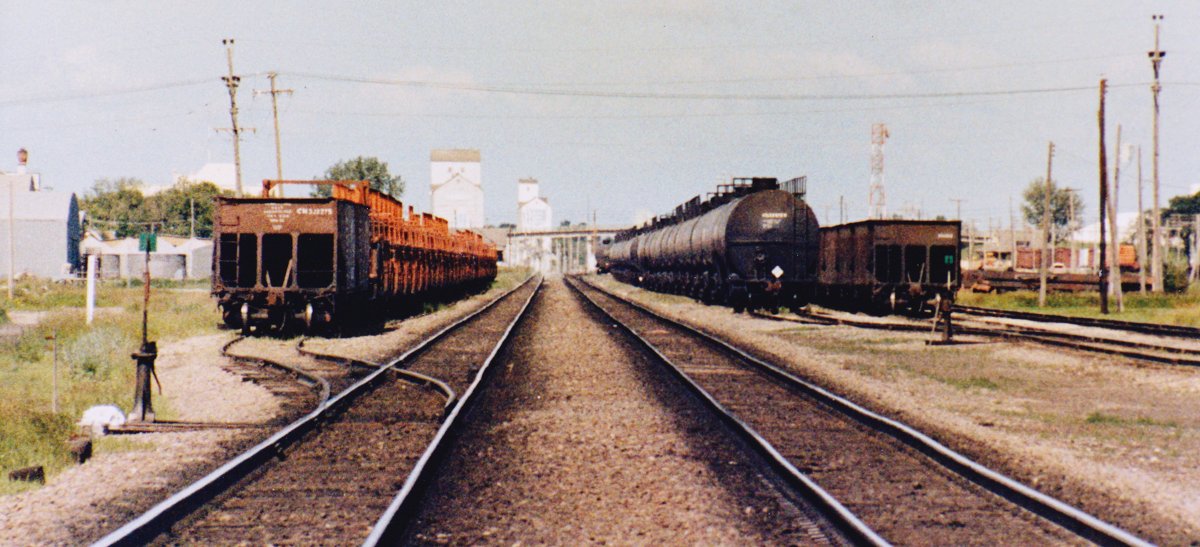
In the east end of the CN yard a Browning crane from 1957 and its idler car are seen.

Notice the step at the left side of the switch stand.

During the main line bolted rail era when local maintenance of way staff lived and worked on the 'section' each switch stand had its own kerosene switch lamp (replaced by today's round reflectors) and the step enabled the maintenance of way staff to reach the lamp for lighting, lens cleaning, refilling and wick trimming.


Near East Tower, the camera is looking west along the CNR main tracks.
The CN station view is blocked by cars, but it is short of the Tupper Street overpass and to the left.
The track to the right holds anhydrous ammonia tank cars for Bloom.
The roof of the CP station can be seen to the right of the brown hopper cars to the right.

I had thought that back when I was young, that all main track rails were properly lined and surfaced.
I guess I was wrong.

Perhaps I'm wrong about yesterday's wheels having fewer flat spots too.

*  *  *

from: GoogleEarth
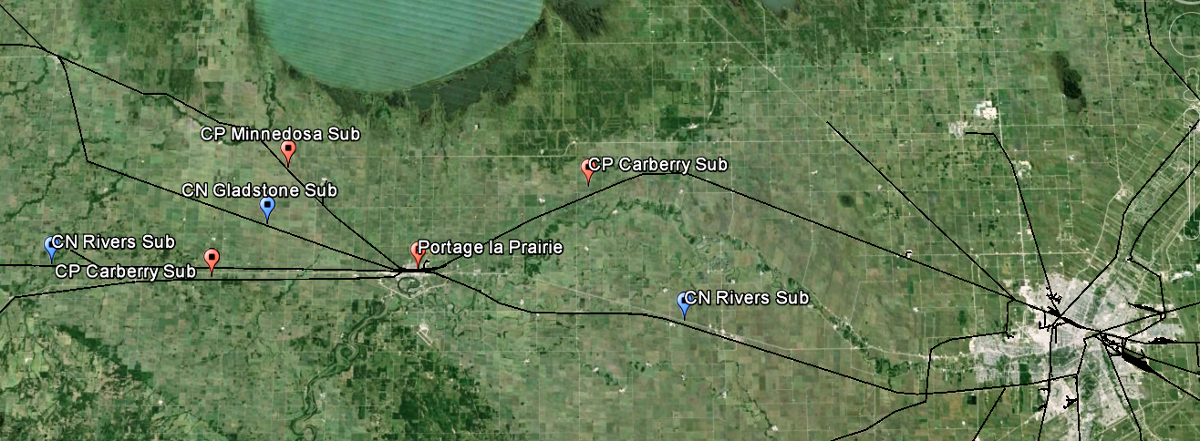
The main lines of  the CPR (Carberry Sub) and the CNR (Rivers Sub) cross at Portage.

*  *  *

from: GoogleEarth
A rough map of local features.
Portage la Prairie (red) is CP.
P la Prairie (blue) is CN.


Because of my vacation proclivity for taking every photo possible with grainy film into the sun, bringing some of the equipment out of the shadow has required some unnatural stretching of colours.

To the right, it is perhaps the Portage operator who is preparing to hoop up a clearance and orders to the extra 1006 west and its consist of grain empties.


The extra 1006 west approaches its signals for the Gladstone Sub.


With the CN station visible to the left of the maintenance of way cars,
VIA No 2, The Canadian, approaches East Tower with red CP Rail paint
indicating the lead unit's heritage under the peeling VIA black.


Hot, dusty, itchy work late on a Portage afternoon.
An elevator worker fills a covered hopper from the UGG elevator.


If you watch a similar operation and hear a cover slam, it is not carelessness.
The covers are lifted to the top of their arc, then released to fall open or closed.
To carefully and silently lower them would risk over-balancing and a possible fall from the top of the car.


The extra 5010 west arrives in Portage - its consist is seen curling around the curve to the south-west.


Probably photographing from the old piggy-back ramp,
my zoom finds the CP switcher conductor checking for handbrakes etc before switching.


The 6569 is taking these four mechanical refrigerator cars to the McCain plant.


Having completed the morning's switching, 
the 6569 runs down the yard ladder track toward the CP station.


Probably zooming in from 18th Street towards West Tower.

While CN, as the 'junior' railway at Portage probably bears the costs of the diamond and interlocking ... consider the other railway systems also at this location.

... Keeping the wayside wire lines clear of each other as they cross must take some co-ordination.


Nearing the station the CP extra 5755 west arrives with (probably) grain empties.


During this era, CN and CP both seemed to operate these unit coal trains.
They were likely headed for Ontario Hydro thermal plants .

With its tailend called clear of the diamond,
 extra 5731 east is working its way up to track speed as it approaches Stephens Avenue.