Showing posts with label Alco. Show all posts

22 March 2024

American Locomotive Company circa 1905 - Rotary Snow Plow

Eric raised a good point pertaining to previous post (linked below) about the Rogers Pass avalanche disaster of 1910. In the block of text appearing after the shovellers shown working in tiers ... was I suggesting that the rotary snow plow chewed right into the amalgam of snow, ice and wood sitting on the roadbed?

1910 CPR Rogers Pass Avalanche - Approx. 2359hr, Friday, 4 March 1910

The text referred to the technique of first shovelling off snow in excess of the ten-vertical-feet maximum capacity of the rotary snow plow. So in this particular case, when they had shovelled down to 10 feet of snow, did the rotary start bulling its way into that mess of snow and timbers?

... In 'post-crafting' I find I often stumble back and forth between technical writing ... and an effort to do 'historical writing' - which is intended to convey 'the human experience of railroading' and/or an imagination of what a period of history was like. 

In that particular section, I was attempting to outline the techniques used to work around the capacity limits of the rotary snow plow technology - organized manual shovelling. This was just general technical writing without trying to consider all the variables confronting those trying to clear the 1910 avalanche destruction.

*  *  *

I was never interested in this disaster before I discovered contemporary newspaper articles about the experiences of the workers ... and in particular those coming from places in Asia and South Asia

... Years ago, I had some exceptional training as I prepared to work with newcomers to Canada as a volunteer, and I've since understood typical Canadian historical stories of 'foreign labourers' in that context. Imagining a reverse situation: Parachuting ourselves into typical life and work in Japan, China, or India in 1910 would have been incredibly difficult without any preparation - such as basic language classes. Except for the promises made to them by agents and jobbers, these newcomers of 1910 probably had little realistic, factual information about the 'adventures' they would have in western Canada.

... In 1910, the CPR just needed bodies pushing shovels during the winter season. There was no desire on the part of Shaughnessy's road to get 'touchy-feely' with language classes and conversation groups and 'integration' activities (to develop connections and a degree of comfort with Canadian society), or efforts to share cultural experiences (e.g. your food/my food) back and forth, canoeing, snowshoeing etc. 

... One of the articles of 1910 sort of jokes about telegraphers having difficulty with the [Asian] "code" as workers tried to send telegrams indicating they were alive and OK to family members on the coast of British Columbia. 

*  *  *

Getting back to our avalanche disaster story, and the use of the rotary snow plow to clear the line ...

If you are NOT visiting this website to risk experiencing vicarious trauma, skip the rest of this paragraph. In the area where the large 1910 avalanche buried the workers trying to clear a previous slide ... the ten feet of snow above the rail would contain ... large timbers, pieces of trees, large rocks, snow, ice, chunks of steel, humans killed by suffocation, humans who had died from traumatic injury, body parts. 

Immediately after this disaster, there would have been plenty of frantic but fruitless hand-digging for survivors when the first small groups of rescuers arrived. There is no record to indicate how long it took the second rotary to finally attend the scene, but one newspaper story says it was forced back by the quantity of timber in the slide. 

One of the Canadian newspaper accounts said that the second slide buried a quarter mile area to a depth of 50 feet. If they only moved the snow once ... to clear a 10-foot-wide strip of roadbed ... the total amount moved by rotary and by hand would be about 0.6 million cubic feet or 17,000 cubic metres of snow.

The work would have been incredibly difficult and the disaster would have been traumatic for many ... as the last paragraph of the final newspaper story suggests. 

The CPR swore up and down to the newspapers that the final death toll was 62 and that all workers were accounted for. Certainly there would be an accurate accounting of the 'regular' CPR employees with families in the area. Some of the American accounts said that many victims were swept away from the main line and might not be found until spring.

*  *  *

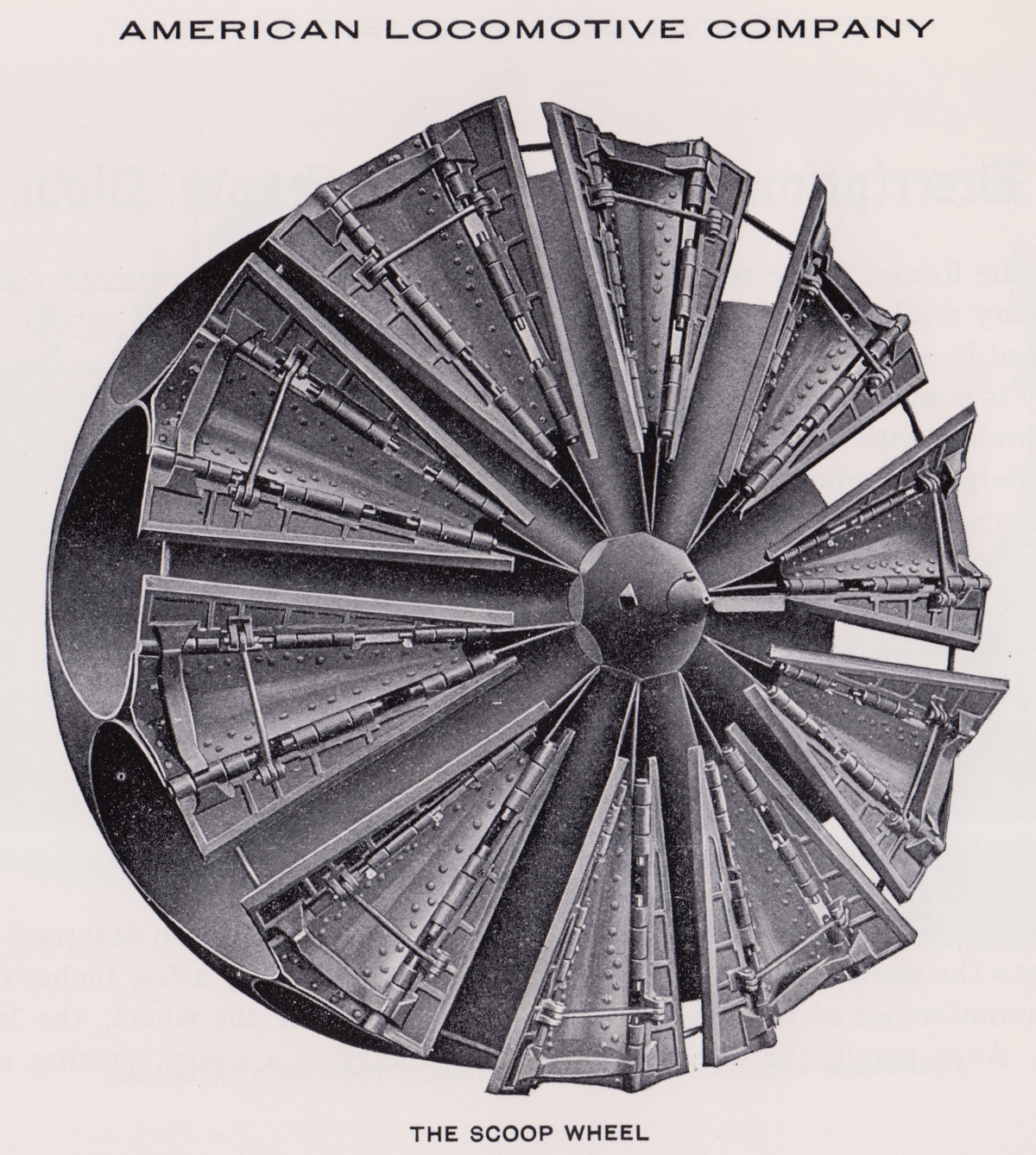
Alco's Rotary Snow Plow


I bought this booklet about 30 years ago - it is a 1973 reprint. It presents a fine bit of technical writing and excellent technical drawings from probably circa 1905. The rotary is described and illustrated. Then 25 rules for its operation are given. 

The rotary requires careful systematic operation and an experienced cohesive crew. The book recommends a specialized crew of three for the plow, with a second trained relief crew available. A book about the Northern Pacific states that continuous periods on duty for rotary crews in the US sometimes reached 24-36 hours before a federal law set the limit at 16 hours.

Rotaries were popular on 'Canadian' railways in the early 1900s (CPR, Canadian Northern, Grand Trunk Pacific, Reid Newfoundland, White Pass & Yukon), but it seems unlikely that many personal accounts were written by their hands-on operators - including anything specific about the 1910 Rogers Pass disaster and recovery.

This week, I searched in vain for any railway rulebooks for the rotaries which had been microfilmed by the Government of Canada. Often there are some interesting items to be found via archive.org. 

I reviewed articles which Jim Christie kindly sent me circa 2015 about CPR's MLW-built plow design. I also did a lot of searching through the professional journals at archive.org for rotary material. I re-found some of Jim's articles in the process. I also found a long article I hadn't seen for 15-20 years which I had used for a snow clearing piece on the old version of this site. 

... Consequently, I have some interesting and some surprising items ready for posting. Unfortunately, this is the time of year when we would like to forget about winter, so another post on rotaries might not be popular. But the timeless internet knows no season.

This particular booklet was mentioned in contemporary professional journals at the time. Its attractiveness and conciseness seems to have provided it with some 'earned media' among railroaders.


11 August 2021

1947 Diesel Electric, Gasoline Electric & Electric Locomotive Lubrication


Imperial Oil put out a well-illustrated 300 page 5x7 inch book which looked at all aspects of lubrication on railways. Petroleum product tradenames: Gargoyle B.R.B. No 3 is my favourite, followed by Van Hymelt 2 ... they are probably both available for video game names if anyone is interested. 

Both the lubricant vendor and the railroader would learn about each other's work by reading this book cover to cover. As you'll see, the railway technology is first described in detail, followed by the desired characteristics of lubricants for its various elements and (considerately) the trade names of specially-formulated Imperial Oil products to meet the railroader's needs. 

Around 1870, the addition of galena (a form of lead oxide) to Pennsylvania petroleum resulted in the enduring Galena brand name in railway lubrication (used by Imperial Oil in Canada in 1947). With the unprecedented high friction and high temperature characteristics of components in steam locomotive service, lubricants like the Galena product line were indeed needed. Smooth, machined metal parts have protrusions and pits at a microscopic level and it is necessary to maintain an optimized film of lubricant to prevent the surfaces from seizing. 

The days of the 'tallow pot' had long ended. However, sheep still kept their hand in the lubrication business, as you'll see - through the use of their wool in diesel electrics! 

Electric locomotives even had their own unique lubricants. How might one lubricate the main working surface of a pantograph? Hint: Using a compound which included the same 'special crystals' used to lubricate main line switches today.

When this book was printed, road freight locomotives were not yet firmly established in Canada. An interesting array of Canadian gas and diesel car photos is shown. Steam fans will be interested to see a big 60% on the cab of a little CNR yard switcher. All the lubricating points on an Alco switcher are shown - be sure to buy each type of special lubricant recommended for best results! Many will recognize a small Wabash unit at St Thomas, Ontario.


Sheep!:


04 January 2020

LRC Locomotive Operating Manual, Part 4


Here is the last segment of the LRC manual.
Lucky Section 7 contains troubleshooting information.

Links to other sections of this manual can be found in
Technology, Index 04 under Diesels, The Second Generation.


In 1983, on bolted rail, an LRC train crosses Counter Street, Kingston near the four tracks of CN Queens.


A westbound LRC train clatters over the switches of Queens East in 1983.


25 December 2019

LRC Locomotive Operating Manual, Part 3


This section of the LRC locomotive manual looks at Air Equipment, Automatic Alarms and Safeguards and Operation. Because the LRC featured HEP, the locomotive manual contains many references to equipment on the cars which connected to controls and monitoring displays on the locomotive.

Links to other sections of this manual can be found in Technology, Index 04 under Diesels, The Second Generation.


Note: All poorly reproduced photograph photocopies appear this way in the original.


*  *  *