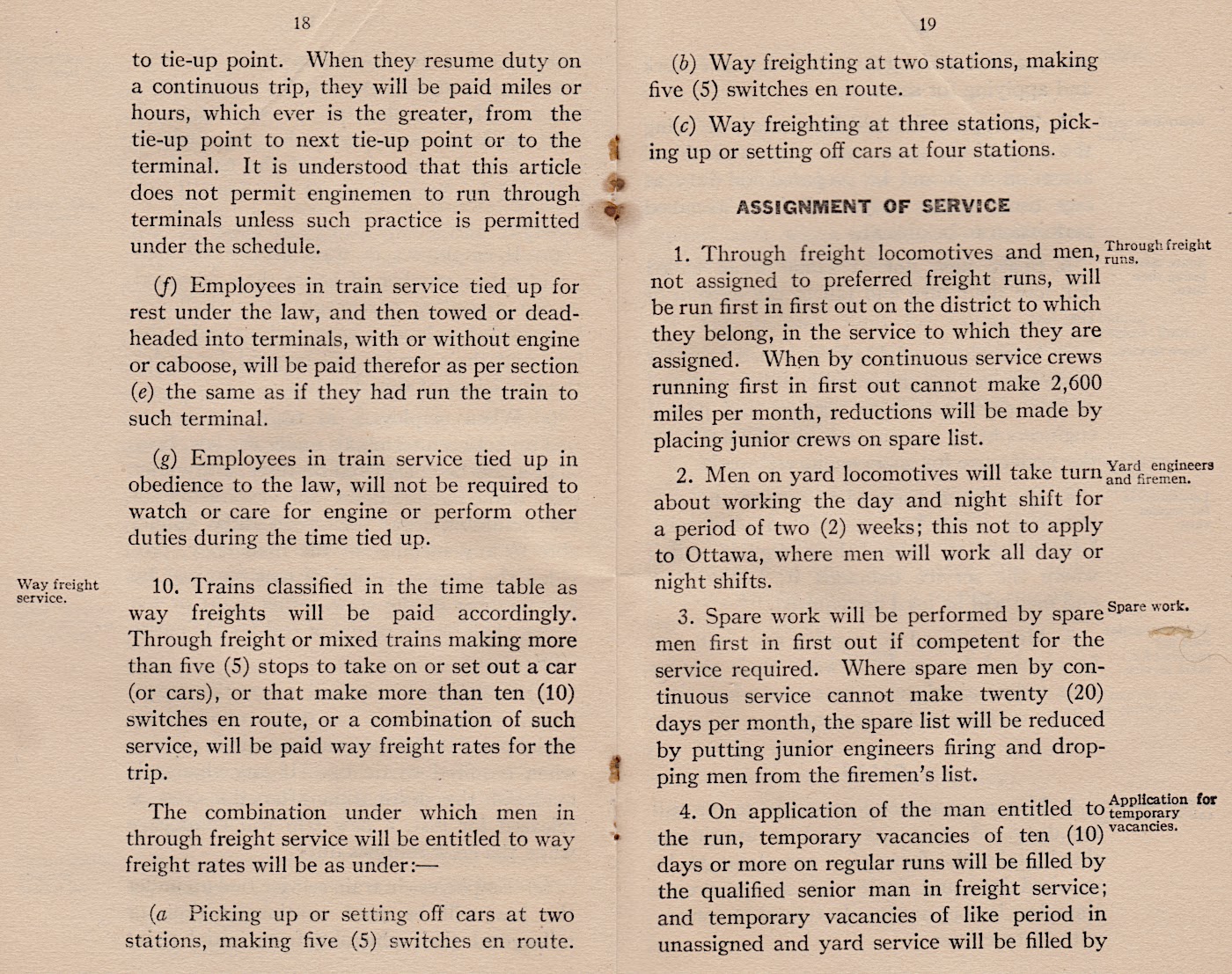
This interesting document describes the working conditions for wartime engine crews over a century ago. Unlike typical collective agreements, it is not issued over the signatures of representatives for both management and labour.
A note on the title page mentions the United States Railroad Administration. This is a bit of a mystery to me. The USRA was set up in 1917 to efficiently coordinate the war effort of the very numerous and geographically diverse American railroads.
... However, the wartime (in Canada: 1914-1918) Canadian labour agreements between the Grand Trunk and the BLE and BLF would have been negotiated through their pre-existing arrangements. It is possible that the GTR agreed to employ the American 'schedule' for the sake of ensuring labour peace. It was a tumultuous period in Canadian railway history.
A bit of historical background follows ...
The Brotherhood of Locomotive Engineers was founded in Detroit in 1863 and the Brotherhood of Locomotive Firemen began in 1873 in Port Jervis, New York. These fraternal organizations initially offered mutual life and disability insurance for members ... during a period when government social programs for workers did not exist.
With the BLE present in Canada in 1865, the next logical step was for it to begin negotiating better working conditions for its members.
In 1875, an economic depression was occurring and Grand Trunk Railway management implemented comprehensive cost cutting measures. It laid off over 600 employees and put in place significant cuts in pay. The BLE called a strike on 29 December 1876 which lasted for 4 days. The government of Prime Minister Alexander Mackenzie declined to intervene.
At this point, the BLE had the full attention of the Grand Trunk. Among other conditions required to call off the strike, the BLE proposed a two-tiered wage schedule for engineers ... with less-senior employees receiving lower pay. Presumably, this resulted in some preservation of pay levels for the more senior employees.
Why might the union have suggested a two-tiered pay structure? There was probably no arrangement for railway pensions in this era, so senior workers probably worked until they became disabled for continued employment, or died ... or they depended on their extended families, or their own life savings after their careers ended.
Unlike two-tiered pay scales advocated by corporations today ... which are intended to permanently eliminate the higher rate through senior worker attrition ... the union may have expected the lower paid workers would later regain the higher wage level after the economic slump had ended.
With the conclusion of the strike in 1877, the BLE had achieved the first union contract in Canada for railway workers. The BLF followed the BLE into Canada after this successful negotiation.
* * *
Forty years later ... With the Grand Trunk's absentee (UK-based) board of directors and its ill-fated Grant Trunk Pacific Railway expansion ... the stage was being set for it to default on its Government of Canada loans in 1919.
In Canada, this was happening during a period of significant labour discontent ... as the financial and social disruption of the Great War overshadowed the preservation or advancement of worker compensation and protections in Canada.
Of coincidental historical interest ... is the fact that the publication date is exactly one week before the beginning of Canada's famous Last Hundred Days offensive of the Great War.
* * *
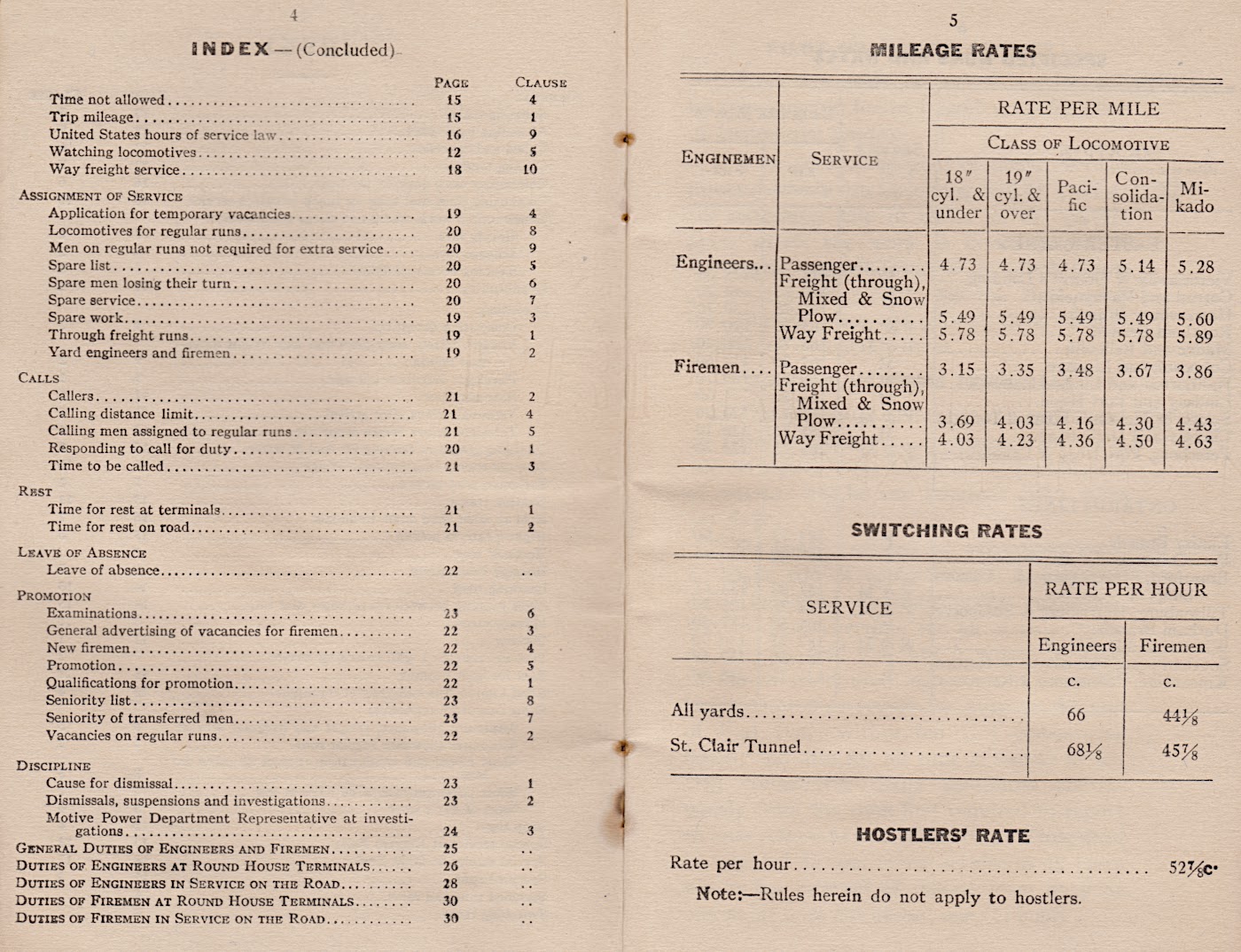
At $00.0549 cents per mile in 1918 ...
an engineer would be paid $1.0431 per mile in 2025 dollars.
... or $104.31 (mileage calculation only) for a standard 8 hour/100 mile day in 2025 dollars.
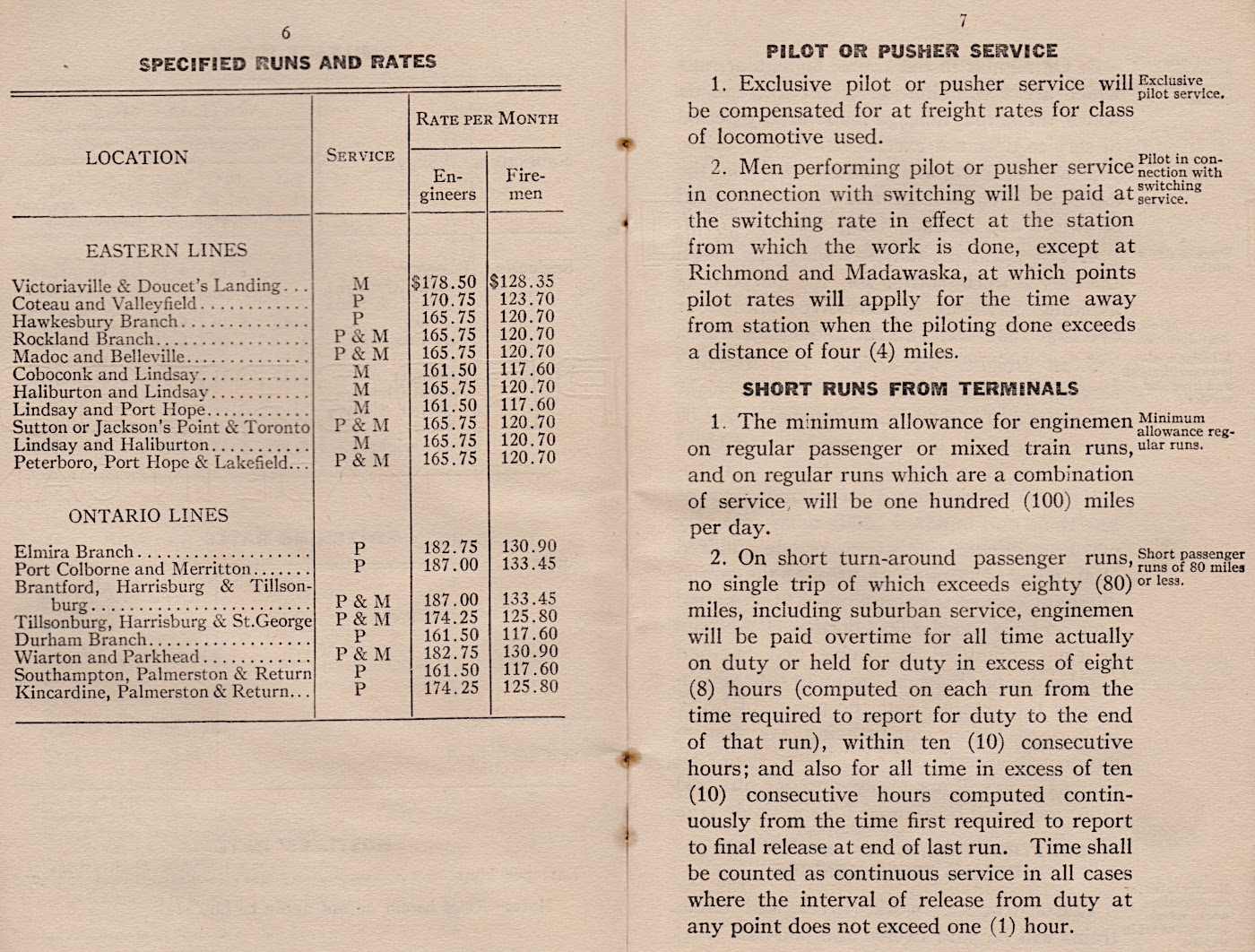
At the top rate of $187 per month in 1918, an engineer would earn ...
$3553 per month, or $42,636 per year in 2025 dollars.
I'm guessing that passenger and mixed service on these secondary lines
often involved slow running and a lot of stops and switching en route.
... Paying a monthly rate eliminated the many compensation calculations provided for in this booklet.
While minute-by-minute crew supervision would be easy for mainline trains ...
the monthly rate probably eliminated a lot of management time and energy watching employees
and/or later dealing with pay disputes
(eg. how many switching moves had been made at a remote location on a given date).
 |
| Unused, undated postcard. |
 |
| from: Railroad History, Autumn 1982; ed: Robert C Post; Railway & Historical Society. |
GTR engine 113 at Lewiston, Maine in 1912 ... on the line to Portland, Maine.
Built by Baldwin in 1912.
Later CNR 5043 (1923), scrapped 1961.
With a safety valve lifted, the fireman refills the tender.
 |
| from: Railroad History, Autumn 1982; ed: Robert C Post; Railway & Historical Society. |
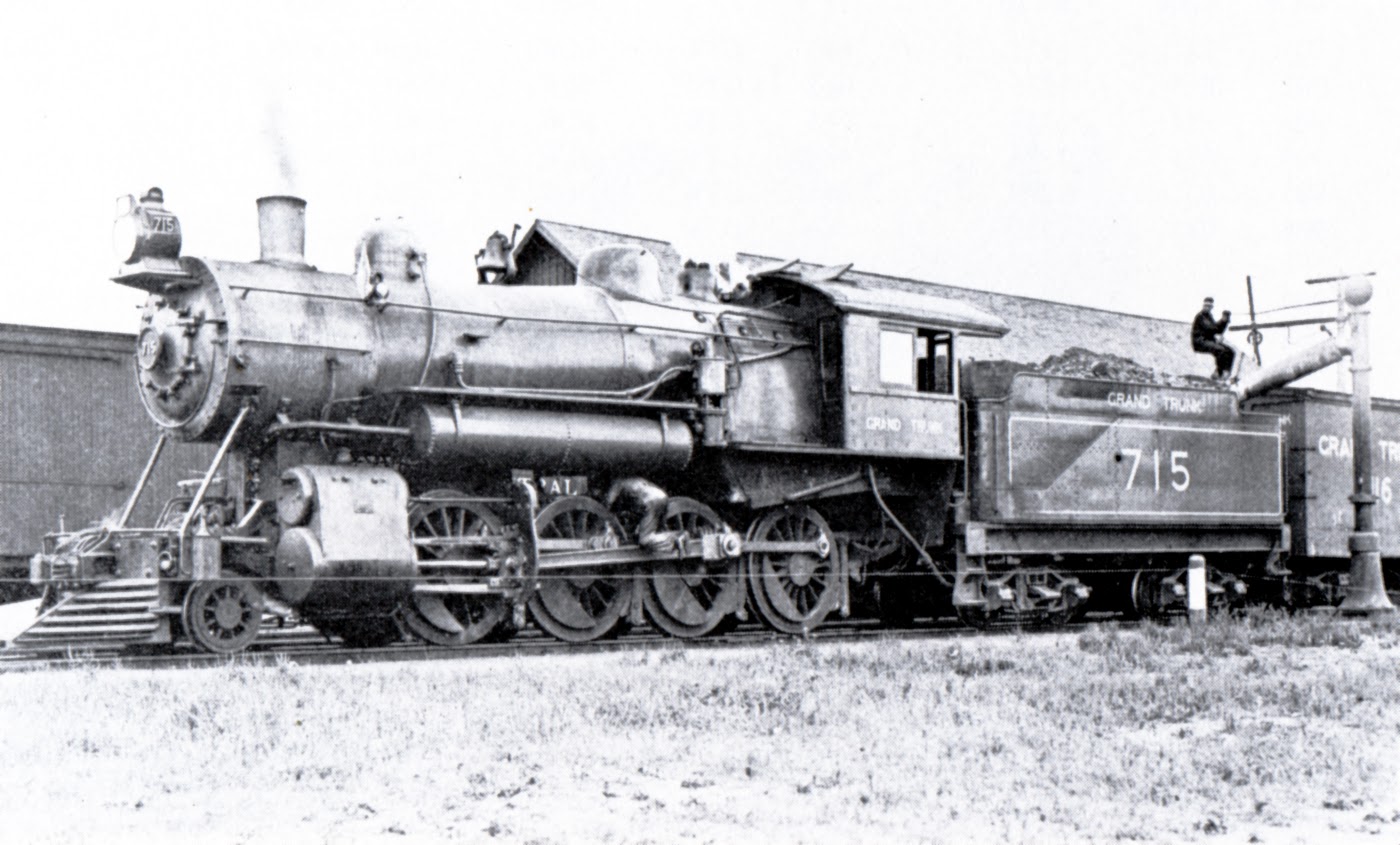
GTR engine 715 - date and location unknown.
Built by Alco in 1907.
Later CNR 2573 (1923), scrapped 1958.
The fireman refills the tender as the engineer inspects the running gear.
Both Engine 113 and Engine 715 seem to have non-electric headlights.
(extra work for the engineer ... Clause 17, below)
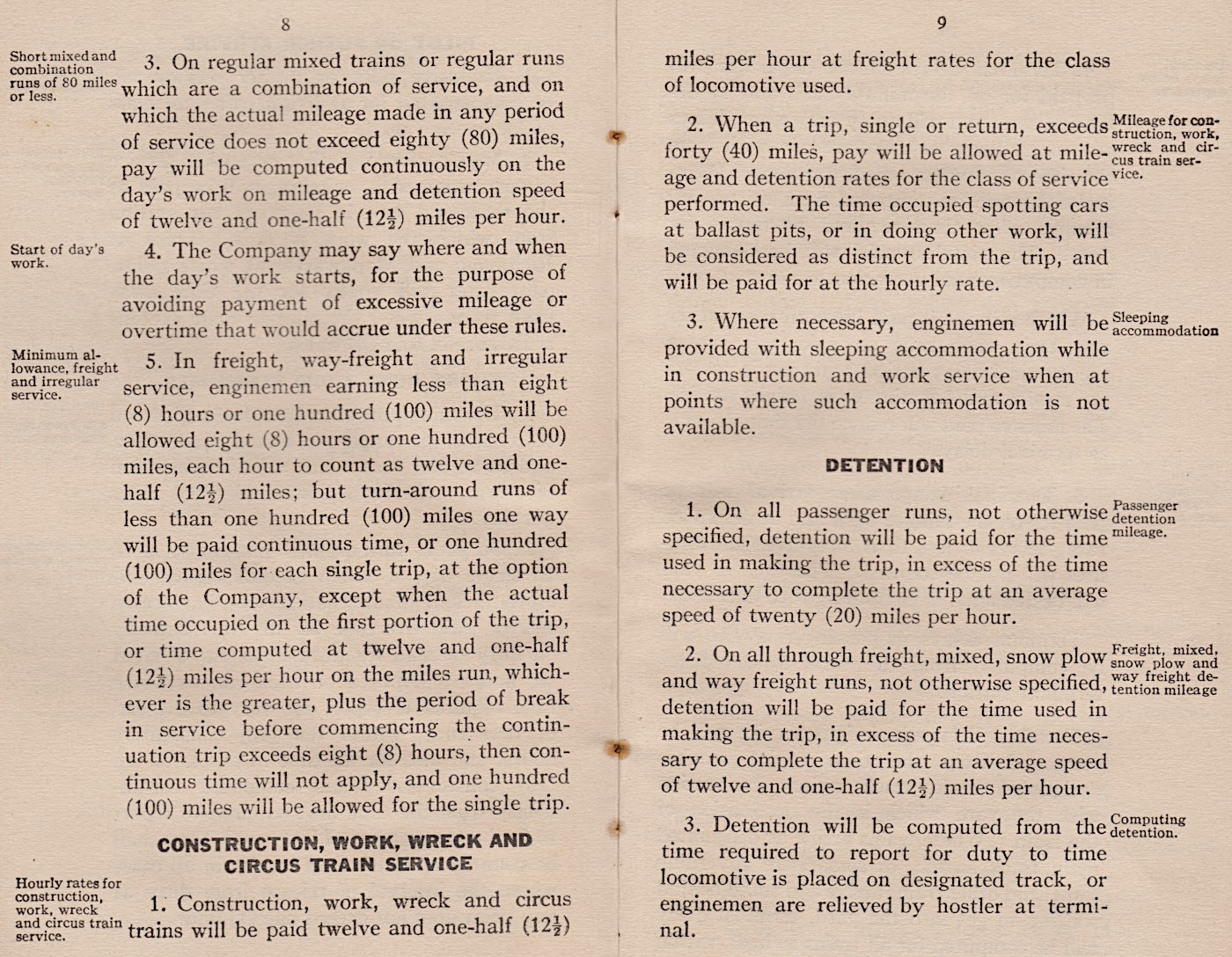
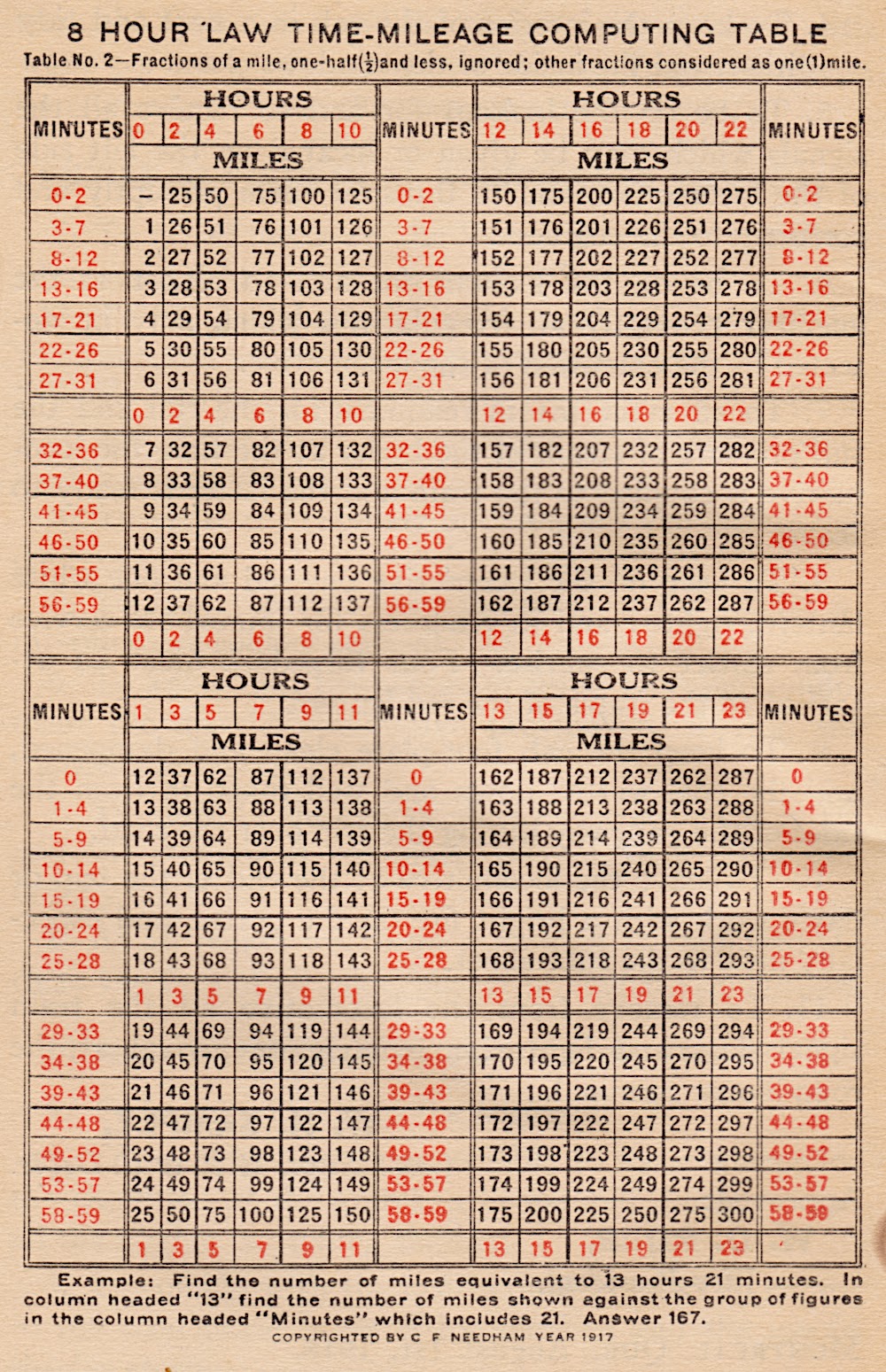
To make this table less intimidating, just remember that the 'standard day' is 8 hours = 100 miles.
Everything else flows from that basic equivalence.
 |
| from: Bulletin No 25, May 1931; ed: Charles E Fisher; Railway & Historical Society. |
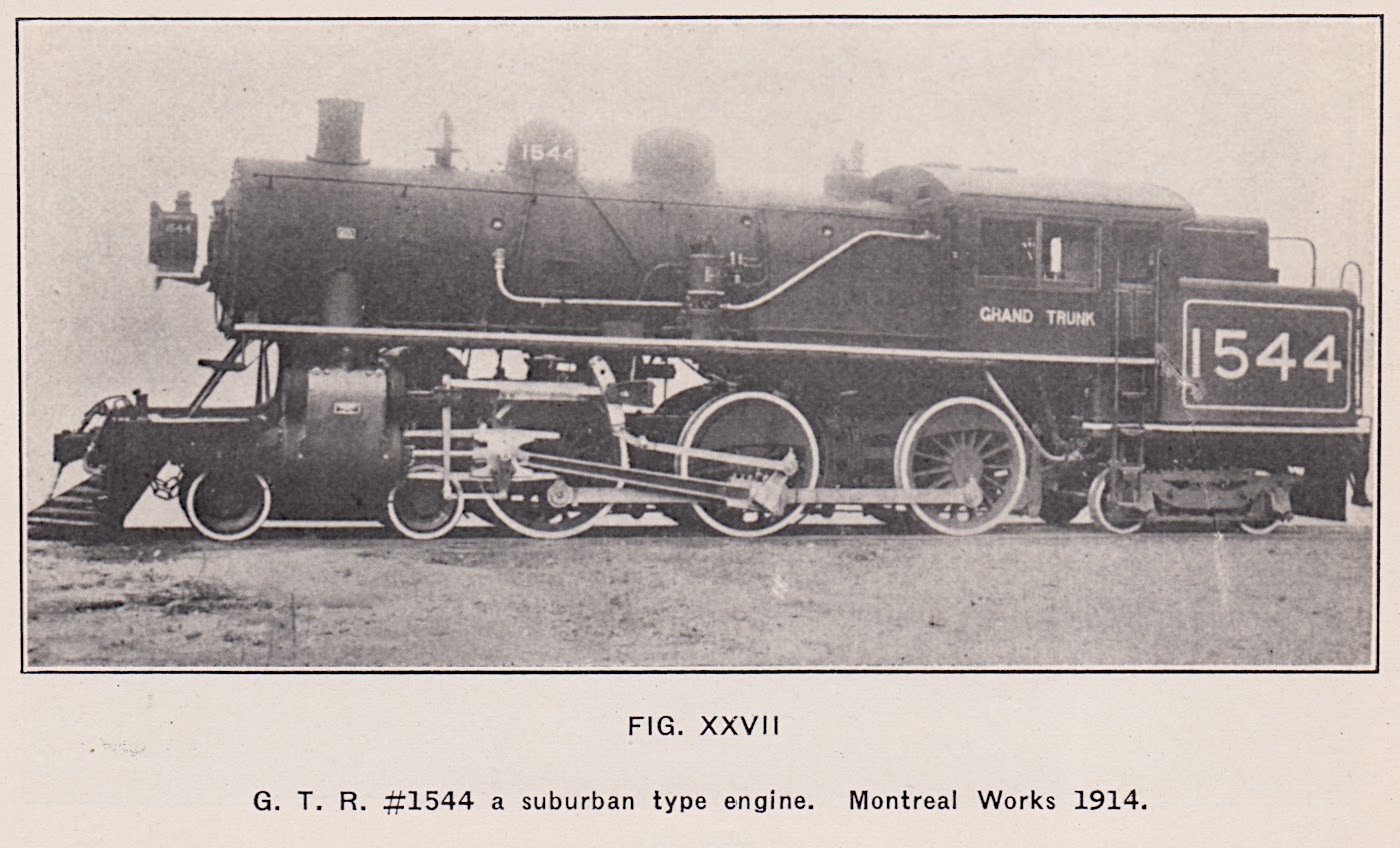
... later CNR 49.
Donated to the CRHA in 1960.