Showing posts with label journal box. Show all posts

23 August 2025

CPR 1965 One Spot Car Shop (Agincourt & Weston)

New computer-assisted hump yard complexes using mechanical retarders were sources of pride for Canadian railways in the 1950s and 1960s. 

Smaller humps, employing small armies of yardmen, to ride the cars and act as human retarders, had been used for decades in Canada. One of Adolf Hungry Wolf's books shows this type of operation at Fort William in 1952. And in one of the CPR textbooks prepared for employee self-study (Factors in Railway and Steamship Operation, 1937) their Winnipeg terminal is described as using a small hump during slack times ... and during peak times (I assume during the fall 'grain rush') they used 'hump riders' 'with the movement considerably accelerated'. 

Switching cars by 'kicking' them down sidings was a practice which probably began deep in the mists of railway history. In contrast to kicking, you can imagine that gently uncoupling cars at the top of a small hump and letting them roll away ... saved wear and tear on both the car draft gear, and on the engineer operating a steam-powered switch engine involved with kicking cars.

*  *  *

At the end of the steam age in Canada, circa 1960, the old technologies - such as 'plain bearings' (brasses within journal boxes holding car oil) and refrigerator cars using ice or heated with charcoal - were still in use. 

The industrial manufacturing techniques and metallurgy of the previous decades, and the tendency of railway technology to have a very long service life ... meant that good surveillance was required to spot mechanical defects on what were often 'legacy' railcar systems. Some of those cars had even survived the deferred maintenance of the Great Depression and the extreme service demands of World War Two.

Railway carmen were key to maintain the safety of railcar systems and to repair defects. 

When major switching operations were conducting on the consist of a through train at a terminal ... the rules in force in 1959 on the Canadian Pacific Railway (and the CNR, too) required a No 1 Test (Initial Terminal) to be conducted. A carman would check the piston travel and proper brake application on each car of the train.

Prior to this - for example on arrival - the cars would be checked for defects like cracked wheels, broken springs, and unsecured brake rigging. For cars without roller bearings, the journal oil on each car (8 locations) would be checked and/or topped up and the waste (the cotton holding and wicking the oil) was checked and repacked as necessary.

Operating crews conducting switching at the terminal might also spot car defects requiring attention. 

So with individual car inspections and routine car maintenance ... and outgoing train consist inspections ... and defect repair ... carmen had lots of work to keep them busy. 

Traditionally, most of this work was done outside at the Repair In Place tracks. Kneeling in the snow to attend to car truck components was a common pastime at major terminals ... and at points all across the railway.

Considering all of this, you can imagine the productivity and quality of work life benefits that came from the facilities described in the following short CPR Spanner article from 1965 ...


As most of us are conditioned to look at it first, I tried to ensure that the motive power in the photo below would be easy to identify. 

However, once I looked at the other rolling stock ... I think one could argue that ALL of the car types in the photo are obsolete today and would no longer be found on major Canadian railways.


If you long for the bygone days of 'plain bearings' with brasses,
here are a couple of earlier posts with images to explain the finer points
of their care and handling ...


17 April 2016

CPR 1943 - Instructions for the Care of Journal Boxes, Part 2


Gil Reid, 1918-2007 was a railroad artist who frequently produced illustrations
for Model Railroader and Trains.
from: Trains, October 1947; Kalmbach Publishing. Collection of LCGagnon
Above: A packing iron is used to check the journal box on a locomotive pilot truck.
The collar of the axle and the waste/oil lubricating system below can be seen.
The can carries oil in case a top-up is indicated.


Previously, parts of this booklet were posted here:


These instructions were published to deal with a crisis. During World War Two, the CPR was experiencing too many train delays because of hotboxes. 

Basic on-the-road procedures and journal packing instructions were covered in the earlier post. This final segment will look at some of the carmen's instructions - they were the skilled tradesmen who were responsible for the maintenance and repair of railcars at most terminals. As the unsung heroes of keeping the wheels safely turning ... it was they who were called out of town on short notice to assist the auxiliary crane and its crew at derailments and wrecks.


If you've read the first post on this subject, you'll know that a train crew could sometimes work on a hot bearing to enable it to travel to the next terminal where carmen could perform a permanent repair. This was advantageous because it was much less efficient to transport carmen out to some lonely siding to temporarily repair a car. It was preferable for train crew to spot the problem as early as possible, and to nurse the car along to the carmen and their fully-equiped shop.

Treating the overheating journal with special grease and tagging it for a carman's attention was previously described as a temporary fix for trainmen out on the road with a hot bearing.

By way of clarification, journal box packing is referred to as 'dope' ...


... Regarding 'Worn-in Bearings 39' above. Previously it was explained that a new bearing, sitting on a turning journal which had already been in service ... would not have the same cylindrical shape worn into it. 

With this 'flat' bearing firmly held on a round journal, there was an increased risk of a 'waste grab' ... that is, loose fibres from the packing could more easily find their way into the gap between the bearing and journal ... and become trapped at the point where the load was being borne ... causing a hot journal.

... so simply installing a new bearing with a pristine babbitt would be more likely to cause problems 'down the road'.

*  *  *

Next, the railway lays out the standardized procedures to be used when preparing, handling and recycling journal packing material and its constituent parts. The long-term health risks of constantly handling this material would have been undesirable.

As you can imagine with such a geographically large operation - there were thousands of cars moving at all times. Each car generally had eight journal boxes packed with oil-soaked cotton/wool 'waste'. When the value of all this material was added up by accountants at the Montreal headquarters, it constituted a large investment in petroleum and fabric - which was too expensive to throw out after a single use. As well, with a war on, petroleum, cotton and wool were strategically important materials which could not be wasted. 
(Historically, Hitler's failure to manufacture, to stockpile, and to maintain supply lines adequate to provide his eastern troops with winter clothing and fuel guaranteed the failure of his invasion of the USSR before it even began in 1941)
A CPR bean-counting form follows so you can see the extent to which the company wanted to know what was happening with its 'dope'.

On a lighter note ... at the very end, we will discover the first step of 'how to start a steam locomotive'. 


08 April 2016

CPR 1943 - Instructions for the Care of Journal Boxes

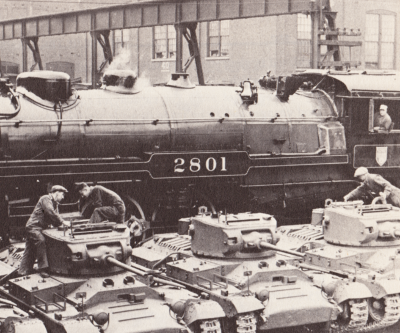
Valentine Tanks at Angus
from: History of the Canadian Pacific Railway;
W Kaye Lamb; 1977; Macmillan.

Tribute to an Artifact

Today's old railway paper artifacts were often used by employees, in the filthy urban corridors, which had cultured themselves along the first pair of rolled iron or steel rails connecting Canadian towns and cities ...

Steam motive power rained lubricating oil and coal cinders from above, while passengers' toilets misted below. Everything from grain chaff, to cattle manure and bedding, to journal oil and coal dust fell down from somewhere in between ... onto the 20th Century substrate of smelter slag and creosote below.

If a company booklet survived in someone's overalls or grip for a year or more, the particular contaminants from that little ecosystem would be absorbed by the paper fibres as well.

Then, in the bottom of a box, in the lowest level of a house, where condensation and fugitive water from defective plumbing or a leaky foundation would accumulate ... a younger generation might find 'some old train books which might be worth something'. 

The fragrant boxful would be sold to a dealer as a lot. The dealer would price each artifact and package it in plastic to seal in its historical goodness.

When you are buying ... this is a book which you prefer to judge by its cover.

*  *  *

Whether they are worthless or priceless, it's probably good to distribute, via the internet, elements of these venerable items because some must be relatively uncommon in libraries today.


When this booklet was issued, the Soviets were grinding down Hitler's armies as their long, grim westward advance was underway. The 'second front' for which Stalin had been begging was being planned by Churchill and Roosevelt. The British and American air forces were getting the hang of bombing Germany by night and day, respectively. The U-boats were beginning to lose the Battle of the Atlantic. In the Pacific, Americans were learning how to 'island hop' - landing on one murderous beach after another. 

Millions of people had already died.

At this point, Canada was particularly important as an exporting country as our agricultural and mineral products were in great demand. These bulk commodities travelled by rail and ship. Railway shops and their employees were diverted into war service to manufacture products such as tanks and guns - with the hope that all this concentrated effort and sacrifice would reach Europe - rather than the bottom of the Atlantic.

Some experienced railway workers had already volunteered for overseas military service ... just try and stop them. The normal quality and quantity of supplies for railway operations were affected by wartime's competing demands. Freight and passenger traffic volumes had blown the Y-axis off those graphed during the Great Depression, exposing a wide assortment of railway system deficits to be overcome. In 1938, the CPR 'revenue freight hauled' statistic was 12.1 billion ton-miles ... in 1943 this had grown to 24.9 billion ton-miles.


The CPR issued this special 30 page booklet so these deficits wouldn't get worse.


Predictably, some of the booklet is very technical, very concerned about which railway company will be billed for what, and prescriptive on how data will be submitted on which forms. We'll leave those joyless details for any surviving railway corporate historians to interpret for their Boards.

While none of us will ever develop into World War Two-era CPR operating employees by reading this, the booklet does give us some idea of how easily-created and how disruptive hotboxes could be. As background, an earlier post looked at what goes where in a journal box ...


If you consider:
  • There might 30 to 100 cars per train, 
  • With 8 journal boxes per car,
... then a freight train had 240 to 800 individual journal 'oil film generating systems' which could fail and cause an overheated journal.

And if you accept the idea there were at least ten types of system faults which could interfere with that thin uniform layer of oil between the bearing and the journal ... there were roughly 2400 to 8000 possible sources of 'oil film failure' just waiting to cause a hotbox and to delay a train ... as the van gently rocked its way over the last yard switch and the train's journey began.

*  *  *

Passenger trains - which were generally allowed to travel at higher speeds than freights - faced their own consequences from a hotbox ...

A sudden, undetected journal oil film failure could result in a shocking outcome.

from 1943:

St Petersburg Times; September 8, 1943.


*  *  *

Back to CPR's 1943 booklet ...

This figure is rotated and reproduced from below.


Instead of using a standard manufactured fabric component to continuously apply oil from the oil cellar to the journal, pieces of 'waste' were used as packing. This cotton waste was also later cleaned and recycled. 
The booklet later states (not included in this post): 
'War conditions have necessitated the modification of the requirements of this specification so that at present, the new waste being supplied consists of approximately 35% wool and 65% cotton.'
... Wool fibres had a greater tendency to stick to the journals and to enter the load area between journal and bearing.  


10. 'the box is to be repacked immediately' ... see Page 9, above, Item 10 (a) (b) ... imagine this job in the worst Canadian winter weather and/or at night.

15. Inspection time ... 'two men, one minute per car' ... would be one journal box inspected every 15 seconds for you students of Taylorism.


To set a cat amongst CPR's beleaguered wartime pigeons, a more recent authoritative source states:
'The term "waste grab" often leads to wrong conclusions because the word "grab" indicates to many a considerable volume of waste, while in reality, most hot boxes, except in cold weather, are caused by grabs where the volume of waste is not readily observable.' (my emphasis)

The Jelly Roll packing from Page 14, above.


Journal box care was central to the 'human experience' of 1940s railroading.

24 March 2016

Hotbox!


This post looks at how a typical boxcar, during the first century or so of North American railways, carried over 40 tons of weight on the 8 outer ends of its axles. The post is intended to provide background for a subsequent post on the CPR's booklet of instructions to carmen and running trades employees, issued during World War Two.


Below are two simplified wheelsets. The axle stubs protruding through the wheels are known as 'journals' - to be more specific, the journals are the turning surfaces which actually bear weight.

The journal, the metal bearing resting on it, a lubrication system, and other bits are housed in a 'journal box'. An overheating journal/bearing set was generally known as a 'hotbox'.

from: Freight Car Repairs; 1985; Canadian National Railways.

After 1963, permanently sealed and lubricated roller bearing systems replaced 'plain bearings' on new cars manufactured for interchange between railroads in order to meet AAR standards. I saw some plain bearing ballast/slag/ore cars used only for company service which survived into the 1990s on the CNR.
Notice that as technology progresses, a more descriptive name must be created for the original version to differentiate it from recent inventions. For example, what was once known as 'a telephone' is currently 'a landline phone' because newer technologies can now be used to transmit two-way voice communication. 
I doubt that Isaac Babbitt (1799-1862) et al said: 
Let's design a "plain bearing" now, because in the future I want to invent a "fancy bearing"!
*  *  *

from: Freight Car Repairs; 1985; Canadian National Railways.

Here is a photo of a burnt-off journal. This could occur if a 'hotbox' was not seen (or heard, or smelled) in time by crew members watching their relatively short train from the headend and tailend. While a hot, smoking bearing might be easy to sense on a summer day with the caboose windows open ... it would generally be harder to detect at night during a raging blizzard.

Considering the example above, this is what could go wrong after a failure: Instead of the journal carrying part of the car's weight, that weight will be dragging directly on the track structure. If the truck assembly breaks down further and/or if the dragging equipment hits an object such as crossing timbers or a switch - a derailment would be likely to occur.

*  *  *

from: The Model Railroader Cyclopedia, Sixth Edition; AC Kalmbach; 1950; Kalmbach Publishing.
Above, the top truck is generally referred to as an 'archbar truck' today - for obvious reasons. It was manufactured by bolting together mainly forged or rolled parts. But in railroad service, some of these bolted bits might eventually work loose and the truck might disintegrate, causing a derailment. 

Circa 1900, William P Bettendorf (1857-1910) invented the single-casting truck side frame (above) which literally bears his name.

*  *  *

from: Freight Car Repairs; 1985; Canadian National Railways.
If you have visited a railway museum where they offer novelty rides on small unsprung maintenance of way trailers pulled by a track speeder ... you will know first-hand how utterly harsh and bone-jarring steel wheels on steel rails are. If only to help protect the freight, the carbody and the track structure, it really makes sense to have some kind of shock absorbing system between the load and the rails.

On the diagram above, the weight of the boxcar body and its load rests on the centre plate (1) which is part of that truck bolster (7) which spans the two truck side frames. Going around curves or on uneven track, the body may tilt a little and place some weight on one or both of the two side bearings (6).

The truck bolster rests on sets of springs (2). This is the end of the cushy 'sprung' part of the boxcar ...

The truck side frames (3) - such as those which were invented by William Bettendorf - hold the bottoms of the springs. The side frame eventually transfers the weight to a bearing which sits on the journal. So it's solid metal on metal from the bottom of the springs to the rail. 

*  *  *

from: Freight Car Repairs; 1985; Canadian National Railways.
The diagram above looks at the end of a cutaway journal box as seen from the side of the track.

The black perimeter represents the cast truck side frame. 

Working down from the top, you have: 
  • the wedge (an inverted 'U' shape)
  • the bearing and its babbitt lining, 
  • a thin layer of oil (4), 
  • the journal (round - 3) and 
  • the lubricator or packing or 'waste' ... partially submerged in oil (1).

In 1839, Isaac Babbitt began inventing alloys which could be used to line bearings to make them more efficient. Our bearing itself is cast out of brass - sometimes railway bearings are referred to as 'brasses'. On a microscopic level, the 'babbitt' lining the bearing is an alloy of hard metal crystals held within a softer metal. The soft metal wears away a little but the hard crystals stay put and bear the load.

*  *  *

Babbitts in the Movies

The Train; 1964; John Frankenheimer; United Artists.
This movie illuminates so many aspects of railway technology, processes and physics that it should be owned by all. The roughness and simplicity in this sequence helps show why railways embraced the practical advantages of babbitt lined brasses for decades. (But we should acknowledge that the movie makes it look a lot easier than it probably was)

... After a locomotive lubricator is sabotaged to foil the Nazis, its bearings must be repaired by casting new babbitts onto them. Above, Burt Lancaster (doing his own stunts in the movie) ladles the molten babbitt alloy into a mould set around 'the brass' to be repaired. You can see some of the 'white metal' flowing out of the form at the lower right corner as it purges air from the mould.


The Train; 1964; John Frankenheimer; United Artists.
The mould and wedges are knocked off the hot casting. You can see an example of the finished product fitted into the locomotive siderod in the background. In the foreground is the brass with its new lining and flash which must be knocked and filed off. At the right, the metal block which looks like a food can was the part of the form which was used to cast the journal shape into the babbitt in the mould.


The Train; 1964; John Frankenheimer; United Artists.
Finally, the half-bearing is fitted into the siderod, the quality of the fit is checked by feel, and any remaining grit is removed by hand.
This is a 360 degree siderod bearing/babbitt, while our freight car brasses just sit on top of a journal.


*  *  *

... Getting back to the freight car journal box ...

from: Freight Car Repairs; 1985; Canadian National Railways.
The turning journal picks up a coating of oil from the lubricator fabric in the journal (oil) well. The oil reduces the friction on those hard-working hard crystals in the babbitt alloy - the oil travels among the crystals via the little spaces where the soft babbitt metal wore away. The oil carries away some of the heat produced at the point where the babbitt and journal rub against each other.

*  *  *


from: The Science of Railways, Cars; Marshall M Kirkman; 1908; The World Railway Publishing Co.
Above, right, is the journal box as seen from the front with the wedge and bearing - similar to the diagram showing the packing and oil seen previously.

Above, left, is a cross-section of a journal box - along the axle centre.The journal box door is to the left. The journal area is clearly seen. Sitting on the journal is the bearing. Between the bearing and the top of the journal box is the wedge. At the left end of the axle its 'collar' prevents the bearing from sliding off the journal toward the journal box door.

Notice that the axle makes no contact with the back of the journal box where it enters - above and below the 2 1/2" notation.

This rear seal area was a classic problem area for journal boxes in regular service, as oil would be lost out the back and splatter onto the wheel, while dirt and grit would enter the journal through the defective rear seal in exchange ... But there must have been reasons for this looseness, don't you think?

Just considering our narrow focus on the bearing ...

If a jack were placed under the journal box (remember it is part of the truck side frame), it would take the car weight off this wedge and bearing. Using a tool (for safety in case the jack slipped) ... the wedge and then the bearing could be removed.

If a car bearing was poorly lubricated and/or worn down and overheating on a train, in some cases, the simplicity of the plain bearing system enabled an operating crew to remove the defective bearing and replace it with a new one. The caboose carried these supplies and 'car oil' too.

*  *  *

from: Kettle Valley Line, Trains and Travel Magazine; article/photo: W Gibson Kennedy; October 1951. Collection of LCGagnon.
Photo caption:

"No 3609 pulls out of Carmi with two flat cars of road-building equipment, a tank car, and a caboose. The crew had discovered a hotbox on one of the flat cars, jacked up the truck and changed the brass with only 15 minutes' delay."