Showing posts with label carman. Show all posts

05 September 2025

1940 Car Inspection Manual - Air Brake Inspection Rules

As I was posting the CPR article from 1965 about the One Spot Car Shop at Agincourt Yard, I came upon this handy 5 by 7 inch book again.


The book was owned by an employee of the CNR carshops at London, Ontario. It was published by the Brotherhood of Railway Carmen of America in 1940 and this is a 1954 reprint.

Considering the multiple publications of company rules produced for employees by US railroads, and publications from organizations such as the Association of American Railroads, it was the author's intention to bring as much information as possible on car inspection into a single publication. As a matter of course, he suggests that in the case of a disagreement with this book, the official publication should be followed. 

You may recognize the author, as Simmons-Boardman published a number of books of CM Drennan's Chalk Talks. These were grouped by broad air brake subject into books, and printed in a 'white on black' format to suggest how a chalkboard diagram of a brake system could be set up for an instruction class.

The first section I have reproduced is a helpful compilation of AAR rules pertaining to terminal tests, inspections of air brakes, and other related items.


Early in life, I was told that the engineer of the leading engine (in a steam motive power consist) handled the whistling and controlled the brakes. 

The trailing units in diesel consists 'in a standard MU configuration' would contribute the output of their powerful compressors to the charging of a trainline.

Rule 22 (above): ... But I had never thought of the arrangement when multiple steam locomotives operated together - from the standpoint of the air compressors. I think that the steam-driven air compressors were probably regulated by a relatively simple high pressure steam valve (resembling an outdoor garden hose valve). I just had never thought of this arrangement on the trailing locomotives before reading this passage.

*  *  *

Air Brake History

While I've gone through Drennan's Chalk Talks on K (older) and AB brakes, I didn't remember the particular names of the last two types and I didn't want to take the time to pull out and leaf through the Chalk Talks.

My first AI search of them led to a diplomatic suggestion that these types may have been 'misremembered' as they were not found in any 'old catalogue', etc. However, a day later, the AI seemed to have a nodding acquaintance with them. On the second try, I just submitted the brake system name.

There are probably few areas of railway industrial history as rich in detail as the design characteristics and operating features of various air brake systems. One needs a plan to stop a train before one sets it in motion. The operation of longer and longer trains was made possible through the advances in air brake technology because the momentum of trains must be kept under control at all times without harsh run-ins of slack.

In CTC territory, the dispatcher's suddenly revealed intention to stop a train at a particular location, over a path of approach with challenging grade characteristics, often required careful planning by the engineer ... and the expectation that the train's air brake system would respond in a reasonably predictable fashion. 

With a timetable and train order system, an extra train's crew 'helping themselves over the subdivision' added the challenge of clearing other trains by a certain time ... to the stress of the engineer's hopeful expectations regarding the functioning of his air brake system on a given day.

... So there are many fascinating stories lost to history about engineers' experiences working with different locomotives and their brake systems, handling a wide variety of train consists, on a wide variety of subdivision profiles, under various traffic control systems, in all sorts of weather conditions.


*  *  *


*  *  *


*  *  *


*  *  *


end

23 August 2025

CPR 1965 One Spot Car Shop (Agincourt & Weston)

New computer-assisted hump yard complexes using mechanical retarders were sources of pride for Canadian railways in the 1950s and 1960s. 

Smaller humps, employing small armies of yardmen, to ride the cars and act as human retarders, had been used for decades in Canada. One of Adolf Hungry Wolf's books shows this type of operation at Fort William in 1952. And in one of the CPR textbooks prepared for employee self-study (Factors in Railway and Steamship Operation, 1937) their Winnipeg terminal is described as using a small hump during slack times ... and during peak times (I assume during the fall 'grain rush') they used 'hump riders' 'with the movement considerably accelerated'. 

Switching cars by 'kicking' them down sidings was a practice which probably began deep in the mists of railway history. In contrast to kicking, you can imagine that gently uncoupling cars at the top of a small hump and letting them roll away ... saved wear and tear on both the car draft gear, and on the engineer operating a steam-powered switch engine involved with kicking cars.

*  *  *

At the end of the steam age in Canada, circa 1960, the old technologies - such as 'plain bearings' (brasses within journal boxes holding car oil) and refrigerator cars using ice or heated with charcoal - were still in use. 

The industrial manufacturing techniques and metallurgy of the previous decades, and the tendency of railway technology to have a very long service life ... meant that good surveillance was required to spot mechanical defects on what were often 'legacy' railcar systems. Some of those cars had even survived the deferred maintenance of the Great Depression and the extreme service demands of World War Two.

Railway carmen were key to maintain the safety of railcar systems and to repair defects. 

When major switching operations were conducting on the consist of a through train at a terminal ... the rules in force in 1959 on the Canadian Pacific Railway (and the CNR, too) required a No 1 Test (Initial Terminal) to be conducted. A carman would check the piston travel and proper brake application on each car of the train.

Prior to this - for example on arrival - the cars would be checked for defects like cracked wheels, broken springs, and unsecured brake rigging. For cars without roller bearings, the journal oil on each car (8 locations) would be checked and/or topped up and the waste (the cotton holding and wicking the oil) was checked and repacked as necessary.

Operating crews conducting switching at the terminal might also spot car defects requiring attention. 

So with individual car inspections and routine car maintenance ... and outgoing train consist inspections ... and defect repair ... carmen had lots of work to keep them busy. 

Traditionally, most of this work was done outside at the Repair In Place tracks. Kneeling in the snow to attend to car truck components was a common pastime at major terminals ... and at points all across the railway.

Considering all of this, you can imagine the productivity and quality of work life benefits that came from the facilities described in the following short CPR Spanner article from 1965 ...


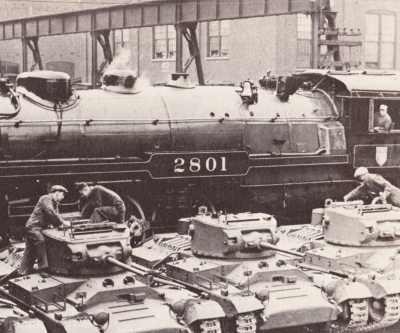
As most of us are conditioned to look at it first, I tried to ensure that the motive power in the photo below would be easy to identify. 

However, once I looked at the other rolling stock ... I think one could argue that ALL of the car types in the photo are obsolete today and would no longer be found on major Canadian railways.


If you long for the bygone days of 'plain bearings' with brasses,
here are a couple of earlier posts with images to explain the finer points
of their care and handling ...


17 April 2016

CPR 1943 - Instructions for the Care of Journal Boxes, Part 2


Gil Reid, 1918-2007 was a railroad artist who frequently produced illustrations
for Model Railroader and Trains.
from: Trains, October 1947; Kalmbach Publishing. Collection of LCGagnon
Above: A packing iron is used to check the journal box on a locomotive pilot truck.
The collar of the axle and the waste/oil lubricating system below can be seen.
The can carries oil in case a top-up is indicated.


Previously, parts of this booklet were posted here:


These instructions were published to deal with a crisis. During World War Two, the CPR was experiencing too many train delays because of hotboxes. 

Basic on-the-road procedures and journal packing instructions were covered in the earlier post. This final segment will look at some of the carmen's instructions - they were the skilled tradesmen who were responsible for the maintenance and repair of railcars at most terminals. As the unsung heroes of keeping the wheels safely turning ... it was they who were called out of town on short notice to assist the auxiliary crane and its crew at derailments and wrecks.


If you've read the first post on this subject, you'll know that a train crew could sometimes work on a hot bearing to enable it to travel to the next terminal where carmen could perform a permanent repair. This was advantageous because it was much less efficient to transport carmen out to some lonely siding to temporarily repair a car. It was preferable for train crew to spot the problem as early as possible, and to nurse the car along to the carmen and their fully-equiped shop.

Treating the overheating journal with special grease and tagging it for a carman's attention was previously described as a temporary fix for trainmen out on the road with a hot bearing.

By way of clarification, journal box packing is referred to as 'dope' ...


... Regarding 'Worn-in Bearings 39' above. Previously it was explained that a new bearing, sitting on a turning journal which had already been in service ... would not have the same cylindrical shape worn into it. 

With this 'flat' bearing firmly held on a round journal, there was an increased risk of a 'waste grab' ... that is, loose fibres from the packing could more easily find their way into the gap between the bearing and journal ... and become trapped at the point where the load was being borne ... causing a hot journal.

... so simply installing a new bearing with a pristine babbitt would be more likely to cause problems 'down the road'.

*  *  *

Next, the railway lays out the standardized procedures to be used when preparing, handling and recycling journal packing material and its constituent parts. The long-term health risks of constantly handling this material would have been undesirable.

As you can imagine with such a geographically large operation - there were thousands of cars moving at all times. Each car generally had eight journal boxes packed with oil-soaked cotton/wool 'waste'. When the value of all this material was added up by accountants at the Montreal headquarters, it constituted a large investment in petroleum and fabric - which was too expensive to throw out after a single use. As well, with a war on, petroleum, cotton and wool were strategically important materials which could not be wasted. 
(Historically, Hitler's failure to manufacture, to stockpile, and to maintain supply lines adequate to provide his eastern troops with winter clothing and fuel guaranteed the failure of his invasion of the USSR before it even began in 1941)
A CPR bean-counting form follows so you can see the extent to which the company wanted to know what was happening with its 'dope'.

On a lighter note ... at the very end, we will discover the first step of 'how to start a steam locomotive'. 


08 April 2016

CPR 1943 - Instructions for the Care of Journal Boxes

Valentine Tanks at Angus
from: History of the Canadian Pacific Railway;
W Kaye Lamb; 1977; Macmillan.

Tribute to an Artifact

Today's old railway paper artifacts were often used by employees, in the filthy urban corridors, which had cultured themselves along the first pair of rolled iron or steel rails connecting Canadian towns and cities ...

Steam motive power rained lubricating oil and coal cinders from above, while passengers' toilets misted below. Everything from grain chaff, to cattle manure and bedding, to journal oil and coal dust fell down from somewhere in between ... onto the 20th Century substrate of smelter slag and creosote below.

If a company booklet survived in someone's overalls or grip for a year or more, the particular contaminants from that little ecosystem would be absorbed by the paper fibres as well.

Then, in the bottom of a box, in the lowest level of a house, where condensation and fugitive water from defective plumbing or a leaky foundation would accumulate ... a younger generation might find 'some old train books which might be worth something'. 

The fragrant boxful would be sold to a dealer as a lot. The dealer would price each artifact and package it in plastic to seal in its historical goodness.

When you are buying ... this is a book which you prefer to judge by its cover.

*  *  *

Whether they are worthless or priceless, it's probably good to distribute, via the internet, elements of these venerable items because some must be relatively uncommon in libraries today.


When this booklet was issued, the Soviets were grinding down Hitler's armies as their long, grim westward advance was underway. The 'second front' for which Stalin had been begging was being planned by Churchill and Roosevelt. The British and American air forces were getting the hang of bombing Germany by night and day, respectively. The U-boats were beginning to lose the Battle of the Atlantic. In the Pacific, Americans were learning how to 'island hop' - landing on one murderous beach after another. 

Millions of people had already died.

At this point, Canada was particularly important as an exporting country as our agricultural and mineral products were in great demand. These bulk commodities travelled by rail and ship. Railway shops and their employees were diverted into war service to manufacture products such as tanks and guns - with the hope that all this concentrated effort and sacrifice would reach Europe - rather than the bottom of the Atlantic.

Some experienced railway workers had already volunteered for overseas military service ... just try and stop them. The normal quality and quantity of supplies for railway operations were affected by wartime's competing demands. Freight and passenger traffic volumes had blown the Y-axis off those graphed during the Great Depression, exposing a wide assortment of railway system deficits to be overcome. In 1938, the CPR 'revenue freight hauled' statistic was 12.1 billion ton-miles ... in 1943 this had grown to 24.9 billion ton-miles.


The CPR issued this special 30 page booklet so these deficits wouldn't get worse.


Predictably, some of the booklet is very technical, very concerned about which railway company will be billed for what, and prescriptive on how data will be submitted on which forms. We'll leave those joyless details for any surviving railway corporate historians to interpret for their Boards.

While none of us will ever develop into World War Two-era CPR operating employees by reading this, the booklet does give us some idea of how easily-created and how disruptive hotboxes could be. As background, an earlier post looked at what goes where in a journal box ...


If you consider:
  • There might 30 to 100 cars per train, 
  • With 8 journal boxes per car,
... then a freight train had 240 to 800 individual journal 'oil film generating systems' which could fail and cause an overheated journal.

And if you accept the idea there were at least ten types of system faults which could interfere with that thin uniform layer of oil between the bearing and the journal ... there were roughly 2400 to 8000 possible sources of 'oil film failure' just waiting to cause a hotbox and to delay a train ... as the van gently rocked its way over the last yard switch and the train's journey began.

*  *  *

Passenger trains - which were generally allowed to travel at higher speeds than freights - faced their own consequences from a hotbox ...

A sudden, undetected journal oil film failure could result in a shocking outcome.

from 1943:

St Petersburg Times; September 8, 1943.


*  *  *

Back to CPR's 1943 booklet ...

This figure is rotated and reproduced from below.


Instead of using a standard manufactured fabric component to continuously apply oil from the oil cellar to the journal, pieces of 'waste' were used as packing. This cotton waste was also later cleaned and recycled. 
The booklet later states (not included in this post): 
'War conditions have necessitated the modification of the requirements of this specification so that at present, the new waste being supplied consists of approximately 35% wool and 65% cotton.'
... Wool fibres had a greater tendency to stick to the journals and to enter the load area between journal and bearing.  


10. 'the box is to be repacked immediately' ... see Page 9, above, Item 10 (a) (b) ... imagine this job in the worst Canadian winter weather and/or at night.

15. Inspection time ... 'two men, one minute per car' ... would be one journal box inspected every 15 seconds for you students of Taylorism.


To set a cat amongst CPR's beleaguered wartime pigeons, a more recent authoritative source states:
'The term "waste grab" often leads to wrong conclusions because the word "grab" indicates to many a considerable volume of waste, while in reality, most hot boxes, except in cold weather, are caused by grabs where the volume of waste is not readily observable.' (my emphasis)

The Jelly Roll packing from Page 14, above.


Journal box care was central to the 'human experience' of 1940s railroading.