Showing posts with label dieselization. Show all posts

10 November 2016

CLC Freight Locomotives - H16-44 H12-44, CNR Operating Manual 1966.


This long posting will complete the Canadian Locomotive Company product section
 of the consolidated CNR engineer operating manual of 1966.

Whether you see it as 'variety' or a 'lack of standarization' - this section of the manual is necessarily long to cover smaller freight (or dual purpose - some had steam generators) locomotives with B-B and A-1-A trucks; 1200hp and 1600hp prime movers; and Westinghouse, Fairbanks-Morse or General Electric electrical gear. For all this variety, fewer than 80 CNR locomotives are represented below.

The retro-popular H24-66 model - the Trainmaster - of which the CNR owned one, does not appear in this manual. The sole CNR copy was originally numbered 2900 in 1955 and left the CNR roster as 3000 in 1966. 


When it selected first-generation diesels, we can guess that the government-owned CNR had to show an interest in all the various Canadian manufacturers of locomotives - to spread the work around. As well, during dieselization, there may have been a benefit in trying a variety of models to see which worked best in Canadian conditions - particularly given the CNR's inherited light-track branch lines.


The following image comes from a Canadian Locomotive Company brochure from 1950.
It gives a rough representation of the lighter freight locomotives shown below.
The first locomotive type shown was not owned by the CNR.

Canadian Locomotive Company brochure; 1950.

*  *  *

This Cyclopedia overview of the 1600hp unit is followed below by its section from the CNR manual.


from: Locomotive Cyclopedia; 1950-1952; Simmons-Boardman.

from: Locomotive Cyclopedia; 1950-1952; Simmons-Boardman.

from: Constructed in Kingston; DR McQueen, WD Thomson; 2000; CRHA Kingston Division.
Built in 1955, the CLC-built H16-44 didn't have the affectation of rounded cab windows shown above. The high running board makes it closer in appearance to a typical Trainmaster than the earlier H16-44 styling.

*  *  *

When it may be helpful, I have enlarged and repeated illustrations from the CNR manual. There is a very wide range of image types and qualities in the manual. Some are rough and difficult to read, regardless of any 'treatment' I can give them. 


Here is the first section of the CNR manual ...


End of 1600hp units.

*  *  *

Begin 1200hp units ...


Truro, Nova Scotia, May 1954. Stan Styles, Vancouver BC. Collection of LC Gagnon.

H12-44 (or H12-46 in Pinkepank's Second Diesel Spotter's Guide; 1973; Kalmbach) number 7608 is shown at Truro in May 1954. Pinkepank indicates these units - having an A-1-A truck - were only purchased in Canada. 

Originally numbered in the CNR 7600-7629 range, they were renumbered into the 1600-1629 range. The locomotive numbering of this era was dynamic as old steam motive power was removed from the roster and new diesel units were added.

Built in 1951-53, the last unit was retired by 1968.


Above: Notice the steam generator in the short hood and the CNR practice of operating long hood forward.


Reproducing these diagrams may not make them more aesthetically pleasing, but details may be clearer.


End of 1200hp six-axle units.

*  *  *

Begin 1200hp four-axle units.

Truro, Nova Scotia, May 1958. Stan Styles, Vancouver BC. Collection of LC Gagnon.


10 April 2016

1952 CNR Magazine - Motive Power Ads


In April 1952, major manufacturers of diesel-electric motive power placed full-page ads in the CNR's magazine for its employees.

However ...
from: Canadian National Magazine, April 1952; Canadian National Railways
The CNR's principal form of motive power was still in use (as seen above) and was also featured on the magazine's cover for that month - a Central Vermont 2-10-4 'Texas' class engine, the 700. At Transcona, notice the recycling of an axle - being held by its journal - as it is hammered into a new part. 

Before the era of free trade, national tariffs protected Canada's locomotive manufacturing industry to an extent. There were even time limits affecting how long a locomotive could operate on the other side of the border without putting its 'nationality' into question as far as trade laws were concerned. 

In hindsight, encouraging the manufacture of locomotives in Canada was no guarantee that the technological advances would be owned in Canada. A great deal of worldwide railway technology standardization has happened during the last six decades ...


from: General Electric 2015 Annual Report.


*  *  *

Ready for the future or not: here are the ads which appeared in the Canadian National Railways Magazine in April 1952.

from: Canadian National Magazine, April 1952; Canadian National Railways


from: Canadian National Magazine, April 1952; Canadian National Railways


from: Canadian National Magazine, April 1952; Canadian National Railways

... home of the diesel locomotive.

19 March 2016

Canadian Locomotive Co, CPR DRS-16 Operator's Manual 1957


We had 'our own local' locomotive builder here from 1850 until the 1960s. Barriers to entry into this industry were lower in the beginning as early steam locomotives were relatively simple machines. They pulled relatively light wooden rolling stock in short trains and there was probably a steady demand for most railway equipment during the great railway building boom in North America between, let's say, 1860 until 1930.

Similarly to how the internet is a 'disruptor' today for many older industries such as newspapers ... the diesel-electric locomotive was a disruptor for locomotive builders, railways and railway employees - beginning in the 1940s.

Diesels were more efficient, more complicated and required much less maintenance on a daily basis. By the time diesels became powerful and reliable, railway network mileage was already in decline - due to more efficient road-building technology, free modern freeways and the popularity of internal combustion vehicles. Thousands of semi-skilled workers were thrown out of work by diesels ... and of course that's why buying them to replace steam was so attractive to railway management.

Perhaps following the example of automakers, the operator's manual became an important document for this sophisticated new form of railway power. While operating them was as simple as driving a bus to veteran steam engineers, new knowledge and new skills were essential to avoiding locomotive failures on the road and expensive damage to this unfamiliar new equipment. 

The foreward of this artifact from March 1957 reads:
This booklet was written to provide concise information on the operation of DRS-16-j classes of Diesel-Electric Locomotives built for the Canadian Pacific Railways [sic] by the Canadian Locomotive Company. 
Since information, to be of any value, must be readily available, the booklet has been designed both as to contents and size with the needs of Operating Personnel in mind. The information contained covers diesel engine and locomotive operation, as well as trouble-shooting information on minor and easily remedied operational faults that might occur 'on the road'.


While the engineer's view of the track ahead on many of the new locomotives seems very limited, it was no worse than the view down the boiler of a steam locomotive. The view was never obscured by swirling clouds of smoke and steam as was the case with steam locomotives, particularly in winter.


Although detailed manuals exist for steam locomotive appliances such as feedwater heaters, stokers and air brake equipment, I have never found a steam locomotive operator's manual per se. The International Textbook Company of Scranton, Pennsylvania sold a very wide variety of courses for private study by railway employees. These explored common and generic aspects of steam locomotive equipment and operation.

Railways were proud of having their own design shops and specifications. Most employees were trained by their railway over years and decades to assume assignments of greater and greater responsibility. 

.. So in this traditional railway culture, if an employee didn't know what an unlabelled valve or gauge on the boiler backhead was for, he probably shouldn't be there. A new spareboard fireman (apprentice) was introduced to the skilled work of steam locomotive operation as if he was entering into some medieval craft guild by the engineer (master) sitting on the seatbox to his right. 

.. But because expensive diesel locomotives were designed by a manufacturing company in a contemporary 1940s culture, the builder's professional engineers probably saw the obvious advantages in labelling equipment for a literate workforce and in providing a 72 page manual such as this so workers would know how to avoid and solve problems on their own. 

With this completely new technology, no one could have previously received decades of diesel locomotive apprenticeship. In this era there was not today's 'roadside assistance' via a radio connection with experienced locomotive troubleshooters - engine crews were on their own.


In another Canadian Locomotive Company publication, this particular line of locomotives was described:

In its line of Consolidation diesel road locomotives, the Company presents an entirely new concept of diesel locomotive design - locomotives so highly versatile and widely useful that they will deserve to be named after their famous steam-drive prototypes first built by the Company in 1886. 
Powered by any one of three Opposed-Piston diesel engines - 1600, 2000, or 2400 horsepower - Consolidation locomotive units can be combined to make locomotives with ratings from 3200 to 9600 horsepower. Each can be equipped with any one of six gear ratios, a total of 78 different locomotives from only one basic unit. This makes possible an infinitely more efficient selection of the exact type and size of locomotives to suit the operating conditions of any road.

The space-saving Fairbanks-Morse opposed piston engines (above, in cross-section) were powerplants with proven reliability in US diesel submarines extending back before US involvement in World War Two. However, they were unique to Fairbanks-Morse (and its Canadian licensee - CLC) in a railway locomotive application. 

When the Consolidation line of locomotives did not sell well, a model was designed which - seen in hindsight - bridged the gap between First Generation and Second Generation diesel locomotives. 

Legendary, and often beloved and mourned by rail enthusiasts, the 1953 Train Master was a six-axle locomotive of 2400 horsepower. In a January 1996 article in Trains magazine, a concise epitaph was written for the locomotive - 'Too big, too early, too different'.


19 September 2015

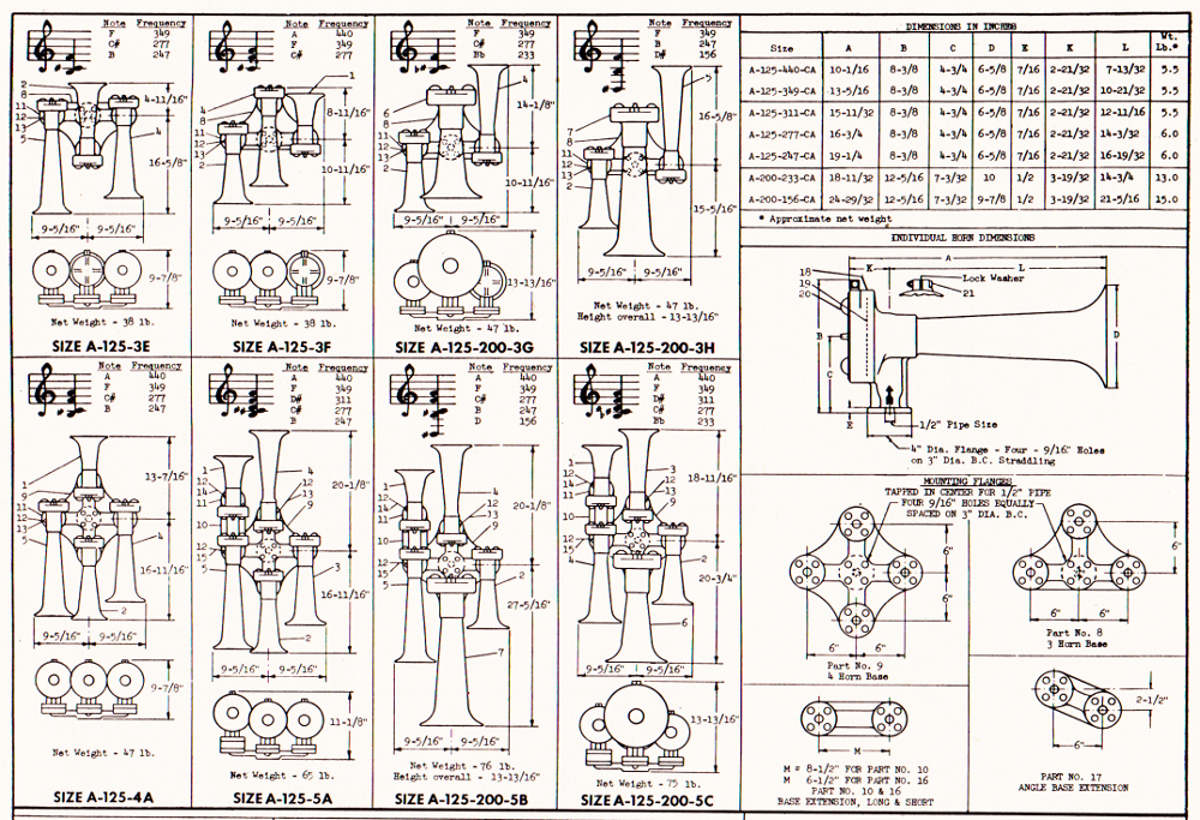
Diesel Locomotive Air Horns (Whistles), 1950


Locomotive whistles are used for public safety and for signaling to railway personnel. 

Today, locomotive whistles continue to provide a backup safety warning for the public when there is a sudden, unreported failure of an automatic protection device at a public railway crossing. There is also a great number of public crossings in Canada having no such protection.

*  *  *

At the beginning of the diesel-electric era, public awareness of the railway warning to 'stop, look and listen' before moving onto a public crossing was probably greater than it is today ... 

People were being vigilant for a steam whistle (often 'played' with distinctive artistry); they were listening for clearly-articulated, percussive exhausts; and a pillar of cloud by day (tinged with carbon) would often signal a steamer's approach. As a generalization ... during the Canadian steam era, steam locomotive headlights were not illuminated during daylight hours.


 Stan F Styles photo, collection of LC Gagnon.
Taken in Vancouver in July 1943, this photo shows a CNR locomotive built in 1909 by the Montreal Locomotive Works. Look at the steam dome immediately in front of the cab. Attached halfway up the dome's side is the cylindrical whistle. In the classic manner, it would be activated by a pull-cord from inside the cab. This provided plenty of opportunities for 'note bending' and other classic steam whistle artistry. 

Give yourself extra points if you spotted the wartime modification to a locomotive appliance - the conical blackout cover on the locomotive headlight. Two years after World War Two began in the Pacific there were fears that a Japanese invasion or an attack against coastal targets might take place. 

Stan F Styles photo, collection of LC Gagnon.
At Durand, Michigan in July 1956 is a Grand Trunk Western Railroad (owned by the Canadian National Railways) Schenectady-built Alco locomotive, which was built in 1942. In order to effectively project the sound of the bell and whistle warning devices, they are located as far forward as possible. You can see the whistle just to the right of the smokestack. Ergonomically, this location would be a little better for the crew as they would be more protected from this regular assault on their hearing. 

However, because of their distance from the cab, neither device could be operated by pull cords. In many cases, the remote-control whistle mechanism limited the 'artistic expression' of the engineer. 

*  *  *

Beginning around 1930, Canadian railways began to experiment with gas-electric or diesel-electric 'cars' (sometimes known as motorcars) and diesel-electric locomotives. It was quickly revealed that members of the public - exercising normal caution at a crossing without automatic protection - relied on regular steam locomotive cues. The approaching cloud of locomotive smoke, the sound of the exhaust and the steam whistle were missing from the new vehicles.

Few collision victims expected to be hit by a glorified bus on rails ...

Stan F Styles photo, collection of LC Gagnon.
A CPR motorcar at Montreal, 1948.
You can see a small two-element whistle at the top left of the vehicle's square front.


As Canadian railways became serious about using diesel locomotives,
it was decided that the one 'steam locomotive cue' which could be retained and reproduced was the sound of the whistle ...

from: Canadian Pacific Diesel Locomotives; Dean and Hanna; 1981; Railfare. (Original from CPR Motive Power Dept)
In Canada, to ensure that whistles were loud enough to be heard and to ensure that they 'sounded like trains', tests were conducted on November 15, 1951 around Mile 39 of the CPR Ste Agathe Sub. The whistles were mounted (shown above) on CPR locomotive 5151.

In attendance were representatives from:
  • Canadian Board of Transport
  • Railway Brotherhoods
  • Equipment Suppliers
  • CPR CNR NYC TH&B ONR C&O

A detailed account of the test methodology is in Appendix H of 
Canadian Pacific Diesel Locomotives; Dean and Hanna; 1981; Railfare.

The standard in use in 1981 was the Nathan K3H.

After the testing, the best horns/whistles for reproducing a steam whistle were considered to be:
  • Leslie 5-ton Supertyphon
  • Nathan 3-tone Standard
  • Westinghouse E2 B3
  • Leslie 3-tone Supertyphon
  • Nathan 5-tone STD.

*  *  *

Advertisements of American Vendors, 1950

The images below come from an American publication. 

Again, whistles provide safety warnings and operating messages to employees. 

But consider the ubiquity of American railroad lines after World War Two ... whistles also had the side effect of making a loud public statement that a railroad's train was in the area. This potentially pleasant or annoying advertisement would be repeated often through the day and night, seven days a week.

Some railroad officers would have selected a pleasing musical chord for the sake of public relations and out of professional pride. 

*  *  *

Nathan products ...

advertisement from: Locomotive Cyclopedia; 1950-1952; Simmons Boardman, New York.


advertisement from: Locomotive Cyclopedia; 1950-1952; Simmons Boardman, New York.

*  *  *

Leslie products ...


advertisement from: Locomotive Cyclopedia; 1950-1952; Simmons Boardman, New York.


advertisement from: Locomotive Cyclopedia; 1950-1952; Simmons Boardman, New York.


advertisement from: Locomotive Cyclopedia; 1950-1952; Simmons Boardman, New York.

*  *  *

A few examples of early diesel whistles in Canada.

No credit, no date, probably a posed CNR photo - from Stan F Styles, collection of LC Gagnon.
On a CNR MLW FA-1 we see a two element, bi-directional whistle. 

Why have a rear-facing whistle element on a this freight locomotive? 

Before semiconductors made portable radios practical ... hand signals by day, and lantern signals by night, were used between (headend) engine crews and (tailend) train crews. They were also used during switching.
(As the result of passenger car fires on moving trains, and other serious accidents early in railway history, passenger trains employed a special air trainline to relay train crew signals to a small whistle inside the locomotive cab)  
Around a curve, on a long train, where vision was obscured, to send out or to recall a tailend flagman ... it was perhaps decided that the a rear-facing whistle above would ensure that the message could be heard.

When a proceed ('highball') signal was sent from the tailend, two short sounds from the whistle provided definitive confirmation that the message was received and the train was starting immediately.

*  *  *

Stan F Styles photo, collection of LC Gagnon.
At Vancouver in July 1956 we see an MLW FPA-2. 

On this passenger locomotive, all three whistle elements are facing forward (I checked the original carefully). Of course, providing a warning for a road crossing as a fast passenger train approached was one important use.

Another important 'forward signal' would have been the long sound which trains were required to provide at station mileboards, etc. - Rule 14 (m). If the signalling train was approaching a 'problem', this was the final opportunity to start some serious flagging to stop the approaching train.

Experimental ditch lights are a curiosity in this photo.

*  *  *

Stan F Styles photo, collection of LC Gagnon.
Finally, at Vancouver in July 1953, here is a CLC, CPB 16-4. 

This particular Kingston-built B unit has a steam generator to provide passenger train heat - not all units of this CPR class did. 

If you look at the post on this blog about Alco locomotives in 1949 (including those with hostler controls) you will see that those controls included a whistle. This would have been useful for signalling if a hostler was operating B units singly on a shop track - for example, during the process of assembling a multiple-unit consist for a passenger train.

Perhaps that is why this B unit has a whistle.