Showing posts with label CLC. Show all posts

21 March 2025

An 11 Ton Cheese on a Flatcar and Other Border Stories

The 1939 shop floor of the CLC, and a flatcar holding an 11-ton cheese for the 1892 Chicago World's Fair are included as we look at a few 2025 issues as they were seen in the past. One school of thought says that history is not just a sterile record of the past - battles and dates - but an effort to understand how people reacted to change in the past.

Below you'll see a Prime Minister and President riding around together and shaking hands over the new bridges of friendship and understanding which have been built between good neighbours. 

The first few images come from this annual look at Canadian progress as documented by the Dominion Bureau of Statistics.


*  *  *

Then, as now, Canada's energy production was dispersed across the country. However, rather than national energy independence, cross-border flows of energy were preferred when it made economic sense.


Beyond coal ... petroleum and natural gas deposits were being developed and distribution systems were evolving - where economically feasible - to get them where they could be put to work.


*  *  *


from: The Rideau, a pictorial history of the waterway; Ed: Adrian G Ten Cate; 1981; Besancourt Publishers, Brockville ON. 

This bridge in Kingston's harbour is gone, but some might like to see this photo. 

*  *  *

from: The Rideau, a pictorial history of the waterway; Ed: Adrian G Ten Cate; 1981; Besancourt Publishers, Brockville ON.

Tariff this!

The international trade bugaboo of Canadian supply management was not an issue in 1892. Cheese, made at local cheese factories, preserved and stored perishable milk protein for consumption during the winter. This was in an era before the mechanical refrigeration of bulk milk ... and also before the road transport of bulk milk was made possible by internal combustion vehicles and paved roads.

As Canadian farmlands developed, milk cans were transported on wagons or sleighs drawn by horses to meet the morning 'milk run'. This all-stops train would take the milk to the urban dairy. The subsidized provision of fresh milk to urban schoolchildren in their classrooms prevented calcium-deficiency disorders. 

During winter, hay and sileage was fed to the dairy cows who were stuck indoors for months and many might go 'dry' during this period. When they finally hit the new grass in June, a surplus of fresh milk was produced and prices for milk would be depressed.

Starting in the 1960s, AI* enabled the selective breeding of cows. Using this method, their freshening could be scheduled to occur throughout the year, preventing boom (June) and bust (winter) cycles of milk production.    *Artificial Insemination

Supply management helped preserve consistent reasonable rates of return for family dairy farms and ensured that production was evenly spread out through the calendar year through the use of 'over quota levies'. The latter were applied when a farmer produced too much milk during a given month. 

Imagine the workload on a typical family farm - cows need to be milked twice daily, 365 days per year. Feeding and other 'material needs' also need to be tended to ... 365 days per year. 

Some experts point out today that Canadians pay more than Americans for dairy products. These experts would probably not turn in their laptops in exchange for the Canadian 'dairy farm lifestyle'.

*  *  *

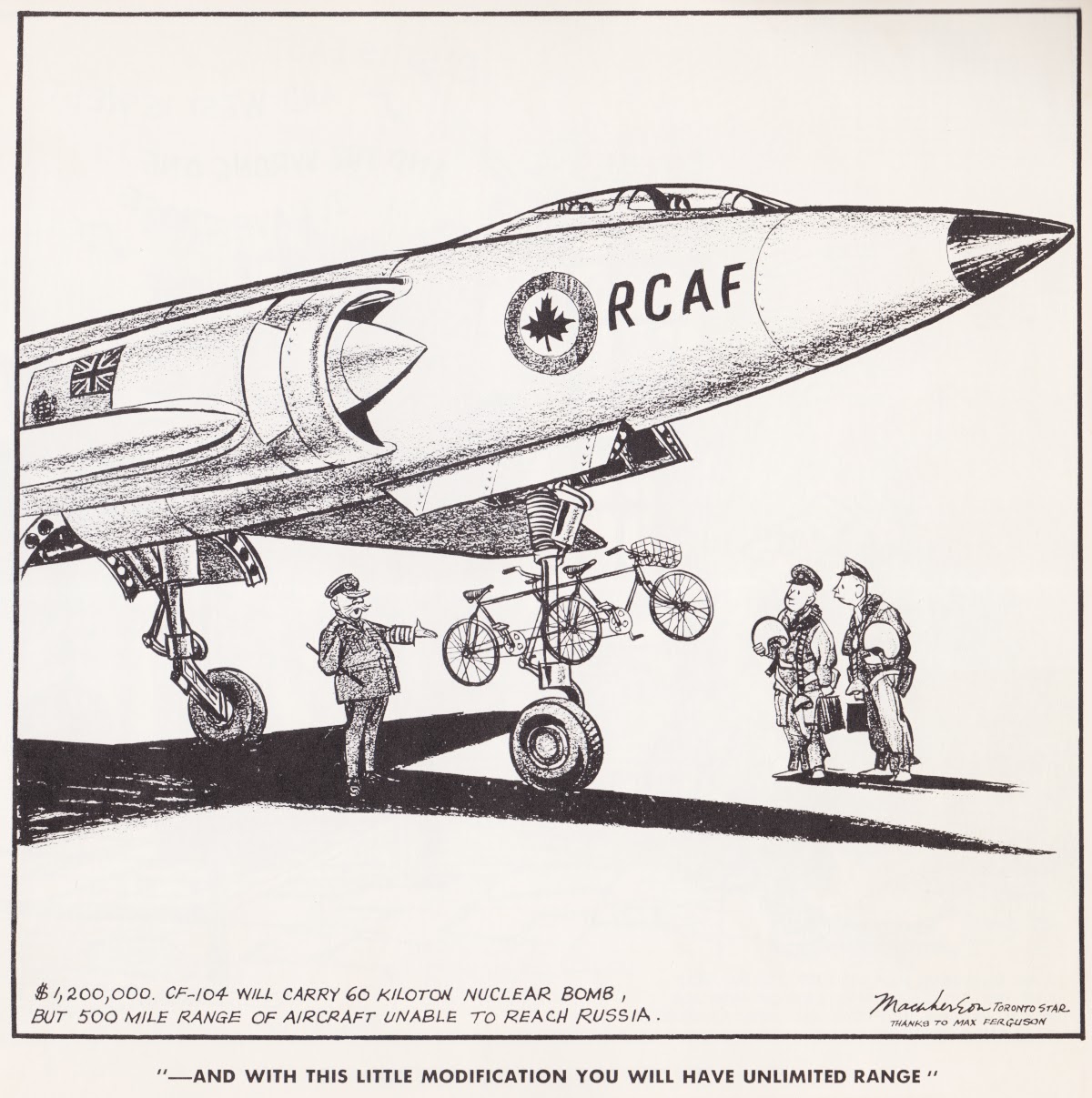
from: Cartoons by Macpherson; Duncan Macpherson; circa 1963; Toronto Star.

In the 1950s, there was a 'Rooshan' under every bed ... and under the ice. There was great fear that bombers of the USSR would be flying over the north pole to drop atomic bombs on us. People built backyard fallout shelters and stocked them with canned goods.

In the early 1960s, the US could use their new nuclear-powered subs to patrol under the ice of the Canadian arctic. While I don't know all of the details which prompted this editorial cartoon, you can see that arctic security was a priority for our American neighbours.

In the late 1980s, Canadian Minister of Defence Perrin Beatty opened talks to buy nuclear patrol submarines from France. France received a gentle nudge from the United States discouraging them from supplying submarines which could patrol under Canada's polar ice.  

*  *  *

from: Cartoons by Macpherson; Duncan Macpherson; circa 1963; Toronto Star.

[Corrected for inflation, $1.2 million equals about $12.2 million in 2025 dollars]

In keeping with the enduring idea that bombers will travel over the north pole ...

The Lockheed Starfighter was a high-altitude supersonic interceptor which (like the Avro Arrow) had been designed to attack the nuclear bombers of the USSR as they sneakily approached North America over the north pole. 

After Sputnik, the Starfighter became kind of useless - but Canada still bought them and Canadair built them under licence providing unionized high-tech aerospace jobs for Canadians.

... Sure, the Starfighter was still a really cool piece of hardware, but the 'rockets' (i.e. missiles) of the inspiring and exciting US/USSR Space Race were really all about the ability to drop nuclear weapons on your enemy with greater and greater precision. Except, with nukes ... precision doesn't matter as much as the wind direction which transports the radioactive fallout.

... While many (including some politicians) still picture the Dr Strangelove image of attacking bombers coming over the north pole ... since the 1960s it would have been more likely that massive warheads would have arrived silently by missile.

What this cartoon doesn't foresee, is that the RCAF Starfighter, as part of the NATO mission, was going to be repurposed as a short-range treetop-level bomber. 

As detailed in Canadian Nuclear Weapons; John Clearwater; 1998; Dundern Press, this high-altitude interceptor would race at near treetop level (to avoid radar) from West Germany ... before delivering its bomb to one of the Warsaw Pact countries as directed by the US and NATO. This type of flying in this aircraft was probably as safe for RCAF pilots ... as running a racing motorcycle at top speed along a biking trail through the woods!

Within particular RCAF bases in West Germany there were separate US military compounds housing the nuclear bombs. Upon proper authority, an RCAF Starfighter would enter the US compound, get bombed up by the US personnel ... and head off toward its target.

Upon reaching the target area, the Starfighter would 'zoom' up to a relatively high altitude, and use a rudimentary computer to release and 'loft' the bomb upward on a parabolic flight - which might be slowed by a parachute on the way down. Given that it was designed as a supersonic interceptor, the Starfighter's nuke could only be slung under the fuselage. The RCAF Starfighters carried 3 or 4 different designs of bomb, each with many more sub-options to enable the US personnel to tailor the bomb's yield before bombing up the aircraft.

So ... during the mission ... the RCAF pilot would have to avoid controlled flight into the ground, avoid getting shot down, avoid nuclear fratricide by all of the other weapons going off nearby ... but ... the pilot could at least outrun the shock wave ... in his supersonic fighter. 

However ... the plane could not outrun the burst of gamma radiation from the detonating bomb. This is why the it was released high in the air with an upward trajectory - to give the aircraft time to dive and thunder away, to escape most of that radiation. The survival of a pilot in this complete scenario seems very unlikely. 

But you have to have some hope ...


Historical lesson? Canadians purchased a US-designed plane which had become kind of useless because the nature of warfare had changed ... so ... with American help ... they found something else for it to do ... 


10 November 2016

CLC Freight Locomotives - H16-44 H12-44, CNR Operating Manual 1966.


This long posting will complete the Canadian Locomotive Company product section
 of the consolidated CNR engineer operating manual of 1966.

Whether you see it as 'variety' or a 'lack of standarization' - this section of the manual is necessarily long to cover smaller freight (or dual purpose - some had steam generators) locomotives with B-B and A-1-A trucks; 1200hp and 1600hp prime movers; and Westinghouse, Fairbanks-Morse or General Electric electrical gear. For all this variety, fewer than 80 CNR locomotives are represented below.

The retro-popular H24-66 model - the Trainmaster - of which the CNR owned one, does not appear in this manual. The sole CNR copy was originally numbered 2900 in 1955 and left the CNR roster as 3000 in 1966. 


When it selected first-generation diesels, we can guess that the government-owned CNR had to show an interest in all the various Canadian manufacturers of locomotives - to spread the work around. As well, during dieselization, there may have been a benefit in trying a variety of models to see which worked best in Canadian conditions - particularly given the CNR's inherited light-track branch lines.


The following image comes from a Canadian Locomotive Company brochure from 1950.
It gives a rough representation of the lighter freight locomotives shown below.
The first locomotive type shown was not owned by the CNR.

Canadian Locomotive Company brochure; 1950.

*  *  *

This Cyclopedia overview of the 1600hp unit is followed below by its section from the CNR manual.


from: Locomotive Cyclopedia; 1950-1952; Simmons-Boardman.

from: Locomotive Cyclopedia; 1950-1952; Simmons-Boardman.

from: Constructed in Kingston; DR McQueen, WD Thomson; 2000; CRHA Kingston Division.
Built in 1955, the CLC-built H16-44 didn't have the affectation of rounded cab windows shown above. The high running board makes it closer in appearance to a typical Trainmaster than the earlier H16-44 styling.

*  *  *

When it may be helpful, I have enlarged and repeated illustrations from the CNR manual. There is a very wide range of image types and qualities in the manual. Some are rough and difficult to read, regardless of any 'treatment' I can give them. 


Here is the first section of the CNR manual ...


End of 1600hp units.

*  *  *

Begin 1200hp units ...


Truro, Nova Scotia, May 1954. Stan Styles, Vancouver BC. Collection of LC Gagnon.

H12-44 (or H12-46 in Pinkepank's Second Diesel Spotter's Guide; 1973; Kalmbach) number 7608 is shown at Truro in May 1954. Pinkepank indicates these units - having an A-1-A truck - were only purchased in Canada. 

Originally numbered in the CNR 7600-7629 range, they were renumbered into the 1600-1629 range. The locomotive numbering of this era was dynamic as old steam motive power was removed from the roster and new diesel units were added.

Built in 1951-53, the last unit was retired by 1968.


Above: Notice the steam generator in the short hood and the CNR practice of operating long hood forward.


Reproducing these diagrams may not make them more aesthetically pleasing, but details may be clearer.


End of 1200hp six-axle units.

*  *  *

Begin 1200hp four-axle units.

Truro, Nova Scotia, May 1958. Stan Styles, Vancouver BC. Collection of LC Gagnon.


02 November 2016

CLC Passenger Locomotives - CPA-16 CPB-16. CNR Operating Manual 1966.


According to one reference, the Canadian Locomotive Company passenger cab units lasted a little longer on the CNR (some until 1969) ... than the other opposed-piston-powered locomotives of Fairbanks-Morse design on that railway. 

Here is how they were covered in the CNR operating manual compilation of 1966.


The pages from the CNR operating manual do not have source captions. 
However, the images from other sources are labelled to show their origin.


There are no diagrams provided for the passenger units in the CNR book. Here is one found in the Locomotive Cyclopedia for 1950-1952. The F-M pages in the Cyclopedia are less lavish than those for the two largest diesel manufacturers. After trying to improve on the rough quality of the diagram below, I decided to leave it in its original state.

from: Locomotive Cyclopedia; 1950-1952; Simmons-Boardman.

Standard F-M nomenclature uses a suffix to denote the number of axles, so to them, the locomotive above is a CPA16-5

In the Cyclopedia, in a number of cases, you can also see Whyte-style classification used. So the unit above is an 0-4-6-0 ... or something.
In North American diesel nomenclature, it is a B-A1A.

I believe that the unusual third axle on this passenger unit is to support the weight of the steam generator equipment. While one could argue that this is evidence of fine engineering ... it might also be true that the opposed-piston design is already more unusual engineering than anyone desired to deal with. 

The two higher powered units of this series of locomotives (2000 hp and 2400 hp) used the same carbody and frame. F-M was selling the interchangeability of components with this design. When compared with units of the same power for freight service, the 2000 hp and 2400 hp units added about 20 tons of steam generator-related weight.

The 1600 hp version (the CNR unit) - detailed below, and also farther below - only adds 6 tons for passenger service. The A1A truck may have been seen as beneficial for use on some of the CNR's areas of lighter track.

from: Locomotive Cyclopedia; 1950-1952; Simmons-Boardman.

*  *  *

Here are the pages from the CNR operating manual.
The CNR images are repeated and enlarged so you can see more detail.


That marks the end of the CPA-16 coverage in the CNR manual.

*  *  *

from: Locomotive Cyclopedia; 1950-1952; Simmons-Boardman.

from: Locomotive Cyclopedia; 1950-1952; Simmons-Boardman.

from: Locomotive Cyclopedia; 1950-1952; Simmons-Boardman.

*  *  *


The cover of a booklet detailing the CLC's steam locomotive history and wartime manufacturing, the Consolidation line of diesel-electrics, the CLC's export locomotives, the other heavy industry equipment manufactured by the CLC, and the significance of the plant to Canada and to Kingston ... featured the CNR-style unit on its cover. The illustration features an enormous front coupler housing.

*  *  *

My father had requested these locomotive data sheets from the CNR.

Collection of LC Gagnon.

Collection of LC Gagnon.