Showing posts with label Dayliner. Show all posts

15 April 2023

Train 185 - Some History

Sudbury-White River timetables since 1887, Omer Lavallee's Spanner article from 1953 on the introduction of the Dayliners, and a relief map appear in this post.

Background

Recently the Ontario public broadcaster, TVO, showed a unique 3-hour film about the VIA Rail Budd car consist which provides service to residents along the CPR main line between Sudbury and White River. Generally, these locations are not accessible by any other means. They are a legacy of the CPR's original construction through this remote area of the Canadian Shield.

Today, a few permanent residents, cottage owners, fishing lodges and canoe trippers seem to create most of the demand for this train.

While they still function, here are the YouTube links to the film and its trailer.

Trailer: TRIPPING Train 185

TRIPPING Train 185

Railway Operations During the Steam Era

Originally, the railway was divided into sections for maintenance ... by 'section gangs'. These employees were permanent residents along the line. Taking representative figures from the 1930s: a main line section was from 5.5 to 6.5 miles long, and was maintained by a foreman and three men in summer, and a foreman and two men in winter. Many workload factors were considered when calculating gang size and section length, however, so these numbers are just representative.

Whenever possible, the local maintenance of way employees lived in a village where there was adequate housing available. Failing this, they were hired to live near a particular station having a telegraph office - so an agent or operator could alert the section foreman when there were emergencies to address, such as derailments, washouts, or fallen poles or trees obstructing the right of way. 

... Before the availability of small, powerful internal combustion engines, most maintenance of way activities were powered by human muscles. This explains the thin, more uniform population of railway employees and dependents along this line during its early decades. 

You will realize that the sectionmen between Sudbury and White River lived in some pretty remote locations. Imagine a settlement where there is silence which is only occasionally disturbed by something as disruptive as a crow. Now imagine the crow is off running errands somewhere. Silence.

The distance from Sudbury to White River is about 300 miles, with Cartier and Chapleau being the main railway towns between these points. These two centres were established as engine and crew change points with the necessary supporting administrative staff, and motive power and car shops. They hosted a relatively large contingent of railway employees during the height of the steam era. 

* * *

1968

from: Canadian Rail; July 1969

from: Canadian Rail; July 1969

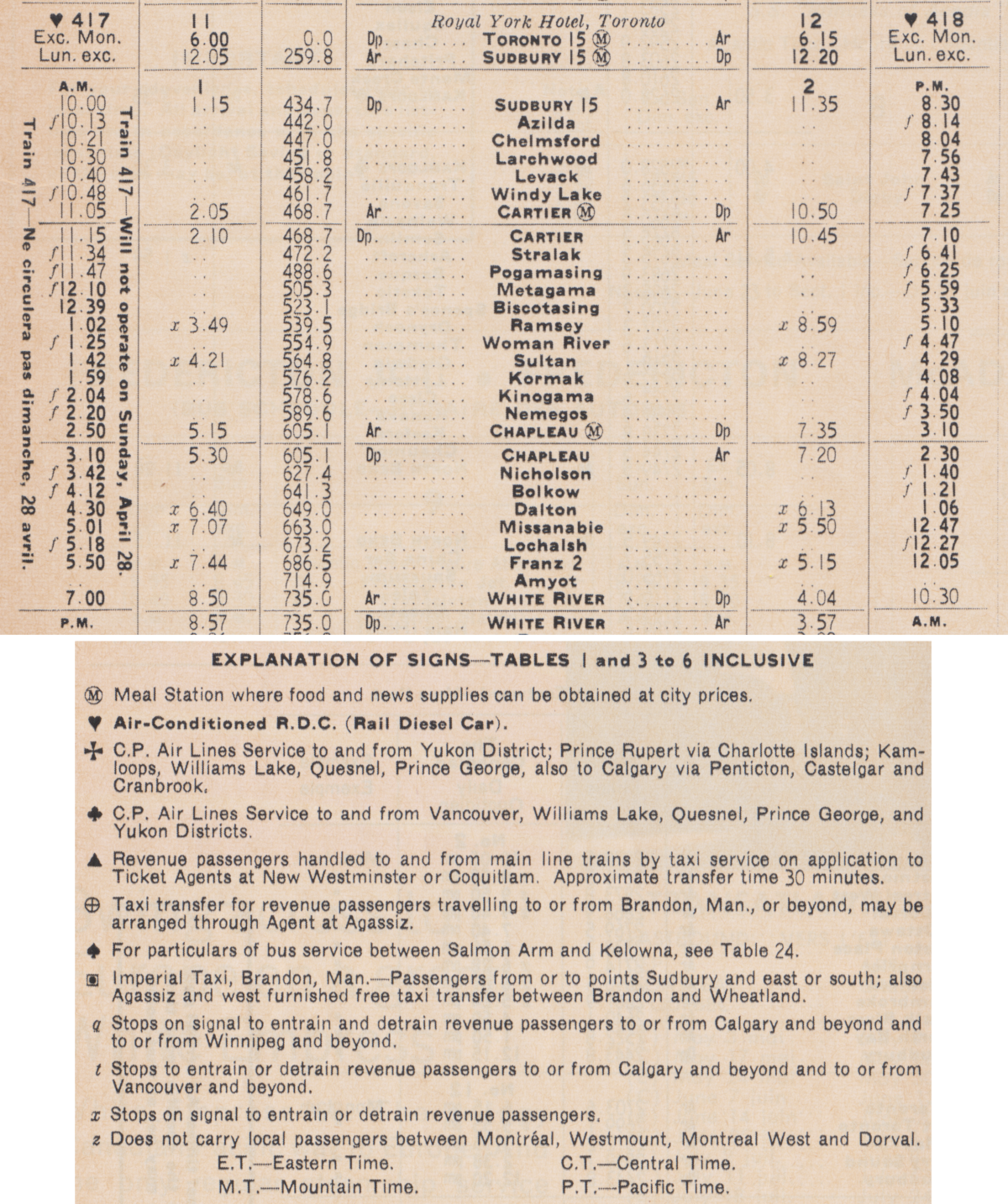
After the age of steam was over, here is what the train was like in the late 1960s. With White River embracing its early 1900s national notoriety of being the coldest [railway telegraph station regularly reporting temperatures to newspaper wire services] in Canada ... the Canadian Rail article mentions that the Stevenson Screen containing that thermometer is shown in front of the station in the top photo. One assumes that the operator observed and relayed the meteorological readings.

Below, The Canadian's flag stops are marked with an 'x' while the Budd car trains 417/418 are marked with the traditional 'f'.

from: Canadian Pacific public timetable; 28 April 1968. 

*  *  *

1990


Having left Schreiber, we were returning east from vacation on a chilly, windy August 18. 

After taking the annual photo of the yard from the lawn of the company house at the east end,
this is what we found at 0930hr - the Budd car spotted for its eastbound departure.


Below: With the trap raised to allow passengers to board, you can see the original layout of the control stand.
This was at the trailing west end of the consist - where you see the step box.


*  *  *

1981 Map - The CPR Line - White River to Sudbury

from: Atlas of Canada; Dr H W Castner; 1981; Reader's Digest Assn. 

You can see 'our' track running from Sudbury at the lower right corner to White River at the top left.
The Algoma Central Railway runs north from Sault Ste Marie and crosses the CPR at Franz.

1976 census figures 
Here is a key to the population markings so you can understand the population density along the line:

Chapleau 1000-4999 residents
White River 400-999
Missanabie 100-399
Michipicoten 50-99 (not on the CPR line)
Franz 1-49
Amyot - population not reported in census

This map shows the local landforms really well.
You can imagine the work involved in the 1880s 
to locate and build this line while minimizing grades.

As the landscape is fairly timeless, the map (above) 
and natural features (below) are relatively 'current'.

*  *  *

1901 - Features of the Line

from: Altitudes in the Dominion of Canada; James White FRGS; 1901; Department of the Interior.

*  *  *

1887 Official Guide


I have hi-lited the relevant portion of the 1887 transcontinental timetable for the Atlantic and Pacific Expresses. 
Back then, it took 13 hours to cover 300 miles. 
It probably seemed quite magical to be able to travel across Canada by rail at that point.

from: Canadian Railway Scenes, No 2; Adolf Hungry Wolf; 1985; Good Medicine Books,

The Priest Plow, with adjustable flangers, leads a passenger train near White River in the late 1880s.

*  *  *

1916 Official Guide


Again, I have hi-lited the Sudbury to White River section of the line.

Postcard mailed in 1912 showing a westbound at Sudbury.

The Great War's Battle of the Somme will be starting a couple of weeks after the timetable, above, takes effect. It seems that Trains 1 and 2 are handling the local stops between Sudbury and White River. The running time has been cut down to about 11 hours. 

Train 1 runs westbound 1303hr to 0020hr. 
Train 2 runs eastbound 0650hr to 1735hr.

*  *  *

1936 Employee Timetable

I think I bought the next two batches of employee timetables as photocopies, 
and I'm glad to have them. However, the print may be a little fuzzy for you.

Sudbury to White River 
(Subdivisions: Cartier 34 miles; Nemegos 136 miles; White River 129 miles)

Train 1 runs westbound 1240hr to 2315hr - about 10.5 hours
Train 2 runs eastbound 0735hr to 1715hr - less than 10 hours.

There are no block signals on the line, so the classic system people describe as 'timetable and train order' is being used to regulate traffic movement. While the trains have times listed for each rulebook 'station' (station = location) on the schedule, the time represents when they are due at that station under normal circumstances. For example, this would be important for the purposes of inferior trains which must clear the main track for superior trains - as prescribed by the rules. 

... so passenger train times are not necessarily stops at station buildings. Only those times with an 's' beside them are scheduled stops, and times with an 'f' beside them are flag stops.

Where the times are shown in boldface (eg. Train 951 at 5.43) there will be a second identical boldface time for another train somewhere on the same line of the schedule - if you run your finger across you'll find it. Considering all the conditions specified in the rules (there are many) 5.43 is the time of a scheduled meet between two trains (eg. at Kirk siding).

The column with 'D' and 'N' shows the locations of day and night train order operators. So you could infer that maintenance of way section gangs are more likely to be found living at some of these locations.


*  *  *

1939 Royal Travelogue for the Sudbury to White River Line

Casting about for something which described some of this typical Canadian Shield territory, I remembered this book. Below are a few descriptions from a presentation-style book prepared for members of the press accompanying the Royal Tour of 1939 - King George VI and Queen Elizabeth. The book was also given to key participants at locations visited during the tour. The descriptions are dated and reflect the values and priorities of their era, but they fit 'here' in the chronology we are building of this line. The train has just left Sudbury ...


*  *  *

1946 - Employee Timetable

Eight months after the dropping of the atomic bombs, the employee timetables, below, reflect the rebound of traffic after the Great Depression during World War II.

The running times of Trains 1 and 2, and the time of day during which they run is virtually unchanged. Between Chapleau and White River, Absolute Permissive Block Signals have been installed (this notation is printed sideways to the left of the station list on the White River Sub sheet). When traffic becomes heavy on a railway line, these signals are designed to keep trains from running into each other - they provide a higher level of safety*. 

(* There are only so many timetables and rules and daily exceptions to the timetable ... which humans - eg. engineers and conductors - can hold in their heads while they are 'driving' without forgetting a key detail at the wrong moment. Today, aviation professionals memorize key data, use checklists when key tasks may be forgotten in the heat of an emergency, and electronic alarms add another level of protection.)

The speed and weight of the typical trains operating on a line are used to calculate how long the signal-protected 'blocks' should be. If a train suddenly encounters an approach signal (eg. a yellow light or a semaphore arm at 45 degrees) it should be able to safely stop before it reaches the next signal indicating 'stop'. Beyond the stop signal may be a train stopped on the main track, or a train clearing the main track into a siding for the approaching train to pass. An absolute signal displaying 'stop' must not be passed.

Absolute signals and permissive signals are deliberately different in their appearance. A permissive signal showing 'stop' might allow the train, after stopping, to proceed under particular speed limits and other cautions. And, you never know, maybe the next signal it encounters will allow it to proceed normally! 

... For example, maybe the train ahead was stopped and dropping off a sectionman in the bush after he had spent a wild night in Chapleau - causing a stop signal (the permissive type) to protect the train's tailend. But this stopped train quickly got back underway, running at the speed limit again - the following train stopped at the signal, then approached slowly with care, but next signal is miraculously 'clear'.

So absolute signals protect against collisions. Permissive signals do the same thing, but they may sometimes make operations more efficient.

While these coloured signals may brighten up the scenery for the crews and add a layer of safety on busy lines, the underlying traffic control system is still 'timetable and train order'.


If you ever have the time, this classic book interprets all the old rules.


*  *  *

Unused postcard from the mid-1950s, showing a westbound passenger train arriving at White River.


1958 - Official Guide

Notice the reference mark that indicates that Trains 417/418 are RDCs.
These Budd car trains run from Sudbury through to Fort William and serve all the listed stations.
This allows Trains 1, 7, 9, 2, 8, 10 to operate on slightly faster schedules.

Because Train 418 arrives at Sudbury at 1300hr, and Train 417 departs Sudbury at 1800hr ...
This suggests that the Budd cars may be based in Sudbury for maintenance, etc.

The Budd car ability to accelerate and decelerate quickly would be valuable 
for this type of all stops local train running on this busy bridge traffic route.

Note: The first times for Franz pertain to the daily Algoma Central train ...

From the Sault, good connections could be made with CPR Trains 7 and 8.
To the Sault, your best connections would be via the Budd cars: Trains 417, 418.

Over the years, I have corresponded with two of the operators who once worked at the CPR station, Franz.
You'd at least have interesting people to talk to if you had a 4-6 hour layover there.


*  *  *

Here is an article by Omer Lavallee on the introduction of the CPR Dayliners
along with his bonus article on the history of CPR self-propelled railcars.




07 January 2023

Four Photos from a CPR Collection, Part 1

Here are 4 photos from part of a collection I bought a decade or so ago. Each is glued to a 5x8 inch card which includes any known details about the subject, its location, the date and photographer. The collector seemed to be quite organized: rubber stamping those field names ... a pen filled in the details (if they were known).

Before the internet, when people had to purchase railway images they wanted to collect, from a collector or photographer, in person or via the mail ... there would have been quite a commitment made, with money and time, to assemble a collection of good images. Unless the collector had a desire to self-publish a book to share the collection ... the images would just sit in a filing box somewhere ... with perhaps a 50% probability that they would be thrown out by someone else at a much later date.

As photos were generally printed exactly as they had been taken, there seem to be few railway photographs which are actually photographed 'straight' - as if a spirit level had been used to align the camera. Trespassing on railway tracks to get a perfectly level photo was neither a healthy pursuit, nor one encouraged by railway officials. Beyond that, the convexity of lenses used to get a 'wide angle' view of a piece of equipment often interferes with the straightness of details at the edges of many photographs.

... The challenge to retroactively level old photos is compounded by the fact that there has never been (it seems) a single wooden pole in all of Canadian history which spent most of its existence straight. However, signal masts are usually fairly reliable.

Often, one has only a few horizontal or vertical engineered 'lines' on the equipment itself - to use so the 'reworked internet reproduction' might achieve something approaching straightness. Rarely, a flat prairie horizon or a large body of water on the horizon can make this mission so much easier. 

After this effort, one must still look at the finished product and wonder if it actually looks properly straight to someone who has not sunk all that time into trying to 'fix' it.

In order that the reader does not feel the straightening and cropping has gone overboard, I sometimes leave the blank white edges of the photo in the image. The Dayliner image in the last photo shows as much detail as possible of the second car - and I have left those 'white triangles' to indicate that there was nothing more to preserve and show from my print.

So when 'photocopying' these photos for the internet, I at least try to get them straight. I also try to correct the exposure so that as many details as possible can be seen - who knows when a particular detail will be historically significant to someone who arrives from the future? While it would be easy to have the software correct the colouring of a photo to 'black and white', perhaps some of the experience of seeing an old image is the observation that it is really old

But sometimes ... one gets so deep into 'optimizing' the image that the result is arguably no better than the original flawed version. In some cases, the best option for posterity is to abandon the photo fiddling and to just post something very close to the original version.


With the sun at its back, the CPR engine 6869 has its tender topped up from the standpipe. The fireman is standing on one of the two headlights which probably still burn fuel - perhaps kerosene. Maybe the presence of class signal lamps suggest that this switcher sometimes leaves the yard on transfer service. The white, seasonal cab curtains are only moderately dirty, so perhaps the cold winter months are yet to come.

CPR 6869 was an 0-8-0 of the V2a class. It was built by the Canadian Locomotive Company at Kingston in February 1900 and scrapped in September 1930. The date and location of this photo are not recorded.

(I am using Canadian Pacific Steam Locomotives; Omer Lavallee; 1985; Railfare - as the source of roster data.)


Above: 
CPR engine 5913 is shown at Field, British Columbia in July 1950. With the plow pilot not removed in the middle of the summer, it is always ready for any kind of eventuality in this demanding segment of the railway. 

One interesting detail to consider is the 90-degree exhaust deflector at the smokestack. The latent energy of the steam leaving the pistons of a hard-working engine would exit the smokestack with considerable force. This force would loosen rocks in unlined tunnels, with the possibility of significant rockfalls taking place over time. I think I read that engine crews didn't like being force-fed their locomotives' exhaust over the whole course of a trip, with the smoke perhaps also getting in the way of signal identification. Consequently, the deflector was often unofficially set in its 'off' position - rotated 180 degrees back off the top of the stack, as you see in this photo.

CPR 5913 was a 2-10-4 Selkirk (T1a) built by the Montreal Locomotive Works in August 1929 and scrapped in April 1956.

Below:
CPR 5915 (another T1a) is shown at an unknown location on an unknown date. One reason for placing the photo here is to note the differences in the details of these magnificent plow pilots. Perhaps its class signals (if green) indicate it has just been running as a section of a passenger train - picking up some fresh snow along the way.

CPR 5915 was built by MLW in September 1929 and scrapped in May 1956.


CPR Dayliner 9102 was photographed at Woodstock, New Brunswick in June 1956. A mail hook can be seen on the next car. The removable Mars light and headlights are not lit. While it may actually be a Gyralite by Pyle National, this was a period of UFO fascination and fear, so please humour my embrace of the historical zeitgeist.

It was relatively late in Canadian railway history that headlights were required to be lit by day. Perhaps this was because a loudly percussive steam locomotive putting out a lot of coal smoke was hard to miss in the daytime. Similarly, someday people will notice with wonderment that autos didn't always have daytime running lights.

Table 13 below comes from the CPR public timetable 25 Sep 1955 to 28 Apr 1956. It seems likely that the photo above is of Train 153 or 154. 


I have about 2 shelf-feet of Canadian Trackside Guides. However, I do not have a complete set of this excellent publication.  As best I can determine from about 30 minutes of research:

RDC-2 (= combine layout as photographed) 9102 was built in 1951 (or a little later). 

It was rebuilt as an RDC-5 (= a CP designation for a full coach conversion from an RDC-2) and renumbered 9300 in 1955. 

VIA had it rebuilt as an RDC-1 (= full coach, the standard Budd designation) and numbered 6146. 

It was retired by VIA. 

... Entering RDC in the search box near the top banner will fill your heart with all the RDC lore and technical data you could ever desire.


15 January 2020

1955 RDC Article: Prices & Optional Equipment Supplied with non-US Sales


Here is more information about the early use of the revolutionary Budd Rail Diesel Car:

This historically-interesting article shows general prices, sales worldwide at this point in history, and the optional equipment supplied to particular foreign railways. The US data is probably very well known so it is not included, but the tally of units sold to individual US railroads is here.
As always, I save and load long columns with exactly the same pixel width (to provide you with a world-class pleasure-maximizing uniform print size experience) ... nevertheless, some Google algorithm always alters their display size, based on an mathematical formula known but to them.
A tale of the demonstrator's encounter with Canadian snow is included. The Budd company must have been very busy turning out rolling stock at this time and a couple of ads related to CPR's The Canadian are also included below. They come from the same edition of the magazine.

More articles on Budd Rail Diesel Cars can be found under Railway Technology & Systems 04 (button located in the banner, above)
under the heading: Diesels, The First Generation.


Considering US inflation,
$160,000 in 1955
equals about $1.5 million in USD in 2019.


*  *  *


"Transcribed Music": I do not think it means what they think it means.

Long before the VIA HEP program ... during many trips on Budd equipment in the late 20th Century ...  On only one occasion (in 1979), shortly after leaving Vancouver on the CPR route with all Budd sleeping cars, did I actually hear Muzak coming through the room speaker in my roomette. There was a rotating selector switch which included options for "Music" and "PA" in sleeping car rooms on the Budd equipment. 

I think there was originally a reel-to-reel tape player in a locker in the Budd dining car for this. There must have been an 'old-school' CPR employee working that day who was pleased to find the equipment to be in working condition!

*  *  *


Probably you have already seen many examples of this artist's work.
You try to get a train picture in the Rockies and a little Bighorn Sheep pops into it!


A once-famous internet meme:


A variation on a meme.

13 October 2017

Budd Rail Diesel Car - Part 3


This last part of the current Budd RDC series
surveys a set of Dayliners from La Tour Joyeuse!

We also look at some of the CNR's Budd activities,
and early schedules for RDC's on both railways.

A table summarizes Budd RDC ownership
by the two major Canadian railways -
to provide an idea of the importance of this technology.


Undated Budd RDC pamphlet.


The Concise Encyclopedia of World Railway Locomotives; ed: P Ransome-Wallis; 1959; Hawthorne Books. 
An idealized tableau of a Budd car in service.

On one of my first 'intercity' rail trips: Montreal West to Lachute,
I was similarly hoisted aboard by my father,
as he shouted to my mother: 'Can you manage?' over the noise of the bus motors.

... In lieu of any CPR help with the valise, she was lugging it.


... The balance of the article was not saved.
A couple of the photos are enlarged/enhanced below.

Once again, these are all items archived by my father
back when steam locomotives were still to be found in service.


An undated newspaper ad.
The non-stop driving time in 2017 is calculated at around 2 hours,
and this includes long stretches of Autoroute driving (source: Google).


from: Canadian National Magazine/Keeping Track.
*  *  *

CPR-related Ephemera


There is no caption describing this cover image, but the identical image appears in the 1955 Canada Handbook with this caption:
"A self-propelled diesel powered day-liner carries passengers, express and mail from Mattawa, Ont., 100 miles north to Angliers, Que. Passenger day-liners are in service between other centres."


This shows both sides of a Dayliner flyer picked up by my father.

In 2017, the non-stop north shore driving time,
Montreal to Quebec City via the Autoroute Felix Leclerc
is calculated at about 3 hours.


*  *  *


Here is another flyer which my father preserved.

In 2017, the non-stop driving distance from Windsor Station to Mont Laurier
is calculated at about 3 hours.

In 2017, Felix Leclerc could drive to Sainte Adèle in style on an Autoroute!
However, were he driving - instead of taking Le train du Nord ...
his hands wouldn't be free to strum his guitar.


*  *  *

How important were Budd Rail Diesel Cars to Canadian railways?

Here are the RDC's retained by the railways and subsequently owned by VIA as recorded in the 1982 Trackside Guide. I have cobbled together the listings into a single image which may be conveniently printed, folded up and kept handy in your wallet or purse. Win every argument with your friends and family about Budd cars!


A Trackside Guide to Canadian Railway Motive Power; Earl Roberts; 1982; Bytown Railway Society. 

The complete listing of CPR RDC's is included below ...
even though entire model 'classes' had been sold to VIA.
I have omitted the British Columbia Railway listing: 8 cars, 6 remaining in 1982.

A Trackside Guide to Canadian Railway Motive Power; Earl Roberts; 1982; Bytown Railway Society. 

*  *  *

At Lac Saguay, circa 1958


From La Tour Joyeuse my father photographed a three-car Dayliner consist just south of Lac Saguay station as it continued its run to Montreal. The parallel road was once the 'highway' to Mont Laurier. 


Seen from the new paved highway to Mont Laurier is La Tour Joyeuse and its roadside advertising. Beyond the hotel are the CPR tracks. Behind the camera is the vista of the lake, hills and mountain which the tower was designed to view.

My father's notes indicate that this was "Adhémar Raynault's hotel near the CPR tracks and the old unpaved road to Mont Laurier". Raynault (1891-1984) had been Mayor of Montreal during three periods in the 1930s and 1940s. He filled in as mayor during the wartime internment of Camillien Houde, CBE OStJ.