The Crimean War (1853-1856) was 'a notoriously incompetent international butchery'.
Who did this?
The leaders in charge were:
- Queen Victoria (1819-1901) of Great Britain
- Prime Ministers:
- Lord Aberdeen in office 1852-1855
- Viscount Palmerston in office 1855-1858
- Emperor Napoleon III (1808-1873) of the Second French Empire
- Abdul Mejid I (1823-1861) Sultan of the Ottoman Empire
versus
- Czar Nicholas I (1796-1855) of the Russian Empire.
Both Napoleon and Abdul Mejid could have been considered reformers as they tried to make conditions and institutions in their countries better.
'Nicholas the Stick' was kind of rigid and doctrinaire about everything.
Empire Building
The general extent of Britain's empire during the Victorian Era is well-known to most.
Napoleon wanted France to have a greater world influence as he worked to obtain colonies in places like Algeria and Indochina.
The Czar had been tempted for some time by the weakness of the Ottoman Empire 'the sick man of Europe' ... not much of a tourism slogan. To create a provocation, he told the Ottoman Empire to let him look after the Christians within the Ottoman Empire. Nick the Stick wanted to set up Russian circles of power and influence within the weakening Ottoman areas, particularly in Wallachia and Moldavia.
... Russia subsequently moved into those two areas and the Ottoman Empire declared war. To demonstrate their enthusiasm, Russia sent a naval force to sink the smaller Ottoman fleet at Sinope - resulting in the deaths of about 3000 Turks in November 1853, and then they shelled the place for a week.
Wanting to keep the Russian Empire in check, particularly on the high seas, France and Britain declared war on Russia a few months later ... and about 6 months later they showed up with armies to demonstrate their sincerity about the whole business.
The British military started in September 1854 to bring in a force of 26,000 soldiers ... reaching 98,000 in 1855.
The French started with 30,000 ... peaking at 310,000 in 1855.
 |
| from: Penguin Atlas of Recent History; Colin McEvedy; 1982; Penguin. |
The map below spans events over a few decades. From all the green arrows, you can see that the Russian Empire was broadening its horizons. One additional reason for their interest in the Black Sea and the Dardanelle Straits leading to the Mediterranean Sea ... was a desire to gain access to a variety of harbours which were not impaired by ice for part of the year.
The Russian navy had an excellent natural harbour at Sebastopol on the Crimean Peninsula. This is correctly 'Sevastopol' as there were longstanding historical errors in transposing one letter from the Cyrillic to the Latin alphabet.
At any rate, most of the action will centre on that location.
 |
| from: Atlas of World History Vol 2; Kinder, Hilgemann; 1978; Penguin. |
* * *
 |
| from: Google Maps circa 2016. |
Above: The general morphology of Balaklava harbour might remind one of a smaller, dryer version of St John's Newfoundland - complete with a 'telegraph' tower. And if you are familiar with historical St John's, you know where to put the railway.
* * *
 |
| from: Google Maps. |
Here is the current view of Sebastopol's excellent natural harbour. You can see the source of the historic B/V Sebastopol letter transposing error. According to Wiki, this was a closed city during the days of the USSR and the Cold War, as there were all sorts of interesting military activities to be seen here.
* * *
 |
| from: The Seat of War in the East; Simpson; 1855,1902; Day & Son. archive.org |
A number of Crimean War events are being skipped for 'brevity'.
Above is the main British harbour used to receive the provisions and weapons for the siege of Sebastopol. The French had other arrangements (map below). Notice that sail is still primarily the means of propulsion for ships. However, many ships are shown with supplementary steam engines which could be used when the winds were not favourable.
The British showed up in the summer of 1854, probably with their classic expectation that the whole affair would be over by Christmas.
It wasn't. And the British were not ready for winter. It had been a few decades since they had fought a war. They had kept themselves beautiful, with an emphasis on immaculate uniforms and parade square precision.
However, their logistics and supply chains did not work, did not exist. There were no warm clothes, no shelter, no food, few draft animals, no fodder for draft animals, no medical care to speak of. Water-borne and other diseases, starvation and death were present in abundance for the poorly supported British soldiers in Crimea.
Fortunately, this was the first British foreign war with a correspondent working for a homeland newspaper - William Howard Russell (1827-1907). And he would soon have access to a telegraph wire. Officials began to feel the heat for this fiasco.
Indeed, as you will already know, in November 1854 Florence Nightingale arrived and eventually revolutionized the existing military health care system. But she worked in Scutari, near Constantinople - over 300 miles away. Far more soldiers would die from disease, poor sanitation, and lack of food than were killed in fighting in Crimea.
British Army Deaths 1854-1856. Combat 2755; Wounds 1847; Disease 17,580.
New Technology for the Crimean War
We've already noted the steam power at sea. This included some fast, powerful steamships.
The rifle and ball/'bullet' invented by Claude-Étienne Minié in 1849 saw their first service with the British here. Instead of a ball rattling down a smooth musket barrel, the muzzle-loading Minié rifle used a 'ball' (designed in a bullet shape but with no enclosed powder, etc) with a concave base which deformed on firing to capture all of the thrust imparted by the exploding gunpowder. A little rifling near the muzzle gave this projectile the spin necessary to achieve much greater accuracy. This high-velocity 'bullet' was much more effective than an old musket ball in its ability to smash bones and cause large wounds which were often fatal - particularly in Crimea.
The undersea telegraph wire, and exploding artillery shells on land and for naval guns, were also 'new' in this military effort.
The Crimean 'trench warfare' pre-dated that of the US Civil War ...
With explosive shells and rifled muskets making life very dangerous for soldiers in the open, living in a trench was essential to limit casualties.
 |
| from: The Seat of War in the East; Simpson; 1855,1902; Day & Son. archive.org |
The careless mistakes leading to the infamous Charge of the Light Brigade occurred on 25 October 1854. The Woronzoff Road (below) was lost to the Russians by the British as a result of battlefield errors. Its loss meant that supplies for the camps overlooking Sebastopol were hauled through mud.
As winter approached, the British managed to kill off almost all of the indigenous draft animals they found from overwork - as they dragged wagons through the mud. As we discussed, there was no fodder for them. Energy-dense grains and periods of rest are required to sustain animals working this hard. The artist has emphasized the ribs of the animals in the image.
 |
| from: The War in Crimea; Hamley; 1910; Seeley. archive.org |
One More New Technology
The following names may sound familiar ...
Thanks to that unwanted war correspondent, railway contractor Samuel Peto found out about the Crimean logistical mess and he rounded up fellow railroaders Edward Betts and Thomas Brassey. Peto had an idea to resolve the military's transportation problems in Crimea.
We all know what a great invention the self-steering, low-friction railway was ... because it enabled long processions of heavy loads to be carried over all types of difficult terrain. For example, in Canada.
With support from the Secretary of State for War, Peto and his colleagues organized and sent steamships out with 500 experienced railway-building personnel - including 250 railway navvies - in December 1854. They were fully-equipped with supplies and equipment and ready to build the 7-mile Grand Crimean Central Railway. (The name really lacked something like '& Pacific' or '& Hudson Bay' to add pizazz.)
Their surveyor had previously arrived after the typical two-month voyage in mid-January and his plan for the railway's construction was ready. Peto, Betts and Brassey never did travel to Crimea. Their experienced on-site engineer for the railway was James Beatty.
Many of the navvies had previous experience with work on Canadian railways. Their warm clothes, construction skills, supporting logistics and provisions, and efficiency ... was the envy of the poor retched soldiers. Doctors, locomotive engineers, carpenters, and other support personnel were sent with this group as well.
* * *
A Map of the Battlefields and Railway
Below, is the best map I could find of the siege area and the railway connecting the British forward positions to the harbour at Balaklava. You'll see that the Russian positions are yellow and that main military formations are arrayed from left to right: French, Turks (Ottoman), British, more French, and Sardinians (late arrivals are welcome).
The bars represent the positions of the headquarters and reserve troops. You can see the jagged trenches and saps reaching the Russian perimeter. Many of the artillery batteries were positioned behind the infantry.
Note: Some of the unit positions may have been specific to the battles fought in the area at different times and they may not represent the positions of units for the entire siege period.
 |
| from: The History of the War with Russia; Tyrrell; 1900; London Printing & Publishing. archive.org |
Railway Operations
 |
| from: Engines of War; Christian Wolmar; 2010; Perseus. |
 |
| from: Delaware & Hudson; Jim Shaughnessy; 1982; Howell-North. |
This undated image from some of the original Delaware & Hudson coal-mining lines in Pennsylvania shows the application of a stationary steam engine to haul railway cars up an 'inclined plane' railway using a cable. This system operated on part of the the D&H from the 1830s until circa 1900. A counterweight was attached to the 'loose end' (shown taut, passing under the cars) at the bottom of the grade to prevent tangling and fouling of the track.
This inclined plane method was used early in the railway era, when contemporary engineering and construction techniques could not economically locate a line in areas of steep grades. If possible, descending routes would be longer with milder gradients to enable uncabled return movements. Control of these uncabled movements was performed by skilled brakemen using only handbrakes.
* * *
 |
| from: The Seat of War in the East; Simpson; 1855,1902; Day & Son. archive.org |
At first glance, I thought this image portrayed the transportation of the wounded. However, it is probably Ottoman Empire personnel marvelling at the railway.
It should be noted that the railway materially improved the care and transportation of wounded soldiers. Before the railway, the wounded were shaken and jarred all the way from the front lines at Sebastopol to Balaklava. They were transported on litters borne by mules or horses in all types of weather.
... Using this method, after first aid at a battlefield dressing station, and possibly further treatment by medical staff, it might take two or three hours to travel to Balaklava for eventual evacuation by ship to the Scutari hospital. Of course, a seriously-wounded patient would not survive the trip to Balaklava on the mule litters.
* * *
 |
| from: The Seat of War in the East; Simpson; 1855,1902; Day & Son. archive.org |
The shelling component of the Siege of Sebastopol is being represented here. Thinking of the previous reference to explosive shells, it seems possible that the mortar 'cannon balls' with holes are designed to receive explosive and a fuse.
So, here we have an early example of a railway feeding the artillery before the US Civil War and the trench railways of World War One.
* * *
 |
| from: Pictorial History of the Russian War; George Dodd; 1856; W&R Chambers. archive.org |
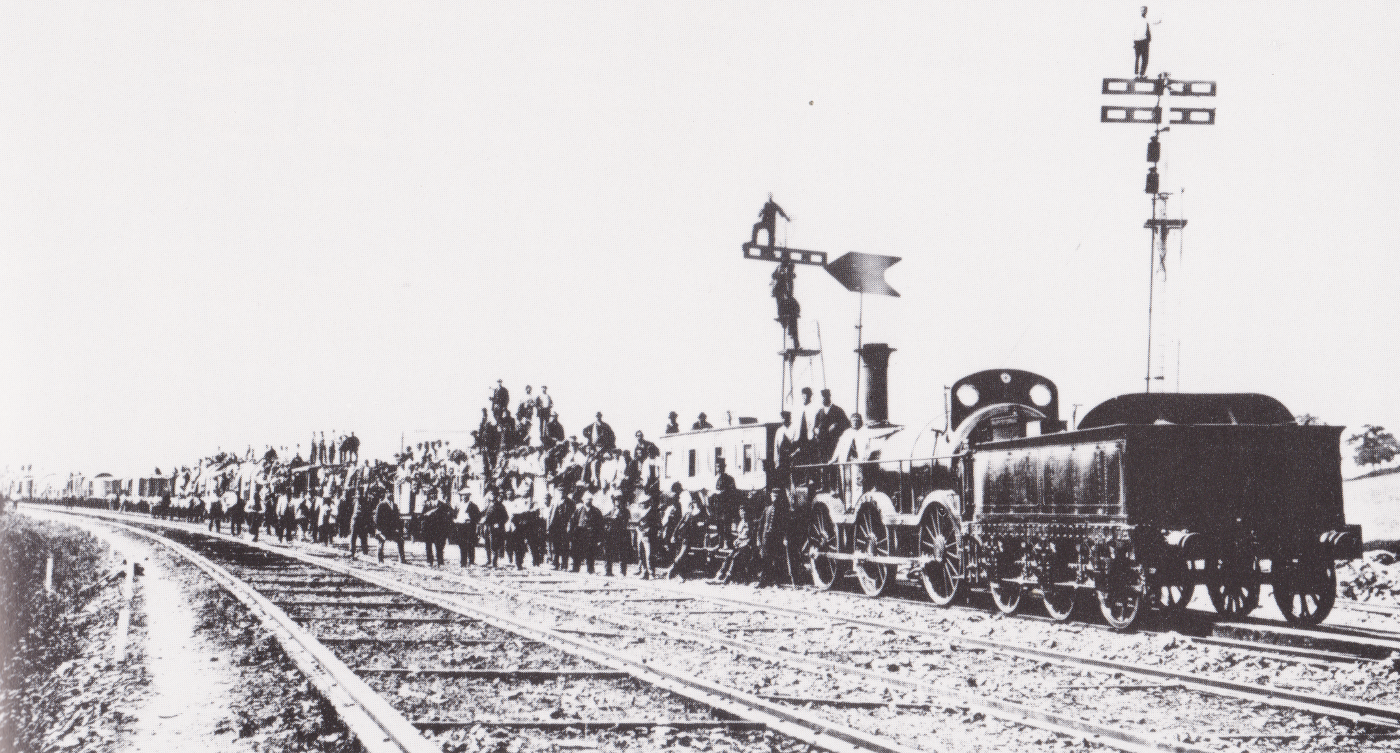
My blog post went to Crimea and all I got was some kid's line drawing of a train.
This is probably a deadhead move between Kadikoi and Balaklava - otherwise, wounded might be on board. The image of the animals struggling to drag wagons through the mud, further above, was also at Kadikoi. If someone asks, we can use these two images as 'before and after' justifications for the railway.
* * *
 |
| from: Atlas of Military History; Parker; 2004; Collins. |
Above is a map showing most of the engagements of the Crimean War.
Ironically, after describing the British efforts, it was the French who finally seized the Malakoff Redoubt on 8 September 1855, making further defence of Sebastopol untenable. The Russian field army had evacuated, destroying the remaining fortifications and naval facilities before they left.
... The Malakoff Redoubt is shown on the largest map above: Find the centre of the harbour, then look to the harbour's south for: Malakoff 'White Tower'.
Regarding railways ... after their Black Sea re-supply routes were cut, Russia's campaign suffered from not having railways to support their counter-offensives on the Crimean Peninsula.
In the end, Czar Nicholas and his campaign failed. He did not witness this, however, as he had died in February 1855.
He was succeeded by his son who became Czar Alexander II (1818-1881). Alexander was a reformer who freed the Russian serfs (Catherine the Great, 1729-1796, used to give serfs away to her many paramours as parting gifts ... by the thousands!). Alexander continued Russian imperial expansion - but in different directions.
... Burned by Britain in Crimea, he later sold Alaska to the US in 1867 to prevent it from being absorbed into Britain's North American colonies.
Ultimately, the British-French 'success' in the Crimean War created no conditions which could not be reversed in due course by Russia.
From cannon captured at Sebastopol were cast the first Victoria Crosses and 111 survivors of the war received this decoration. The Victoria Cross was not awarded posthumously until this policy was reversed in 1907.
Metallurgical research has led to the conclusion that metal from captured Chinese cannon has been used since 1914 to create the medals.
end