Showing posts with label freight routing. Show all posts

26 May 2023

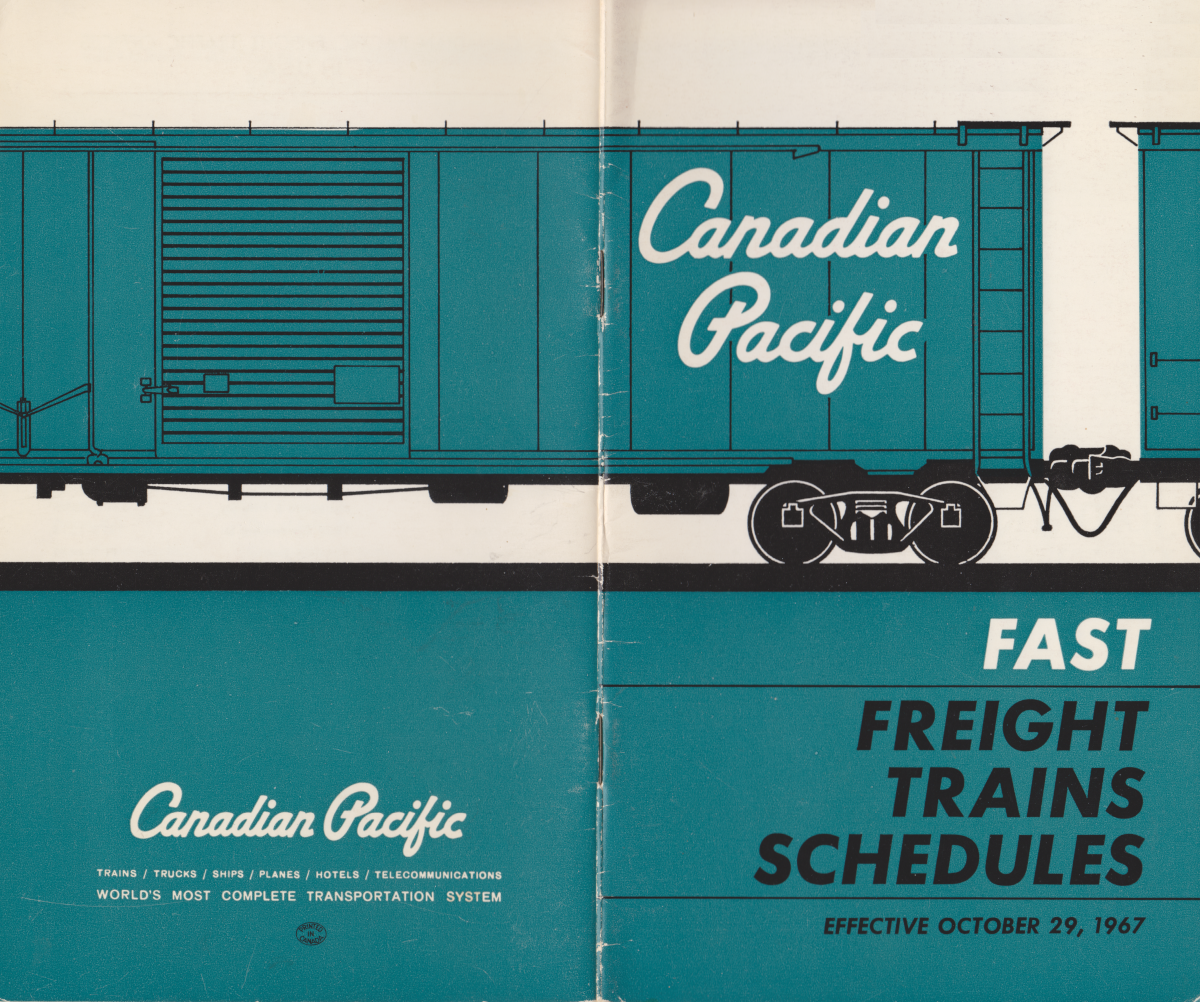
CPR 1967 Fast Freight Schedules

A photo of a 'fast freight' from the early spring of 1969. An engineer on a westbound CPR freight is putting on a show for a small band of railfans who are visiting my usual trainwatching spot north of 40th Avenue Lachine. Westbounds passed here at a good clip and the warm diesel fuel mist coming out of the stacks is an unusual confection for the photographers' benefit.

Car control computers were in use by the time this schedule was published. At crew change points, several teletype terminals might be present, using code-punched paper tape (essentially 'ticker tape') - a medium providing 'temporary local data storage' of a train's consist. A complete train's tape would be wound in a neat figure-8 on the operator's thumb and pinkie finger, and carefully cinched in the middle with the tail of the paper tape end or an elastic. The local 'off-line database' was a board with train-number-labelled wooden pegs, on which the figure-8s were hung. 

(To see a few articles showing this and older CPR car control systems type Bob Mura into the search box at the top of this page and press 'return'.)

... As trains were broken up or assembled, segments of tape (representing blocks of cars) could be fed into the teletype terminal's tape reader ... in the appropriate consist-sequence ... so that a new consist could be registered with the central computer. Then users could print a wheel report on tractor-feed paper for those employees needing one.

Whether they were using a purely manual system, or the newer teletype/tape system, one must admire the experienced headquarters and divisional car control clerks, machine operators and other staff who had a mental model of how the CPR's complex freight routing system worked. Here is an quick overview of the sections inside this booklet:

Pages 1-3: A listing of the various runs, sorted by city of origin, providing train number(s) for the run.

Pages 4-9: Local trains, listed from east to west. 

Pages 10-19: Transcontinental trains, but also including western and US local runs.

Page 20: A summary of CPR freight cars by type 

This list includes archaic types (in 2023) such as: standard refrigerator cars (using ice); automobile boxcars (using the Evans Device to winch the first 2 of 4 automobiles carried per car into the upper corners); and livestock cars. The principal stock feeding stations are recorded as Winnipeg and White River (Page 13).

Page 22: A list of Canadian and US freight offices.


from: Mike Gammon (via Jim Christie)
See Page 6, above.

The time for 86 was similar coming east through Calumet across the Ottawa River from me in the wee hours of the morning in early from 1972 on as I remember it.

Montreal Ottawa # 85 was usually around 10:00 to before noon westbound through Calumet.

from: Jim Christie
I recall 85 at the time you mentioned.  I didn't remember that 86 ran at night.  I dug out my old CP employee timetables; 75 ran via the M&O!  86 ran on the Lachute.  There's no train 85 listed.  I think it ran as an extra, but there is a train 54 that ran during the day from Ottawa to Montreal.  I'm guessing that was the local that picked up/dropped off at Gatineau, Masson, Thurso, Marelan, Lachute etc.  Trains 75 and 86 were shown as Third Class, whereas 54 is shown as Fourth Class.

Thanks to Jim Christie for passing on the additional information comments regarding this post!


from: John Ruth (via Jim Christie)
See top left of Page 11 above.

The destination "New York ( Oak Point )" for Train NH-NE-2 is a reference to a car float yard on the East River in the southeast of the Borough of The Bronx of NYC.

This was one of two NY Harbor car float yards of the NYNH&H. ( The other was Bay Ridge in Brooklyn, reached via the Hell Gate Bridge. )

Interchange here with MANY other RR's via car float, plus "pier floats" to interchange with ships.

A person could spend their life studying all the interchanges and possible routings that once existed in the USA and Canada!


21 April 2018

CPR Railway Line Clearances in 1963


This post looks at how North American railways ensured that a special dimensional shipment, or a new larger rail car, could be transported over their lines in safety.

At the end of this piece are three articles my father clipped from the Canadian Pacific Spanner magazine from the 1950s and 1960s. They show three different systems used to check these clearances. As many will know, the dome cars of The Canadian required some advance work along the railway and that is the subject of one of the articles.

A management truism is that people don't plan to fail - they fail to plan ... I just hurt myself writing that. This failure is often the subject of TV news novelty stories. Overheight buses and trucks are regularly peeling off their top layer of metal when they come in contact with a restricted overhead clearance - this is often a railway bridge taking its revenge on its rubber-tired rivals. This type of accident seems to be caused by temporary traffic rerouting from a known safe route, becoming lost in a strange city, or reckless reliance on a GPS device.

After railways became an essential transportation system in North America in the late 1800s, it was advantageous to develop an integrated trans-national system which eliminated most of the risk of moving unusually large items ... about a century before laser measuring devices, portable computers and the internet.

In the 1960s, a directory was published annually, including every section of every line and its height and width limitations. Weight limits - often documented in employee timetables - were also included in this reference.


*  *  *

Here are some of the basic dimensional standards used back in 1963.


*  *  *

Here are the pages applying to the Canadian Pacific Railway in 1963. 
Here's how to use this reference document.

If you look under the Atlantic Region, Woodstock Division, you'll spot the 'railfan famous' Norton to Cumberland Bay, New Brunswick piece of line with an unusually low 142,000 pound weight limit.

At the right side of that line, you'll see this section is represented in column No. 97.

To see how you can determine the dimensional limits on this line, join me down on Page 52, below ...


Hello again ... below, you'll find column No 97.

At the bottom left corner of the page is a rail cross-section and the column above it is graduated in feet and inches above the rail. 

Looking back at column No 97, you'll see a dark black line capping the column, suggesting that the tallest shipment must clear 19 feet. At 19 feet, the maximum width is four feet, six inches.

Between 2 feet and 15 feet above the top of the rail, the maximum width is twelve feet, zero inches.

To see if it was theoretically possible to route a shipment over several railways, it would be necessary to list all the line segments to be used by the shipment ... then ensure that each line segment could handle the weight and dimensions of the shipment.

Keep in mind that the final dimension restrictions for a line segment might be cumulative - that is, there might not just be one tight clearance as the 'ruling clearance' for the line - there might be many places where structures and objects encroached on the passage of unusual movements. These might include railway truss bridges with their structures above the track, tunnels, rock cuts, road overpasses, buildings, etc.

... In fact, on the line segment listings on Pages 46 and 47, above, you'll also notice the dimensional limits of some railway watercraft used on CPR routes.


Rail enthusiasts often enjoy model- or computer-based train operation and even dispatching. You never know ... there may be an extremely small and truly elite group who would enjoy sitting down with a reference such as this ... and spending hours calculating how a heavy, oversized shipment could travel between two points on opposite sides of the continent. 

However, it is likely that there would be no market for a Freight Clerk Simulator! computer application. Many, many railway jobs were just not particularly glamourous or exciting.

*  *  *

Here are three articles looking at different methods of measuring or checking a line's dimensional limits.

probably from: CPR Spanner, April 1964.


Below, you can see one of the workers standing by an air brake gauge and backup up whistle.
Probably included here is lever to dump the air in an emergency.