Here are four articles, in chronological order, describing the creation and evolution of the centralized power and car control systems used by the CPR in the 1970s.
You can imagine that this kind of live, graphic representation of the entire railway had been a dream of railroaders since the CPR was completed. Out of technological necessity, the railways had been segmented into Divisions with a Superintendent overseeing the local physical plant, staff and the rolling stock.
The early supervisory 'range' of the division superintendent had been determined by the limitations of the early steam locomotives. Every 125 miles or so (a Subdivision), they had to be re-coaled and have their fires cleaned at an ashpit. These dirty operations were incompatible with the clean station waiting rooms, passenger platforms and the travelling public. Over by the roundhouse ('the shop') was where the coal dust and ashes flew.
Once a fresh, clean engine from the roundhouse Ready Track was coupled to the headend, the train could depart. After it had travelled 125 miles away, the former fresh clean engine was uncoupled, the dust and ashes flew, it was turned on a turntable, and returned to its home roundhouse at the headend of the next appropriately-sized train travelling in that direction.
You can see on the 'planning stage' map, below, that the railway's segmented structure was determined by the range (and speed) of the steam locomotives of the 1880s. Each circle along the top of the map connects with the projected location where a steam locomotive would begin or end its run. At the end of the 125 mile run would be a roundhouse with locomotive maintenance staff, a coaling facility and a plentiful supply of 'good' water which was free of mineral impurities.
A superintendent would reign over the track 125 miles to the east and 125 miles to the west.*
His 'subjects' would be his:
- locomotives
- the roundhouses and roundhouse staff
- the running trades crews (engineers, firemen, conductors, trainmen)
- the dispatchers and (their remotely-located hands and eyes) the telegraph operators
- the maintenance of way staff - with the staff sub-divided into handcar-range 'sections'
- yard clerks to document and bill for the railway cars in the various yards and industrial tracks
- personnel and payroll staff
- And experienced, specialized management staff to supervise all these specialized groups of workers
* Note: Divisions often exceeded 250 miles in length (or 2 subdivisions) and there were many other specialties of railway workers.
This is just a simplified explanation.
 |
| from: Van Horne's Road; Omer Lavallee; 1974; Railfare. |
Considering the original technology used by a Canadian wilderness railway, the only method of communicating with Headquarters was by paper (travelling at the speed of the fastest passenger train) ... or by telegraph.
Locomotives became more powerful and dependable and some were operated through/beyond the usual 125 mile change-off points - particularly on fast passenger trains where retaining the same locomotive saved time. The track and roadbed evolved to support faster, heavier trains. Operating rules and signalling improved to accelerate train movements - for example, when a train had to slow down and stop as it cleared the main line for an opposing train.
The system-wide implementation of telephone communication 1900-1930 (it was probably phased in - based on traffic density) enabled more immediate and more detailed reporting on the location of trains, locomotives and cars ... and on the general condition of the railway.
Reporting could have been done by telegraph from the earliest times. However, with telephones ... any person without telegraphic skills could pick up the phone and immediately speak to any other person. This facilitated the timely reporting of information (without telegraphic 'translators' on each end) and it allowed for a dialogue when a company officer wanted to direct subordinates toward a particular outcome or to assess their needs for special resources. As Canadian railways were generally conservative in their adoption of new technology, routine reporting of car control information was still largely done by paper.
However, in spite of these significant technological advances ... the steam locomotives still required constant, specialized maintenance by their local divisional roundhouse workers. These engines generally had useful lives of 30-40 years - with regular but conservative rebuilding. The firebox, the high-pressure vessel (the boiler), the pistons, valves and linkages (the transmission), the countless simple curved metal-on-metal bearings greased with different specialty petroleum products ... demanded expert attention.
... There were many different designs of steam locomotives and some were better suited to particular work in particular geographical territories more than others. So it was still beneficial for the Superintendent and 'his regional roundhouses' to generally have 'their own engines' to control the maintenance challenges and complexity as much as possible.
In the 1950s, teletype equipment was set up at large freight yards of the CPR so that train consist information (listing every car on a train) could be relayed to a centralized database in Montreal. This was much faster than paper.
Also in the 1950s, diesel-electric locomotives were well on the way to completely displacing steam locomotives. Diesels required much less frequent maintenance. A single engineer could operate an integrated (multiple unit) locomotive consist of almost any power. Motive power could be coupled to a through train and run over distances of 500 to 1000 miles without a change. This was far beyond the practical range of the steam locomotives of the 1880s. The roundhouses and the coaling plants were doomed.
With dieselization, telephones, and 'long distance' computer-facilitated car control it was finally possible to centrally supervise, almost in 'real time', what was happening out on the transcontinental railway. The necessity of entirely delegating the operation of segments of the railway to distant superintendents and their armies of workers was coming to an end.
... If a train left a yard with 3 locomotives and 80 cars, central supervisory staff at Headquarters knew the identities of each piece of equipment.
If cars were set off or lifted, or a locomotive was replaced or 'isolated' because of a defect, those details were centrally known no later than the next crew change point ... because the crew going off duty reported these events on paper to the yard office staff. In most cases, however, the motive power information had already been communicated to the dispatcher via a trackside telephone box, or by radio. This information was available to those making decisions about motive power at Headquarters so power problems could be dealt with at the next possible opportunity.
The Operations Centre of the 1970s (articles)
The business of a railway is safely moving railcars for a paying customer, between two points, based on promises of a certain consistent level of service.
The cars are transported by locomotives costing millions of dollars.
In order to meet those service guarantees and to make best use of the new, dependable diesel motive power ... centralized decision makers were finally able to receive timely information on all rolling stock and to quickly communicate their plans, or necessary adaptations when faced with problems.
* * *
For the sake of getting things right ...
I think they mixed up the captions for the first two groups of people (one group of 4, one group of 5). Paul Cavanagh appears in the third article (for confirmation) and he resembles the man in the middle of the second photo (a group of 5).
From 25 April 1973:
From 27 June 1973:
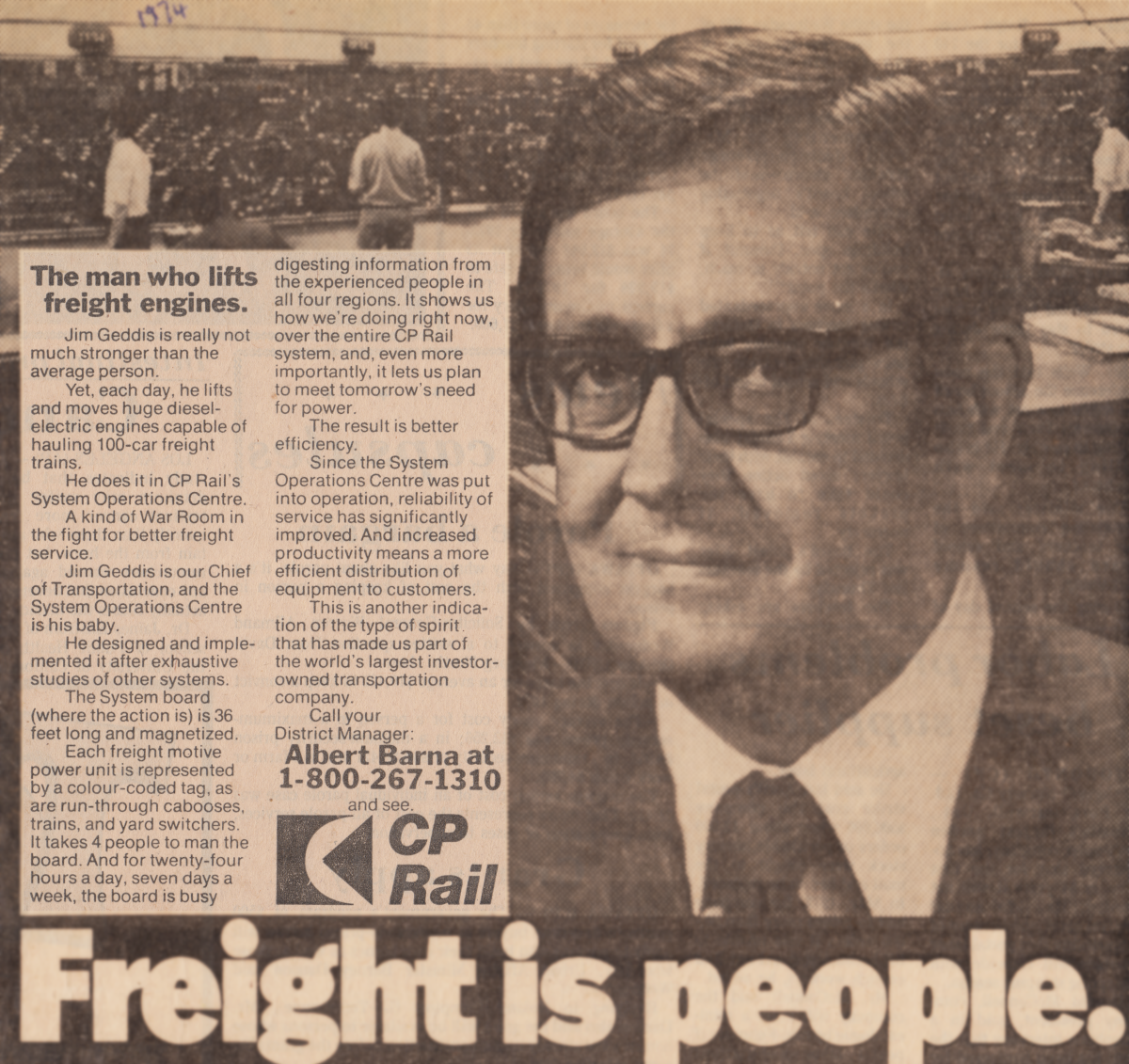
From 27 March 1974: