Showing posts with label Sudbury. Show all posts

06 December 2024

CPR 1957 Condensed Public Timetable (Toronto); Postcard: Sections at Sudbury

Pool trains, mixed trains, Dayliners, The Canadian, steam. It is hard to imagine a period of Canadian passenger train history which had more variety in its rolling stock. ... Claims like this can always be debated - so I said 'it is hard to imagine'.

And it is hard-er to imagine ... a passenger train smartphone application which could present all the data shown in these cheap little folders as concisely and effectively. Looking beyond the schedules, we've got train equipment listings and interior specifications for the particular cars normally in service on a train, Toronto Union Station's CPR arrival & departure board, taxi and ferry arrangements (SSM), international routes and the railroads providing the service beyond CPR rails.

This folder had to present all this information in a small space to avoid the expense of handing out system timetables for every potential passenger who had a multi-city travel plan from Toronto. It had to be complete, correct and clear enough in its design to allow as much passenger 'self-service' as possible - to forestall the need for lengthy explanations by ticket office staff.

A continuing criticism of North American time reckoning is that 'we' don't work well with a 24-hour clock system ... so the printer had to fiddle around with regular type for AM, and boldface type to denote PM hours. 

The task of proofreading the final draft of this folder would have required considerable knowledge and certainty that the data was correct. There would have been exacting attention to detail. The extra cost resulting from a spoiled print run would probably be investigated by superiors.


*  *  *

A Sudbury postcard from the late 1950s.


*  *  *

A Sudbury topographic map from 1938.

from: Historical Topographic Map Digitization Project. https://ocul.on.ca/topomaps/collection/


19 July 2018

Capreol, Sudbury, Ignace - Places Along the Way, 1989


In September 1989 we made our usual western trip.
Some railway features along the way are the focus of this post.

While our schedules seldom permitted lingering at intermediate towns,
I'm glad I invested in locally-produced town histories when I could find them.

... Over decades, as fewer citizens have been employed by railways at these smaller railway centres,
the cultural awareness of local railway operations has eroded quite quickly in many cases.

Often, the local public library maintains a valuable cache of railway heritage information.


*  *  *

CAPREOL - JUST NORTH OF SUDBURY
(Originally a Canadian Northern division point)


This location is known in 2018 as the Northern Ontario Railroad Museum & Heritage Centre. In 1989, here at Capreol, we spoke to one of the women volunteers who was very knowledgeable about local history and the railway. 

How long ago was this? Another person was interviewing a potential employee and he asked her if she had ever 'burned a CD'.


We dropped by at 20hr on the evening we arrived at Sudbury to see the museum site.

... Via Google maps in 2018, the Centre seems to be doing really well today.


On that same evening we also visited Capreol yard.
Above, looking west ... below, looking east.


*  *  *

SUDBURY


On the morning of our easiest day of travel,
between Sudbury and Schreiber,
we had a quick look at Sudbury yard.


This photo above is over-exposed because I wanted to get some detail of the station.


This hand-coloured postcard was mailed to Ormstown, Quebec in 1912.

*  *  *

MAP OF NORTHERN ONTARIO FROM 1912

Atlas of Canada; WJ Roche, Minister of the Interior; 1912; Govt of Canada.


*  *  *

IGNACE

... The first CPR division point west of Thunder Bay.


A postcard mailed in 1984 looks toward the west end of Ignace.
The station is beyond the right edge of the photo.
You can see a large, turquoise CPR bunkhouse radiating south from the power track.


These photos were taken on our return trip - between Portage la Prairie and Thunder Bay.
I believe we are at the west end of the yard.
Taken at 16hr, my photo caption jokes that the track crews were playing 'tie plate soccer'.
... At least, they were skirmishing over something that heavy on the ground.


I never found the modern iteration of the Ignace station particularly attractive.
I believe this is the south side.
The fish-eye treatment of my lens makes it difficult to match the two halves well.


Cover image detail from: Ignace, A Saga of the Shield; Elinor Barr & Betty Dyck; 1979; The Prairie Publishing Company.

The Winnipeg to Fort William section of the CPR line was doubled between 1905 and 1909 (source:Wiki) to accommodate grain traffic. The strange-looking mounting of the train order signal at the 'back' (south side) of the station was a bit of a puzzle. I would love to see a 'ball signal' hanging beyond that dog, but it is probably just a yard light.

Passage from Ignace, A Saga of the Shield :
'Crews completed doubletracking in 1908. Allied work at Ignace included enlarging the railway yards substantially. The CPR houses, now blocking the proposed crossover south of the station were shifted back on to basements poured behind each building.'

The station no longer exists, but the company housing with its hip rooves still appears in a 2012 version of Google maps ...

from: Google 2018 - Image from 2012.

The view above is on Front Street with the tracks beyond the houses and to the north.


from Bing maps circa 2018

The former CPR houses can be seen above on Front Street.
Between them and the light grey 'island' where the station was located,
is the 'new' south main track which displaced them circa 1908.

This interesting summary of the first CPR facilities at Ignace comes from Ignace, A Saga of the Shield:
'The CPR finished constructing its facilities in 1887. The 12-stall roundhouse and hand-operated turntable dominated the less pretentious buildings surrounding them. Nearby a coal shed 280 feet long paralleled a side track, and the platform-fronted station hugged the main line. To the west stood a water tank, with its eye-catching windmill; to the east, a fenced field where prairie cattle broke their journey.'

from: Ignace, A Saga of the Shield; Elinor Barr & Betty Dyck; 1979; The Prairie Publishing Company.

Before its purchase by the CPR in 1910, this building was a hotel built during the Sturgeon Lake gold rush.


Ignace, A Saga of the Shield; Elinor Barr & Betty Dyck; 1979; The Prairie Publishing Company.
Caption from: Ignace, A Saga of the Shield :

'An Ignace crew prepares this woodburner for duty as a doubleheader.'

The engine seems to be 'cold' so its crew probably has not been ordered for duty. This may show the locomotive in the process of having its coupling system and pilot changed from a link and pin technology, to Janney-style couplers.

A number of old design features and locomotive technologies can be seen in the photo above.


13 August 2016

Roadmasters Debate Switch Targets in 1910


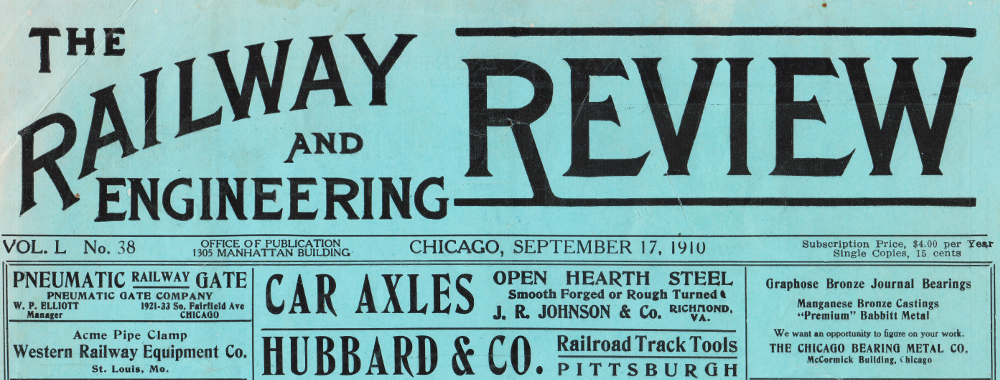
Years ago, I purchased this roughly treated old journal. The ads are perhaps more interesting than some of the professional/technical articles on Northern American and British subjects. Bound copies of this journal may be found (without advertisements) at archive.org.


A simple but important safety appliance - particularly on the main line - was the switch target. Below are views presented in a committee report of the Roadmasters' and Maintenance of Way Association Convention at Chicago in September 1910.

The committee members fail to resolve the question. Their perspectives illustrate the difficulties encountered when trying to standardize the practices of individual railroad companies.

From other sources I have inserted a few illustrations of targets.


A break from these deliberations for illustrations of some targets ...

Early Railways; JB Snell; 1964; Weidenfeld and Nicolson.
Here is a British Home (absolute) Signal of the 1850s. The book doesn't elaborate on the purpose of the two rotating target shafts ... and whether one is linked to a switch or not. This may be a sampler which displays two pieces of equipment together - but not in a real operating combination.

At the right, the basic principle of a 90 degree shaft rotation which displays the target at a right angle to the track to indicate a restriction, or no target to indicate clear track ('normal' position) ... can be seen.

At the left: Considering the difficulties of finding switches in the dark, possible disorientation, and the added dangers of operating by night ... the desirable idea of always displaying one of two lights by night - a restricting indication or a clear indication ... is also demonstrated.

Leaving the earliest targets on signals or switches ... and on to more modern switches ...


By Steam Boat and Steam Train, The Story of the Huntsville and Lake of Bays Railway; Niall MacKay; 1982; Boston Mills Press.
Near Huntsville, Ontario in 1951, are the artifactual remains of a stub switch on a switchback.

Switchbacks were track zigzags with tails - the camera is over a tail - which were used to ascend steep grades. Switchbacks were relatively rare on Canadian railways because a train had to stop on the tail track and reverse direction onto the next segment of track.

To increase the 'run' for a given 'rise' ... loops or spirals of track were more efficient than switchbacks because trains could save time, and maintain their momentum up the grade, without having to stop ... and they could avoid the derailment risks of extra stops and extra switching at each tail track.

Above, to present a warning where safety is more likely to be at risk - a target is presented to a descending train when the switch is set against it.

*  *  *

Canadian Railway Scenes, No 2; Adolf Hungry Wolf; 1985; Good Medicine Books.
At the first station at Sudbury are two nice examples of old switch targets on the early CPR. 

The main track switch by the locomotive's tender shows the single target (with two holes) for daytime and the two-colour switch lamp for night operation. Both are elevated so an approaching engineer can know for certain as soon as possible if the switch is lined 'normal' for the main track ... or for a diverging route.

The chevrons of the target in the foreground cannot be mistaken for the main track target. They apply to the secondary route in front of the station and show whether or not it is set for a diverging route.

*  *  *

The Toronto Grey and Bruce Railway 1863-1884; Thomas F McIlwraith; 1963, 1971; Upper Canada Railway Society.
At Owen Sound, Ontario, circa 1890, is a three-way hand-thrown switch with an interesting oil-burning switch lamp. Switch stands and lamps of simpler construction can be seen in the distance.

With three possible routes to and from this switch ... it remains a question how or if the switch lamp was used to precisely communicate the exact lining of the switch to approaching movements from both directions.

*  *  *

The roadmasters continue ...


*  *  *

The Compendium of Signals; Roger FR Karl; 1971; Boynton and Associates.
Above, are shown some standard switch targets. Whether there is a need to display a second target - when the switch is lined 'normal' for the main track is what the Roadmasters are debating. As the diagrams indicate, most or all of these switch stands are designed so a switch lamp can be fitted for night operation.

It seems likely that the general improvement of railway technology and practices eventually eliminated the desirability of having a daytime target for 'normal'. In the early days, there were many manufacturers of equipment and there may not have been iron clad traditional practices recognized by all operating employees. Trains travelled at slower speeds on the early, primitive track structures.

Once railways had employed a few generations of track maintenance and operating employees - rules and operating practices would have become better established ... eg. 'our switches are in always in normal position when lined for the main track'.

As train speeds and traffic density increased, engine crews became busier. It would have been simpler to watch ahead for rare, prominent red switch targets of 'danger' ... than to watch the track ahead for all the other possible signs of danger ... and also to search ahead to identify every single approaching switch target and to confirm that it was safely lined for the main track.

*  *  *

Advertisements from The Railway and Engineering Review ...