Showing posts with label Dufferin. Show all posts

01 December 2023

The Countess of Dufferin, Postcards x5


At the top of the postmark, you can barely make out GT Ry. According to its serial number, the postcard below was published in 1910 - although the photo may have been taken earlier. Lords Mills is northeast of Brockville. 

The postcards below all show the CPR station at Winnipeg.

It is interesting to see how postcards were used for everyday messages. A telegram would be more cumbersome to arrange and costlier to send. A long distance telephone call would have been extremely expensive - to the point of being unthinkable. I marvel at how postcards used locally for routine messages often showed photo subjects which were so far away.

Finding the correct name for the historical writing utensil used below was interesting. 

When roller bearings were developed, it seems that the old brass bearings were retro-actively renamed plain bearings - prior to that, they were probably just called ... 'bearings' ... maybe 'brasses'. 

... Similarly, a fountain pen - an instrument composed of a nib fed from a refillable reservoir (or a disposable plastic cartridge) was a new technology which superseded a ... 'pen'. 

... The 'pen' was 'a stick with a nib' which held ink by surface tension. During a writing session, it was continually dipped into a bottle of ink. Before that, people would cut a large feather's shaft (the quill or calamus) on an angle and dip that into a bottle of ink.

This first type of mass-produced 'pen' with a metal nib - as used below - is now often referred to as a calligraphy dip pen.


When we were taught cursive writing in Montreal in the mid-1960s (around Grade 4), we used fountain pens with plastic ink cartridges. Pressing down on the pen would spread the tines of the nib to make a thicker line. Often downstrokes are wide and lateral strokes are thin. Ballpoint pens were a great improvement and a great relief - once we had completed our fountain pen phase!

I don't remember seeing a 'pen' being used like this on a postcard before. You can see how Mabel is in a rush to complete her message. In her phrase 'short of men at the shops' ... her nib dries out and she goes back with a freshly-dipped pen to cross the 't' in 'short'. 

Communicating this kind of haste through calligraphy must violate all kinds of Victorian-era rules of etiquette - but the stamp shows King Edward VII, so get over it! (He died during the same year the postcard was sent - in May of 1910.) 

Mabel (the sender) has probably been told to send this message by Jack. She is probably not happy about being caught in the middle. Gressie's father evidently wants his house painted now. I think Gressie is an old Scottish familiar version of 'Grace' ... from what I could find.

*  *  *

In every way, the underlying subject of this post was the epitome of Victorian grace. 

Her spouse would probably generously pay someone to paint your house..

But first, some postcards showing a locomotive ...


The very small circular marking at the top-centre indicates this card was printed in Cambridge, Massachusetts.

*  *  *


*  *  *


*  *  *


*  *  *


from: Manitoba Historical Atlas; Warkentin & Ruggles; 1970; Historical & Scientific Society of Manitoba.

The underlying events of this post take place (1876, 1877) when the Canadian Pacific Railway (often then referred to as the Canada Pacific Railway) was still a government enterprise. Canadian politics had been rocked by the Pacific Scandal. Sir John A Macdonald had lost power in 1873 and would not return as Prime Minister until 1878. 

Notice that the map above shows the CPR avoiding Cactus Plain and 'extensive plains, more or less barren'. This would be Palliser's Triangle in the southwest corner of the map.

*  *  *

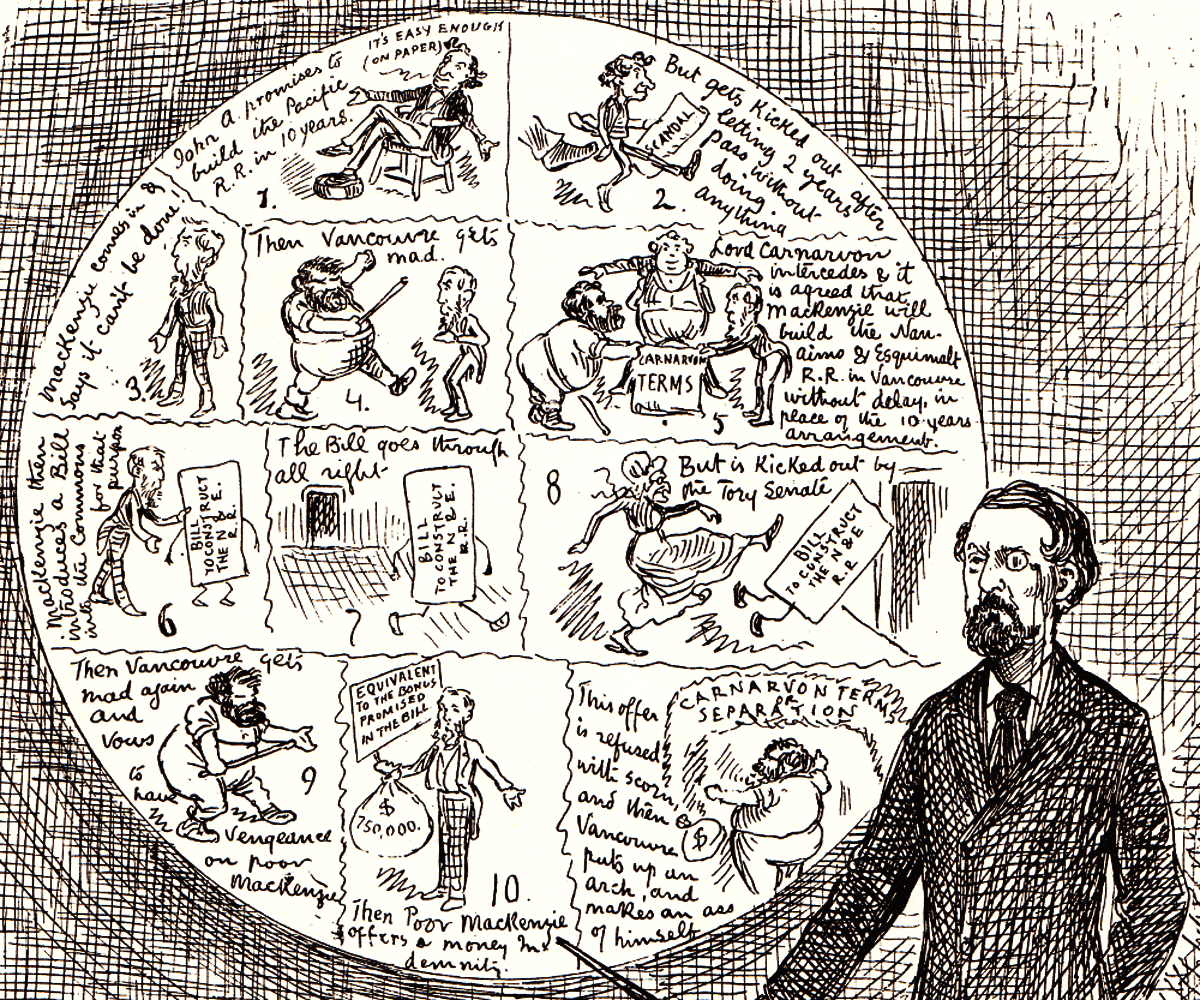
The Earl of Dufferin - the Governor General - and his spouse (the former Hariot Georgina Rowan-Hamilton) 'Hariot Dufferin' travelled to British Columbia in 1876. The caricature below summarizes the events and agitation against the federal government as the promised Pacific railway had still not been built during the regime of Prime Minister Alexander Mackenzie. 

Dufferin was a skilled and accomplished diplomat and helped to calm the waters. He was really an exceptional public servant who put service to Canada first. In a larger context, he was serving the British Empire and his future assignments reflected this unselfish devotion to duty. 


from: A Caricature History of Canadian Politics; JW Bengough; 1886; The Grip (reprint 1974).

Back in those days, wooden arches decorated with greenery, and messages of welcome in large letters, were often built over the main streets on which visiting dignitaries would pass. This was frequently done when heirs to the throne visited Canadian cities. In this particular case, Frame 11 shows 'Vancouver puts up an arch' ... and this wording is what the Governor General Lord Dufferin was confronted with when he came to visit and make peace.

*  *  *

In 1877, Dufferin and his spouse travelled to visit Manitoba and the surrounding area. To read through the account of their trip, one is impressed with the inconveniences and discomfort they met on these trips through wilderness Canada. Representing more than themselves, they consistently rose to the occasion and put service before self.

The people they met, the travel, the settlements, the isolation, the food, and the customs described during this type of old pre-railway cross-Canada trip really give one a sense of what the Canadian wilderness had been like for hundreds of years. And how it was being changed forever. 

Hariot Dufferin's letters home, including her account of the Manitoba trip, were published years later in 1891 as a book. You can get an idea of how this couple approached their duty in the following few pages.

Page 365 and Page 367 can be considered primary historical documents for their description of Hariot Dufferin's contacts with CPR hardware

It is very difficult to keep up with the dates of all the title changes these two experienced during their careers. Apparently, a marchioness is the spouse of a marquess. The anglicized word is pronounced something like 'Martian-ness'.


Here is the archive.org link to Hariot Dufferin's account of her travels if you are interested:

My Canadian journal, 1872-8 : extracts from my letters home written while Lord Dufferin was Governor-General


03 July 2016

Canadian Political Cartoons Around the Railway 1840-1880


The following political cartoons come from A Caricature History of Canadian Politics - a two-volume selection of Canadian political cartoons from 1841 to 1885. The original was produced by John Wilson Bengough (1851-1923) the founder and editor of the weekly political paper Grip - named after the pet raven of the title character in Charles Dickens' Barnaby Rudge.

My copy is a 1974 reprint in a single volume which leaves out cartoons on political issues deemed to be minor and obscure in the modern era. I believe the original two-volume set is preserved at archive . org.

With the railway being the modern, fast, all-weather way to transport heavy loads ... and a key demand of virtually every British colony in North America ... most of the cartoons below are linked in some way to Canadian railways.

Besides Bengough's Grip cartoons, Punch in Canada, Diogenes and Canadian Illustrated News cartoons are also included. 

In the original book, the cartoons were printed on the right-hand page with a brief explanation on the left-hand page. I have connected these into a single image.


In the history of the Canadian rebellions for political reform, Papineau was more patrician that Patriote. When things heated up in late 1837, he headed for the States ... and then it was off to France. After others had made a trip to the scaffold, or the penal colony in Australia, Papineau only returned to Canada when everything was safe.

Brother Jonathan (depicted above and below) was originally a personification of New Englanders - which merged with the Uncle Sam character around the time of the War of 1812. 

After New France was conquered by the British in 1759-60 - and forsaken by France - the British authorities probably had no choice but to make a deal with the Canadiens who outnumbered them along the St Lawrence River.

By the time the 1840s came down the track, it seemed unlikely that the 'French Fact' in North America, and the provisions of the British North America Act of 1774 (aka The Quebec Act), would mean anything ... if ... the Canadiens of British North America were 'liberated' by the monoglot United States of America through annexation.

Approximate population c1840: Lower Canada 700,000; US 17 million.

A contemporary Stephenson engine is shown below.

Restored Stephenson and Sons engine from Nuremberg to Furth line - 1835.
from: Early Railways; JB Snell; 1964; Wedenfeld and Nicolson.

*  *  *


from: Canada's Five Centuries; W Kaye Lamb; 1971; McGraw-Hill.

Sir John A Macdonald in 1868. He became Prime Minister at age 52 in 1867. His first term ended, in 1873 - largely due to the Pacific Scandal. He was back as leader in 1878, and served until his death in 1891.


The use of Time Balls and Noon Guns is a well-worn topic of my internet efforts. Railways, the telegraph and Sandford Fleming precipitated forms of standard time. As this cartoon pre-dates the founding of the Dominion Observatory in 1902, a local solar observation or a timepiece of railway or military accuracy probably cued the gun crew.


from: Vanishing Canada; Rick Butler; 1980; Clarke Irwin and Co.

Here is the interior of the first House of Commons in 1897 - which was destroyed in the 1916 fire. It is not clear if the flaring light is natural or produced by flash powder or electricity. This was long before the blaze of today's TV lights in the House.


Passages from: Lords of the Line; Cruise and Griffiths; 1988; Penguin ...
  • [Sir Hugh] Allan grew increasingly irritated through 1871 with Macdonald's incessant harping about a predominantly Canadian railroad.  
  • ... Allan went right to the source of his problem, the politicians - hatching a brilliant scheme of bribery and blackmail.  
  • The most astonishing aspect of the Allan affair is not that it happened, but that it was so well documented. In July 1872, Allan actually outlined his blueprint for buying the government to General GW Cass, one of the 'yankee confreres' Macdonald so vehemently opposed. It was nineteenth-century political hardball at its best - or worst.

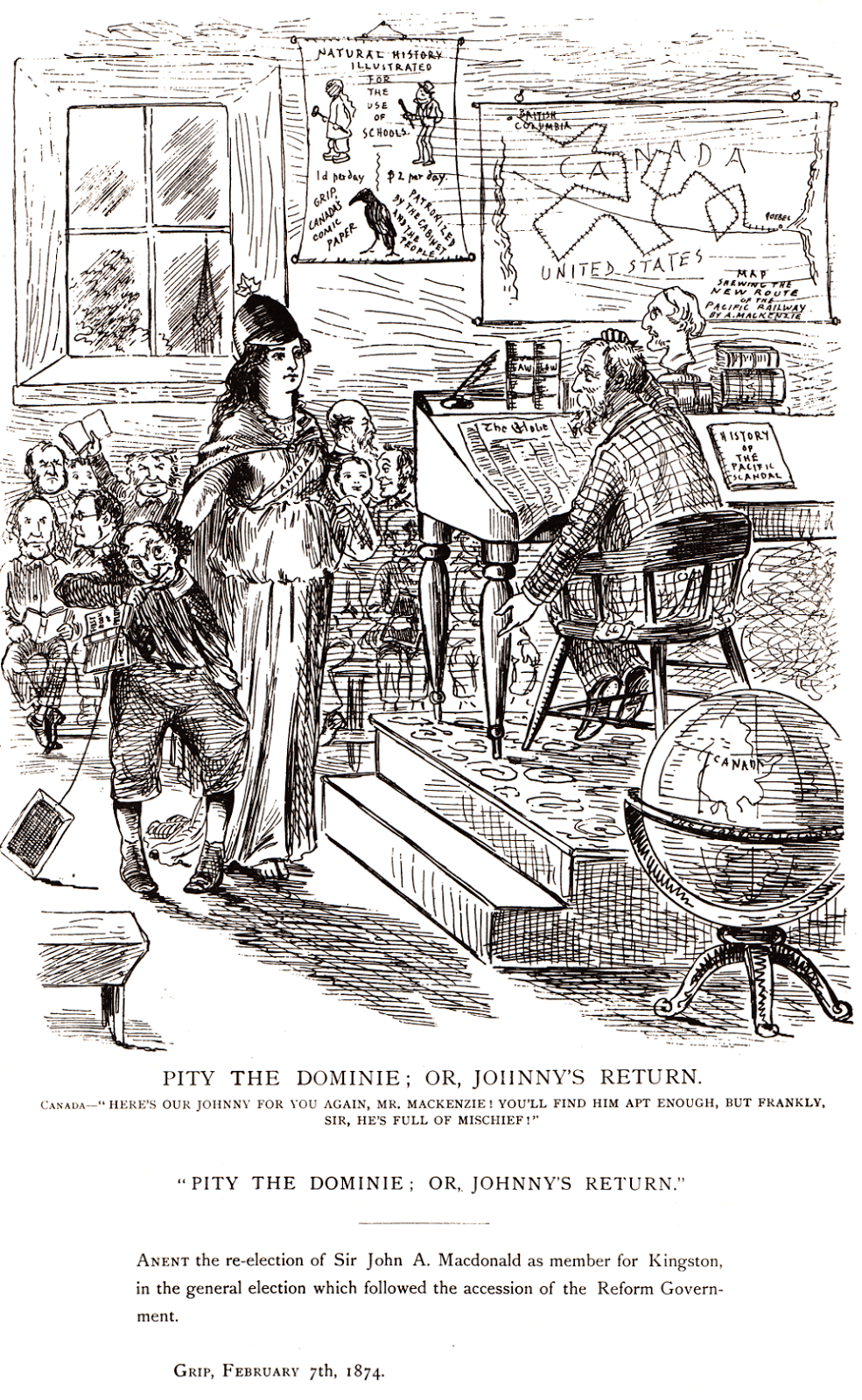
With Alexander Mackenzie as the new Canadian dominie (Scottish schoolmaster), Sir John A Macdonald returns with this new class of the House of Commons from his Kingston riding. Macdonald trails his school slate - paper was too precious in that era ... with First Book of Politic [sic] under his right arm. Mackenzie is reading the 'Reformist' Globe newspaper, which has endorsed him in the past.


from: Canada's Five Centuries; W Kaye Lamb; 1971; McGraw-Hill.

(Poor old) Alexander Mackenzie - undated photo. At age 51, he became Canada's second Prime Minister, serving from 1873 until 1878. He came in with the best of intentions, was in office during a significant economic downturn and couldn't bear to spend money lavishly to build a transcontinental railway. A haphazard blend of rail, water and bush trails was his answer to those clamouring for a Pacific railway.


Grip perches on the chair back.

... but that was not the end of Riel, his role as MP, or his effects on the history of Canada and the Canadian Pacific Railway.

*  *  *

Next: Enlargement below!
This is a wonderful panel - details below ...


from: Canada - A History in Photographs; Hall and Dodds; 1981; Hurtig.
British Columbia wanted its promised telegraph line and railway. The arch was in Victoria in 1876. Notice that the cartoon shows 'Vancouvre'. Still working in the US, Van Horne was years away from naming some future place Vancouver. 

This arch was prepared for the visit of Governor General Lord Dufferin. It was probably bitterly noted at the time that US railroads provided his transportation for most of the trip.

'Carnarvon Terms' referred to British Colonial Secretary Carnarvon's promise that Vancouver Island would at least get an Esquimalt to Nanaimo railway in the interim. The Governor General refused to pass under this archway - rather than condone this blackmail of a/the Canadian government. 

Staying on message is not a modern technique.


Cartoons showing lavish Christmas gifts were a Bengough standard.

Trimming the tree is Charles Tupper - Minister of Railways and Canals. He was approached by George Stephen regarding the idea of a private syndicate to build the Pacific railway. Tupper subsequently worked to convince the Cabinet of the CPR Syndicate concept. 

Edward Blake, Alexander Mackenzie's successor as Conservative leader, is kept away from the tree by Prime Minister Macdonald.


from: Pictorial Encyclopedia of Railways; Hamilton Ellis; 1968; Hamlyn.
An eastbound train on the original Stoney Creek Bridge.