Showing posts with label petroleum. Show all posts

04 April 2026

Diesel Fuel

A 40% premium on diesel fuel?! What happened?

A Volkswagen Rabbit which sounded like a farm tractor was never something I found attractive. However, during the oil price gyrations of the 1970s and 1980s, a number of people did choose diesel passenger vehicles because the fuel was 10-20% cheaper and diesel engines were significantly more fuel efficient than those powered by gasoline. 

Elsewhere, the 1970s and 1980s were characterized by the same old domestic North American products, showing little re-engineering or innovation. Tariff barriers often helped ensure they were made in this country or on this continent. They were relatively expensive. Electronics?: a cathode ray tube TV (maybe colour), a stereo for your 'records', a VCR. An audio cassette player in the car!

Welcome to the 2020s! 

Diesel is more of a globally-traded and -priced commodity today. With this blog's favourite Strait facing selective traffic attenuation, Persian Gulf crude oil is not getting to European refineries ... but our refined diesel fuel is. I saw a Sky News (UK) story today with a graph showing that Canada has the largest diesel fuel reserves in the world. I guess 'had' would be more accurate. 

Since 2000, there has been explosive innovation in new products. Twenty years ago, we could not have imagined all the changes which have taken place - both the new products and the changes they have caused in our societies. 

And now, the whole economy of the "globalized world" runs on diesel - from the trucks moving the shipping containers to the docks of China, Vietnam, Japan, South Korea and Taiwan ... up to and including the wide assortment of courier trucks racing up and down our street every single weekday ... and now on weekends.

And the Europeans have perfected clean diesel automobiles! These are not your father's Volkswagens!

With the US military on the move in recent months, 'middle distillates' diesel and jet fuel are in greater demand than usual. 

Farmers are planting - creating the usual seasonal demand on diesel ... and they are not happy about the price changes.

And if your experience and knowledge-based hunch is that the higher diesel fuel demand will continue or increase ... petroleum financial derivatives, or a loaded petroleum tanker slow-steaming or loitering between here and Europe or Asia ... is even more of a sure thing than a White House insider pre-Tweet bet on a prediction market. 

*  *  *

Diesel - How It Began

https://archive.org/details/11650204bsb/page/n4/mode/1up

Rudolf Diesel (1858-1913)

If you were to copy and paste the link above, you could read Rudolf Diesel's original treatise. 
Warning: lots of German ... even more math!

*  *  *

screencap from: Rudolf Diesel, Pioneer of the Age of Power; Nitske & Wilson; 1965; U of Oklahoma Press. archive.org 

*  *  *

screencap from: Diesel, Technology and Society in Industrial Germany; Donald E Thomas Jr; 1987; U of Alabama Press. archive.org

Diesel's patent from the Kaiser. 
M-A-N is the abbreviation of Maschinenfabrik Augsburg Nürnberg. 
It will appear again below.

*  *  *

from: Iron Horse to Diesel; Paul Snow; 1961; Whitman.

From a childhood storybook, came this image. I love the artist's flying cogwheels. I believe there were two motor explosions in different settings. One was fuelling with ammonia, the other was using a powdered coal/water slurry. 

During my research, I was reminded that General Electric was experimenting with a powdered coal fuel for a diesel-electric prototype in 1990 ... but there was a note that railroads would have to indicate an interest in the technology for the development to continue. 

*  *  *

screencap from: Rudolf Diesel, Pioneer of the Age of Power; Nitske & Wilson; 1965; U of Oklahoma Press. archive.org

*  *  *

The new fields of aviation and diesel power must have set records for the 'short elapsed time' between the invention of a technology, and its application in war-fighting. 

Elsewhere on this blog, you'll find that a recent Rudolf Diesel biographer speculated that his apparent English Channel ferry suicide was a cover orchestrated by the British to spirit him off to Montreal. This was on the evening of 29 September 1913, on the SS Dresden, steaming between Antwerp and Harwich, England. 

Overnight, on 1 January 1915, the Vickers shipyard at Montreal was turned into a high-security facility with a complete change of personnel. The British Admiralty oversaw the building of 10 H-Class submarines by a workforce of 2000 Americans. The biographer's theory is that the multi-lingual, well-travelled Diesel was 'an expert' brought in to apply Diesel's latest technologies there.

Meanwhile ...

from: Die Höllenmaschine Im U-Boot; Kapitän Herbert Sauer; 1928; August Scherl. archive.org

Top: In the oil engine room of a U-boat in front of the main switch and the engine telegraph.

Bottom: In the diving control center, forward port side. High-pressure compressed air distribution system. In the center of it, the base of the central periscope with eyepiece. Central control station with repeater gyrocompass. Top left, engine telegraph. On the right, under the clock, the quick-venting handwheels of the forward ballast tanks.

*  *  *

from: Geology of Petroleum; William Harvey Emmons; 1921; McGraw-Hill.

At one point, Ontario was Canada's premier petroleum producing province.
The tar/bitumen/oil ... sands are the source of the heavy oil which facilitates the production of large quantities of diesel fuel.

*  *  *

The 1930s, United States ...

There was enough interest in diesel engines in the late 1920s and all through the 1930s, that a magazine existed to write about all the different applications in which the technology could be used. The advertisements are particularly good at depicting this potential. 

Notice the United Fruit Company motive power, pulling what looks like sugar cane. There is a good chance this operation was in Cuba. Unlike the many steam locomotives already present on Cuban railways, these light diesels were able to operate with less maintenance. They didn't have the thirst for water of the steam engines. They were also less likely to emit sparks which could set fire to the dried cane as it stood in the fields.

from: Diesel Progress magazine; June 1935; Diesel Engines Inc. archive.org

*  *  *

The gimmicky, art-deco, streamlined trainsets rode like maintenance-of-way speeder trailers but they spurred on many technological changes.

from: Diesel Progress magazine; June 1935; Diesel Engines Inc. archive.org

*  *  *

Coming to German Cinemas in 1942 ...

from: https://archive.org/details/diesel0000illu/mode/1up

The text-heavy side of this November 1942 German leaflet concludes: 
"A man and a fighter triumphed. And with him, his idea, his work, which changed the face of the global economy."

... Probably the 'Reichsminister für Volksaufklärung und Propaganda' did not subscribe to the theory 
that Rudolf Diesel disappeared in order to build Royal Navy submarines in Montreal. 

I've watched parts of this movie - it's on YouTube.
The directing is a little heavy-handed ...

*  *  *

1950 - General Motors Booklet

from: Diesel the Modern Power; Ralph A Richardson; 1950; General Motors. 


from: Diesel the Modern Power; Ralph A Richardson; 1950; General Motors.


from: Diesel the Modern Power; Ralph A Richardson; 1950; General Motors.

To make interpretation a little easier ... the three little rocker arms above the cylinder show you when the valves and the injector are doing something. 

The two-cycle innovation is 'scavenging'. Instead of using a piston cycle just to push the exhaust gases out ... an attached blower clears them and replaces them with fresh air at the same time. Consequently, every 'downward' piston movement is a power stroke. 

These opposed-piston engines were even more efficient ...
but, as adapted space-saving marine/submarine engines, 
they were more complicated, too different, and too troublesome in the long run.

*  *  *

From a 1957 Textbook on Petroleum ...

from: Petroleum, Prehistoric to Petrochemicals; GA Purdy; 1957; Copp Clark. 

*  *  *

A Transport Canada Railway Locomotive Document from 2001
(a quarter of a century ago)

This material will not be on the proverbial test. 
Perhaps some readers may be interested in how some of these older units compare.
This publication says this data comes from AAR testing.

IG is Imperial Gallon
MM is millions
NOx and SOx are oxides of nitrogen and sulphur.
HC - hydrocarbons, unburned 'oil'
PM is probably PM 2.5, the nasty little bits of soot that can pass from the lungs into the bloodstream.

from: Diesel Fuel Quality and Locomotive Emissions in Canada; Robert Dunn; 2001; Transport Canada. archive.org


I believe that Brake Specific Fuel Consumption (bsfc) is a way of expressing fuel efficiency. It is more complicated that the 'best' fuel efficiency ... because it factors in cycles of performance under different conditions. The lower bsfc numbers indicate a more efficient engine.

A 'brake dynamometer' attaches to a crankshaft and applies different measured braking (i.e. resistance) forces on it to simulate the various loads under which the engine works.

While the newer units don't seem to offer significantly better efficiency on a 1:1 basis ... the text reminds us that they provide more power per unit and that they burn the fuel with less pollution.


from: Diesel Fuel Quality and Locomotive Emissions in Canada; Robert Dunn; 2001; Transport Canada.

*  *  *

Diesel Engines in Ships

When we get to the use of 'diesel' in large modern ocean ships such as tankers and containerships, there is not one single type of fuel which is burned. Ships carry multiple fuel tanks to allow for cost-effective operation or for low-pollution operation.

Since 2020, the International Maritime Organization (IMO) has required that all ships (unless using scrubbers) must carry fuel oil with no more than 0.50% sulphur content (mass/mass). In specific Emission Control Areas (ECA) fuel with no greater than 0.10% sulphur content can be used. Effective March 2027, the Canadian Arctic and Norwegian Sea become ECAs with the 0.10% sulphur regulation becoming effective.

The text below revisits my 1957 petroleum textbook. The unrefined petroleum is still the same today. The processes for refining it are more complex, so I sometimes like to start with the basic explanation of what they did 75 years ago in simpler times. 

The last paragraph is still applicable. The ship owner is not going to allow the ship's engineers to put just any kind of fuel in a marine diesel engine that costs millions of dollars. 


from: Petroleum, Prehistoric to Petrochemicals; GA Purdy; 1957; Copp Clark.

In reading about future 'alternative fuels' to be used instead of diesel fuel for shipping ... e.g. biodiesel, hydrogen, ammonia*, methanol*, LNG*, etc ... I get the impression they all have some characteristic which makes them impractical outside of those ECAs which require low sulphur fuel. (*Currently used in Emission Control Areas.)

For example: fuels may be scarce and expensive; or, they may consist of the smallest molecule which is always escaping and its supercooled liquid form damages the metal it interacts with; or, potentially extremely toxic to the crew if not handled with great care; or, not containing enough energy per unit and/or requiring more specialized handling than diesel oil. 
Exception: On ships designed to carry LNG ... the ship can be designed to use the 'boiled off' vapour exclusively as fuel.

As with the previously-presented locomotive fleet (and our current automobile fleet) ... owners are unlikely to scrap a piece of equipment which has only been in service for 5 years. Tankers and containerships generally have a service life of 20-30 years. The main engine usually works for the whole lifespan of the hull. 

... So if a miracle like cheap solar-powered electric containerships suddenly descended down upon the earth, the ship owners would probably continue to use their old ships, burning their old fuels, until the end of their normal service lives.

*  *  *

Another interesting thing about modern ocean ships such as tankers and containerships ... 

We have all seen that they are 'welded together' in China or South Korea using cheap labour and/or very intensive automation. You should see some of the plate steel cutting/handling/welding automation videos! ...

However, these mass-produced ships are a 'global trade product'. Sure, the steel is made, the 'unfair subsidies' given, and the brute force assembly is done in Asia. However, the complete engines generally come from Europe. The electronic control systems may come from somewhere else, etc. 

*  *  *

A Ship Built in 2025

from: CGTN news website.

Recently completed in China, this Greek-owned tanker will carry 850-900,000 barrels of oil - depending on the oil's density. 

If you can imagine about 115 of these ships fully-loaded ... it would represent the world's petroleum use on a single day.

The Seascout is powered by a MAN B&W 6G60ME-C Mk9.5 engine - a low-speed, six-cylinder, two-stroke marine diesel. It puts out approximately 22,850 horsepower or 17,040 kW. Its engine drives the propeller directly with no transmission between the engine and the prop. It generally operates at 60-85 RPM (range 20-95 RPM), travelling at about 14 knots. 

You may have noticed the 'MAN' (Maschinenfabrik Augsburg Nürnberg) which takes us right back to one of Rudolf Diesel's first engine builders. Just like General Electric, the name endures but the corporate structures have changed over the decades. I believe MAN is now owned by Volkswagen's parent. 

* * *

People may remember that during the first oil crisis, top highway speeds were reduced, to decrease the fuel burned by highway vehicles ... because of the exponential resistance of air as a car's speed increases ...

The Danish shipping line Maersk first came up with the idea of 'slow steaming'. As with the highway speed reduction, the idea was to decrease the exponential resistance of the water at higher speeds to save on fuel costs. They ran a trial involving 110 ships in 2007. Adjustments were required to the ship engines to avoid damaging them by running them at speeds for which they weren't designed. By dropping the speed from 24 knots to 14-18 knots they found they could reduce fuel consumption by 30% or more. 

Obviously, containerships in high demand and operating on a schedule will operate at higher speeds when necessary.

However, for bulk commodities, ship fuel economy is often more important for profitability than speed. This is particularly the case when petroleum is going to remain 'at sea' for a period of time. There, it waits for the shipowner or product consignor to determine that a given market will provide an advantageous price ... and the ship is then instructed to dock and make delivery.

* * *

He was born in a foreign country. He lived and worked in poverty during his first decade of life. He was subsequently deported to another foreign country at the onset of the Franco-Prussian War.

Rudolf Diesel hoped that poorer countries could fuel his simpler engines with whichever plant oils they had in abundance. He hoped people could derive the economic benefits of efficient, modern motor power. 

Diesel never could have imagined how his invention would dominate the world's transportation system over a century later.

'His work changed the face of the global economy.'


end


05 August 2023

Petrolia, Oil Springs, Sarnia ... and Engine Houses


The 6069 looked well preserved beside the spur leading to the government docks in August 2000. 

Back in the 1960s my parents had also stopped at this spot as we travelled through to visit relatives in Clio, Michigan.


In August of 2000, my spouse and I were off to Sarnia because we had not vacationed there before and because I wanted to look at the present-day refinery facilities. We also stopped at the Dawn Hub to see that major natural gas facility. 

... Some people like to burn refined kerosene for vacation - we like to see where it originates. 

However, the surprise of this vacation was one of best museum combinations I have ever visited. These vacation photos were taken by a point-and-shoot camera during the last days of local automated film processing and printing.


Under the Blue Water Bridge at Sarnia you can see a local switcher near the Thomas Edison Depot Museum in Port Huron, Michigan. 

Similar to visiting Windsor-Detroit, the local river concentrates the inter-lake shipping for those interested in watching ships.

Ships and a barge-tug combination head north over the horizon on Lake Huron as seen from Sarnia.


As we drove toward Sarnia along Highway 402, it was striking to see the endless fields of corn. It seems likely that most of this corn was destined for fermentation into biofuel as a gasoline additive. Back then, 'corn biofuel' was a fairly new provincial scheme to subsidize Ontario agribusiness. 

I haven't seen persuasive evidence that the less-energy-dense ethanol contributes to less greenhouse gas production ... considering the fuel, pesticide and fertilizer inputs to grow the corn ... and considering the energy needed to produce, transport and blend the ethanol. And ethanol's affinity for water dictates railway tank car transportation, rather than 'product pipeline' transport. The good news? Thanks to ethanol we never have to buy gas line antifreeze!

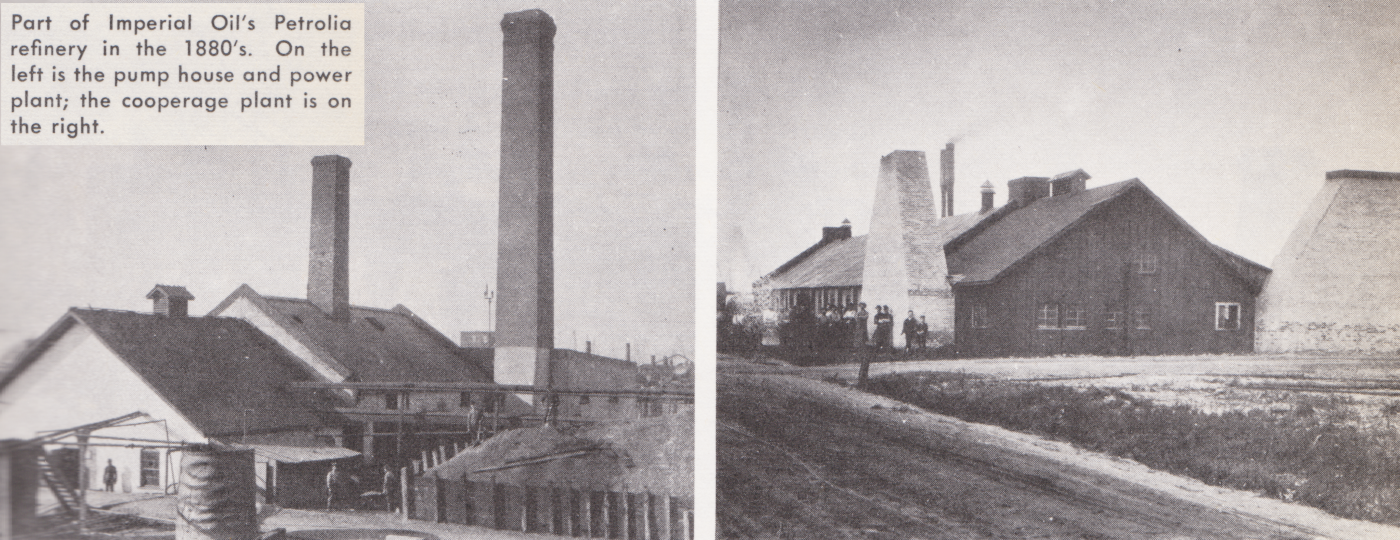
Pioneers of the oil industry in this region had first collected the oil which had seeped out of the ground. As it sat in the 'gumbeds' its lighter fractions (eg. like gasoline) had evaporated - leaving a thick tarry substance. The earliest commercial use of this field-harvested petroleum was 'tar' for caulking wooden ships.

Crude oil was first produced on a commercial basis at Oil Springs, Ontario in 1858. Horse-drawn wagons carrying oil barrels, and later tank wagons, were used to haul the crude from Oil Springs to the Great Western Railway at Wyoming. 

Whale oil had been an important fuel for lighting. The kerosene fraction of the first oil produced was in high demand because of its brighter and cleaner burning qualities in new hi-tech hot blast kerosene lanterns. Modern production techniques would make kerosene cheap and then people could do more things at night.

The lighter components of the oil which were prized as motor gasoline in future decades - were often disposed of in ditches and bodies of water. This is according to an account I read of the early Pennsylvania industry. Otherwise, the unmarketable petroleum was flared off. 

The Titusville versus Oil Springs - 'Who was first?' - I'll leave to people who like that kind of thing.

*  *  *


A commercial:

This post is a direct result of interesting anomalies found within the excellent map resources*
 used in my previous postcard-based post about the international railway tunnels in southwestern Ontario.

Specificially, from the 
*Historical Topographic Map Digitization Project 
https://ocul.on.ca/topomaps/

All top map images in this post are from the 1912, 1 inch:1 mile, Sarnia sheet, topographic map from that website.

Note: Above, there are at least two railway roundhouses in Sarnia,
but neither of them is labelled as an 'engine house' (EH).

Petroleum - Prehistoric to Petrochemicals; GA Purdy; 1957; Copp Clark.

Fans of the Temiskaming and North Ontario Railway will recognize that name Jacob Lewis Englehart (1847-1921). He was one of those who worked to establish Imperial Oil as a collective effort by Canadian companies to dominate the Canadian oil market and meet the competition of John D Rockefeller's Standard Oil of the US.

... The purchase of Imperial Oil in 1898 by Standard Oil resulted in the former's Petrolia, Ontario refinery being shut down in favour of the new refinery built by Standard Oil at Sarnia. The location of this Sarnia refinery is shown on the topographic map above.

The rest of the post will look at the local map from 1912, scenes of early oil drilling and production, and the interesting museum artifacts we saw in 2000.

*  *  *

from: Oil Springs ... The Birthplace of the Oil Industry in North America; Michael O'Meara; 1958, 1998; Oil Museum of Canada.

The map above, shows the general orientation of the key towns and cities in this post.

*  *  *

Below, the 1912 topographic map shows the locations of Petrolia and Oil Springs 
and the railway lines in the area.

Notice all the engine houses ...


Below: It would be meaningless to reproduce the map scale, 
but here is the consolidated legend for these 1912 map segments.


Here is a larger version of the Petrolia segment.


from: Oil - The History of Canada's Oil & Gas Industry; Ed Gould; 1976; Hancock House.

Above, you can see a drilling table, a chain turned around a wooden pole and a ratchet gear. 
There are whole books written about the development of early drilling equipment.

from: Petroleum - Prehistoric to Petrochemicals; GA Purdy; 1957; Copp Clark.

Above: You can see a horse-drawn tank wagon taking on a load of crude oil. The stack of a stationary steam engine is also shown. It looks as if the engine steam dome is connected by a pipe to the wagon! Probably, the engine could have been used to run a pump to load the oil wagon - when it was not actively being used for drilling.

Below: Many different drilling technologies were tried. With this example a walking beam was used to lift and drop a drilling rod - pounding and breaking the rock below. The circulation of drilling 'mud' to clear the fragmented rock from the drilling face was a practice not yet invented. 

With the shallow deposits exploited by the early petroleum drillers, it was probably not too critical to keep the bore clear. Petroleum deposits often had a 'cap' of compressed natural gas. If this pocket of gas was struck first, it would certainly clear out the bore hole!

Sometimes, the gas would blow the oil up in an uncontrolled manner as a 'gusher'. Sometimes, the gas dome might be struck first, venting itself before the oil layer was reached. Just like coal miners, who had special traditional names for the poisonous 'damps' they encountered underground, it seems likely that the early oil drillers were sometimes poisoned on the spot by petroleum gas bearing particular toxins.

The first gusher in world history occurred on 16 January 1862 at Oil Springs and it spewed out about 2000 barrels per day. Before it was brought under control, about 100,000 barrels of oil had been deposited on the landscape. Looking at the watercourses shown on the topographic maps, you can only imagine what kind of condition they were in during this era.

In any case, the natural gas was vented to atmosphere as another unmarketable type of petroleum. No system had yet been invented to capture, compress and ship it through pipelines.


from: Petroleum - Prehistoric to Petrochemicals; GA Purdy; 1957; Copp Clark.

from: Petroleum - Prehistoric to Petrochemicals; GA Purdy; 1957; Copp Clark.

Above: Numerous jerker rods systems are being used to actuate the walking beams which are pumping oil from the well shafts below. In the foreground: This may be a pipe which collects the small amounts of oil produced at each well so the flows can be consolidated into a tank for collection and transport.


from: Petroleum - Prehistoric to Petrochemicals; GA Purdy; 1957; Copp Clark.

Above: No doubt the bunker at the right contains coal to power the pumping steam engines and perhaps to heat the oil during the refining process. Early in petroleum history, wooden barrels of oil were floated down watercourses and across harbours to ships. This process of free water transportation was similar to the log drives used in the forest products industry.

from: Petroleum - Prehistoric to Petrochemicals; GA Purdy; 1957; Copp Clark.

The dome of a railway tank car can be seen in the foreground. Perhaps a failed still boiler lies between the tank car and the closest horse and wagon.


*  *  *

Images from August 2000

Both Oil Springs and Petrolia had fascinating museum displays. The images which follow are not in 'negative order' or sorted by location. Instead they are illustrating the technology as effectively as I can.


Above is a central 'engine house' with giant flywheels (at Petrolia, I believe) which would have originally been driven by a stationary steam engine (notice the small electric 'museum engine' at the left). If you can imagine the power, noise and inertia in this engine house during its steam days ... be ready to marvel at how it is transmitted and stepped down. 

In the end, its transmitted inertia becomes as gentle and quiet as a pendulum-driven grandfather clock. 


On this very, very hot day, the prototypical crude oil, creosote, sulphur, tar smell hung heavily in the air. The circular motion on a vertical plane has been stepped down, and changed to a reciprocating motion transmitted on a horizontal plane (I think) by that assembly seen behind the museum interpreter.

The large 'jerker rod' coming toward the camera is quietly and efficiently swinging longitudinally - suspended from those hooks.


Rocking almost silently, this line of jerker rods is simulated to be powering the pump jack by that distant display shelter (perhaps housing an original oil wagon). You can see an early railway tank car in the distance.

from: Early Development of Oil Technology; Wanda Pratt & Phil Morningstar; 1987; Oil Museum of Canada.


Although this simulated pump jack is kind of broken, it wins an award for best use of recycled railway hardware - the tie plate weights and the cross-tie.


Here is a view of a nicely-presented walking beam and its pump jack.


Here is a variation on this type of equipment, designed to exert a greater amount of force with each stroke.


I think the photos have now made a round trip back to Petrolia to see this old riveted collection tank. The interpreter showed us the production of a well which was still in operation ... churning inside a well 'Look Tank'. It was water with a very strong raw crude smell. In the water could be seen small droplets of oil in suspension. If I remember correctly the oil probably ascended that modern pipe into the tank above. While we were there, a present-day tank truck from an oil company came to pick up the liquid for refining.

Every museum should have its own oil well to provide supplementary income!

Those quiet and unique operating jerker rod systems really enhanced the museum experience because they ranged over much wider areas than traditional museum displays do. Regularly coming into contact with distinctive hydrocarbon smells was also part of the larger historical experience. This was clearly the area in which significant industrial events had occurred. 

Expressed from a modern perspective ... in its heyday, the area had gone through a noisy, very dangerous, low technology industrial boom accompanied by successive large- and small-scale environmental disasters and insults to the countryside. Occupational exposure to carcinogens, burns and traumatic physical injury were part of the oil business from its beginnings - 165 years ago in Oil Springs.

But ... worldwide, we still burn up 100,000,000 barrels of this substance every single day as nothing can yet match, with comparable safety (burning automotive lithium ion batteries aboard Fremantle Highway, I'm looking at you!) the portable power it contains.


A couple of nice railway artifacts from the days of Ontario's oil boom.


30 July 2021

1914 Canadian Troop Transportation by Rail & Lord Strathcona's Royal Navy Petroleum


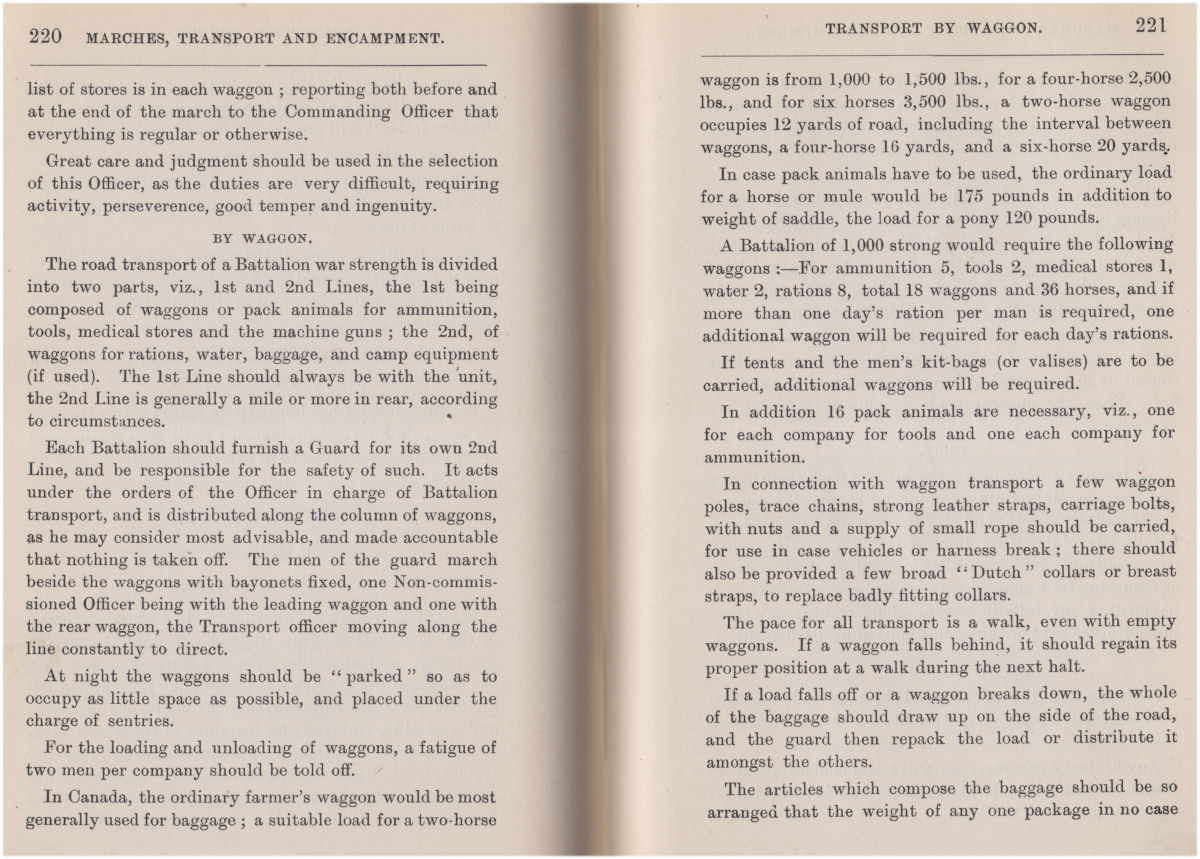
How do you organize the movement of Canadian troops by rail? A simplified consolidation of the regulations and best practices (a 'how to' for young officers) was in print beginning in 1880. My water-damaged copy was printed in 1914, before/as the world was blundering its way into war. Many other interesting practices and procedures are covered. I have only extracted the section about the transportation of troops.

In the course of the usual tangential researching to satisfy my curiosity and to avoid error, I discovered an interesting series of facts connecting Lord Strathcona with the modern Middle East. The information is related to developments in transportation and is centred on the period of the Great War ... so it is included as a digression. Hopefully, you will find it interesting as well.


'According to the internet' this label was attached to a piece of military clothing auctioned in Bancroft, Ontario in 2018.
(see the embossed stamp on the title page above).


from: Canada, The Missing Years; Patricia Pierce; 1985; Stoddart.


from the Wikipedia entry on: Donald Smith, 1st Baron Strathcona and Mount Royal:

'He raised Strathcona's Horse, a private unit of Canadian soldiers, during the Second Boer War, and became one of the leading supporters of British imperialism within London. After the end of the war, he was appointed among the members of a Royal Commission set up to investigate the conduct of the Second Boer War (the Elgin Commission 1902-1903). He was involved in the creation of the Anglo-Persian Oil Company, of which he became the chairman in 1909. Lord Strathcona subsequently used his influence to make the company a major supplier of the Royal Navy.'

[Persia: later, more commonly called 'Iran']

*  *  *

A Digression on Lord Strathcona's Royal Navy Petroleum 


Subsequent to Donald Smith's activities, the British government purchased 51% of the Anglo-Persian Oil Company in 1914. The Canadian Pacific steamship Empress of Britain 1905-1924 (i.e. renamed Montroyal in 1924) was converted to oil-firing in 1919. 

... You can draw your own conclusion whether Donald Smith (1820-1914) saw oil as the fuel of the future for the CPR fleet.

The first trials of oil-firing for warships began with the 'torpedo boat destroyer' HMS Spiteful in 1904. Winston Churchill became First Lord of the Admiralty in 1911 and was involved with the change from coal-fired to oil-fired British warships. 

Coal has 50-75% of the energy density of oil ... AND ... refueling in port with oil was faster and much less labour intensive. Coal had to be moved by hand multiple times as it made its way up from the supply barge, down into the bunkers (in which it was regularly trimmed by hand to maintain the ship's balance), out to the fireroom floor, and then into the fireboxes. Spontaneous combustion of coal was also a problem while it sat in the bunkers.

From 1912, all new British warships were designed to burn fuel oil.

The HMS Queen Elizabeth was the first British dreadnought battleship propelled by oil-fired steam turbines. 

from: Jane's Fighting Ships of World War I; 1919 (reprint: 1990); Military Press.

With the increasing strategic importance of oil in mind, it was necessary to acquire reliable sources of oil and a network of oil refueling stations wherever the Royal Navy expected to be active, viz. 'this vast empire on which the sun never sets' - that was written by George Macartney in 1773.

The map showing the location of known petroleum deposits in 1915 will help illustrate the calculations of the Royal Navy. Coincidentally, some of the CPR cargo ships requisitioned by the Admiralty during the Great War were converted into oil tankers.

from: Our Country and Its Resources; ed: Albert A Hopkins; 1917; Munn & Co.

... continuing with Persia/Iran ...

In 1952 the democratically-elected prime minister of Iran (Mohammad Mosaddegh) nationalized the Anglo-Persian Oil Company's local assets. In 1953, the CIA and MI6 staged a coup to depose him. The descendant of Donald Smith's Anglo-Persian Oil Company was renamed the British Petroleum Company in 1954. 

Initially seen as a harmless, young figurehead monarch in the wake of the coup, the Shah of Iran consolidated his power as an autocratic ruler who was friendly to US and western interests as the 1950s drew to a close.

End of digression on Lord Strathcona's Royal Navy Petroleum

*  *  *


Back to transporting Canadian troops in 1914 ...


from: The World War; ed: Holland Thompson; 1921; Grolier.

Apparently, the 'colonial' Canadians were judged by Kitchener not to have the training necessary to properly integrate with British forces in battle, so they trained and drilled on the Salisbury Plain during the first winter of the Great War. Their habitat became a sea of mud as the result of unusually heavy rains. Proper heating equipment was not available for these soldiers living in tents and the cold rains and mud made everyone miserable and/or sick. Getting into battle was soon expected to be a better existence than continuing to live on the Salisbury Plain.


from: The World War; ed: Holland Thompson; 1921; Grolier.

from: Canada, The Missing Years; Patricia Pierce; 1985; Stoddart.


End of the section from The Guide.


from: Light Railways of the First World War; WJK Davies; 1966; David & Charles Ltd.

As Canadian troops approached the trenches of the Great War, their transportation would often change from standard commercial railways to military narrow gauge railways which were designed to support the front lines. Commodities carried included ammunition - especially large quantities of artillery shells, food, barbed wire, lumber, fodder and bedding for draft animals and other supplies and equipment. 

Specialized Canadian military units and personnel were sent over to become involved in the building and operating of many of these railways ... and simpler human and animal-powered tramways as well. 

Many Canadian civil engineers and workers were familiar with the techniques used in building railway lines across muskeg, as Canada's railway boom had been in full swing as the war started. It was a relatively simple matter to transfer these railway-building skills to the poorly drained sea of mud near the front lines.