Showing posts with label Grand Trunk Pacific. Show all posts

23 June 2023

Portage la Prairie Lines Part 8 - 1920 CPR versus the CNR

Saved from the woodstove a century ago. This handy reference for business travellers in the west has details on post offices and postage, real estate, banks, politicians, lawyers and courts, and governments including local municipalities. 

However, its largest section shows passenger train schedules west of Winnipeg. The map - inside the back cover - showing railways, etc, was extracted by a previous owner ... but I've got maps for you ...

The booklet is 3 1/2 by 6 inches and 160 pages long. In 2023 inflation-adjusted dollars, its $.20 selling price would be $3. Archive.org has one from the 1940s and a few from the 1950s - if you want to thumb through one for yourself.

Chronologically in history, this forms the next part of the my Portage Lines series. Through this effort I am trying to better understand the history of the railway lines through Portage la Prairie, Manitoba. Consequently, only those pages which show passenger trains through Portage are reproduced below. I don't think I have missed any of the railway subdivisions associated with Portage.


With James J Hill deceased, this is all that remains of his line north to Portage. 

Boosters of Portage (see Part 7) described its northern terminal as the Portage Union Station (GTP + GN).


*  *  *

Next, comes the Canadian Pacific Railway. 
Officers and agents are thoroughly listed.

*  *  *

Considering the first page of timetables, below ...

In the far right column, Exp. Rate is definitely an abbreviation for 'Express Rate' - but the term is not defined in the booklet.

Of course, these fares are not official - as a ticket agent would be quick to tell you.

And, given the great post-war demand for rail travel, the railways have had their wishes granted for fare increases 'by Government order' ... bottom of the page.


As the timetable suggests, this line is in the direction of Rapid City. It is north-west of Portage. Rapid City is almost due north of Brandon.


This map from 1916 is posted in two sizes.
The first is an overview.
The second makes it easier to see railway line details as the colours have faded.
from: Atlas of Canada; 1916; Minister of the Interior, Government of Canada.

from: Atlas of Canada; 1916; Minister of the Interior, Government of Canada.
*  *  *

Printed separate from its timetables, perhaps as a late-breaking detail, are the officers and agents of the new Canadian National Railways. Because the Canadian Northern Railway (based in Toronto) preceded the Grand Trunk Railway (based in Montreal) into government control, it seems logical that the new CNR's headquarters are occupying the already-established Canadian Northern office space in Toronto. 

... No one is writing history articles yet ... using 'CNoR' to distinguish it from the CNR ... so the new CNR is just in the old CNR offices. 

The new CNR President is an experienced Canadian Northern official whose autobiography contributed to earlier segments of this Portage Lines series.

Soon the government will be winding up the sad Grand Trunk Pacific-National Transcontinental/Grand Trunk saga and CNR headquarters will relocate to the Grand Trunk's building in Montreal. 

... This GTR consolidation will result in future short blurbs on the history of the Canadian National Railways citing 1923 as the year in which this crown corporation was established. However, as you see in this 1920 woodstove-dodging booklet, the Canadian National Railways name was in the public space earlier than 1923. 


As you probably know Canora (above) is a contraction of Canadian Northern Railway.


The Grand Trunk Pacific (a railway laying track where there were few pre-existing towns) had the practice of naming their new sidings and siding-side settlements in alphabetical order, east to west. This probably made early operations and clerical work easier ... and may have prevented the odd collision.

... One of my bosses was a New Yorker who married a fellow PhD student from Prince Albert. Driving over the Prairies with relatively little for him to anticipate except the next letter of the alphabet used to drive him nuts!

*  *  * 

Finally, these historically interesting operations have no association with Portage la Prairie.


08 April 2023

Portage la Prairie Lines, Part 7 - Apotheosis - Grand Trunk Pacific!

Maps, photos, timetables, legislation, Stephen Leacock!

This interesting Portage la Prairie booster booklet can be seen at archive.org. Photos in books printed during that era tended to be kind of 'muddy', and the older scanning algorithms reduced file size at the expense of detail. The photos shown below have been downloaded as the largest 'page' possible from archive.org and were fiddled with to bring out detail.

Link to archive.org P la P booklet


For example, the retouched/redrawn photo above does not show a lot of detail, but it was perhaps taken in the yard area near the shops. Probably it shows some CPR/Manitoba & Northwestern and Canadian Northern single-storey buildings.


Here are the three stations as they existed. The famous GTR/GN 'Union' station, the familiar CPR station and the less well-known Canadian Northern station with its interesting 'gas station' sign. The caption has been moved to make the image more compact.

Various industrial views are presented below without interpretation. The photos are not great, but they are the key 'heavy industry' images from the booklet.


The map from the back cover of the booklet will help present the focus of Part 7 as it shows the Grand Trunk Pacific's trajectory. 

Without any branch lines, the GTP enters one side of Portage and exits the other.

*  *  *

I think the Winnipeg 'Fort Garry' reference below refers to the GTP's hotel ...
which is across the street from the Union Station which the GTP shared with a handful of railways.

... or ... 

A circa 1920 CNR guidebook refers to a stone gateway and wooden door
which remains from the second Hudson's Bay Company Fort Garry of 1850.
I think that relic still exists between Union Station and the Fort Garry Hotel. 

from: Altitudes of Canada; James White; 1915; Canadian Commission of Conservation.


*  *  *

The British-based Grand Trunk Railway was one of Canada's oldest railways and originated in the mid-1850s. It had built and acquired an extensive network in Quebec and Ontario, with an important asset being its line to Chicago. A decision was made that the Grand Trunk would develop a transcontinental profile of its own. 

The proposed line from Moncton, New Brunswick - via Quebec City, northern Quebec and Ontario - to Prince Rupert ... would be a sort of public/private partnership. This 'deal' would be different in a number of ways from the government incentives offered to the CPR and CNoR. 
  • The historical account on Page 234, below, will give you a little bit of detail on the two main sections of this railway system. 
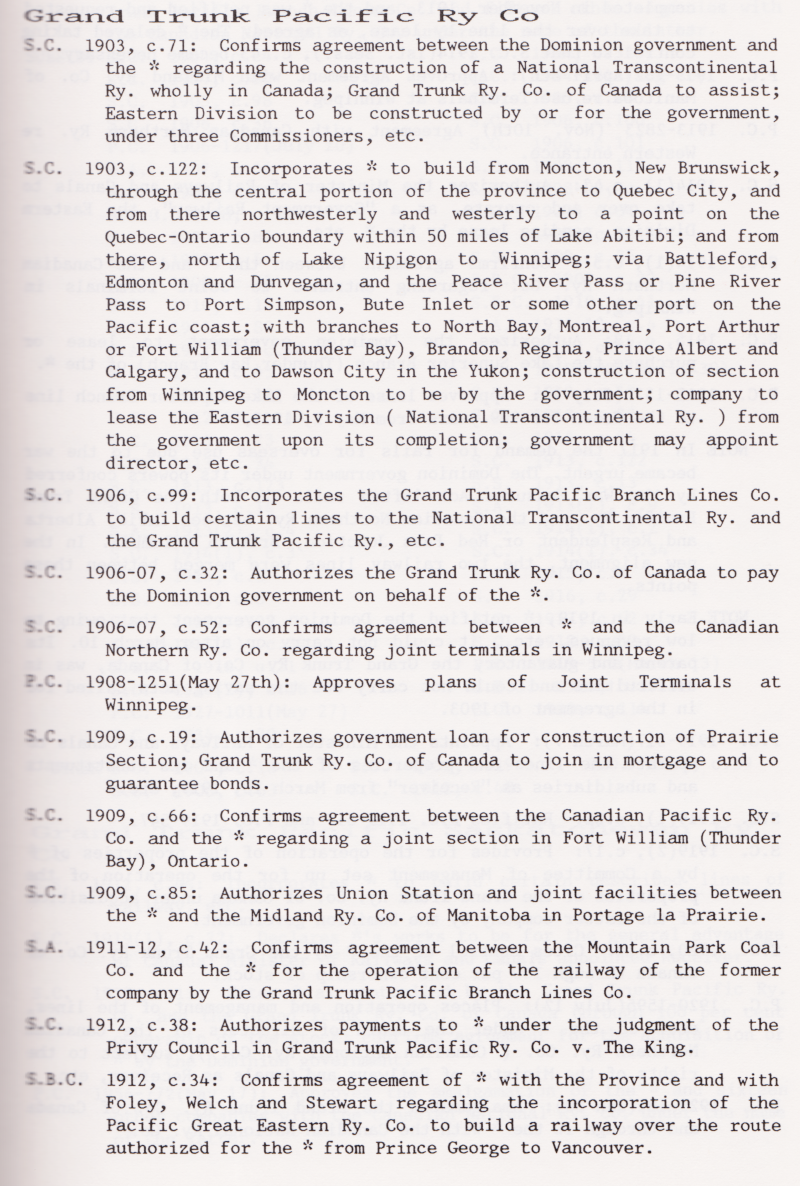
  • Closer to the end of this post are the chains of legislation for both the Grand Trunk Pacific and the National Transcontinental for you to compare ... if you are really interested!
Here is a map from 110 years ago ...
from: The Railway Builders: Oscar D Skelton; 1916; Glasgow, Brook & Co.   edg

The red lines represent the traditional regional Grand Trunk - a British-style operation which was poorly-supervised from London. People at the Canadian headquarters at Montreal had no authority to make strategic decisions.

The solid blue lines represent what the Grand Trunk Pacific (and its federal government partner) intended to build and operate from scratch. 

'Not exactly as shown': 
The extreme ends of the connection to Vancouver via the Pacific Great Eastern were not completed until the 1950s. The GTP depended on their own steamships to connect with Vancouver. Like the CPR, the construction of the mountain section was begun from the coast - at what became Prince Rupert. 

Keep in mind that the Grand Trunk's transcontinental construction would benefit from 30 years of technological advances since the building of the CPR. This would include more efficient and safer explosives, mechanically enhanced tracklaying techniques, more powerful locomotives and higher capacity railcars, plentiful continental supplies of heavier rail and better track hardware, and a well-established railway network west of Winnipeg to deliver construction materials and workers. The GTP construction process would be different from that of the pioneering CPR.

However, similar to the CPR's WC Van Horne, an American railroad superman by the name of Charles Melville Hays was re-hired to mastermind the Grand Trunk's new transcontinental transformation. He was credited with organizing a corporate turnaround on the Wabash. The first time he was hired by the GTR, he started to make some significant changes. However, he suddenly quit for an opportunity at the Southern Pacific, but found he had less independence that he'd hoped. He was nonetheless welcomed back by the Grand Trunk.

 
from: The Railway Builders; Oscar D Skelton; 1916; Glasgow, Brook & Co.


from: Biographical Directory of Railway Officials; T Addison Busbey; 1901: Railway Age.   edg

Your mission, should you decide to accept it, is to work with the Laurier government to build a transcontinental railway from scratch.

The GTR bureaucracy at the Montreal headquarters was comfortable and risk averse. Hays shook up the local Canadian corporate culture by firing people who were not sufficiently committed to his railway. So then ... he had a nucleus of people who were a little more motivated, no more talented than they had been, and afraid of being fired. 

Over the course of a few short years, how do you build a corporate culture with enough knowledge, skill and courage to create a great, modern steel highway - a 'standard railway' which others will envy and try to emulate? How will decision-makers thousands of miles away (from Montreal ... and from London) make choices as the line is built? It's not just two rails and ties ... it's surveying and locating, construction processes, materials procurement and management, recruitment, labour relations, land acquisition and land use and land sales, urban planning and harbour development, local government relations and taxation, provincial government relations and taxation, public relations, legal affairs, traffic decisions including interchange with other railways, equipment decisions. Relations with Laurier's government. Dealing with the board in London. Getting securities underwritten for sale in Europe ... After half a century of existence, the Grand Trunk Railway didn't even trade on the tiny Canadian stock market like the CPR did.
 
Answer: Charles Melville Hays

A good case study which examines these complexities is: 

A Thousand Blunders, The Grand Trunk Pacific Railway and Northern British Columbia
Frank Leonard; 1996; UBC Press.

For comparison, Mackenzie and Mann, over on the Canadian Northern, were contractors who had personally built parts of the western CPR and other lines. For using common agricultural graders and horses, they had been known as 'the farmers outfit'. Their little Gladstone, Manitoba railway ('and canal company') started and ran as a shoestring operation. They expanded their railway network in western Canada, which included a sizable low-cost branch line system, to provide income ... and then used their experience and connections to make strategic decisions about building a transcontinental system. 

Their early methodical approach toward growth was almost the exact opposite of the 
National Transcontinental/Grand Trunk Pacific approach. 

Hays died during the sinking of the RMS Titanic in April 1912 - two years before the first through train arrived in Prince Rupert. 


We can get a favourable version of GTP/NTR history from this account:


Of course, the GTP's use of the Yellowhead Pass was not innovative ... 
it had been advocated by Sandford Fleming for the CPR,
and the Canadian Northern was also building through the Yellowhead. 

Another section of this account provides dates and a unique detail about Portage la Prairie.


... and the National Transcontinental's battle with the muskeg goes on for paragraphs! Canadian school textbooks often worked to impress students by mentioning a section of generic Canadian railway line which swallowed 7 layers of fill ... I think it was during the National Transcontinental's construction that this happened.

Continuing with this 1933 account ...

from: Waiting for the Light: Brock V Silversides; 1995; Fifth House.


from: A Statutory History of Railways in Canada 1836-1986; Dorman/Stoltz; 1987; Canadian Institute of Guided Ground Transport.


from: archive.org


The map above is not entirely in touch with reality.
See if you can spot some examples.

*  *  *

Excerpt from: My Discovery of the West; Stephen Leacock; 1937; Thomas Allen.
Leacock had a doctorate in political science and political economy.

'The other original competitor of the C.P.R. in Eastern Canada was the Grand Trunk Railway, intended to link the Great Lakes to the Atlantic, a company of great opportunities, which it never realized. It had absorbed a group of minor roads in Ontario and Quebec, but it never paid a dividend on its Common stock, being managed or mis-managed, from London. The C.P.R., organized and conducted by a group of men of exceptional talent and enterprise, was soon able to compete successfully with the Grand Trunk on its own ground.

'It was this situation which Sir Wilfrid Laurier, whose true function was benevolence and not business, proposed to turn to political account by organizing a second transcontinental system, based on the co-operation of the Government and the Grand Trunk. The Government and the Grand Trunk were to build a railway from tide water in New Brunswick (Moncton) to a northern (ready-made) port on the Pacific, presently called Prince Rupert.

'From Moncton to Winnipeg the Government was to build and own the line, as a National Transcontinental spanning the St. Lawrence by a bridge just above Quebec. This was the last word in American railway construction. In England and in Europe railways were built to connect existing cities; in America, to connect cities with others not yet existing—the railway at the start going from somewhere to nowhere. The railway came first and the towns came after.

'This new departure went further. It went from nowhere to nowhere, passing nowhere. It was constructed far north of existing settlement. Its construction reaped a rich harvest for contractors; scandals grew like wild oats along its right-of-way. The western part of the line, from Winnipeg to Prince Rupert, was built by a new company, the Grand Trunk Pacific, its bonds guaranteed to 75 per cent. of its cost. The new company was to rent the National section for fifty years at 3 per cent. of the cost, an agreement by which everybody, except the taxpayer, wanted the cost as high as possible. But the taxpayer, as yet, didn't count. The bridge at Quebec was in the class of the Colossus of Rhodes, equally scenic and about as valuable. The system, operated in conjunction with the Grand Trunk, was a failure from the start, a mill-stone round the neck of Canada.'


*  *  *

Here is dandy map which was printed about 110 years ago.
It shows all the Canadian-linked railways.

Notice how all the through railway lines funnel through Portage la Prairie.

You should print this map out, fold it up, and carry it in your wallet, purse or pocket! 

from: The Railway Builders: Oscar D Skelton; 1916; Glasgow, Brook & Co.


01 April 2023

Portage la Prairie Lines, Part 6 - Portage Union Station and the Great Northern

It seems unfortunate that the rare and unusual so often receive the attention of railway preservationists - and the common and typical are lost. 

Nonetheless, ignoring my own lamentation, here is the story of a line which existed for fewer than 20 years as it was conceived by one of the great railway tycoons.

In the 1980s, I heard an engineer say he had switched a car into the 'Old Great Northern' at Portage la Prairie. I've always been curious where that was. Back then, I mistakenly assumed it was in the Canadian Northern section of the railway yard area. An image which Eric discovered and good old Google Earth helped me answer the question for myself. 

from: History of Railroads in America; Oliver Jensen; 1993; American Heritage Books.

Above: James J Hill in 1909, unknown location.


from: The Railway Builders; Oscar D Skelton; 1916; Glasgow Brook & Co.  edg

Here are a few samplings of contemporary railway news. 
As it says above, the Midland & Manitoba was Hill's company. 
The Grand Trunk Pacific was also enjoying some 'earned media' as it gave the Canadian Northern a poke.

Railroad Gazette 1905 11 10 - archive.org

Railroad Gazette 1905 11 10

Railroad Gazette 1905 11 17

from: The Railroad Gazette, November 1907; archive.org

The article in the Railroad Gazette was very long and was full of boring financial details. It was fine for James Hill and the Great Northern to be this ambitious, to rattle the cages of the CPR and CNoR, and to gallantly and publicly eschew 'spoon-feeding'. However, when reading the excerpt above ...

It is not obvious why the existing Canadian railway rates westbound from the Canadian Lakehead should be particularly cheap ... when compared to the rates via the Hill lines from Duluth. Manitobans had already learned the hard way (after the Battle of Fort Whyte) that eastbound grain was carried cheaper in Canada than in the US. 

So exactly why was Hill working so hard at building extra branch lines? So he could lose money by cutting his US rates ... as he tried to compete with established Canadian railways with lower rates?

Hill must have had some kind of genius 4-dimensional chess 'reason'. Or, perhaps he was just enjoying 'the game' he was playing with Van Horne, Shaughnessy et al - as a Canadian Rail article suggested. Life is short, enjoy it by keeping the other tycoons guessing.
  • Hill was working to siphon off profitable near-border Canadian shipments with his many north-south branches across the west.
  • Hill was threatening the CPR with the possibility of another southern Canadian transcontinental.
  • Hill was even musing about building a line to Fort Churchill. Perhaps this was a swipe at the former Winnipeg & Hudson Bay of the 1880s, by then a charter in the Canadian Northern portfolio. But ... laying rails to Hudson Bay, or even just as far as The Pas, was never something which Mackenzie and Mann saw as a spectacularly profitable venture.
Perhaps if Hill had lived a little longer, he could have experienced delight 
as he threatened the Grand Trunk Pacific's pipedream of building a railway line to the Yukon. 

https://natural-resources.canada.ca/earth-sciences/geography/atlas-canada/explore-our-maps/map-archives/16868   *
* Time travellers from the future - this URL worked way back in 2023. Here are possible search terms if the URL does not work. 'Natural Resources Canada' 'The Atlas of Canada's Map Archives'
Above (1906) and below (1915) are pages from Government of Canada atlases - available at the URL quoted above. These are great atlases to look through.

You can see how the strategic picture changed for the Canadian Northern builders over the course of a decade. Where's the harm in a little more ruinous competition between tycoons when the Prime Minister is paying for everything?

Carman, Manitoba was quite a railway centre! The CPR build a branch there in 1885 and was followed by the Canadian Northern and the Great Northern. 


*  *  *

How does all of this relate to railway lines at Portage la Prairie? 

Where was the Great Northern Railway in Portage?


from: Scarborough's Map of Manitoba, 1918
https://www.flickr.com/people/manitobamaps/

The map above is made busy (and handy) as it shows the surveyed square miles which are part of surveyed 'townships' - the latter being 6 square miles in size. You can see part of the township numbering system printed above and below the US border. A square is 640 acres and a 'quarter section' is 160 acres. 

The map above will relate to the Google image below.

Above: The Great Northern line leaving Portage in a south-east direction passes just east of a distinctive large bend in the Assiniboine River before it reaches the station 'Dunn'.

Below: The large bend in the Assiniboine River has turned into an 'oxbow' (the one in the lower right corner) which has become subject to eutrophication or perhaps it has been filled in with earth. Where the Great Northern Railway was you will now find Angle Road which deadends at the Assiniboine River - in the lower right corner of the image.


*  *  *

Above: We've swung around and we are looking south-east from Portage, at Angle Road, and the embankment continuation south of the Assiniboine River.
The lightened rectangle near the horizon contains a little pink Google map pin at Carman.


Above: Returning to Portage to show north at the top of the image again, Angle Road comes in at the lower right corner. The Great Northern shared the new Grand Trunk Pacific station which you can barely see in the top left corner. This long rectangular building, surrounded by windbreaks, is the current 'beside the CNR ex-station building', to be exact. It was referred to as a 'union' station, because both Great Northern and Grand Trunk Pacific shared the facility. 

(Whether it was the Grand Trunk Pacific ... or Portage boosters ... claiming a 'union' station in Portage, I don't know. I can't see the GTP diluting their British-American grandeur by going halfsies with Hill's dinky little line. But that ship will soon hit an iceberg, as many of you already know.)

A century after the Great Northern line into Portage was abandoned (in 1926) the former railway land use is still echoed in the land use and zoning. Above, to the west of the railway area you generally find residences. On the north-east side of the line's gentle curve to line up with today's CNR ... you can still see industrial use of the land.

*  *  *

Portage la Prairie fire insurance map 1959
from: https://www.flickr.com/people/manitobamaps/ 

About 30 years after the Great Northern left Portage, it is possible that some of the former Great Northern real estate is being used by McCall Frontenac and North Star Oil and their siding. With a wooden raised platform around the union station, the Great Northern passenger trains probably discharged passengers on the south side ... while the Grand Trunk Pacific trains used the north side. Unfortunately, these fire insurance maps do not show all of the railway buildings and facilities at Portage.

*  *  *

Portage la Prairie image from 1908. archive.org
Above and below are south-facing images which show the relative positions 
of the Canadian Northern, Grand Trunk Pacific and Great Northern in Portage la Prairie.

The image above comes from a 1908 Portage-boosting booklet which will appear in Part 7.

The image below is one of my favourite postcards because it was the first image I ever saw which showed some of the history of these lines in Portage.

I think the well-treed street to the right is 1st Street NW.

Unused, undated postcard.

* * *

Here is the legislative chain which enabled some of Hill's railway activities in Manitoba. 
I think item 1913-782 would include the four railways' joint use of Winnipeg Union Station.
(Counting the National Transcontinental and the Grand Trunk Pacific as 'two'.)

from: A Statutory History of Railways in Canada 1836-1986; Dorman & Stoltz; 1986; Canadian Institute of Guided Ground Transport.
Note: The charter of the Brandon, Saskatchewan and Hudson's Bay indicated it would build to The Pas.

To summarize the abandonment of the Great Northern line to Portage:
      • Portage la Prairie to Carman was abandoned in 1926.
      • As noted above: Carman to Plum Coulee was turned over to the CPR in 1926.
      • Plum Coulee to Gretna was abandoned in 1926.
      • The CPR abandoned Carman to Plum Coulee in the 1970s.
*  *  *

The following data is for the Portage, Morden and Brandon lines and comes from 1915.

from: Altitudes of Canada; 1915; James White; Commission of Conservation, Canada.

*  *  *

From November 1920, this handy pocket-sized reference shows the mixed train schedule.

James J Hill died in 1916, so his 'vision' for this particular line had probably been altered. 


If one was not in a hurry, the 7-hour northbound running time of the mixed train would have been quite pleasant on a nice summer day. Except for the presence of freight cars, wayside switching work and the fact that only a single coach was probably employed, the experience and equipment might have been quite similar to an excursion on the Prairie Dog Central.