Showing posts with label TTC. Show all posts

22 March 2019

TTC 1943 Route Map


My father obtained this wartime map of Toronto Transportation [sic] Commission routes in 1943 - the printing date of October 1943 can be seen on the last map image. 

In addition to showing the usual attractions, the map is of historical interest because it shows the locations of organizations supporting military personnel in training and/or travelling through Toronto.

As you have likely noticed with other wartime publications shown on this blog, the printing and folding of this map was not done to perfection. With wartime demands and limits on the usual materials and workers ... you can imagine that quickly printing a great number of these maps for all those coming to Toronto was an exercise in quantity rather than quality.


The location key below is also reproduced with the city-wide maps farther below.
It shows organizations supporting service personnel and their families.


The city-wide map is posted in two halves to give you the most legible presentation,
while compensating for the idiosyncrasies of the Google blogging platform.
Bloor Street and its neighbouring streets are duplicated on both images.

You will notice that streetcar turning loops are shown for each line.
As usual, please scroll to the right to see the entire image.


Considering the route map's era,
a couple of examples of the latest technology are shown below.

from: Wheels of Progress; 1953; Toronto Transportation Commission.

' ... since the complete rehabilitation of the system in 1923. ... Outstanding among the achievements of these years was the introduction, in the Fall of 1938, of 140 new streamlined street cars that completely revolutionized all former ideas of street car design and performance.'


from: Wheels of Progress; 1953; Toronto Transportation Commission.

14 October 2018

Engineering Streetcar Tracks in 1914


This week we look at track structures which are usually hidden within city streets.

In the 1960s, through the cracking pavement of Broadway in Lachine, Quebec, I could trace the rails of the Montreal Transportation Commission's west island streetcars. I'm quite certain there was a similar phenomenon visible along King Street in Kingston in the 1970s - just east of our famous prison.

This was an MTC show of retired streetcars at their Youville Shops on a hot September 23, 1961.
I wasn't taking notes.

I once heard a key member of a national railway historical organization politely dismissed as follows: "Well, he knows everything there is to know about trolleys, but ... "

Knowing nothing about trolleys, I am fortunately immune to such criticism. As one pokes around the history of vehicles on rails and their worldwide distribution today, one can begin to appreciate the 'railwayness' of a much broader spectrum of railed vehicles and the systems which support them.

When possible, there are advantages in letting a voice from a particular period of history speak. What did 'they' think about then; what experiences did they have; did they make any predictions about the future?

Urban passenger railways (city streetcars) had the same requirement for good track as Class 1 common carriers. If 'all politics is local' ... streetcars worked in a much more demanding environment than the Class 1 railroads.

Not only did they operate beneath, above and among other crucial - often fragile - infrastructure systems which could not be disrupted ... 

Every day, the streetcars performed before thousands of pairs of eyeballs - workers, employers, local elected officials ...

Repeatedly delaying the arrival of part of a large plant's workforce due to regular derailments or frozen switches had more real time urgency and greater political consequences than ... putting a few boxcars in the bush several times each winter - like a Class 1 common carrier.

The engineering textbook forming the main part of this post gives us a comprehensive view of the construction of urban railways, when the technology was still early in its evolution.


The Time of the Trolley; William D Middleton; 1967; Kalmbach.
Lexington, Kentucky, 1890s (above)
If you have studied aspects of railway track structure, you will note that this situation is the worst - particularly in a climate (like Canada's) which includes temperatures below freezing for a significant part of the year. Generally, water needs to drain away from your track ... and frozen water causes heaving and derailments.

In their defence, this may be the inaugural run of this line. The local officials may not yet realize that operating through mud and horse manure will be an unpleasant experience.


*  *  *

Here are three diagrams representing about 50 years 
of technological advances on the Toronto system.

Many readers recall that William Mackenzie (of Canadian Northern Railway fame)
was an early investor and developer of the Toronto horsecar/streetcar system.

Wheels of Progress; 1953; Toronto Transit Commission.

Wheels of Progress; 1953; Toronto Transit Commission.

Wheels of Progress; 1953; Toronto Transit Commission.

Above: I think you can see a thermite weld represented here - on the second rail to the left of the tie bar.

*  *  *

Track Infrastructure in Toronto and Montreal

Wheels of Progress; 1953; Toronto Transit Commission.
In the undated photo above, the very large pixels could not be smoothed more without harming detail resolution.


July 2018, Google.
The same intersection recently.
The two buildings on the corner - to the left of the centre streetcar - can help you get oriented.


A Toronto Album; Michael Filey; 1970; University of Toronto Press.
Here is the same intersection, in 1923 - perhaps during the same job which is pictured above.
From a social history perspective, cobblestones and granite blocks made excellent projectiles during riots.


A Toronto Album; Michael Filey; 1970; University of Toronto Press.
Enlarged detail of what the workers are doing ...


A Toronto Album; Michael Filey; 1970; University of Toronto Press.
Enlarged detail of what may be a traction engine which was used for the transportation of materials.
There seem to be granite blocks piled on the wagon.


A Toronto Album; Michael Filey; 1970; University of Toronto Press.
When the rails provided an essential service, the priority was to keep them operational.

After rubber-tired vehicles became more common (buses and personal autos) perhaps there was not the same sense of overnight urgency.
  • Buses could detour passengers around the area being rebuilt.
  • Instead of using 'modular' granite blocks, it was necessary to carefully pave over the track structure.
  • In addition, local businesses, dependant on rubber-tired restocking and shopping, needed the whole street back in its original condition.

*  *  *

Two Views of Track Structure in Montreal

Montreal's Electric Streetcars; Richard M Binns; 1973; Railfare.
'Roller Skating at The Forum' (from 1912)

This streetcar is turning from St James (St Jacques) to Windsor (Peel). This book's author notes that the rickety wooden steps at the Grand Trunk Bonaventure Station (right) were a longstanding feature of the facility. Notice that a sewer hatch may be be located within the trackwork - just one more complication. I think those may be bonding cables for the switch rails which you see lying over the ties.


Montreal's Electric Streetcars; Richard M Binns; 1973; Railfare.
In the middle of the Great Depression (1935) you can see a disadvantage of paving over the track with concrete instead of granite blocks or asphalt. You need jackhammers to get at the track. The residents along The Boulevard in Westmount will simply have to make do as best they can with all the noise and inconvenience.

*  *  *

After posting, Jim Christie sent me some really interesting links.
Here are two of them:

Montreal's Street Railway System 1893

Rules for Drivers and Conductors, Toronto Street Railway, 1880


03 June 2017

Montreal Terminals - A Descriptive Sketch, Part 2


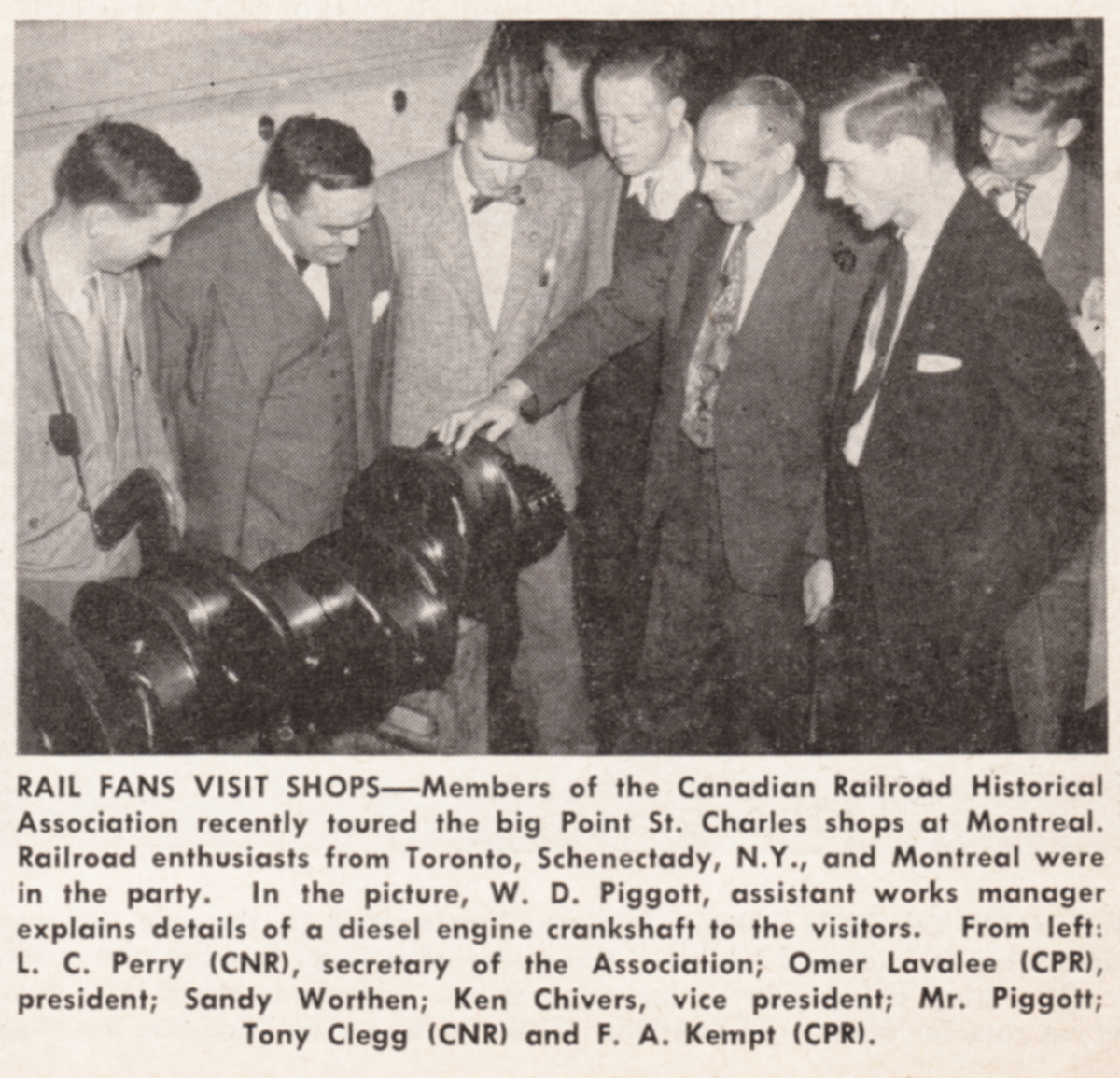
Point St Charles and other CNR Montreal features are described here.

My brother gave me this wonderful little 4 inch by 6 inch booklet. In the railway's own words, it documents the state of many of the CNR's Montreal facilities in the late 1950s. 

For people not familiar with the area and its features, and to provide some contemporary atmosphere, I have added a few images from the era described.


from: Canadian National Magazine; November 1959.


from: Canadian National Magazine; November 1953.
Perhaps some readers will recognize some familiar faces here. As a minor brush with greatness, several of my basement-scented Canadian National magazines bear a mailing label for Omer Lavallee. Brushed a second time ... one of these professionals, while visiting my parents in Kingston, dropped by and operated No 1 on the Nipigon Sub of my former HO layout.

So far removed from the Montreal railway environment of the 1960s - I obviously take great pleasure in the few links I can make with it.

*  *  *

from: Canadian National Magazine; October 1952.
Above: A scene from a bygone era.


A CRHA trip to Hemmingford, Quebec on Saturday, June 6, 1964 provided a number of unique sights and experiences. My father took my 2yr 9mo-old sister and me on this wayfreight excursion. In keeping with mixed train tradition, our heavyweight coach was marshaled just ahead of the caboose. An open-air observation car (a gondola), with its end lowered, was coupled ahead of the coach - mind the gap!

To board the train, we took the bus from Lachine to the south side of Turcot yard in the morning. I don't recall the return there in darkness, but my father's notes indicate it was at 2300hr. One of my father's teaching colleagues was kind enough to drive us home. This long-since-hailed-hero, Stan Jones, also dashed over to a depanneur at a post-sunset stop (sunset had been at Hemmingford) to buy rations for his party and milk for ours.

Providing a false sense of  'security' ... a similar, shorter excursion had previously returned us in time for dinner. However this trip provided a good insight into the long, unpredictable hours of work for a crew on this type of operation ... bring an oversized lunch pail and be ready for anything. 

The photos above and below were taken as we left in the morning. We are approaching the Victoria Bridge via the west side of Point St Charles. 

Above: The Jacques Cartier Bridge can be seen over the 3119. The Victoria Bridge can be seen on the right horizon.


The photo above was taken on July 18, 1961 - probably to check the location for the event described below. Assorted wooden cars, a water tank and lumber storage can be seen, along with the main span of Champlain Bridge under construction.

*  *  *


Above and below: On July 22, 1961, my grandfather, father and I were at Point St Charles to see 6153 pull an excursion train to Victoriaville, Quebec. After photographing 6153 reversing to its train at Central Station, we set up near the train washer at Point St Charles. 

Generally, CNR steam locomotives in Montreal were held and scrapped at Turcot, so these two were a curiosity to us. According to Clegg and Corley, the 8320 was scrapped in December 1961 ... the 8447 was held/'preserved' for a time at London, but it seems it was also scrapped.

While waiting for 6153, our presence was requested in the tower of the washer. My grandfather was proficient in French and my father subsequently told me about the safety briefing we received, particularly the dangers of getting a foot caught in a power switch. The washer operator let us know when the train had departed Central Station so we could get into position. My father got his photos and we left the CNR and the washer operator in peace.


from: Canadian National Magazine; September 1953.


from: Canadian National Magazine; April 1957.

The images above and below illustrated the Lab's testing of supplies for the pending opening of the new Queen Elizabeth Hotel.

The accompanying article, of course, noted that these items were more delicate than most of those usually tested by the CNR's lab.

from: Canadian National Magazine; April 1957.


While the buildings of some of the older facilities described above may still exist (this was checked by using Google maps etc), I wasn't able to find any photos of them in use by the CNR circa the 1950s. 

So, to wind up this descriptive sketch of CNR's Montreal Terminals, here is an article about the new CNR headquarters from the CNR's renamed corporate magazine: Keeping Track, May 1961. 

The old building (still in existence) shown on the second page was the former Grand Trunk Railway headquarters - which had been used for this purpose by the CNR since its inception about 40 years earlier.


Keeping Track; May, 1961; Collection of LC Gagnon.

Keeping Track; May 1961. Collection of LC Gagnon.