Showing posts with label Christmas. Show all posts

20 December 2024

Trains of Christmases Past, 1960-1968

Full-size, model and toy trains were often associated with the winter school holidays. For the benefit of extended family members, some other Montreal-based historical photos of interest are included in this selection.

1960: This toy train was built by LC Gagnon, but its first iteration had a locomotive of similar wooden construction, with something like a black-painted Johnson Klear floor wax can serving as its boiler. Here, the CPR, Great Northern and Union Pacific are represented. This rare colour print was specially-made from a slide - probably to document all the effort he put into creating this colourful set.

For some time I was puzzled by my father's persisting interest in building sophisticated toys from a large Meccano set he/we owned. However, many adults today value their Lego sets and specialized Lego kits. I've concluded that many of us 'finish off' our childhoods as young adults when we finally have the resources to buy adequate quantities of our favourite childhood hobby supplies.

Back then, my own skills with Meccano were extremely limited. The tiny nuts and bolts (mimicking rivets) for this 'Canadian railway boom era' British-designed toy were too hard on little fingers unless one had developed the necessary callouses to 'start them' ... before giving them a final tightening with a small screwdriver or wrench. Considering current corporate liability defensiveness, it is hard to imagine how impossible it would be to sell a children's toy with so many small metal parts today.

You can see the Viking TV with rabbit ears. Its manual tuner had a satisfying 'clunk' as you skipped around the dial: 2 (CBFT), 3 (WCAX, Burlington), 4 (CBM), 5 (WPTZ, Plattsburgh), 10 (CFTM), 12 (CFCF). Filtering out either very snowy or French channels ... only 3, 4 and 12 were viewed regularly in our 3-channel television universe.

*  *  *


1962: The Eaton's Train was set up just for the Christmas season. Its annual operation was anticipated with excitement at our home. It was incredibly quiet and smooth in its typical slow-speed operation. It is explored in more detail elsewhere in this blog.


*  *  *


Dec 1962: Outside of our 45th Avenue, Lachine, apartment. 
Our kitchen window is behind the front bumper of our new VW.

*  *  *


1963: A Christmas gift of 1960 appears here. It's a British-designed Hornby wind-up train set. This set was added to over the years. From the earliest days of my parents' marriage there was an HO layout present in the house so there was no thought of buying an electric toy 'O' gauge set for the kids. 


My father's 'cottage organ' can be seen with its seven stops. An Argus slide projector and a Bell & Howell reel-to-reel tape recorder are ready to document family events. 

They sit atop my father's 1950s-era Viking AM/FM/shortwave, 33/45/78 rpm record-playing, mono sound system. The automatic record changer was used cautiously with multiple 78 rpm records  ... in case their complete massive weight crashed down prematurely, breaking the previous selection. Back then, 5 hit songs (chosen at random) weighed 1.018 kg.

Socio-technical verdict of history: The Vikings may have been a fierce, fearless, seafaring gang, but my guess is that history will remember them for the very fine vacuum tubes they made for TVs and radios sold through Eaton's.

As the family enlarges with my sister, I should include my deliberately-seldom-photographed-with-trains mother in here somehow.  (She took the photo above.) There are no Christmas photos showing her with any kind of train, but she documented her own western train trip in exquisite detail.


Her father had been with this outfit:


... And a paternal cousin ... who was the previous owner of that small rocking chair ... had a father-in-law ... who was a locomotive engineer on the Intercolonial Railway ... who was killed in a collision at Ste Rosalie Junction, Quebec in 1910. 

(You have certainly come to the right post to find obscure railway curiosities!)

*  *  *


Feb 1964: At our second home on 43rd Avenue, Lachine, here is a view of snow clearing operations. Shortly after the snowfall stopped, the sidewalks were plowed by small Bombardier tracked plows and now the accumulated roadside snowbank is being centred for the attention of the snowblower.


This is a good front-window view of a Sicard snowblower. It seems that the plow truck above also has the distinctive Sicard lines.


This fine shot shows the operation on our side of the street. 
Compared to modern Montreal snow removal vehicles, the receiving dump truck looks quite dainty.

*  *  *


Dec 1964: It seems we only just arrived here from the previous apartment, but it's time to move again. This time we are moving from our rented rowhouse to my parents' first owned house. The family has another new member, and so we move from 43rd Avenue to 47th Avenue. Here, the camera faces south in front of our point of departure. Even the Christmas tree has been loaded with the intention of re-erecting it at 47th.

The caption in the photo book notes an endless series of VW shuttle trips with books and papers. In fact, virtually every move by every family member since ... has involved heavy, special shuttle moves with 'books and papers'. That's just how we roll.

*  *  *


Jan 1965: Another toy train set-up. This is in the basement of the house on 47th. 
While there are no proper rails with this toy, 
the track segments provide a guideway for vehicles which is quite similar to the early 'plateways' used in Britain. 

*  *  *


Dec 1968: I am let loose with the black and white print camera to make one of many expeditions to the CP commuter station at Grovehill - at the top of 40th, Avenue, Lachine. Just eight years later, I would have my chance to work on this class of engine at Schreiber. By then, my 'fantrip photography technique' would have been altered by three summers of farm work, to include a healthy respect for the dangers of heavy equipment. Consequently, in early 1977 I'd stand farther back from the track during running inspections of passing freight trains!

*  *  *


Dec 1968: At 47th Avenue, Lachine. 
We had all made a trans-Canada trip on the Super Continental during the previous summer. 


A move to Ontario would take place seven months after this photo.

It was a logic-defying shock to discover that Kingston's CBC Hockey Night in Canada only showed Toronto Maple Leaf games! 
By then, it was too late to move back.

*  *  *

Dec 1968: On a dark winter afternoon, whether in watercolours or oils, we all paint together.

*  *  *

15 December 2018

1959-1962 Eaton's Train


From a number of family 'caches' I have put together photos of the 'Eaton's Train' during its final few years of operation in Montreal. 
As you would expect, the black and white photos aged the best. The 'bad Ektachrome' slides of the early 1960s slid into their usual rusty, sepia type stain but were restorable when I scanned them a few years ago. Some 60-year-old colour prints had aged to an almost white appearance, but it was possible to darken these enough to obtain colour details.
If you have not already seen it, at the end of this post is a link which will download a PDF version of the November/December 2005 edition of Canadian Rail with its excellent Peter Murphy article about the development, technology and operation of the trains commissioned for Eaton's Toyville operations.

From my perspective, the 1960s in Montreal presented a procession of wonders. Above all were the railway experiences ... from the Eaton's Train, and Turcot Yard ... to the developing CRHA museum at Delson, and the mainline steam and branch line wayfreight excursions which operated out of Montreal.

It came as a surprise that these things were not eternal. Gradually, many of the Montreal railway wonders met their natural ends.


As you see, the view above comes from 1961. Until I read the Canadian Rail article yesterday, I didn't realize how long the Toyville trains existed before I first boarded one.

In fact, my father might have been just a little older than I was (above) when he first rode the train. He probably took his younger sister to ride on it as well. 

*  *  *

The idea for this post was precipitated by finding this clipping (a number of years ago) in my father's thick files of Montreal history. Eaton's took a full page ad. The top of the page promoted the train, the lower half showed particular toys, including those small orange plastic tractor tricycles, and pairs of battery-powered toy 'morse (Aldis) lamps' - like those used for naval ship-to-ship communication.

Check the date of the Montreal Star advertisement.
Even back then, the day after Halloween was the first retail day of ... Christmas!


The 1959 colour prints above and below are good for representing the 'bewitching little world' through which the train operated. The low-light, sparkled features were sometimes animated. The scenery was unique in my experience, but the train ride was the main point of being here. I don't think I ever bothered to spend time with the Eaton's Santa.

The view above shows crew change time for lunch.

The image below shows the position occupied by the engineer when operating the train.


*  *  *


The print from 1961, above, shows the train on the move. The multiple light fixture reflections are probably from plexiglass panels designed to prevent excited children from getting on the right of way.

*  *  *


Eaton's Train photography had reached the point of its highest technology by 1962 - the final year of the train's operation. My father had graduated to slide photography. These three colour images are provided in enlarged form so you can see details of the track and engine.

Two key points I discovered from the article ... 1) Those are 'blind' drivers (without flanges) so the rigid frame holding them can get around the tight curves. 2) The leading passenger car provides the electric motive power - the actual driving wheels and rods are there for effect only.

As you've observed, the equipment is dual-gauge ... narrow for the locomotive model, broad to hold two child passengers per seat.

The photo below provides some detail on the construction of the cars.


My father's disposable flashbulb, below, was blocked by the lineside fence. However, you can see the care that was taken in constructing the locomotive details and the pride CPR employees put into it - including the miniature builder's plate.

I remember the engineers using the bell, but not the whistle - I just don't remember the sound. The ride was very quiet - with the electrical equipment 'purring' its way around the oval. Out of necessity, the train operated at a slow, smooth speed. 


*  *  *


Finishing with an image from 1961, you can see some detail of the tailend car.

*  *  *

Here is a starting point which you might be able to use to
get access to the edition of 
Edition 509 of Canadian Rail for Nov/Dec 2005
on the history of the multiple Eaton's trainsets.


(I hate leaving dead links for you and 
CRHA/Exporail have changed their URLs for individual editions
many times over recent years.)


*  *  *

AFTER POSTING THIS PIECE ...

My brother Eric passed on this information 
from someone else who also had special experiences with this train.

... from Thom Cholowski ...

"Yes, that locomotive is still around. It is in storage at Canada Science and Technology Museum in Ottawa.  I have several pics from '59-'61 of my Dad in front of and driving that model, it has a special place in my family's history."


*  *  *

Eric also passed on Christmas greetings from a CPR Schreiber supervisor 
(if my memory is correct) 
who was once Rolly Martin's boss - Bill Needham.

Rolly always had good things to say to me about Mr Needham.

Bill was also kind enough to send me photos of Rolly's retirement ...
when he brought Number 2 into Schreiber for the last time.

Here is the link if you want to see The Canadian during a really cold night in Schreiber!


24 December 2016

Canadian National Magazine, December 1951


This post comes from the Christmas-themed issue of the Canadian National Magazine of December 1951. Back then, one could make a good case that railways were still the most essential element in Canada's transportation system. 

... Transcontinental highways and interstate-style controlled-access freeways were not yet well-developed. Many Canadians, even if they did have cars, avoided the inconsistently-plowed roads in the winter months. Extensive broadcasting of road salt was unknown.

... Transportation by air had been recognized by the railways as a potential threat to their passenger business as early as the late 1920s. However, in 1951, most passenger aircraft were still powered by noisy piston engines and flying was comparatively expensive.

Why was this magazine published?

The technologies used by the railways in Canada still required large numbers of employees. Labour intensive systems in wide use during this period included:
  • Steam locomotives.
  • Track composed of boxcar-length rails joined together by bolts.
  • Business offices supervised by station agents who often lived in local railway stations with their families.
  • Railway traffic control aided by paper train orders issued via wayside operators on duty in the stations.
  • Paper forms, reports and reference books ... were used for almost all communication ... and for most data storage and retrieval. 

With employees strung out across the country, often at very remote locations, a company magazine was essential to try to develop and maintain a sense of unity within this very diverse and scattered workforce. 

Considering the 'corporate culture': the government-owned CNR was only about three decades old ... As an added organizational challenge, in 1949, a new Canadian province had just added its narrow gauge railway and coastal ships to the CNR transportation system.

An effort was made to include material for every member of the family, including the children ... 

If the breadwinner only looked for articles about motive power or the names of friends who had just retired, their spouse might check the magazine for recipes. In leafing through the magazine, the latter might spot details about a employee benefit program which might be helpful to the family ... which the breadwinner might have ignored. N.B.: In most cases on the railway during this era, breadwinners were male and their 'spouses' were female.

The first article shown below states 'the railroad never sleeps'. For the children of running trades or other operating employees, their railway parent often missed birthday celebrations or Christmas - in contrast to most of their classmates in a large economically-diverse town. Well, the magazine article explained a little of the higher purpose of this unfair arrangement affecting their family celebrations.

*  *  *

Advertisements in this magazine promoted everything from 'capital goods' such as new diesel locomotives; to employee necessities such as railway-grade watches; to financial institutions and financial products; to expensive jewelry, food staples and cleaning products; to cigarettes - but not (see Rule G) alcohol ! 

... Both corporate decision makers and relatively well-paid unionized employees and their families were in the target audience of this publication and its advertisers.


*  *  *


from: Railroad Magazine, October 1953. Collection of LC Gagnon.

*  *  *


A single-page digression follows. My father purchased this early Omer Lavallee publication after a ride on the Quebec Railway, Light and Power Company to see the family's patrimonial landing site in New France at Chateau Richer. Below, you can see one of this railway's famous anachronistic stub switches.


from: Chemin de Fer de la Bonne Sainte Anne 1889-1959; Omer S A Lavallee. Collection of LC Gagnon.


*  *  *

Returning to the last two pages of the Canadian National Magazine ...


16 December 2016

VIA 1981 to 1985, Kingston in the Winter


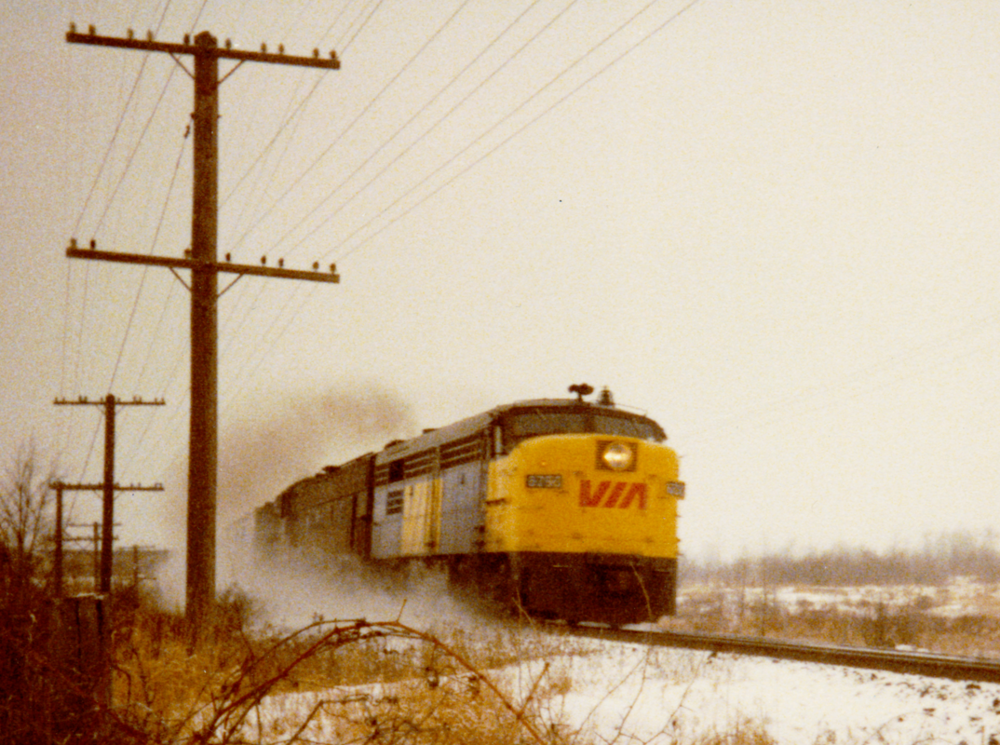
This post looks at VIA trains at Kingston in the early 1980s.
It is a thematic exposition combining leaking high-pressure steam with snow.


The Era:

In the early 1980s, bulbs with incandescent tungsten filaments lit our homes 
and saturated hand-held time exposures with yellow.

In high school, kids had the option of taking instrumental music classes.
There is enough knowledge and talent here to synthesize Christmas carols or locomotive whistles.


Nearby: An eastbound rolls by mile 183 on the Kingston Sub.
The rail snapshots before the timetable are circa 1981 and were taken with a camera using 110 cassette film.


A common sight - VIA 6523.


The westbound is loading one of the last cars ...


... the long train has the power and the leading steam leak spotted beyond the end of the platform.
Pardon my corona.

The ties piled so nicely may have come from renewals between the platforms.

*  *  *


The next time your new LRC is stalled somewhere in the bush, don't despair and pass out ...
you might see a chickadee or something on a fencepost while you wait.

As I take another careful over-the-shoulder potshot at interpreting recent Canadian railway history,
I can assure you that I have not included photos of trains 561, 565, 560 or 564.

We made rather merry at the sight of such VIA-decorated rolling stock at the station.
The evolving Napanee/Brockville-Smiths Falls-Ottawa track network was not being kind to VIA.


A lifelong contempt for fine print reference marks has caused me to enlarge them significantly.


I don't know if that is an Engine Service Brakeman, Baggageman or a train-rider Steam Technician talking into the cab.


The snow hi-lites the small total area where rail adhesion occurs.
... Unlike trains 561, 565, 560 and 564.


From CN comes a steam-lined RS-18 with no steam generator of its own.


Notice the low-mileage Sears garden tractor used in baggage service on the north platform only.


*  *  *


Princess Street once included a double-tracked section of the
Kingston Portsmouth & Cataraqui Electric Railway.

Among other places, it provided service to
the penitentiaries, the asylum and the Grand Trunk 'outer station'.

Below, a plastic banner for a nativity pageant catches the gentle lake breezes.