Showing posts with label Bay of Fundy. Show all posts

03 February 2017

Dominion Atlantic Railway: Steam Power Snapshots, Maps, Books/Ephemera


This post features an exquisitely-curated hodge podge of old steam snapshots; some of the first passenger timetables published for Nova Scotia's first railways; railway maps of the Maritime Provinces; and images from, and links to, old books on archive.org which you can explore.

Maybe 20 years ago, I purchased a small box of CPR steam locomotive snapshots at a railway show in Ottawa. Some are particularly small. Many were inserted into a typewriter to formalize the data in the photo. Most are labelled with fairly accurate locomotive and place data. Special paper dividers were inserted for those CPR subsidiaries which maintained their own corporate identities for a while.

There are nine photos of Dominion Atlantic Railway locomotives which I would like to get 'out there' to you. Where necessary, I have supplemented the data on the photo's reverse with information from Omer Lavallee's Canadian Pacific Steam Locomotives.

According to that reference, the CPR acquired the DAR's locomotives in 1912 - at the same time it leased the railway for 999 years.

Later on, as power needs changed, the CPR would 'lend' locomotives to the DAR from its own roster. As the DAR shop forces at Kentville seemed to have little interest in the intricacies of CPR long-term asset bookkeeping ... they'd repaint 'their new' locomotives in DAR heraldry and often bestow names on them. This naming practice probably originated from the early days of railroading when everyone named their locomotives ... but possibly it was reinforced by the maritime ship-naming culture all around the DAR. Lavallee stresses that these names were not used officially, e.g. for engine identification in train orders.

The snapshots are presented in road number order ...


Engine 24 La Tour, built by Baldwin in June 1898.
At Kentville, June 1939.

With their stacks capped, this is the dead line. The child is obscured by errant light during the film handling or printing steps - not live steam. The wheel arrangement and the deep firebox suggest that this engine started life as a wood burner.


Engine 44.
Truro, July 1943.

CLC 1913? From QCR in 1943?
... If my guess is correct ... this corresponds to the 'second use of 44' in Lavallee.

There are two entries in Lavallee for Eng 44. My guess is based on the diamond-shaped builder's plate. I am not someone who will fight to the death over a locomotive detail. Sometimes, I think plates were also attached for devices such as superheater bundles so I could well be wrong.


Engine 45 Alexander (ex-CPR 503), 'Alco', November 1902.
Kentville, 1931.

Before the ravages and deferred maintenance of the Great Depression and World War Two, a similar engine to 44 presented a much different appearance. I think the 'coaling facilities' are also shown in this photo ... or the ash pit (left foreground) has just been cleaned out.


Engine 534, built North British (Glasgow) 1903. Ex-CPR 995.
Digby, 1938.

My scant Digby knowledge leads me to believe that this engine is bound for Yarmouth. The fireman is probably snacking on a locally-grown apple. Having enjoyed Duncan du Fresne's When Steam and Steel Get in Your Blood, we can probably agree that a previous fast passenger train had its fire cleaned on the main track by that rail joint. 

Below the fireman's hand, I think it may be the can holding potable water for the crew which you see. Often these were designed to be hung up inside the cab. Inside the lid was often a hook to hold the common metal drinking cup shared by the crew.


544 Hébert. Saxon Locomotive (Chemnitz), 1903.
There is no date or location noted on this photo.

The stack is capped and headlight parts may have been scavenged.
Perhaps the metal fabrication at the right is a former tender 'pilot'.


547 Champlain. Saxon Locomotive (Chemnitz) 1904, ex-CPR 547.
At Truro - June 4, 1939.

It seems that some DAR locomotives sometimes had white smokebox fronts?


552, Membertou. Built by Saxon, 1904.
No place or date noted.


555 Nicholson. Built by Saxon 1904, ex-CPR 555
At Truro, July 8, 1940.

If you squint and stare, you may see the fireman filling the tender from a standpipe. 
The water would be coming from that water tank at the right margin.


CPR 1090, DeRazilly. Built by CLC, 1913.
No date or place data.

At the 'ash pit'?
The worker in the fireman's seat seems to be in comfortable repose.


*  *  *

Official Railway Guide; June 1868 (reprint).
This seems to represent the extent of the Nova Scotia passenger railway transportation system at the time of Canadian confederation. You'll notice on the last line that, before the DAR to Yarmouth was dreamed of, ocean steamships were transporting passengers from the railheads reached overland from Halifax. You may also have spotted the names of future employees of the CPR in the header.


*  *  *


from: Appendix to Statutory History of the Steam and Electric Railways of Canada, 1836-1937; Robert Dorman; 1948; Department of Transport, Canada.

Above (CPR) and below (CNR) are railway maps for the Canadian maritime provinces. Using the line numbering system, you can determine their antecedents in the lists at the right. 

These fold-out maps are roughly legal size and the book is 'bound' with two robust staples. Any fuzziness is the result of avoiding damage to the book while scanning. Google limits the size of my image on the blog.

from: Appendix to Statutory History of the Steam and Electric Railways of Canada, 1836-1937; Robert Dorman; 1948; Department of Transport, Canada.

*  *  *

The following images come from some of the related books on the archive.org website.
At the end of this post are links to these three books, if you'd like to have a look.


from: Clarke's History of the Earliest Railways in Nova Scotia, 1924

from: Clarke's History of the Earliest Railways; Will W Clarke; 1924; Hants Journal Press.
Above, is the second Windsor and Annapolis Railway engine - Gabriel.
The railway's first two locomotives were named after the main fictional characters in Longfellow's poem.
The adapted British design of this engine can be seen.


from: Clarke's History of the Earliest Railways; Will W Clarke; 1924; Hants Journal Press.
In olden tymes, they didn't have as many different 'names' for ships/engines as we do today ... it seems.
Did the restroom doors bear signs 'Evangelines' and 'Gabriels'?
How much did this noble vessel roll in a gale?


from: Clarke's History of the Earliest Railways; Will W Clarke; 1924; Hants Journal Press.

*  *  *

from: The Land of Evangeline, Dominion Atlantic Railway, 1897

The Land of Evangeline, Dominion Atlantic Railway; 1897.


The Land of Evangeline, Dominion Atlantic Railway; 1897.

*  *  *

from: Boston and the Maritime Provinces, 1900


from: Boston and the Maritime Provinces, Dominion Atlantic Railway, 1900.


from: Boston and the Maritime Provinces, Dominion Atlantic Railway, 1900.


from: Boston and the Maritime Provinces, Dominion Atlantic Railway, 1900.


Here are the links for these books:


Clarke's History of the Earliest Railways in Nova Scotia, 1924

Land of Evangeline, DAR, 1897

Boston and the Maritimes, DAR, 1900


31 December 2016

DAR 1949 Digby to Halifax


This post shows photos from 1949 which were taken during part of a vacation my father took while he was employed with the Auditor of Freight Receipts at CPR headquarters at Windsor Station, Montreal. He was probably using a 'box camera' with the typical roll film of the era.

This leg of his trip was from Montreal to Saint John, Digby and Halifax. His actual ticket stubs appear at the end of this post. Unless otherwise noted, the materials are from his collection.

After taking an overnight train over the CPR 'short line' via Maine, he took the CPR ferry SS Princess Helene to reach the DAR train at the Digby wharf which took him to Halifax.

Looking at the Table 9 below, he probably followed the schedule under Train 98 ... leaving Montreal at 1515hr, arriving at Saint John at 0645hr for the ferry departure at 0745hr and departing Digby by train at 1201hr for an arrival on CNR rails at Halifax at 1815hr.

Travel time: 27 hours - Montreal to Halifax.

from: CPR Public Timetable September 1947.

I included Table 9A (above) because it shows the equipment used on various DAR passenger trains. Travelling on an employee pass, my father took a lower berth to Saint John, and was probably in a coach Digby to Halifax. My father's 1949 timetable had been cut and re-constituted so a 'mint' condition 1947 timetable is reproduced here.

Fast 'land bridge' service between Halifax and Yarmouth,
with steamship transportation Yarmouth to Boston,
was an early and longstanding source of passenger revenue for the DAR.
See trains 95 and 98, and the map above.

from: Canada by Canadian Pacific, no date, c1950.

The illustration above comes from my father's contemporary collection of pamphlets. The small advertising image of 'his' lower berth was not really useful so it is not included. Notice the (probably) 'anti-motion sickness' hue of green paint in the drawing room. The clerestory-ceiled parlour and dining car images are included for their woodgrain elegance.

He was travelling just four years after the end of World War Two ... so post-war equipment and marketing decisions were probably still being made, and were gradually being implemented ... after a long period of 'making do with current assets' during the national war effort.

Speaking of wartime exigencies: While it was still being threatened by Hitler's Unterseeboots, the SS Princess Helene usually had some sort of surface or airborne military escort - particularly after the sinking of the Newfoundland Railway's SS Caribou in 1942.


Unused patent 'postcard'.


from: The Land of Evangeline; Dominion Atlantic Railway; 1947.
Gift (1980) of E N Bytalan - an accountant friend of my father's from his CPR days.


A historical digression ...

On the Romantic History of Evangeline and the Acadians

Pictured above is a sort of a railway theme park. The DAR (leased by the CPR for 999 years in 1911) had used both the fictional character 'Evangeline' and her ethnic group 'the Acadians' as passenger marketing attractions. Between 1917 and 1930, this pleasant setting became the new focus of railway and provincial efforts to attract tourism. 

The view in the photo, above, would be seen to the north as passengers detrained at Grand Pre. The guidebook above carefully states that the site is a 'memorial' with a 'replica' church of 'Norman character'. (Today this setting is part of Canada's Grand Pre National Historic Site.)

Coming from France, these French-speaking Roman Catholic settlers had started new-world lives around the Bay of Fundy, and elsewhere in the region, between 1632 and 1653. The extreme tides of the Bay lent the tidal zone to diking and eventual desalination by the settlers ... to produce the rich farmland yielded from these labourious, time-consuming techniques.

To jump ahead a century, Henry Wadsworth Longfellow - born in Portland, Maine - wrote a 16,000 word poem, which was published in 1847. Titled Evangeline, it told the story of the 'expulsion' of these Acadians at the hands of the British. (As a teacher of both History and English, and with a Queen's University education, my father would have studied and taught this work.)

Although Longfellow could have been rather more brief about it, he gives the reader the separation of young Evangeline and her betrothed Gabriel as a small-scale personification of a large-scale tragic event during a complex period in history. This poem awoke the English-speaking world to the tragedy of the Acadians ... no doubt French-speaking North Americans would have a persisting cultural memory of these events.

Permanent family separations did occur as the Acadians were dispersed. Several hundred drowned as their transport ships sank. As a shock and awe memory aid that they would not be returning, most of the Acadians' buildings, including their Catholic churches, were torched as they were taken away. Settlers from Connecticut (Longfellow omits) were pleased to help the British authorities make the area more ethnically uniform by taking over the rich farmland thus vacated around the Bay of Fundy. 

A historian would say this was how most European great powers of the day conducted business. Everybody did it. 

Boiling it down:

The Grand Pre theme park is a 1920-era tourism representation 
... of an 1847-era artistic representation ... of complex historical events which culminated in 1755.


... end of digression.


Grand Pre can be seen on the map below - south of the Minas Basin.

from: The Land of Evangeline; Dominion Atlantic Railway; 1947.


Starting my father's 1949 trip to the Land of Evangeline ...


Similarly to my overnight trip to Fredericton Junction in the 1960s, my father took no photographs of his overnight train. The first photo is taken aboard the SS Princess Helene in the low, morning sun of early October. The coal fire is drafting nicely. You can see the three-element steam whistle mounted on the stack. This ship was built in Scotland for Saint John to Digby service and was used there between 1930 and 1963.


In Saint John harbour, the crew is in the process of casting off. Their uniforms were patterned after those of the Royal Navy and Royal Canadian Navy. At the right, a cross-harbour ferry and coal-powered dock cranes can be seen.


Grain elevators and some of Saint John's skyline can be seen as the Digby boat leaves the dock.


This may be Partridge Island - site of the harbour's main lighthouse.
It seems likely that some of the structures were added during the World Wars.
Torpedo nets, guns and other defensive features may have been associated with the island.


Having crossed the Bay of Fundy under calm conditions,
the Princess Helene is probably approaching Digby Gut, and beyond it, the Annapolis Basin.


The ferry has arrived at Digby.


The bridge, masts and single stack of the Princess Helene are seen beyond the railway's harbour facilities.
My father's train probably awaits the handling of baggage, mail and express before departing from the dock into Digby.


On a nearby dock, the A J Falkland takes on lumber.


The ferry's stack and masts are still in sight as the train travels through Digby. With ship and train movements subject to blizzards and ocean storms, local accommodations would sometimes be important for waiting out bad weather and delayed transportation.


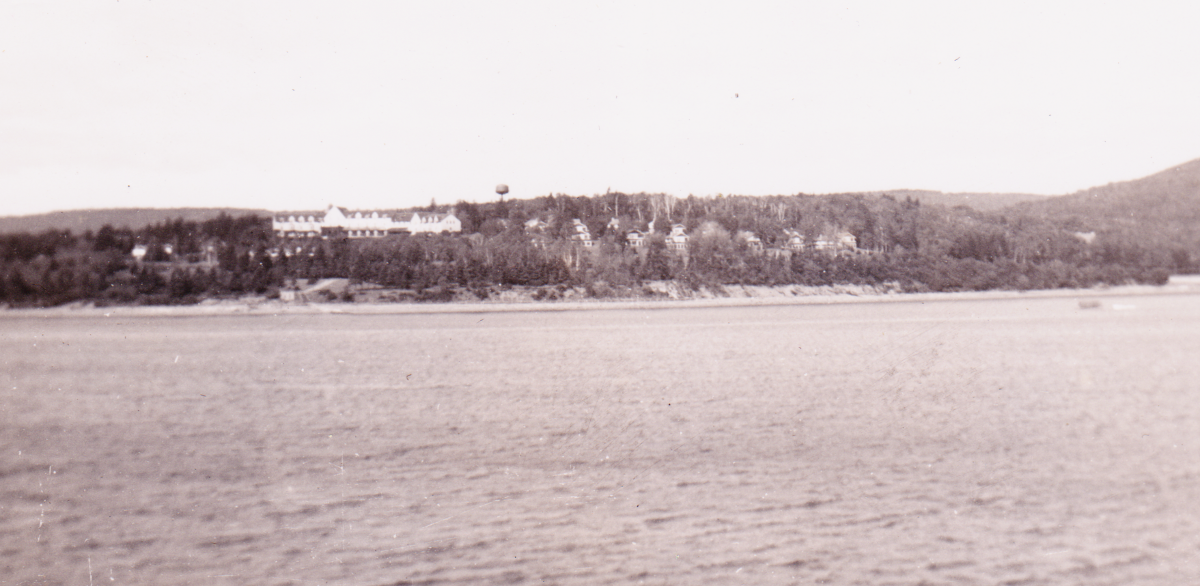
The CPR Digby Pines resort is seen from the train.


from: Canadian Pacific Hotels from Sea to Sea; 1950.


This engine at Digby was built for the CPR by Saxon
(Sachsische Maschinenbau AG, Chemnitz) in October 1903.
It was scrapped in August 1952.


The greater Digby area is seen from the train.
The top of an evergreen bisects the Princess Helene at the wharf.
To its right, descending to the right, is the white-fronted Digby Pines resort.


Barrels of apples appear trackside in an orchard.


An apple processing and storage facility.


The Canadian National Hotel Nova Scotian with the Halifax station at the right.


Below, are my father's vacation documents for both ends of his trip as he mounted them in his photo album.
The Lord Nelson is the CPR's answer to the CNR Hotel Nova Scotian.


His trip will continue from Halifax to Yarmouth on the CNR.
Then he will return Yarmouth to Montreal via the CPR.