Showing posts with label diesel. Show all posts

13 June 2018

CNR 1981 Kingston: M-630 Locomotives


During hot summer days in the 1980s, Alco Century Series 6-axle units were a favourite locomotive to spot and photograph. With some of the smoking external 'personality' of steam locomotives, they were particularly interesting to watch as they lifted heavy trains.


Diagrams come from this January 1970 operating manual ...
which made many trips along the north shore of Lake Superior with Rolly Martin.


Before the widespread provision, and company mandated use of dynamic brakes on Canadian railways, train air brakes were generally used for train control when descending grades and/or preparing to clear in sidings. Above, brake smoke blends with summer haze as an eastbound approaches the Kingston VIA station in 1981.


A time-honoured practice was to put freights into sidings for peak periods of VIA traffic. Before the 1986 Commission of Inquiry, Hinton Train Collision this was done through CTC signalling with very little 'sharing' from the Belleville-based dispatcher on the master plan evolving at his desk.

The tailend crew would advise the engineer when they were in the clear.

Above, Alco-MLW thoroughbred power supplements the summer heat at the east end of Kingston's Queens track 4.

Italics denote archaic railway terms.


Getting underway, the trailing unit - an M-636 - is putting on a show.


An earlier effort to look at M-636 power can be seen here:

CNR 2300s in June 1982 at Kingston


The evening summer sun in 1981 does a nice job of lighting elements of the brake system on the loaded boxcar above.
Probably no railroader mourned the extinction of roof-mounted hand brakes and 'plain' bearings.


26 October 2016

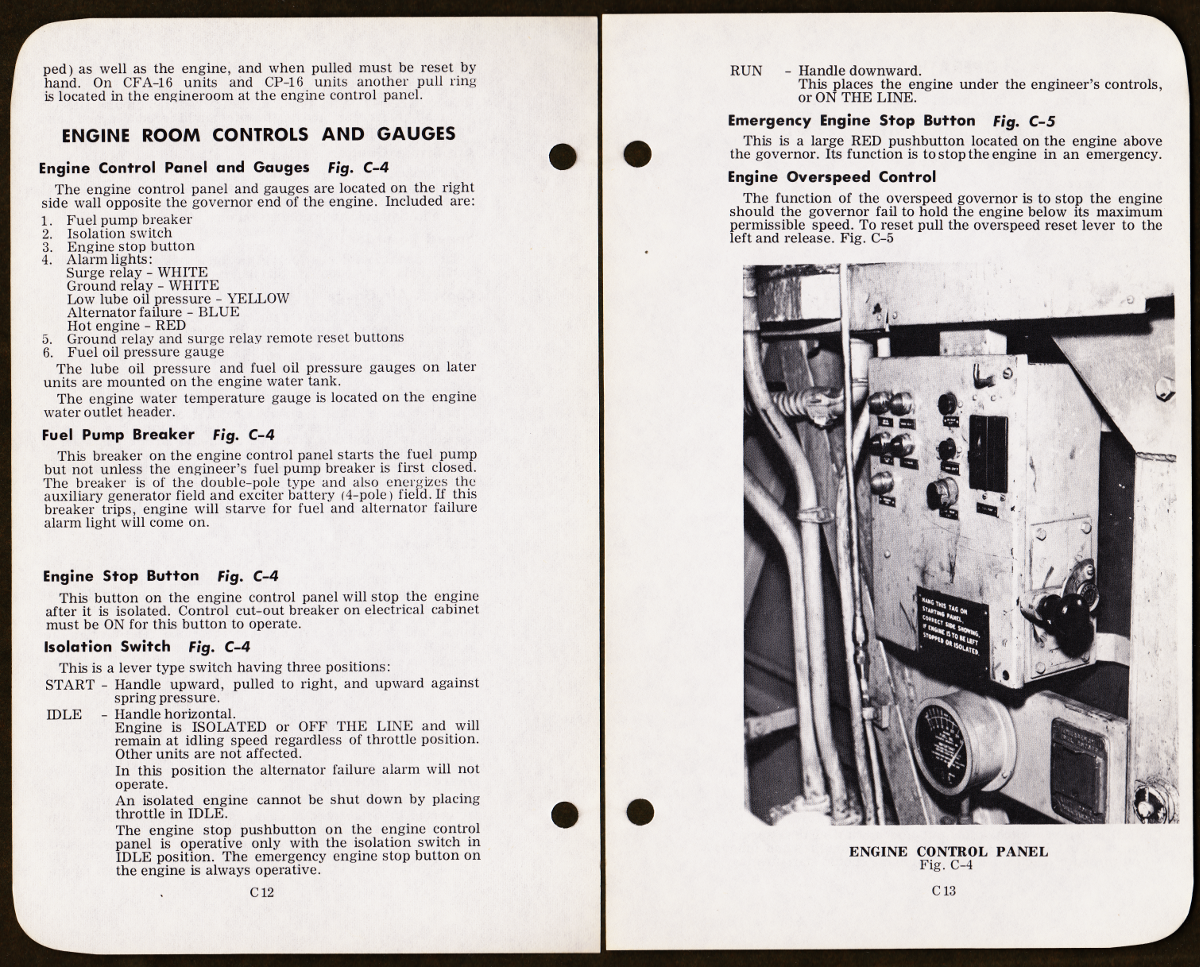
CLC Road Freight Locomotives - CFA-16 CFB-16. CNR Operating Manual 1966.


This post looks at part of a locomotive operating manual consolidation for engineers, issued by the CNR in 1966. 

With a wide variety of first- and second-generation diesel locomotives in service across the system, there was a great advantage to engineers in having just one manual to carry in their bags - rather than one for each of the most common models. You can also imagine the stress imposed on an engineer having to perform some obscure function on a unit seldom encountered before ... often in bad weather, and/or at night. 

Of course, there's the other side of the coin: employees should have no excuses for failing to follow the right procedures. The railway would avoid some train delays and some repair costs ... or managers could inquire why the correct procedures were not followed.

Without this adversarial perspective ... it was simply a good idea to put this book together.


I have chosen a relatively rare locomotive of unique design to present here - the freight version of the Fairbanks-Morse cab units manufactured in Kingston, Ontario by the Canadian Locomotive Company.


In Trains magazine in 1964, this handy box appeared within an article about F-M locomotives ...

from: Trains magazine, Born at Beloit; Jerry A Pinkepank; Nov 1964; Kalmbach.

*  *  *

From the CNR Manual ...

In some cases, I repeat detailed diagrams in a larger format.


*  *  *

My father purchased snapshot-sized railway photos from Stan Styles of Vancouver BC. There are no examples of CNR units of this type in his little collection. 

However, there are a couple of CPR units. The 4081 and the 4455 were both used by CPR for motive power from 1953 until 1968.

Nelson BC, May 23, 1955; Stan Styles, Vancouver BC. Collection of LC Gagnon.
*  *  *

Locomotive Inspection Reports

The following locomotive inspection reports were literally 'collected' by my father as they lay or blew around on the ground at Turcot Yard. No doubt, being saturated with oils, creosote and other similar preservation agents helped protect them from the weather. 

In July 1961, when we first visited the yard to see and to document the steam engines awaiting scrapping, Turcot Yard was a ghost facility - particularly on the weekend. Anything of value to the railway's operations had been removed and relocated to the CNR's new Montreal yard to the west. Only lines of dead locomotives, and those in the process of being cut up, remained. Because we stayed well away from buildings, these very few reports would have found their wind-borne way over to the locomotive deadlines. 

After 'collection', the forms would be placed in an olive-drab camera bag already containing rolls of film, a Brownie 'Holiday Flash' camera (black and white print film) and a blue Brownie 'Star Flash' camera (Ektachrome colour slide film - but the colours quickly washed out). Not owning a car yet, he and I (and sometimes my grandfather) would return to Lachine via an MTC bus caught up the hill on Upper Lachine Road.


At the end of each run over a subdivision, it had long been standard railway practice to have the engineer complete a report for the roundhouse/shop - noting any problems encountered with a steam locomotive. This process continued into the diesel era.

In many cases, the defects noted would actually be repaired - however - somewhere in the past I saw a series of increasingly angry comments on this type of report ... when repairs deemed necessary by an engineer were not made and the uncorrected problem was encountered on successive trips. 

I also remember an article written by an American shop foreman entitled 'One More Trip' - this being the mantra/prayer of the shop foreman who hoped that problematic locomotives would run well enough to reach someone else's territory before a costly and labour-intensive repair became necessary.

CNR designates the form as a 'back tumble' ... this term has long since been appropriated by the gymnastics industry. As the reverse side of the form is printed upside-down, perhaps the forms were originally hole-punched along the top and temporarily filed on wall-mounted ringed clipboards.

Just as I was surprised to find these reports, I was also pleased to see we have three forms covering the same 'leader' CFA-16-4 ... the CNR 9336. Although the last colourful report does not bear the year, I think I have arranged them here in chronological order.

The 9336 was delivered in 1953 and wrecked at South Parry, Ontario in July 1965. Also appearing are 9320 (scrapped 1966) and B-unit 9301 (scrapped 1966). Keep in mind that the date of the CNR Operating Manual which included these locomotives was also 1966. 

As you'll notice, Brockville and Belleville were still division points. While the CPR had labour conflict over its firemen, the CNR had similar problems with 'run-throughs' - the longer crew work days which were made possible by the new diesel-electrics.

Report #1


Report #2


Report #3

If I am reading this report correctly, the engineer has delegated the writing to his fireman. The engineroom leaks may have been a particular problem with this type of power. Notice the use of 'hay wire' for repairs. 

On freight (at least on the CPR), a headend brakeman/trainman and a grandfathered 'fireman' from steam days would be in the cab with the engineer. The fireman travelled back into the carbodies of these first-generation diesels (and later, to attend to more modern power) and kept them running. 

I've mentioned before that as a diesel fireman, Rolly Martin spoke with some pride of his work to maintain or to resurrect similar well-used CPR locomotives so that his engineers' trains could get over the road in good time, and particularly, so they would not need to double the train up some of the major grades around Lake Superior. I guess the fireman job was what you made of it.


from the Quebec Chronicle-Telegraph, April 3, 1958


05 July 2016

CNR 2300s in June 1982 at Kingston


I was probably surprised by this freight coming down the hill to the Kingston station and by its unusual consist. These ore cars are loaded with slag, a waste of steel refining ... or other metal smelting.


A Harsco PDF on artificial aggregates from 2009 stated: 
A rail ballast needs to be cubical in shape with a high angle of internal friction and high aggregate interlocking characteristics. This is particularly important on track curves, where the lateral forces on the track can be very high and the ballast is the structural element which maintains the longitudinal alignment.

Ballast slag often has bubbles in it, or it may have a satisfying 'ringing' sound - suggesting metallic content.

The 2300s had distinctive characteristics which often endeared them to trackside observers:
  • With standard Alco exhaust-driven turbo ... lag ... when starting to pull, they gave off clouds of smoke until the fuel/air mixture was rebalanced.
  • At a distance, their exhausts could be imagined as a steam locomotive - with discernable chuffing.
  • Like steam locomotives, you could watch moving parts - like the radiator fan drive, housed behind a simple grill.
  • And, as I was puzzled to first experience on a train leaving Schreiber yard ... some of these long Alcos had a tendency to oscillate heavily at low speed. 


Unfortunately, most of these photos were shot into the direction of the sun.


I don't believe that the slag is so fresh that it is steaming. I think the long slide into Queens Track 4 is generating a lot of brake smoke. On the tailend you can see the expected caboose. I believe a large stockpile of slag ballast was kept in Brockville yard during these days.

We might long for the good old days of obsolete plain bearing (thus illegal for interchange) ore cars retained for captive ballast service on CN. However, I don't think they are missed ...

On one warm summer day such as this, a crew was working to apply fresh ballast to a curve near Kingston. The cars were being unloaded one-by-one in sequence. A worker would wrestle to open a single hopper (this was not even possible in all cases) and the power would be quickly radioed to pull ahead before the worker's legs became buried in ballast. 

... But, when the ballast was demonstrating its 'high aggregate interlocking characteristics' so well that nothing was coming out, some magnificent severe slack action was introduced into the consist to improve the flow rate. 

In particular, I remember workers scrambling eastbound on the uneven, oblique roadbed alongside the moving cars as they worked to start and stop the ballast laying process. Always having to avoid being caught between the wheels and rail, it was a hot, tiring and continually dangerous job.

*  *  *

The following technical images are from:

Operating Manual, M-Line M-630 and M-636 Road Locomotives, AC-DC Transmission; MLW-Worthington Limited; January 1970.


*  *  *


Here is a view of the same train in Queens 4. As this is a bad place to inspect a passing train, the crew member is probably just enjoying some quiet time outside the hot cab.

To the right is the CP interchange - showing different layers of ballast. Formerly, the CP tail track closest to the camera led to downtown Kingston - via an overpass over the CN main line. The track departing through the right side of the photo connected with the CP at Tichborne.

Below is the employee timetable for the CP Kingston Sub from 1976.
Trains still operated on the CP to the interchange into the early 1980s.
from: CPR ETT No 47; April 25. 1976.
A local railfan - who was authoritative on other subjects - said that the track inspection standard for the CP Kingston Sub was: 'sufficient to bear a maintenance of way speeder during an inspection trip'.

*  *  *

One last endearing quirk of note within the Operating Manual for the M-636 is its air starter. 
The procedures are presented here for their historic value. 

... Compressed air is available in quantity on the railway. It maintains its potential energy on cold winter nights better than electric batteries.


*  *  *


Still backlit by the sun, the ballast train starts to pull from Queens 4. 
Sand, dust, and smoke from overheating parts, swirl as the power gets the train moving.


A concrete mileboard is visible in the foreground.
It is my guess that these were installed in the first decade of the CNR's operation of this former Grand Trunk trackage.


A pleasing photographic effect is produced when the sun is located behind the camera!
The train is travelling under the Division Street overpass.