Showing posts with label C-liners. Show all posts

02 November 2016

CLC Passenger Locomotives - CPA-16 CPB-16. CNR Operating Manual 1966.


According to one reference, the Canadian Locomotive Company passenger cab units lasted a little longer on the CNR (some until 1969) ... than the other opposed-piston-powered locomotives of Fairbanks-Morse design on that railway. 

Here is how they were covered in the CNR operating manual compilation of 1966.


The pages from the CNR operating manual do not have source captions. 
However, the images from other sources are labelled to show their origin.


There are no diagrams provided for the passenger units in the CNR book. Here is one found in the Locomotive Cyclopedia for 1950-1952. The F-M pages in the Cyclopedia are less lavish than those for the two largest diesel manufacturers. After trying to improve on the rough quality of the diagram below, I decided to leave it in its original state.

from: Locomotive Cyclopedia; 1950-1952; Simmons-Boardman.

Standard F-M nomenclature uses a suffix to denote the number of axles, so to them, the locomotive above is a CPA16-5

In the Cyclopedia, in a number of cases, you can also see Whyte-style classification used. So the unit above is an 0-4-6-0 ... or something.
In North American diesel nomenclature, it is a B-A1A.

I believe that the unusual third axle on this passenger unit is to support the weight of the steam generator equipment. While one could argue that this is evidence of fine engineering ... it might also be true that the opposed-piston design is already more unusual engineering than anyone desired to deal with. 

The two higher powered units of this series of locomotives (2000 hp and 2400 hp) used the same carbody and frame. F-M was selling the interchangeability of components with this design. When compared with units of the same power for freight service, the 2000 hp and 2400 hp units added about 20 tons of steam generator-related weight.

The 1600 hp version (the CNR unit) - detailed below, and also farther below - only adds 6 tons for passenger service. The A1A truck may have been seen as beneficial for use on some of the CNR's areas of lighter track.

from: Locomotive Cyclopedia; 1950-1952; Simmons-Boardman.

*  *  *

Here are the pages from the CNR operating manual.
The CNR images are repeated and enlarged so you can see more detail.


That marks the end of the CPA-16 coverage in the CNR manual.

*  *  *

from: Locomotive Cyclopedia; 1950-1952; Simmons-Boardman.

from: Locomotive Cyclopedia; 1950-1952; Simmons-Boardman.

from: Locomotive Cyclopedia; 1950-1952; Simmons-Boardman.

*  *  *


The cover of a booklet detailing the CLC's steam locomotive history and wartime manufacturing, the Consolidation line of diesel-electrics, the CLC's export locomotives, the other heavy industry equipment manufactured by the CLC, and the significance of the plant to Canada and to Kingston ... featured the CNR-style unit on its cover. The illustration features an enormous front coupler housing.

*  *  *

My father had requested these locomotive data sheets from the CNR.

Collection of LC Gagnon.

Collection of LC Gagnon.

26 October 2016

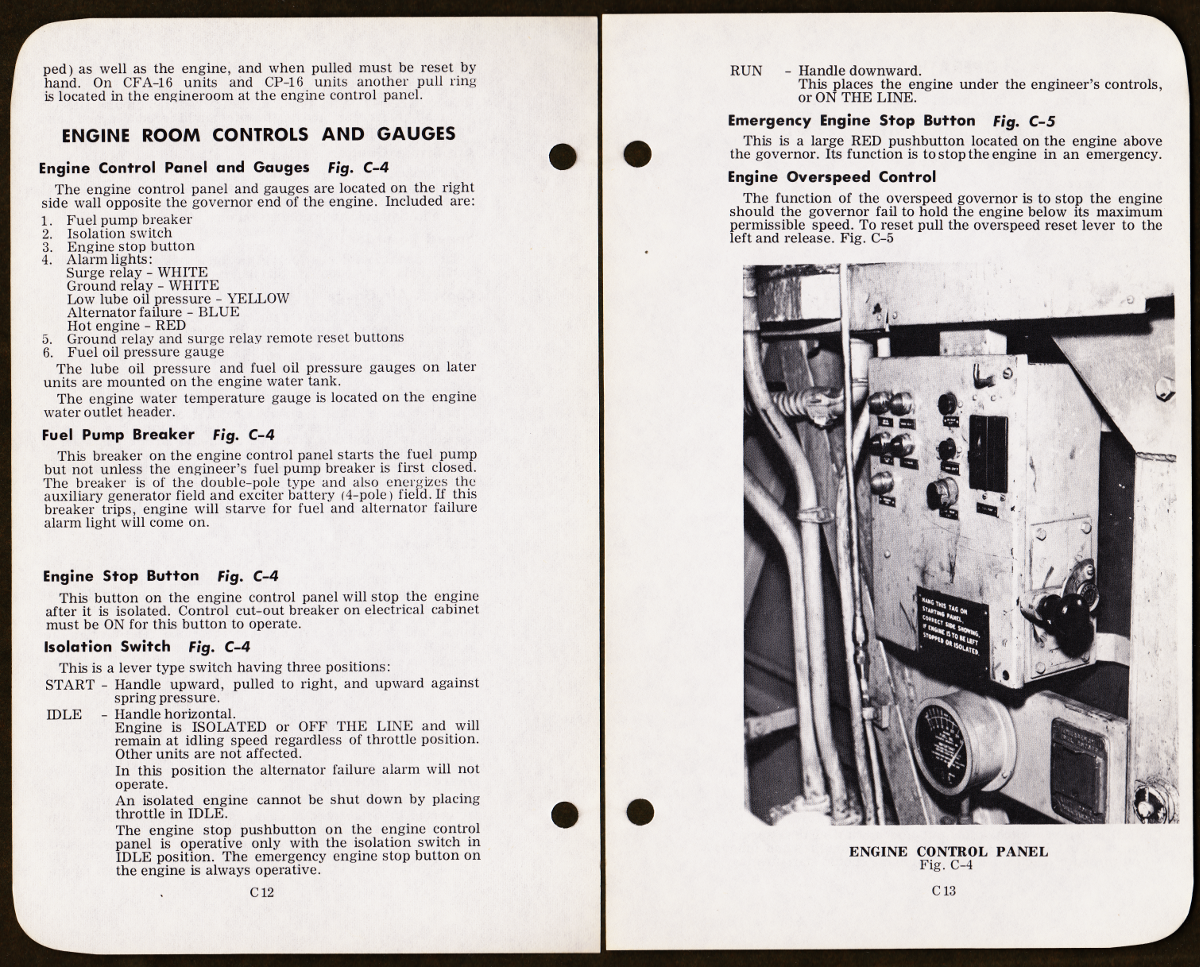
CLC Road Freight Locomotives - CFA-16 CFB-16. CNR Operating Manual 1966.


This post looks at part of a locomotive operating manual consolidation for engineers, issued by the CNR in 1966. 

With a wide variety of first- and second-generation diesel locomotives in service across the system, there was a great advantage to engineers in having just one manual to carry in their bags - rather than one for each of the most common models. You can also imagine the stress imposed on an engineer having to perform some obscure function on a unit seldom encountered before ... often in bad weather, and/or at night. 

Of course, there's the other side of the coin: employees should have no excuses for failing to follow the right procedures. The railway would avoid some train delays and some repair costs ... or managers could inquire why the correct procedures were not followed.

Without this adversarial perspective ... it was simply a good idea to put this book together.


I have chosen a relatively rare locomotive of unique design to present here - the freight version of the Fairbanks-Morse cab units manufactured in Kingston, Ontario by the Canadian Locomotive Company.


In Trains magazine in 1964, this handy box appeared within an article about F-M locomotives ...

from: Trains magazine, Born at Beloit; Jerry A Pinkepank; Nov 1964; Kalmbach.

*  *  *

From the CNR Manual ...

In some cases, I repeat detailed diagrams in a larger format.


*  *  *

My father purchased snapshot-sized railway photos from Stan Styles of Vancouver BC. There are no examples of CNR units of this type in his little collection. 

However, there are a couple of CPR units. The 4081 and the 4455 were both used by CPR for motive power from 1953 until 1968.

Nelson BC, May 23, 1955; Stan Styles, Vancouver BC. Collection of LC Gagnon.
*  *  *

Locomotive Inspection Reports

The following locomotive inspection reports were literally 'collected' by my father as they lay or blew around on the ground at Turcot Yard. No doubt, being saturated with oils, creosote and other similar preservation agents helped protect them from the weather. 

In July 1961, when we first visited the yard to see and to document the steam engines awaiting scrapping, Turcot Yard was a ghost facility - particularly on the weekend. Anything of value to the railway's operations had been removed and relocated to the CNR's new Montreal yard to the west. Only lines of dead locomotives, and those in the process of being cut up, remained. Because we stayed well away from buildings, these very few reports would have found their wind-borne way over to the locomotive deadlines. 

After 'collection', the forms would be placed in an olive-drab camera bag already containing rolls of film, a Brownie 'Holiday Flash' camera (black and white print film) and a blue Brownie 'Star Flash' camera (Ektachrome colour slide film - but the colours quickly washed out). Not owning a car yet, he and I (and sometimes my grandfather) would return to Lachine via an MTC bus caught up the hill on Upper Lachine Road.


At the end of each run over a subdivision, it had long been standard railway practice to have the engineer complete a report for the roundhouse/shop - noting any problems encountered with a steam locomotive. This process continued into the diesel era.

In many cases, the defects noted would actually be repaired - however - somewhere in the past I saw a series of increasingly angry comments on this type of report ... when repairs deemed necessary by an engineer were not made and the uncorrected problem was encountered on successive trips. 

I also remember an article written by an American shop foreman entitled 'One More Trip' - this being the mantra/prayer of the shop foreman who hoped that problematic locomotives would run well enough to reach someone else's territory before a costly and labour-intensive repair became necessary.

CNR designates the form as a 'back tumble' ... this term has long since been appropriated by the gymnastics industry. As the reverse side of the form is printed upside-down, perhaps the forms were originally hole-punched along the top and temporarily filed on wall-mounted ringed clipboards.

Just as I was surprised to find these reports, I was also pleased to see we have three forms covering the same 'leader' CFA-16-4 ... the CNR 9336. Although the last colourful report does not bear the year, I think I have arranged them here in chronological order.

The 9336 was delivered in 1953 and wrecked at South Parry, Ontario in July 1965. Also appearing are 9320 (scrapped 1966) and B-unit 9301 (scrapped 1966). Keep in mind that the date of the CNR Operating Manual which included these locomotives was also 1966. 

As you'll notice, Brockville and Belleville were still division points. While the CPR had labour conflict over its firemen, the CNR had similar problems with 'run-throughs' - the longer crew work days which were made possible by the new diesel-electrics.

Report #1


Report #2


Report #3

If I am reading this report correctly, the engineer has delegated the writing to his fireman. The engineroom leaks may have been a particular problem with this type of power. Notice the use of 'hay wire' for repairs. 

On freight (at least on the CPR), a headend brakeman/trainman and a grandfathered 'fireman' from steam days would be in the cab with the engineer. The fireman travelled back into the carbodies of these first-generation diesels (and later, to attend to more modern power) and kept them running. 

I've mentioned before that as a diesel fireman, Rolly Martin spoke with some pride of his work to maintain or to resurrect similar well-used CPR locomotives so that his engineers' trains could get over the road in good time, and particularly, so they would not need to double the train up some of the major grades around Lake Superior. I guess the fireman job was what you made of it.


from the Quebec Chronicle-Telegraph, April 3, 1958