" I hired a locomotive and tender with a coach attached ... What a thrill it was! "
In the late 1990s, I was studying for my second or third career and Maria Bartiromo was employed by CNBC to report facts from the floor of the New York Stock Exchange. On a few occasions she mentioned the 'legendary investor' Bernard Baruch. A few years later, at a local used book store, I purchased the autobiography he had written in 1957.
I thought readers might enjoy imagining themselves in the situation he describes below.
(Manila Bay and Santiago are explained further down the post.)
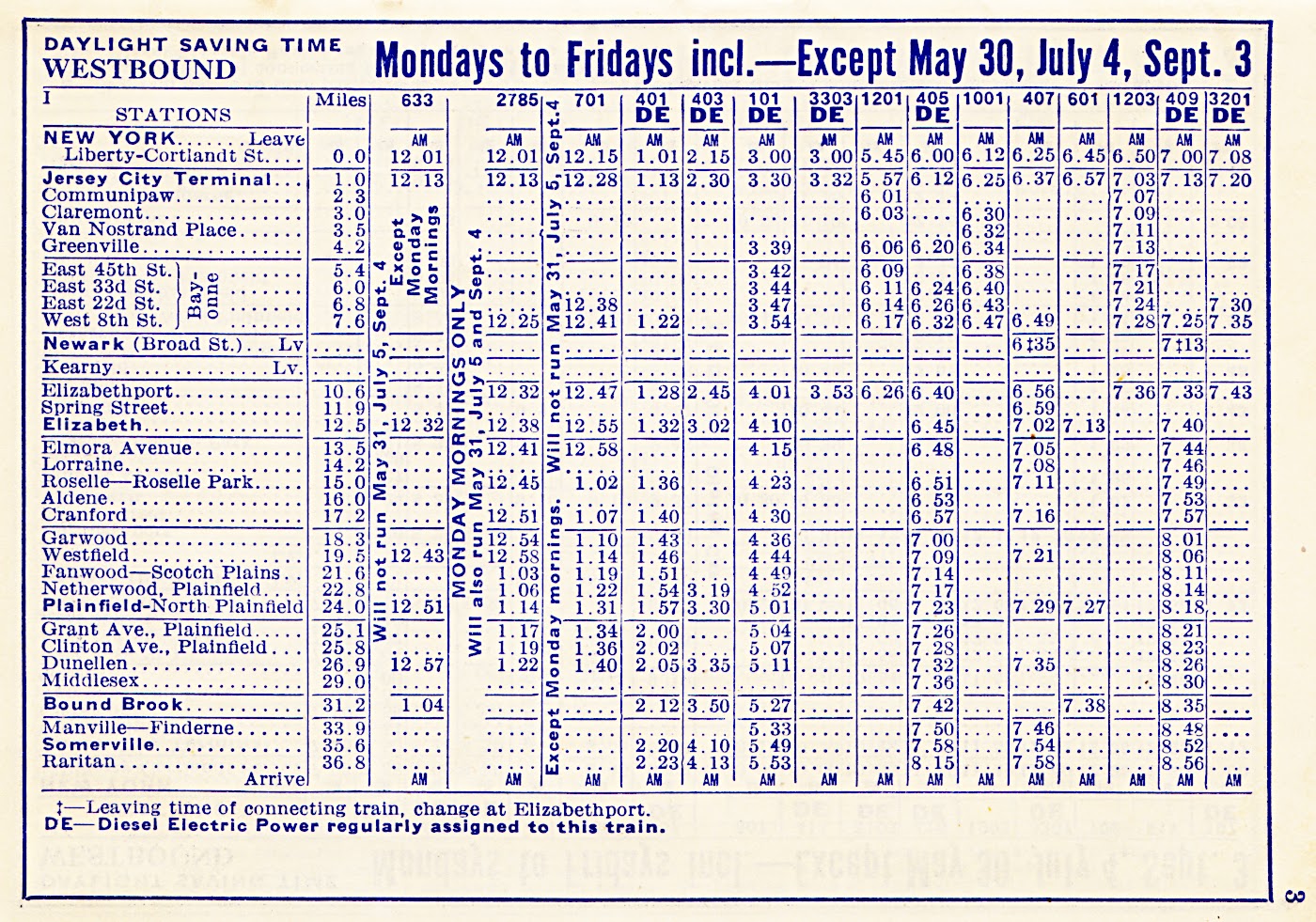
I have recently prepared a piece on the New Jersey Central
and it seems likely this was the railroad Baruch used for his trip.
On the map below, Baruch departed from Long Branch (bottom, centre) and took the ferry from Jersey City to New York.
 |
| from: 1928 Handy Railroad Atlas of the United States; Rand McNally; Kalmbach, reprint. |
Short version (events mentioned by Baruch)
:
Commodore of the US Asiatic Fleet, Commander George Dewey (1837-1917) had begun his naval career at age 16 and had served with distinction in the US Navy during the Civil War. On 1 May 1898, he destroyed the Spanish Pacific Squadron during the Battle of Manila Bay (Philippines).
On 3 July 1898, Commodore Winfield Schley and Rear Admiral William Sampson sank all of the Spanish warships they engaged during the Battle of Santiago de Cuba.
It was the news tip about the decisive victory at Santiago which caused Baruch to rush to New York and telegraph instructions to buy up depressed American stocks on the London Stock Exchange when it opened on Monday, 4 July 1898.
But what was the American motivation to attack Spanish ships?
 |
| from: The Modern Age; Richards & Cruickshank; 1955; Longmans Canada. |
* * *
 |
| from: Cartoons of our war with Spain; 1898; Frederick A Stokes Co. (at archive.org) |
 |
| from: Cartoons of our war with Spain; 1898; Frederick A Stokes Co. (at archive.org) |
There were many cartoons showing the mast and crowsnest of the USS Maine protruding above the waters of Havana's harbour in US newspapers in the months after the explosion. President McKinley is seated and in contemplation in the image above. Like many of his political contemporaries McKinley understood armed conflict, having fought in the Civil War.
The armoured cruiser USS Maine (in service: 1895-1898) arrived at Havana, Cuba on 25 January 1898 'to protect American interests'. Cuba was a colony of Spain with extensive US sugar and tobacco operations. Roughly 90% of these exports were shipped to the US - not Spain.
In Havana harbour, on the evening of 15 February 1898, the 5 tons of naval gun propellant (I think the charges were in 'stick' form) aboard the Maine exploded, killing 261 of its crew. This explosion was caused by ...
Choice 1: A mine planted by Spain.
Choice 2: A fire in the coal bunker ... which was adjacent to the magazine holding the 5 tons of naval gun propellant.
If you have ever read an old book about firing steam locomotives, you'll remember that firemen are discouraged from over-firing and creating too much smoke ... as half of the coal's energy is contained in its volatile gases - primarily methane - which are lost in that smoke.
The US Navy at this time was changing from ('smokeless') anthracite to the more heat-dense bituminous coal (as used by most railways) because of its greater heat content. Low-smoke anthracite was a more desirable coal to use in cities and increasing urban demand may have made it too expensive for the Navy.
In addition to its tendency to fill up enclosed coal bunkers with natural gas, iron sulphide deposits within the bituminous coal react exothermically when exposed to oxygen ... and ... these iron pyrites can also produce sparks when struck by something metallic - like a shovel.
 |
| from: Dictionary of American naval fighting ships; 1959; United States Navy. (at archive.org) |
After posting:
Brother Eric kindly sent me the stamp image commemorating the event's centennial.
The full historical quote was:
"Remember the Maine, to hell with Spain."
(I guess the bellicose sloganeers could not rhyme "firedamp" and "spontaneous heating")
* * *
Another overview:
 |
| from: World History; Hayes, Moon, Wayland; 1946; Macmillan, New York. |
* * *
Thinking of the Civil War military service of the future President William McKinley and so many of his political contemporaries, here is a table from the time just before the Spanish-American War.
As you can see, it was a feature of the culture back then to regularly call on professional soldiers, militia and volunteers to attend to problems by igniting gunpowder. The period between the Civil War and the Spanish-American War was the longest interval in which there was no armed conflict - 33 years.
 |
| from: The World Almanac, Commemorative Edition; 1992; Pharos Books. |
The United States had a population of 31 million at the time of the Civil War.
* * *
The USA and its possessions are shown on a map from 1912.
This fascinating historical map has always intrigued me. The colour overprinting isn't as precise as it could be. You can see that some long island chains are overlaid over other possessions so they all can be shown in the correct scale over the continental US.
 |
| from: A Descriptive Review of the Empire State [part of a world atlas]; 1912; George F Cramm. |
As this post is being prepared, there is talk about a new 51st state being added to the Union.
If you look at Virginia on the map above, you'll see Puerto Rico superimposed on it. Today, Puerto Rico has a population of 3.2 million.
Puerto Rico's population is greater than that of each of the following states: Nevada, Arkansas, Kansas, Mississippi, New Mexico, Nebraska, Idaho, West Virginia, Hawaii, New Hampshire, Maine, Montana, Rhode Island, Delaware, South Dakota, North Dakota, Alaska, Vermont and Wyoming (19 states).
After 127 years of being part of the USA, if there was reasonable democratic fairness, Puerto Rico would be the 51st state.
The Gods of AI tell me that the state of Puerto Rico would be entitled to 2 Senators and at least 5 representatives in the House of Representatives.
Wiki indicates that statehood for Puerto Rico has long been an election plank of the Republican Party ... however this item was removed from its 2024 campaign platform.
* * *
To finish off ...
For the purpose of illustrating the engagement which precipitated Bernard Baruch's special train from Long Branch to Jersey City,
here are two images from the naval battle at Santiago, Cuba, 3 July 1898.
 |
| from: Harper's pictorial history of the war with Spain; Nelson Miles; 1899; Harper & brothers. (at archive.org) |
 |
| from: Harper's pictorial history of the war with Spain; Nelson Miles; 1899; Harper & brothers. (at archive.org) |
I think you can see from the map above that the battle began at Santiago in the east, and the chase proceeded westward with fewer ships remaining as the Spanish fleet was destroyed over a period of about four hours (0935hr-1315hr). You can see the surviving Spanish ship Colon beached at the extreme left.
Each ship has its abbreviation (eg. NY for the USS New York). Up to seven positions are shown for each ship by ascending numbers (i.e. starting at position NY1 and ending at position NY7).