Showing posts with label Brockville. Show all posts

01 December 2018

Brockville, May 1981, Part 3 (More Work for the Carmen)


As darkness begins to fall, the last few switching moves are made at Brockville. 


To see the earlier parts of this series, here are the links:


Brockville, May 1981, Part 2


As Number 46 departs up the CPR Brockville Sub, the power for Number 56 waits for the switch.


No 46 begins its maximum 40 mph trip up to Smiths Falls,
56's power makes its move.

The semaphore governs the CPR Loop Line to the Brockville waterfront.


A clear signal beckons.


With his hammer, carman's lantern, and ankle bands
(to prevent his pant cuffs from catching on passing equipment)
the carmen prepares to make the joint.


After the safety stop, he prepares the knuckle to hopefully make a good joint the first time.

If you follow the coach air hoses back, you can see the relative pipe sizes of the
train (air brake) line and the communicating signal line (above the train line, thinner).


The hammer is propped on the inside of the rail,
before it is used to secure the locking fittings of the Barco steam line connection.


I thought the 'rumpled tan raincoat' at the joint looked like the traditional outfit of a master mechanic/official
(as seen high on the tenders of refuelling steam locomotives in excursion service).

On closer inspection ...
He may be attending to the needs of the author/historian/dignitary
who seems to be wearing a nametag on his right chest
and a white engineer's cap.
There seems to be a crowd in the cab on departing.

(I checked, and OS Nock wrote about the 'corridor' trains way back when the old
'outer' Kingston station was still on the long curve.)


Time to go.


And a nice freight to round out the evening.


24 November 2018

Brockville, May 1981, Part 2


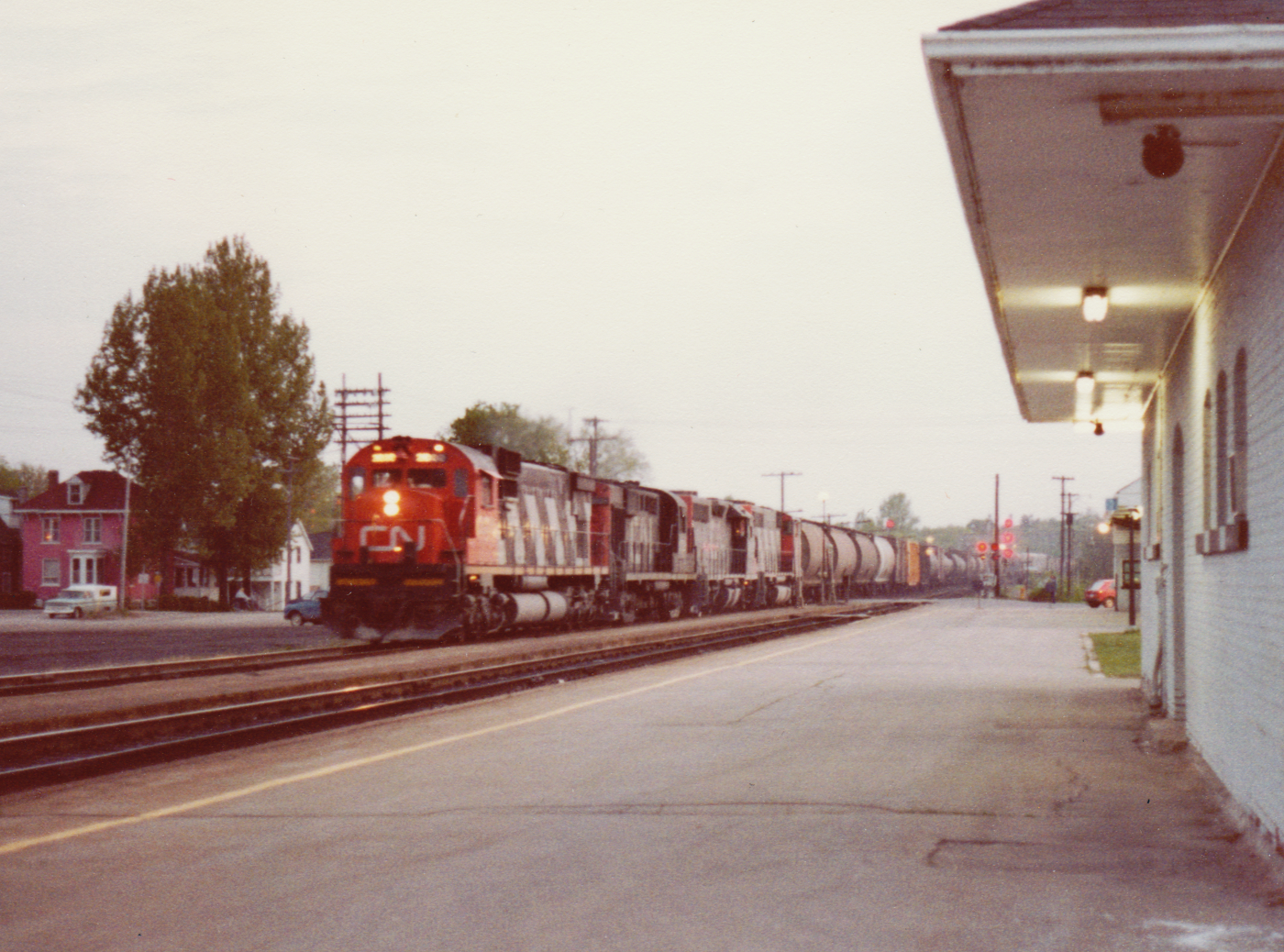
This post continues with a look at Brockville evening operations. The public timetable appears at the end of the post. I think this sequence shows the splitting of Trains 46 and 56.


Probably after waiting a while, a yard move arrives from the west.


The right front (RF) of the unit.


Some portraiture of the power for Train 56 as it waits behind the station.


Do you recognize that train at the left edge?
I'm not sure, but I think it might be 'Turbo'!

(Be sure to send for my kitbashing article
on turning your ancient conventional equipment
into a Turbo trainset! Be sure to send an SSAE!*)

Today, I was wondering ...

The way the government set up the expensing of contracted service for VIA equipment ... what kind of 'annuity' was written to pay the CNR (the beneficiary) for servicing VIA's 'new' Turbo. I also wonder what the asset value of the Turbo was ... when it was transferred from CN's to VIA's books. CNR officials must have been relatively pleased to have the long-suffering Turbo experiment become someone else's responsibility.

I remember reading an example of the 'no fault' service contracts the railways were given at the time: If steam generator water was used to top up a diesel fuel tank because the contracted railway employee was not familiar enough with the different (or similar in this case) filling ports - VIA paid for the repair. 

This kind of thing happened back then because CPR workers were servicing former CNR equipment and vice versa.

I was told (on a VIA 'CPR train') that the Canadian's stainless steel equipment had so many wheel flat spots (during one trip, right under our roomettes - but it did save us from sleeping through the stop at Bisco!) ... because the CNR crews on the transcontinental service were not accustomed to the effectiveness of the Canadian's disc brakes.

... And, of course, the steel brake shoe equipment was operated in trains which also included the CPR equipment ... so how were they supposed to set the air to get a consistent braking force?

* stamped, self-addressed envelope


The crew for Train 56 is reporting for duty.


A dramatic old-school arrival of Train 46/56.
The steel-on-steel braking is putting on a good show.
Notice the second engineer getting ready ...


He's snagged the string loop knotted to orders and a clearance.
You can see the little bundle hanging beside his belt.

The train will be transferring from CNR to CPR track.


As if to answer my puzzlement from the previous post
(regarding the title of a VIA crew member signalling for a brake test) ...

The acting conductor is differentiated from brakemen/flagmen by that gold hat band.

Notice the brake cylinder travel, and shoes against wheels.

... more from this sequence next time ...


The timetable in force when these photos were taken:


16 November 2018

Brockville, May 1981, Part 1 (2 Carmen & 1 Switcher)


While I am generally fuzzy about the dates of photos, I certify that these evening photos were taken in late May of 1981. The Montreal-Toronto passenger schedules from this timetable are reproduced at the end of this piece.

It seems likely that the first set represents the connecting of VIA train 55 (from Montreal) and train 45 (from Ottawa).


The carman is walking the train.


Another carman is controlling the movement as a car attendant stands by.


The carmen makes the connections.


The passenger brakeman (qualified as a conductor - but probably not this train's acting conductor)
 uses the communicating line to signal the headend for the necessary brake test.

At the last car, the carman will watch for 
piston travel at the brake cylinder and brake shoes against the wheels.

*   *  *

The "Communicating Signal Appliance"

Many of these practices were seen at the Kingston VIA station ...

Radios were later approved as the primary system for train crew to engine crew communication. However, at this point, the reliable, proven communicating line ("communicating signal appliance" in the rulebook) was the mandated method used for brake tests, spotting passenger trains, giving the highball etc. The valve in the car vestibule would hiss loudly as it was used to sound the small whistle in the locomotive cab.

Stopping

When stopping a train, the train crewman sounded two whistles as required by the rules.  The first whistle would be sounded ("get ready to stop") and the second would often be sounded several seconds later when the vestibule had almost reached the desired spot. On a very long (heavy) slow moving train the interval between signals might be ten seconds or more. During Air Canada strikes circa the late 1970s, Toronto-Montreal trains sometimes reached 19-20 cars.
To avoid a 'brickwall stop' (shoe/wheel/rail adhesion is highest at the slowest speeds) ... Generally, the passenger engineer would use a relatively heavy application to slow the train, release, and then use a lighter application to spot the train as required. In the failing evening light, part of the steel brake shoes (and a thin part of the wheel treads) would sometimes glow red and give off sparks if the approach to the station was aggressive.
Starting

On a long train, a number of vestibules would be opened - each attended by a member of the operating crew. An exception might be a club car with its own attendant - just a few passengers would quickly exit/board there while the masses milled around the other vestibules. As the platform emptied of boarding passengers, the train crew members would remain on the platform and they'd often stay down there until the time indicated in the employee timetable ... as the passengers settled themselves and their belongings.

When loading was complete at each vestibule, the brakemen and conductor would each raise one hand vertically at arm's length. This would be the high sign for the highball among the train crew and they would board. The "proceed" signal ('highball' does not appear in rulebooks) came from the conductor using the communicating signal. 

Some conductors would observe from the upper vestibule door to (presumably) witness that no late passenger was injured in some desperate attempt to board the moving train through a closed vestibule. Habitually watching the bare platform would also help ensure that no train crew members were left behind - an rare error which would rest on the conductor's shoulders.

The cab whistle cut through the engine noise and could be heard quite a distance from the train when the cab windows were open. A photographer could use the whistle as a warning to get ready for a 'train-starting photo' - especially if smoking Alco/MLW units were in the locomotive consist.

Occasionally, in the few years which followed this photo, one might hear a train crew member give a verbal 'OK to go Number xx' via his radio. Nothing would happen. The engineer would explain he was waiting for the proper signal. The crew member would dutifully use the signal line and the train would depart.

I covered (rulebook and diagrams) the need, development and mechanics of the communicating appliances in this older post. And I see that I gave that brakeman an increase in pay to acting conductor when I used that same photo ... hopefully one of my two statements is correct.


Time to go!

Below the couplers, you can see (top to bottom): 
the (air brake) train line,
the communicating signal line (smaller hose),
the steam line.


A westbound Rapido rolls through Brockville without stopping.
I counted 9 cars.


A freight waits for some of the evening traffic to clear.

*  *  *

The timetable for this date appears below.


Applicable reference marks are reproduced below.
The system timetable has 4 pages of them.

The high-numbered reference marks are not included
They pertain to 'no local traffic', 'no checked baggage' and GO Transit.


03 November 2018

Kingston, Brockville, CPR Main Line, 1981


Here are a few more snapshots and photos from the early 1980s at Kingston, Brockville and somewhere on CPR's eastern Ontario main line. My method for dating them follows because I wasn't sure whether they were 1981 or 1982. 

Over the years, we experienced or saw some of the effects of Prairie droughts. In the late 1980s, when for vacation we still operated Kingston to Portage la Prairie with a CB radio, we met dozens of stock trucks bringing beef cattle to eastern markets because there was no local pasture to sustain them through the summer. Naturally, this had severe effects on the market prices received by the ranchers and farmers.

The first photo shows some boxcars of the government-owned Canadian National Railways spotted at the team track which was once located (I think) west of Gardiners Road and south of the main line in Kingston. 'Plain' - compared to 'roller' - bearings still rode the rails.


There was a campaign by farmers in eastern Canada to help support the farmers and ranchers in the west by donating hay to them. Being conscious that I'm looking at free hay ... this seems like the crispy hay which spent a couple of years in the back corner of the loft ... because the farmer wasn't desperate enough to use it for his/her own animals and they didn't have the heart to recycle the hay bales into their own fields via the manure spreader and the plow. Again, this was a gift and they were getting desperate out west.

*  *  *

Back in those years, I was more keen on living my life than documenting things in detail.
Photofinishing stores didn't bother writing the year on their envelopes.
So, some of my photo books are not precisely dated or captioned.
How can one date them? Was this 1981 or 1982?

Options:
  1. You can ensure that your printed photos are properly dated in your books. Nope! ... next ...
  2. You can go through an alternate process to try and date them. 
  3. I have a third option: Ask my brother - knower of great quantities of railway and western Canada data ... or (if I am 'on deadline') I could sneakily search his website for the answer. I am usually quite certain it will be there. But I've never done this because it's 'cheating'.

So I chose Option 2. I think these photos are from 1981. 
Here is my process ...


from: Comparison between the Droughts of the 1930s and the 1980s in the Southern Prairies of Canada; L Nkemdirim, L Weber; Journal of Climate, August 1999. 
Having just done a few posts on the Big Beaver area of southern Saskatchewan,
I'm interested in learning more about the history of the southern Prairies.

Below is an explanation of the PDSI.

We once attended a Gwynne Dyer lecture during which he noted that Canada would be a net 'winner' - if such a thing is possible - as climate change continues. He continued: "But we'll lose the Prairies [as an agricultural area]". So you'll hear more about this kind of thing in the future.

from: University Corporation for Atmospheric Research website; https://climatedataguide.ucar.edu.

*  *  *

After my posting came this message from Eric:

"I was able to narrow down the hay boxcar date because I photographed the same cars on my little 110 camera: CN 424187-421888-427196-421150 (attached) and the date was July 18, 1980. 
"Interestingly, on July 10 at an unrecorded location (?midday) I recorded a westbound freight with CN 9526-9519-5071-3208 so it seems at least that photo might be from around that date if the units were still together as shown westbound in your photo."

Here is the link to his photos of those cars and the other tracks in the immediate area.

CN's Kingston Industrial Spur, Part 2

Trackside Treasure has the details!

... so 1980 is the date which is best documented.
(See what I mean?)

*  *  *

So this is probably 1980 ...

An westbound freight led by 9319 approaches Collins Bay Road in Kingston.

*  *  *


This sequence was taken somewhere between Merrickville and Brighton. I'm not certain that the absence of a headlight on the eastbound is helpful in determining whether this is a double- or single-tracked zone.


1981
*  *  *
1969

I remember coming home quite excited (as an 11 year old) after I shot these two photos in March 1969 at 40th Avenue, Lachine. Next, there would have been the weeks waiting for my father to finish the roll of slide film and mail it to Toronto for developing (the incentive was that Toronto sent a free film for each roll developed). These units are westbound on the CNR. Commuters, after crossing the future Autoroute 20 using traffic lights and a crosswalk, used that overpass to reach the CPR commuter station behind the camera.


*  *  *

Back to 1980 ...


This is turning into a bit of a freak show. This is a Vivitar 110 film roadside quick shot. I pulled over to photograph the switching at the DuPont plant in Kingston. As a bonus, I got a railway physics demonstration. This was an interesting illustration of a force being applied to an object resting on a low friction surface - admittedly on an incline. The brakeman riding the car started his own switching manoeuvre by releasing the handbrake and pushing on the car for about 10-20 seconds. I realize that one-person car movers were extensively used - particularly at Prairie elevators. There was no leverage used for this move.

*  *  *

Brockville


A typical westbound for this period rolls through Brockville yard.


A westbound with autoracks - maybe on their last trip - passes under the gantry at Lyn, Ontario.


After quietly rolling down the nearby hill at speed, this eastbound Turbo
 appeared out of nowhere and I didn't have time to properly frame the shot.