Showing posts with label winter. Show all posts

19 November 2022

CPR 1960 Montreal - A First and Last Steam Experience

While researching a Lachute-based piece, I was going through ancient family photos. It probably wouldn't hurt to have this little vignette of railway history preserved.

When he was almost 33 years old, and I was 2 1/2 years old, my father decided I should have a ride behind a steam locomotive before they were all gone for good. Of course, the future is always difficult to predict. Probably no one could have foreseen CNR's supportive corporate culture for steam excursions into, and far beyond, the 1960s.

Knowing my paternal grandparents' interest in recording events through photography, perhaps the main 'longterm desired outcome' for this trip was my father's desire to document the event with photos. Whether I remembered the experience or not, at least we could both look back and see that it had happened. In other words, here was proof I had been exposed to an important, historic aspect of my father's lifelong interest in railways.

... or maybe ... he was doing my mother a favour by getting a two year old out of the apartment, and he was getting to go for a train ride. You be the judge.

According to his notes in the photo album, the date was Monday, February 15, 1960 - during my father's mid-winter school break. Our trip was from 40th Avenue, Lachine to Windsor Station. The day was cold and blustery and we took a morning train. We returned by Provincial Transport bus.

Most of the morning commuter trains would be eastbound to downtown Montreal (Windsor Station). To return westbound by train ... we might have had a long wait. And perhaps he chose a Provincial Transport bus which dropped down from the '2 and 20' (the four-lane highway) to return us closer to the lakeshore of Lachine where we lived.


Before the train's arrival, my father photographed this westbound passenger train with his snapshot camera.

I have no statistics on the effective range of a 2 year old bundled for cold weather operation.  However, I just measured the distance from our apartment to the CPR station at 40th Avenue, Lachine. It was 1.7 kilometres. We may have taken a taxi to the top of 40th to facilitate our mission.


Our engine was Pacific 2412. The era's dress of zippered rubber galoshes over lace-up Oxfords, and Fedoras (and similar classic hats useless for winter wear in Canada) can be seen. In about a year, President John F. Kennedy would attend his inauguration bare-headed - changing men's fashions forever. 

I had wondered whether a north wind had caused the passengers to turn their backs to the train. If one looks at the clean, almost vertical stack of the engine, perhaps they were not sheltering from the wind. It seems possible that they were avoiding the oily mist of blowing steam, and the mini-blizzard from the 'bow wave' of the train as it rushed in. 

Steam or diesel, these commuter trains didn't really operate in 'the company notch'. It seems likely the experienced engineer is working steam against the train brakes to stay on schedule and to facilitate a precise stop.


And here we are at Windsor Station. We don't know any of these people. They must have been wondering why someone was using a flashbulb at them within the semi-sheltered trainshed at Windsor.

CPR 2412, a 4-6-2 built by the Canadian Locomotive Company in December 1942, was scrapped in April 1961.


Dressed to avoid frostbite and/or 'getting a chill' during our adventure, I am standing inside the gates protecting the trains from unauthorized and unpaid access. These heavy gates were built to last and you'll notice the wire-reinforced glass - designed to survive decades of sliding open and closed.


Postscript: In the years which followed, my father revised his photo album description of the event in light of the fact that all five of us had experienced steam fantrips. This was 'my only trip behind a steam locomotive' in scheduled service.


09 January 2021

1972 CPR Battles Winter in British Columbia


In January 1972, the CPR experienced "British Columbia's biggest battle against winter in living memory". 

A 'chronology of disaster' appears next. 

Employee timetables from 1977 for the affected areas follow, along with a map.

Then, articles describe the work done by people and equipment to reopen the various blockages of the railway.


Canada Descriptive Atlas; 1933; Government of Canada.
You can scroll to the right to see the rest of the map.
The CP lines are shown in green.


01 June 2019

Steam Generators - CNR 1966


This post looks at the section of a CNR manual for its engineers on the subject of steam generators. 

New passenger rolling stock of the 1950s was still designed to be heated by steam. While it seemed clear that diesel-electric power would eclipse steam locomotives for all types of service, the railways still had a large roster of older steam-era passenger rolling stock which was still in use. For maximum flexibility, it was beneficial to ensure that trains could be made up of a mix of new and pre-diesel passenger equipment.
Furthermore, in Canada and the US, it seemed that family automobiles and air travel might soon lead to the demise of the federally-regulated, generally money-losing railway passenger business. While examples of diesel-generated electric 'hotel power' for passenger cars existed in the 1960s, railways are capital-intensive conservative organizations. No one was going to invest great amounts of money in 'new concept' equipment when the older equipment on hand would still operate acceptably well for another 30 years or so. 

... so we have this jet-age publication on keeping your passengers warm with steam.

Before you look at the 1966 document, here is a helpful overview of steam generator technology from 1950. It describes other uses of steam besides heating ... and carefully differentiates between warm climate steam generation needs, and the steam needs for equipment operating in places like Canada.

from: Locomotive Cyclopedia of American Practice; 1950-1952; Simmons-Boardman. 

Incidentally, the CNR manual below was not the last word on steam generators in Canada. 

In the late 1980s, there was a renaissance of steam generating literature publishing by VIA as it struggled to keep its 1950s-era equipment in operation. While the equipment was designed to require 'a minimum of attention' on the road (in the 1950s), VIA sometimes hired 'train riders' to operate and troubleshoot their old steam generator equipment on its transcontinental trains as it became less and less reliable.


Page SG 8 should be on the reverse of  Page SG 7 (above) but the page is blank.
Unfortunately, that page includes procedures for starting when the ambient temperature is below freezing.
... something we'd all be interested in learning about in Canada.

I'll take this printing error up with the CNR's mechanical department!

... Don't worry - I've got lots of steam generator information to share in future posts.

In lieu of page SG 8, please accept this 1982 photo of a westbound
made up of original CNR equipment, steaming away at Kingston station.


So, I guess we must pick up the procedures when it's time to shut down the steam generator ...


23 December 2017

Winter Arrives


from: Trains; February 1950; Kalmbach.


Both photos are from Number 2, west of Kenora in 1979.


from: Factors in Railway and Steamship Operation; 1937; Canadian Pacific Railway.


All the best to those working,
or away from friends and family this Christmas.


16 December 2016

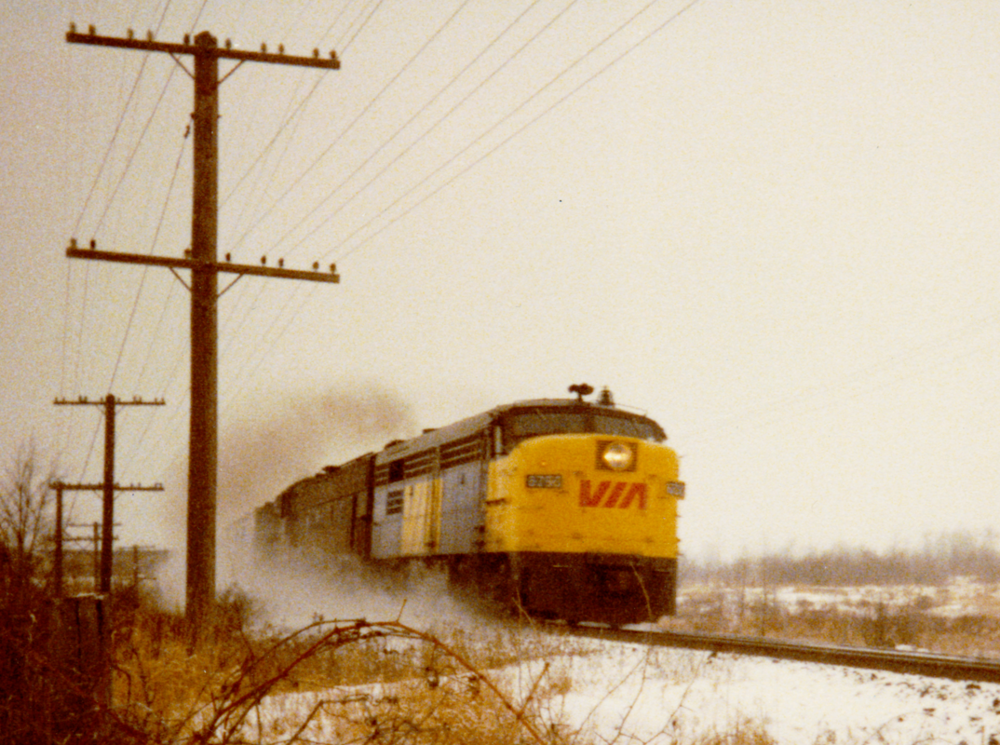
VIA 1981 to 1985, Kingston in the Winter


This post looks at VIA trains at Kingston in the early 1980s.
It is a thematic exposition combining leaking high-pressure steam with snow.


The Era:

In the early 1980s, bulbs with incandescent tungsten filaments lit our homes 
and saturated hand-held time exposures with yellow.

In high school, kids had the option of taking instrumental music classes.
There is enough knowledge and talent here to synthesize Christmas carols or locomotive whistles.


Nearby: An eastbound rolls by mile 183 on the Kingston Sub.
The rail snapshots before the timetable are circa 1981 and were taken with a camera using 110 cassette film.


A common sight - VIA 6523.


The westbound is loading one of the last cars ...


... the long train has the power and the leading steam leak spotted beyond the end of the platform.
Pardon my corona.

The ties piled so nicely may have come from renewals between the platforms.

*  *  *


The next time your new LRC is stalled somewhere in the bush, don't despair and pass out ...
you might see a chickadee or something on a fencepost while you wait.

As I take another careful over-the-shoulder potshot at interpreting recent Canadian railway history,
I can assure you that I have not included photos of trains 561, 565, 560 or 564.

We made rather merry at the sight of such VIA-decorated rolling stock at the station.
The evolving Napanee/Brockville-Smiths Falls-Ottawa track network was not being kind to VIA.


A lifelong contempt for fine print reference marks has caused me to enlarge them significantly.


I don't know if that is an Engine Service Brakeman, Baggageman or a train-rider Steam Technician talking into the cab.


The snow hi-lites the small total area where rail adhesion occurs.
... Unlike trains 561, 565, 560 and 564.


From CN comes a steam-lined RS-18 with no steam generator of its own.


Notice the low-mileage Sears garden tractor used in baggage service on the north platform only.


*  *  *


Princess Street once included a double-tracked section of the
Kingston Portsmouth & Cataraqui Electric Railway.

Among other places, it provided service to
the penitentiaries, the asylum and the Grand Trunk 'outer station'.

Below, a plastic banner for a nativity pageant catches the gentle lake breezes.