Showing posts with label caboose. Show all posts

25 January 2020

"A Strange World" - The 1965 Freedman Report on CNR 'Run-Throughs'


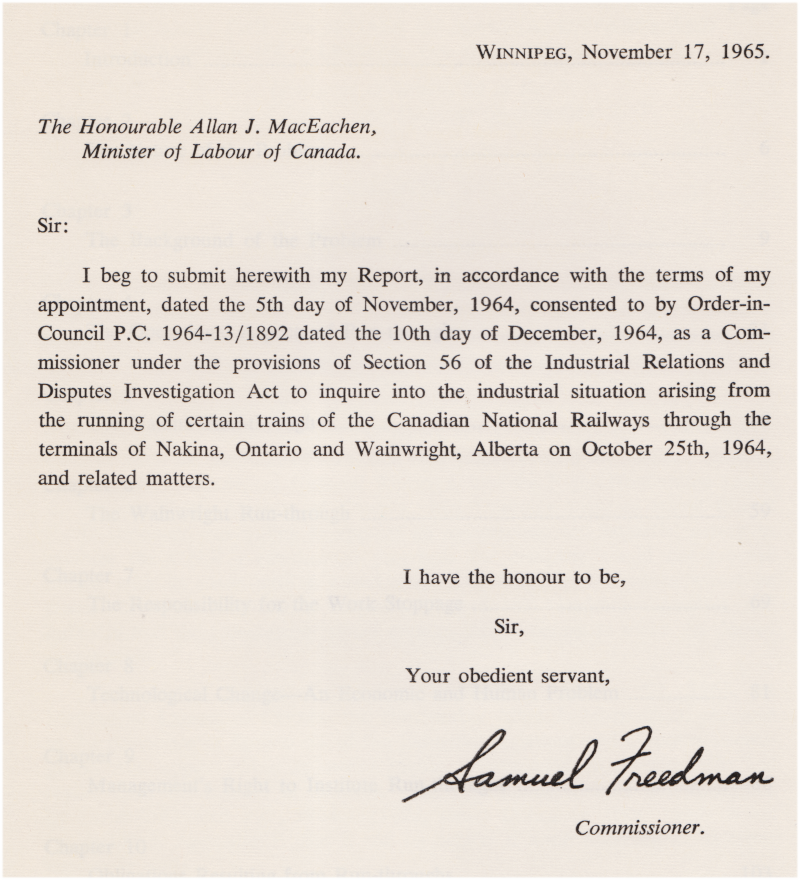
Here is a contemporary account, by a judge, of working conditions for running trades crews in the early 1960s. As the author notes, the actual collective agreements and arrangements use specialized language, customs, and vocabulary " ... this is a strange world ... ". I always like to find and post accurate contemporary non-specialist accounts to better describe the 'human experience' of railroading for a general audience.

After World War 2, new technologies were widely applied to Canadian railway operations. Key among them was the diesel-electric locomotive - which replaced the more labour-intensive steam locomotive.

Another was Centralized Traffic Control - which (generally, according to some) could enable a single main track to safely handle the traffic of two main tracks dispatched using the traditional 'time table and train order' system.

Computerized (teletype-style) waybilling and consist management systems enabled centrally-stored customer-linked data to be efficiently shared with multiple points on a railway. No longer were paper-schlepping and telegraphing/telephoning necessary to obtain updates on the status of shipments and train consists.

Fewer occupied station buildings, simpler locomotive shop facilities at most terminals, and (most importantly for the railways) fewer people were needed to support operations as the result of these new technologies.

Almost 60 years ago (as I post this) an experienced Manitoba judge was appointed to look into changes to Canadian railway operations pursuant to a labour action which interfered with the CNR's operations. You can find a page about his career on Wikipedia. While the rest of the report is interesting, the layperson's description of the running trades is probably the most valuable chapter to reproduce here.

Essentially, in late 1964 the CNR wanted to use efficiency gains from diesel locomotive technology to eliminate Nakina, Ontario and Wainwright, Alberta as crew change points. In the course of discussing the changes, the judge notes that the company contributed to the dispute because "[the workers had] the disquieting feeling that they were being exposed to a plan whose implications had not been fully examined."

In late October of 1964 over 700 running trades employees booked off sick on the Great Lakes Region. By 18hr on Saturday, October 24th, 1455 running trades employees booked off sick on the Mountain Region and 659 on the Prairie Region.


In May 1963, an eastbound CNR local freight passes 40th Avenue, Lachine, Quebec.
The CPR line appears in the distance.


Note: 

A Division was often formally defined as the portion of a railway assigned to the supervision of a Superintendent.

A Subdivision was often formally defined as the portion of a division designated by (employee) time table.

... And many subdivisions in timetables were about 125 miles in length. 

Whether a "division point" is where a Division is headquartered or where steam locomotive engine crews traditionally changed ... is something which could be passionately argued to infinity on the internet. I have not noticed that term in this report.


A morning CNR eastbound is seen at 48th Avenue, Lachine, Quebec in March 1961.
This photo was taken when the former Grand Trunk Railway line still ran along where today's Victoria street is found.
The 'get over the road' efficiency of diesel locomotives for fast run-through freight is illustrated well.


During my PSBGM Christmas holidays in December 1968,
a westbound CNR freight is seen from Lachine's 40th Avenue pedestrian overpass.
Wooden cabooses were still in use.


The largest paragraph above suggests that a prolonged period in the hole might be considered 'rest and relaxation'!

One should take care to determine whether crew members sitting in a siding for an hour or two are experiencing rest or fatigue.

... Variables such as time of day, previous hours of sleep and quality of sleep, time between trips,
noise, vibration, temperature, the requirement to remain consistently alert while on duty
might be considered here.


During an NRHA wayfreight fantrip to Ste Hyacinthe, Quebec in May 1964,
my father took this photo from the fan-coach/fan-openend-gondola car section of the train.
The camera is looking north, through the caboose, with the Victoria Bridge in the distance.


19 January 2019

CNR 1985 Kingston Caboose Derailment

Alternate title: A Caboose Runs through It


For over a century, trains passed by Kingston's 'outer station'. 
This event occurred after this segment of the main line had become a spur.


Above, the camera is facing timetable east in April, 1985. Behind the camera is Elliott Avenue. The south track has been lifted, The north track remains. It is possible that a slight downgrade leads around the curve to the former Kingston station. There was generally a 30mph limit on this curve while it was the main line, and eliminating this sharp curve was the principal reason the line was relocated.


from: Altitudes of Canada; James White; 1901; Government of Canada.

Above is the elevation and mileage data circa 1900. It is important to note that the Kingston (outer) station was then 'Kingston junction' and the Grand Trunk 'Kingston station' was downtown, west of Kingston City Hall. 


from: Unknown railway directory (front section missing); 1874.

Above, looking at what is probably the mileage calculated from Montreal Bonaventure Station, you'll notice that mile 172 is Kingston. As well, a through train only makes a 10 minute stop, so we can safely conclude that Kingston (above) refers to Kingston junction.

None of this has much bearing on the subject of this post, but sometimes it's nice to scan in some old references in case people find them interesting.

from: CNR Great Lakes Region Timetable; June 1 1981; Kingston Sub footnotes.

Above: The employee timetable from the era of our tale (below) shows how this segment of the long-standing main line has been reduced to a 10 mph spur.


Above, the camera is looking timetable west to the original Grand Trunk Kingston main line station. You can see the south track forming the station lead has been lifted and that the old north track remains. A dump of concrete ties which did not perform well under the relocated line segment await legal and literal disposal.


A broadside of a boarding car. Some of these photos have been lightened to show more detail of the trucks and other systems hidden in the shade. I know the date of this incident because (as usual) my brother, Eric, had properly recorded it. You can see some of his photos of this event and other interesting period developments through the link to his page below:


Above, you can see that the caboose has run into the stop-block at the east end of the spur.

Except for the trainwreck-style physical damage, this seems like a minor incident. However, you can imagine that company officials and the legal department would take this kind of thing very seriously, partly because of its potential to cause casualties and damage beyond the railway property. Visible behind the caboose is Montreal Street - one of Kingston's main south-north links to the 401.


So those are my photos of this little affair. The superlative Transportation Safety Board was not created until 1990, so one of its excellent reports would not have been filed about this event.

Cause?: Perhaps the caboose was at rest, an effort was made to couple on to it, and the pin didn't lock properly. Perhaps a handbrake had not been applied to secure the coupling movement so the caboose just rolled away. 

The enlarged image of the open knuckle (below) makes it tempting to conclude this was the cause. However, the impact popped an inspection light out on the leading end (seen farther above) so the force of the impact could also have shaken up the coupler.

This caboose was built in 1980 and it was returned to service after this event.


22 June 2018

Hawk Junction on the Algoma Central Railway, June 1991


In June of 1991, we were again making our way west for visiting in Schreiber and Portage la Prairie. As usual, we stayed overnight at Sault Ste Marie and went on the Algoma Central Railway's Agawa Canyon excursion. 

Probably being inspired by some of Rolly Martin's stories and artifacts, from the time he worked as a sectionman on the Algoma Central, we decided to visit Hawk Junction. 

After leaving Sault Ste Marie, just before reaching Wawa on the Trans-Canada, we simply took a short secondary road to reach this location.


from: Official Guide, June 1916.

As you can imagine, looking at the map detail above - a lot of traffic would have passed through Hawk Junction over the years. If iron ore was not passing through Hawk Junction on its way south to Sault Ste Marie, the engine crews switching the mines and taking the ore to Michipicoten Harbour would have worked at or through Hawk Junction. Another key source of freight revenue on the ACR was forest products and some evidence of this traffic can be seen in the following 1991 photos.

*  *  *

Pot Shots


Being the lazy way to get photos of what was in the ACR's yard at Sault Ste Marie, here are a couple of pot shots taken through the window of an Agawa Canyon excursion coach. 

Above, in the distance is a steam locomotive tender converted into a steam generator car. In the foreground is a good example of how not to take a railway photograph. It seems the Algoma Central has rooftop-mounted coffee drip apparatus so the tailend brakeman and conductor can each enjoy their favourite brew on the road. I'm guessing those are actually sanding towers.

Below, is another potshot of what was to be found that day near one of the shops.


*  *  *

Sault Ste Marie Circa 1960?

Railways of Canada; OS Nock; 1973; A & C Black.

This undated photo shows the ACR yard and the steel works, looking roughly southwest.

*  *  *

At Hawk Junction


Looking timetable north.


A classic passenger train schedule blackboard - as prescribed in the Railway Act.
The door looks as if it leads to the bulletins and crew booking-in room.


The rear of the station - where once the telegraph wires would have entered.


Having watched them being manhandled at Montreal West station in the 1960s as a kid,
I thought it was important to record this impressive formation of baggage wagons.


The caboose track and the classic ACR yard switcher at the 'shop' (extreme right).


ACR baggage car 307.
It was built by American Car and Foundry in 1951.
It began life as CN 9061 and went to the ACR in 1983.

Again, we are looking timetable north.
The former line to Michipicoten Harbour ascends the grade to the left.

On top of the switch frog and bits, there seems to be a combination switch push broom and ice pick.
The bulkhead gondolas may be loaded with ACR ties ...

During the Agawa Canyon trip, we saw numerous 'Wolmanized wood' ties trackside - they looked like the green-stained copper-treated wood for home deck construction. I concluded that this was an economy measure and not a good sign for the line's future. 

However, OS Nock wrote in 1973:
The line is practically laid throughout with rails weighing 100 lb to the yard, but quite apart from this the quality of the sleepers and the ballasting is absolutely first class ... At many points along the line I saw new sleepers laid alongside the track at the places they were to be inserted. They were of a pale green colour, and I learned that the Algoma Central has a method of its own in treating new timbers. Suitable materials are so plentiful that it has been found economic only to dip them in an osmose [*sic] compound, instead of using the pressure creosoting method usual elsewhere. It gives a life of 20 to 22 years, and I was to see the plant where this is done, at Hawk Junction, later in the trip.
*Osmose is a company which began in Buffalo, New York with a single wood preservative patent in 1934. You can find the MSDS forms for their products on the internet.

Railways of Canada; OS Nock; 1973; A & C Black.
OS Nock, and Dale Wilson in The Algoma Central Railway Story (1984), agree that the transition from steam to diesel was accomplished 1952-1953. This made the ACR the first Canadian railway to fully convert, according to Dale Wilson.

In the aerial view above, you can see the station on the west side of the tracks. Perhaps the two-storey building with the hip roof and white foundation - behind the station on Road 547 - is a Railway YMCA ('bunkhouse')?

As was often the case, the heated railway water tank was probably retained into the diesel era because it was key for the municipal water supply, including firefighting. You can easily see the diesel fuel tanks and tank cars ... and the diesel shop to the right.

The main line to the north exits to the right of the photo, while the Michipicoten line ascends that grade into the woods.

If you are interested in more Hawk Junction detail, the site linked below is worth viewing. It is searchable - e.g. for Hawk Junction. Track diagrams show some of the recent changes to the yard.


*  *  *

From the 1916 Official Guide


The entries for the 'Algoma railways' are seen here.


Above, you can also see the entry for the Lake Huron and Northern Ontario.

The LH&NO map does not label the Algoma Central's line.
The LH&NO began as the Bruce Mines and Algoma Railway in 1899.