Showing posts with label WW2. Show all posts

17 January 2026

USSR 1982 Passenger Train Schedules, Maps, & Why Not 51

War in Ukraine makes amateur geographers of us all. 

I was really interested in doing something different for a post, so here are all of the Soviet passenger train schedules as published in this reference as of April 1982 with particular interest in those cities located in Ukraine. 


from: Canada and the Cold War; Whitaker, Hewitt; 2003; James Lorimer & Co.

In 1982, the USSR had almost always appeared in black and white (on TV and in newspapers), so the image above sets the scene perfectly.

There is little reason to feel nostalgic about 1982. Some of us had become conditioned to expect that it would take only one stupid act or one reckless error to wipe out most of human life on earth. 

Today, we are so fortunate that international diplomacy is devoid of reckless errors and stupid acts.

To continue with 1982, Gwynne Dyer, with his brilliant NFB/CBC series War, elucidated where the profession of arms had come from and where it stood in 1982 (link to series, below). The hydrogen bomb pictured with Dyer below, dropped over a large city, could kill one million people, he says.

from: Gwynne Dyer, Notes on Nuclear War; 1982 CBC/NFB ... on YouTube.


*  *  *

To the Trains


End of the timetables.

*  *  *

In the early 2000s, I volunteered with a local non-profit agency which provided services to newcomers to Canada. This was a great experience and forever changed my perspectives on many things. For self-study, I purchased a book to provide a concise overview of cultural differences. I think a 2019 edition of this book is still available. Here is part of Ukraine's section. 

... There is also an entry for Canada. We'd reasonably expect that the conclusions made in preparing every national entry are generalizations which could be open for debate and would not apply uniformly to every single person in the country. 

from: Kiss, Bow, or Shake Hands; Morrison, Conaway, Borden; 1994: Adams Media.

*  *  *

Here's a rough old map showing Europe 500 years ago. 
A few years later in 1534, Jacques Cartier would be making his first exploration around the Gulf of St Lawrence.
As Cartier is 'our history', the cultural memory of this map would probably constitute 'Ukrainian history'.

from: World History; Hayes, Moon, Wayland; 1946; Macmillan.

*  *  *

What is the difference between Canadians and Americans?
What makes us think we're different? 

A classic high school era answer was ... 'Well, we're NOT Americans!'. 

In ... 1982 ... Pierre Berton wrote a concise little book explaining why we act like Canadians: The way we live today and our identities as Canadians are a product of our collective history. Having a nuanced understanding of history can make it easier to understand and explain why most Canadians would not want to be subsumed into a larger country.

*  *  *

Russia in Europe, circa 1900

from: Handy Reference Atlas of the World; 1904; JG Bartholomew.

... the map keeps changing ...

South Russia: The Don Cossacks!!

*  *  *

Considering the current Ukraine invasion, which started in 2022, some bi- and tri-lingual interpreters of current events have recently pointed out that affluent ethnic Russians, particularly within the urban areas, are generally not being forcibly steered into military service. In effect, the President of the Federation is deliberately sparing 'his base'. 

Someone also pointed out that it was Ukraine which bore the brunt of the German invasion of 1941. The scorched earth policy of the retreating USSR forces directly affected the surviving Ukrainians who found themselves dealing with the Germans ... and trying to live on that scorched earth. 

The 27 million USSR war dead included a higher proportion of Ukrainians (40-44%) as the German tide went east and receded west. Ukraine constituted 16-18% of the population of the USSR at that point.  

A retired RCAF airman once gave me the opinion that 'Russia won the war' ... because they had fatally weakened the German military before the D-Day landings. 

So ... I guess ... if you appreciate your freedom: Thank a Ukrainian. 


from: Atlas of World War II; Natkiel, Sommer; 1985; Bison.

Above: If you look at the German front lines - shown in red - you can see that they fought east across Ukraine from June 1941 to November 1942. 

Below: From the turning of the tide in November 1942, it was June 1944 before the fighting west had crossed most of Ukraine. 

from: Atlas of World War II; Natkiel, Sommer; 1985; Bison.

... and then there's the Holodomor (1932-33) ...

from: Canada and the Cold War; Whitaker, Hewitt; 2003; James Lorimer & Co.


28 February 2025

War Atlas, Part 2 - Roundhouse of Democracy

The WW2 titles Arsenal of Democracy and Aerodrome of Democracy have often been used to describe extraordinary wartime efforts.

Selecting railway content to go with this post, Roundhouse of Democracy seems like a fitting title to describe the quantity of railroading equipment and operating expertise exported by the USA during World War 2.


A whole book was written by General Electric after the war to document all the electrical wonders produced by GE and its employees during the war: Men and Volts At War; John Anderson Miller; 1947; McGraw-Hill.

In brief, Erie produced: gun mounts, 75mm howitzers, motors, portable power plants, remote control turrets, ship-propulsion turbines ... and 'transportation equipment' ...

from: Trains; August 1949; Kalmbach.


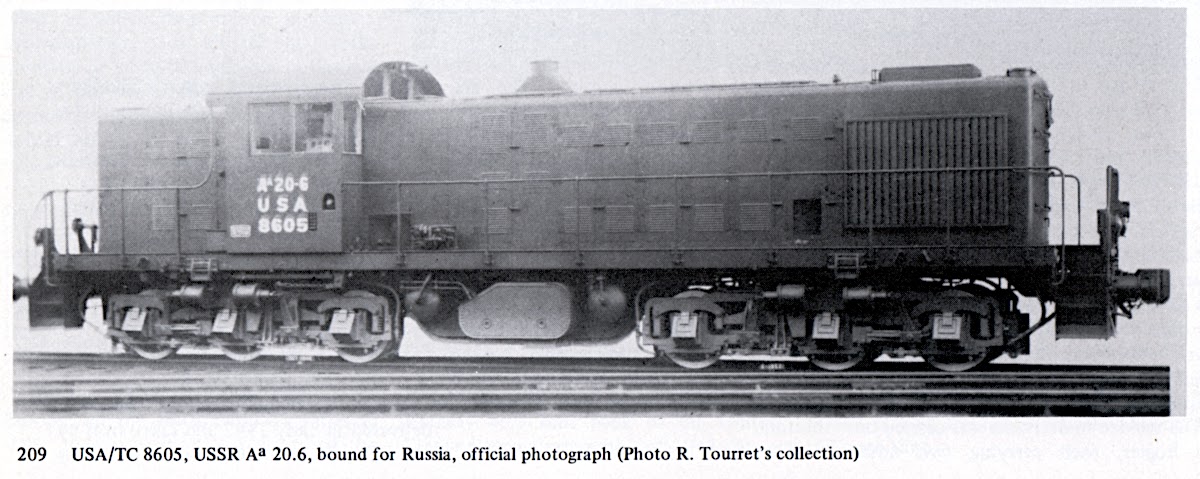
from: United States Army Transportation Corps Locomotives; R Tourret; 1977; Tourret Publishing.

Treforest is in southern Wales, not far from Cardiff, where these locomotives might have been unloaded from ships. This may look like a lot of motive power ...

However, last night, I was watching an SNCF documentary on YouTube which was made shortly after the war. It documented the efforts made by French railway workers to rebuild the country's railways - repairing tracks, yards, shop buildings and machine tools, bridges, locomotives and other rolling stock, water towers, coaling facilities - everything had been destroyed. 

Only a small proportion of the SNCF's steam locomotives remained in usable condition at the end of the war. The Wehrmacht (as often happens during wartime in Europe) ran off with the best locomotives as they retreated ... and they disabled many of the remaining viable engines. A few engines had been destroyed in sabotage efforts by the French Resistance. However, the greatest proportion of engines lost by the SNCF were destroyed by the Allied bombing campaign.

Railways were the most effective way of quickly moving supplies, troops and armaments - so a great deal of Allied effort was spent destroying them. A key feature of rail transportation was that it didn't burn up Germany's limited refined petroleum supplies - with slave labour, plenty of coal was available for locomotives. However, refined petroleum was essential to propel military vehicles - particularly diesel for use in tanks.

Around the time of the D-Day Invasion, disrupting effective transportation would have been critically important ... so that the nascent Allied ground forces in Europe could build their strength and begin to recapture the continent ... without being overwhelmed by a rush of Wehrmacht assets to the Normandy area.

In the photo above, I was able to count perhaps 60 locomotives on that single track - so you might imagine twice as many of them massed at Treforest - to truly picture what the caption suggests.

These engines were one of the standard designs of the US Army - intended for worldwide service. There were 2120 of this single class built by Alco, Baldwin and Lima between 1942 and 1945. 

... So you can imagine the total production of this particular class was perhaps 30 times what you see above.


Ross Robinson, a highly-skilled volunteer (and very patient mentor) at the railway museum at Smiths Falls, got me interested in these engines. He said there was one of these units at his winter domicile at the San Diego Railroad Museum. It was designed to be convertible to other gauges ... to match the gauge of the foreign railroad system to which it would ultimately be assigned.

from: United States Army Transportation Corps Locomotives; R Tourret; 1977; Tourret Publishing.

Here is a better overview of this power than I could provide ...

from: The Second Diesel Spotter's Guide; Jerry A Pinkepank; 1980; Kalmbach.

If you have ever watched the locomotives switching the massive first-stage booster rockets at the Baikonur Cosmodrome in Kazakhstan ... you'll notice that those TEM2 units have a very 'American character' to them. Indeed, they are descended from the Lend-Lease power.

... I remember reading that some Americans had had a close look at some of this family of units elsewhere in the USSR, and they had clearly been reverse-engineered from the units originally sent there. In fact, the original molded Alco part lettering could be seen on the engine block castings of these entirely Russian-built locomotives!

*  *  *


from: I Saw Palestine; Robert W Richardson; Trains; February 1949; Kalmbach.

This article and this railway line have always intrigued me. I had never thought about the railways here before, but it was immediately obvious that the line would not have survived as it is depicted in the article. 

The author, in the US Army at the time of his rides in 1945, arrived at Tel Aviv in a truck convoy from Iran. He rode a Palestine Railways mixed train from Tel Aviv to Lydda (today known as Lod) and return. Lydda was the location of the main shops. Later, he took a passenger train from Tel Aviv to Jerusalem and return.

A US serviceman was a rarity on the mixed train. Like all mixed trains everywhere, it ran late, returning at night. This train reversed, tender first and without a headlight, Lydda to Tel Aviv.

The US military offered truck trips so servicemen could visit Jerusalem on leave and most preferred this method of transport to the local trains. The European riders on the passenger train were primarily British military personnel, including sailors - as the area had been a British 'mandate' from shortly after the First World War.

The line was originally built from Jaffa to Jerusalem to carry tourists, opening in 1892. The Palestine Railways are really well documented on Wiki - if you are interested.

The author said he experienced these trips in a seemingly peaceful area while the rest of the world was at war. In 1949, he wrote: 

'Today, I suppose, the mixed train runs later than it did before, if it runs at all, for Palestine is no longer peaceful.'


from: United States Army Transportation Corps Locomotives; R Tourret; 1977; Tourret Publishing.

According to the interesting book from which the above image is taken, it was decided that American personnel would take over operation of the Trans-Iranian Railway in 1943 - as far north as Tehran. This system ran north from the Persian Gulf port of Bandar Shahpur, via Tehran, to another port on the Caspian Sea ... across which cargoes could be transported to the USSR. 

Up to that point, American 2-8-2s had been powering the line. However, the extreme heat and scarcity of good water along the entire line impaired train operation by steam.

The 'Aid to Russia' materiel was being routed this way. This had required double-headed steam in the mountainous sections ... as there were many sections with 1.5% gradients. To add to the fun, there were 144 tunnels in this stretch of 165 miles. The accumulation of smoke in the tunnels was particularly hard on the crews operating the second steam locomotive in the consist.

The first non-MU diesel units arrived in March 1943. As the rail was 67-75 pounds per yard, the A-1-A trucks were desirable to distribute the units' weight. During the following month, MU-capable units were operated in pairs on the heavy northbound traffic as it traversed the mountainous sections of the line. Returning southbound, often five units would run together with some units deadheading within the locomotive consist. By May 1944, the MU units were operating through to Tehran.


21 February 2025

War Atlas, Part 1 - The Stopping Power of Water (and Winter)

This atlas came from an antique store in Perth. It was relatively expensive, but there is considerable value in an artifact which describes its own historical era. Measuring 9 x 11 inches, the maps required 2-4 scans for each image presented below. So it would travel better along its historic journey, the atlas had been folded in half - which added to the irregularities in the paper's surface.

Maps from this atlas have illustrated a few posts in the past. However, it seemed like a good moment - as everything is so 'geo-political' these days - to share the whole thing in serialized posts.


I have inferred that the original owner purchased this atlas while posted overseas. My casual research suggests he was a company quartermaster sergeant in the Stormont, Dundas and Glengarry Highlanders ...

After the American Revolution, certain British military veterans were settled in eastern Ontario to help protect British North America from an invasion by the Americans. Indeed, some of these settlers fought in the War of 1812. Their regimental descendants also fought in the Rebellions of 1837-8, the Fenian Raids, the Great War, World War Two and the NATO-invoked mission in Afghanistan. They were at the amphibious operation at Normandy and experienced the phenomenon which I will describe next.

Back around the turn of the century, I read The Tragedy of Great Power Politics; John J Mearsheimer; 2001; WW Norton & Co. A few hours ago, I pulled this book from 'the stacks' and was surprised to discover that the author (whose name I had forgotten) is someone whose ideas I have recently watched on YouTube.

The most enduring idea from this book was 'the stopping power of water'. Why have the countries of Canada and the United States had the option of spending little on national defence? The stopping power of water. After the Spanish-American War, the US slipped into isolationism before the two world wars because it could afford to - it was protected. Belgium, Poland, Ukraine - for example - did not have this option, residing with other countries on the European continent. Even today, it is impossible to imagine how any conventional army could successfully invade the US from the sea.

I gave 'winter' its own stopping power, simply because readers looking at these maps will remember how Hitler and Napoleon were both defeated as their supply lines grew too long and their armies were weakened and defeated by winter ... and generally inappropriate winter clothing, inadequate food supplies and unsuitable weapons. One should never sell short the importance of quartermasters and their logistical brethren.


From Mearsheimer ...
(Some of this may sound familiar from the news.)

How do great powers go about maximizing their share of world power?
  • Regional hegemony - Remember that total global hegemony would bring pesky water as a limiting power.
  • Maximum wealth - Control as much of the world's wealth as possible.
  • Build a pre-eminent land power - Necessarily supported by a strong air force and navy.
  • Nuclear superiority - 'Why can't we use them? ...' as a US president asked in recent history.
How does a great power gain power?
  • War - Take what is needed - eg. oil fields.
  • Blackmail - 'Coercive threats and intimidation - not the actual use of force - produce the desired outcome'.
  • Bait and Bleed - Secretly provoke a conflict between two great powers and stay out of it.
  • Bloodletting - In 1941, Vice President Harry Truman thought it would be strategically beneficial to help the loser of the new German-USSR conflict - so that as many as possible would be killed on both sides. Recall that Hitler had suddenly turned on his ally in Operation Barbarossa. 

from: Propaganda Cartoons of World War II; ed: Tony Husband; 2013; Arcturus.
Stalin & Hitler had secretly conspired to split Poland before Hitler's invasion (see maps below).
That invasion and partition happened in 1939 - the same year as this prophetic cartoon was drawn.

... Hopefully Ukraine looks in on this blog regularly ...

*  *  *

Railways were still significant for transporting war materiel, so they are documented on these maps.


30 December 2020

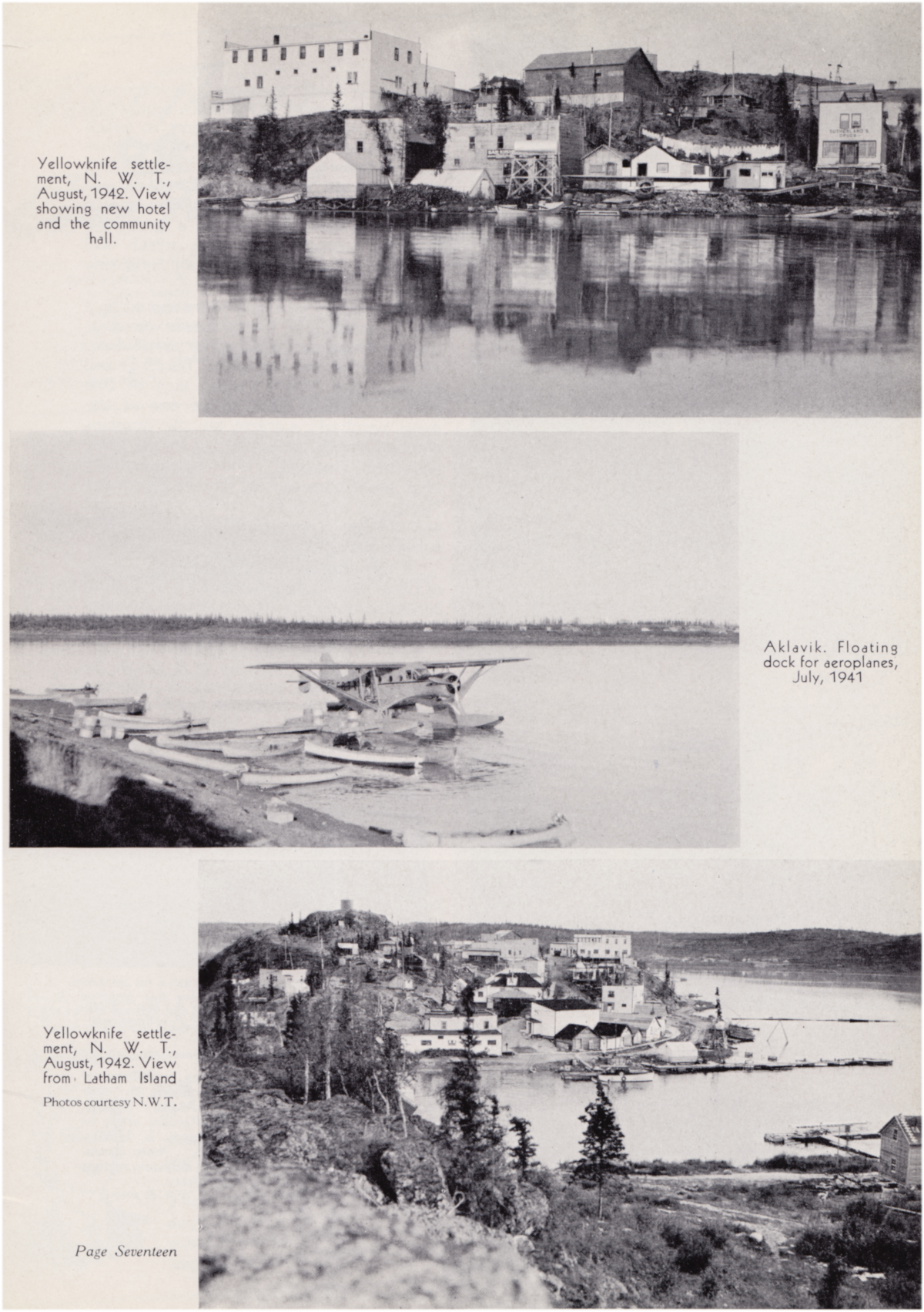
1943 Canadian Pacific Air Lines, Northern Air Routes


It was Thomas Shaughnessy who got Canadian Pacific into the airline business. At least it was he who, in 1919, had Parliament change the company's corporate charter to enable it to own and operate a wide range of air services. 

I'm short of time, so I won't be using Empire honourifics in this post. I always check to see if they had been awarded at the particular point in history I write about. I should make a chart for myself, because it's always the same people!

A previous post looked at the formation of Trans-Canada Air Lines - whose stock was originally held by Canadian National Railways. There was more to that story ...

Kingstonian James A Richardson of Hanley Spur and Smoke on the Waterfront fame, transplanted his operations centre to Winnipeg. Among other holdings, he owned Western Canada Airways (established 1926). In 1930, he initiated feelers between Presidents Henry Thornton (CNR) and Edward Beatty (CPR) regarding possible railway company involvement in developing the airline business. Eventually the three made a deal to create a new company named Canadian Airways. After Richardson's heart attack in 1939, his widow held the controlling interest in this company. Beatty bought her interest in December 1941.

However, back in the 1930s, Prime Minister RB Bennett was cutting the necessarily lucrative air mail routes (essential for many routes to survive) to save money ... so grand coast-to-coast schemes were shelved until after a change of government.

Meanwhile, as this booklet shows, Canadian Pacific had been quietly collecting Canadian 'wilderness' air carriers. In the future it would be prevented from competing against TCA on any trans-Canadian or international routes. Nonetheless, people were eventually concerned that Canadian Pacific Air Lines (CPAL) had secured a monopoly on north-south air traffic in Canada.

Regarding CPR's potential involvement with TCA ... to make a tortured, protracted saga short ... as the exploratory talks later progressed with Minister of Transport CD Howe, Beatty always got the feeling that the TCA legislation would be a rigged game against the CPR's best interests - with the government having more control than it deserved for the money it expected CPR to invest.

In the end, World War 2 shook the chessboard and everything changed. Commercial aircraft were requisitioned, pilots and support crew went into the military or its aeronautical activities, and new programs were quickly developed to support the war effort.

Due to wartime censorship, one notable aspect of CPAL's involvement is not discussed or illustrated in the reprinted Canadian Geographic article below. CPAL set up the system of air-ferrying aircraft across the North Atlantic. This involved organizing crews of civilians, support and refueling services at airports in the middle of the North Atlantic, as much navigation support as possible - recognizing that celestial navigation would be necessary, and the receipt and delivery of the aircraft themselves. 

... Aircraft generally went over in loose formations, with the crews returning together on one plane. One of my father's favourite movies was the Canadian-based 1942 US wartime movie Captains of the Clouds. It is entertainment/propaganda which shows the bushpilot to ferry pilot 'career path'. Here are a couple of screen grabs from the iTunes version. After we have developed the daring bushpilots' movie characters in the Canadian movie wilderness, they decide to just fly in and sign up!

The Canadian bushpilots create chaos when they drop in on a Canadian training base to volunteer. (I think this was Uplands?) This includes Alan Hale, Jimmy Cagney, a buttoned-down guy with a British accent and the requisite zany French Canadian pilot. 

Billy Bishop performs an inspection of airmen from all over the Commonwealth 
(and the US) who have responded to the call.


The idea of flying new aircraft over the ocean released industrial resources and commodities in Britain for other uses, increased cargo space on North Atlantic convoys, saved entire shipments of precious completed aircraft from the risks of being sunk by U-boats while in a convoy of ships, and speeded up delivery of aircraft to Europe. 

Apparently because of the preferences of President Roosevelt - the US was building most of the aircraft being ferried - this program was subsequently put under military control. CPAL ferried the first 300 planes across between November 1940 and July 1941. Then a British Transport Command system was set up. 

You'll find none of this documented in the October 1943 account ... 

However, it is mentioned in an advertisement on the last page! Axis spies may subscribe to the Canadian Geographic to discover Canada's secrets, but, by Jove, we'll keep this booklet out of their fascist fingers!!