Showing posts with label US history. Show all posts

02 October 2016

Railway Biographies of 1901 with a Canadian Connection


My brother recently purchased this rich artifact for me. Here are few short professional biographies with a Canadian connection. Some prominent figures have been chosen, and others were selected at random.

To help readers place these people in their era, some images of their roads, at about the same point in history, are included.


There are many historical figures associated with railways whom you will not find in this directory. One filter to pass through was actually working 'in railway service'. Explorers, surveyors, contractors ... and some officers ... are not listed. Some of the last may not have responded to Railway Age's request for biographical information ... if that was how the database was built.

If you consider the explosive development of railways and their technology in North America between 1860 and 1900 ... this reference might compare to a LinkedIn site for IT professionals: programmers, game developers, system administrators, security experts, telecom company executives, and so on. 

... It would include IT professionals from the proliferation of the personal computer, through to the development of the networked server farms of 'The Cloud'. But, unlike LinkedIn, this book doesn't pester you on a daily basis to finger new contacts for it.

This artifact shows that there are some differences between the railways of 1900 and professional advancement today. Back then, one could be employed with a low level of skill or experience and advance through a combination of apprenticeship, displayed competence and self-study to reach the higher ranks within a company.


These selections are in no particular order ...


Hanna's portrait was taken about 20 years after the biography, above, was written.
from: Trains of Recollection; Hanna/Arthur Hawkes; 1924; Macmillan.


Kingston Mills on the Grand Trunk Railway, circa 1900.
Kingston Mills on the Grand Trunk Railway circa 1900. Postcard mailed Kingston to England in 1910.


from: The Imperial Highway; 1900; CPR.


Below is the Oriental Limited on the Great Northern circa 1904.
from: Lines West; Charles R Wood;; 1967; Superior Publishing.


Depot Harbor circa 1904 on the Canada Atlantic.
from: A Way to the West; Allan Bell; 1991; Privately Published


If this type of reference is of interest to you, a few editions of this publication are available at archive.org . This 1901 version may have been the last edition published.


13 August 2016

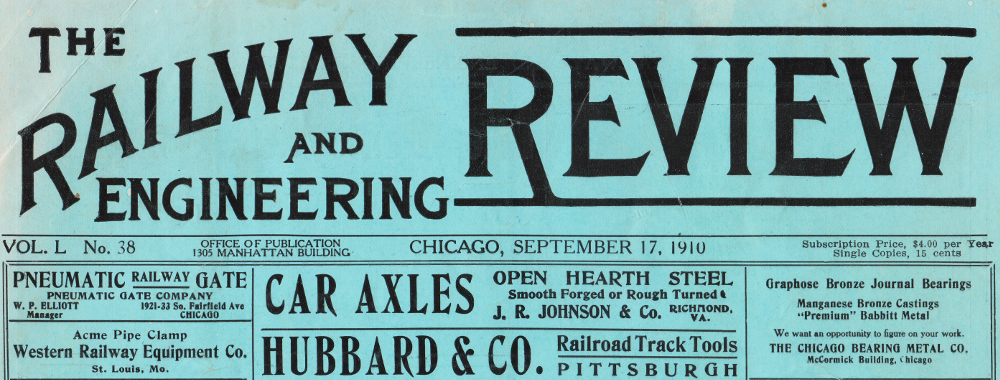
Roadmasters Debate Switch Targets in 1910


Years ago, I purchased this roughly treated old journal. The ads are perhaps more interesting than some of the professional/technical articles on Northern American and British subjects. Bound copies of this journal may be found (without advertisements) at archive.org.


A simple but important safety appliance - particularly on the main line - was the switch target. Below are views presented in a committee report of the Roadmasters' and Maintenance of Way Association Convention at Chicago in September 1910.

The committee members fail to resolve the question. Their perspectives illustrate the difficulties encountered when trying to standardize the practices of individual railroad companies.

From other sources I have inserted a few illustrations of targets.


A break from these deliberations for illustrations of some targets ...

Early Railways; JB Snell; 1964; Weidenfeld and Nicolson.
Here is a British Home (absolute) Signal of the 1850s. The book doesn't elaborate on the purpose of the two rotating target shafts ... and whether one is linked to a switch or not. This may be a sampler which displays two pieces of equipment together - but not in a real operating combination.

At the right, the basic principle of a 90 degree shaft rotation which displays the target at a right angle to the track to indicate a restriction, or no target to indicate clear track ('normal' position) ... can be seen.

At the left: Considering the difficulties of finding switches in the dark, possible disorientation, and the added dangers of operating by night ... the desirable idea of always displaying one of two lights by night - a restricting indication or a clear indication ... is also demonstrated.

Leaving the earliest targets on signals or switches ... and on to more modern switches ...


By Steam Boat and Steam Train, The Story of the Huntsville and Lake of Bays Railway; Niall MacKay; 1982; Boston Mills Press.
Near Huntsville, Ontario in 1951, are the artifactual remains of a stub switch on a switchback.

Switchbacks were track zigzags with tails - the camera is over a tail - which were used to ascend steep grades. Switchbacks were relatively rare on Canadian railways because a train had to stop on the tail track and reverse direction onto the next segment of track.

To increase the 'run' for a given 'rise' ... loops or spirals of track were more efficient than switchbacks because trains could save time, and maintain their momentum up the grade, without having to stop ... and they could avoid the derailment risks of extra stops and extra switching at each tail track.

Above, to present a warning where safety is more likely to be at risk - a target is presented to a descending train when the switch is set against it.

*  *  *

Canadian Railway Scenes, No 2; Adolf Hungry Wolf; 1985; Good Medicine Books.
At the first station at Sudbury are two nice examples of old switch targets on the early CPR. 

The main track switch by the locomotive's tender shows the single target (with two holes) for daytime and the two-colour switch lamp for night operation. Both are elevated so an approaching engineer can know for certain as soon as possible if the switch is lined 'normal' for the main track ... or for a diverging route.

The chevrons of the target in the foreground cannot be mistaken for the main track target. They apply to the secondary route in front of the station and show whether or not it is set for a diverging route.

*  *  *

The Toronto Grey and Bruce Railway 1863-1884; Thomas F McIlwraith; 1963, 1971; Upper Canada Railway Society.
At Owen Sound, Ontario, circa 1890, is a three-way hand-thrown switch with an interesting oil-burning switch lamp. Switch stands and lamps of simpler construction can be seen in the distance.

With three possible routes to and from this switch ... it remains a question how or if the switch lamp was used to precisely communicate the exact lining of the switch to approaching movements from both directions.

*  *  *

The roadmasters continue ...


*  *  *

The Compendium of Signals; Roger FR Karl; 1971; Boynton and Associates.
Above, are shown some standard switch targets. Whether there is a need to display a second target - when the switch is lined 'normal' for the main track is what the Roadmasters are debating. As the diagrams indicate, most or all of these switch stands are designed so a switch lamp can be fitted for night operation.

It seems likely that the general improvement of railway technology and practices eventually eliminated the desirability of having a daytime target for 'normal'. In the early days, there were many manufacturers of equipment and there may not have been iron clad traditional practices recognized by all operating employees. Trains travelled at slower speeds on the early, primitive track structures.

Once railways had employed a few generations of track maintenance and operating employees - rules and operating practices would have become better established ... eg. 'our switches are in always in normal position when lined for the main track'.

As train speeds and traffic density increased, engine crews became busier. It would have been simpler to watch ahead for rare, prominent red switch targets of 'danger' ... than to watch the track ahead for all the other possible signs of danger ... and also to search ahead to identify every single approaching switch target and to confirm that it was safely lined for the main track.

*  *  *

Advertisements from The Railway and Engineering Review ...


28 April 2016

Runaways with Freight Trains, BLE 1905


The Railroad Safety Appliance Act of 1893 was passed by the US Congress to provide a uniform national safety standard for US railroads. This law came into effect in a significant way in 1900 ... but various provisions came into force in the period from ... 1894 (drawbar height) ... to 1910 (85% of a train's car brakes must be controlled by the engineer). 

To a limited extent, a patchwork of state standards had arisen for important railroad safety devices such as brakes, couplers, and car grab irons used by train crews during switching. Railroad occupational safety had been a source of concern since at least the early 1870s. 

The national standard applied to railroads engaged in interstate commerce and, as one might expect, it was the Interstate Commerce Commission which was empowered to enforce the law and further regulate the industry.

*  *  *

The Brotherhood of Locomotive Engineers could be considered to be a trade union as well as a professional association. Deep in my archives lurks one of their periodicals from December 1905 and it offers suggestions on preventing runaways through the competent use of air brakes.

While we might expect that a railroad company would train and instruct its own employees on the proper use of the air brake system, this was a new and evolving technology. The people obtaining significant operational experience with it were the locomotive engineers themselves. During this era of rapid industry growth, very little in the field of railroad technology was staying constant for long.

On the inside front cover of this 'union magazine' is a full-page Westinghouse advertisement. The author of the article, Robert Henry Blackall, was an  Air Brake Association President in 1899. He wrote a catechism on air brakes and was an official of the Delaware and Hudson Railway.


from: Brotherhood of Locomotive Engineers Journal; December 1905; Cleveland, Ohio. 


An interesting detail in the drawing below is the location of the retainer valve at the roof level. As the brakemen were employed to travel along the car roof walks of the cars to turn the MANUAL brake wheels when called for, it made sense to locate this AUTOMATIC AIR brake system adjustment on their 'usual route'.
Note: Trains run on incredibly low-friction self-steering guideways. A vehicle on rails stopping ... can feel like a car stopping on glare ice. If you can't control a car's speed at the top of an icy hill ... you won't be in control at the bottom - the same is true for trains.
Train air brake system recharging (necessary after a brake application) could be a slow process which depended on a relatively weak air compressor(s) on the steam locomotive increasing whatever pressure was left in its main air reservoir - from this reservoir, through the engineer's complicated brake valve, flowed the original potential energy for the brake system. 

... Where significant grades were to be descended, brakemen would 'turn up' the aptly named retainer valves to slow the release of air from the individual car brake cylinders ... thus keeping the car brake shoes in contact with the turning wheels longer than was normally desirable.

Why? A necessary quirk of the 'automatic air brake' is that the system on each car is charged (or 'powered' or 'armed' - to be more descriptive) by increasing train brake pipe pressure ... counter-intuitively, this also releases the brakes on each car. For the engineer running downhill (working with the air brake valve): adjusting how hard the train's brakes were set a few times during the descent of long hill was often desirable for better train control and to be prepared for emergency stops.

... In the modern era, retainer valves are usually located under the car body and they are accessible at track level only when a train is stopped. Because of advances in technology, there are only a few locations where their use is required today.


from: The Science of Railways; 1891-1900; The World Railway Publishing Co.

... it was very thoughtful and sweet of them to provide a hanger/plug for the otherwise exposed gladhand.

31 March 2016

The Interstate Commerce Commission - Introduction


from: American Heritage History of Railroads in America; Oliver Jensen; 1975; Forbes.
1896, Collis Potter Huntington (1821- 1900) of the Central Pacific/Southern Pacific

*  *  *

Some of the ICC stats from this book are quite interesting as they provide insights into American railroad history. On the non-profit book website archive.org there are a number of similar books available free. Here is a quick introduction to the ICC and an initial posting of stats from over a century ago.


The Interstate Commerce Commission (1887-1995) was originally created to regulate US railroads.

By the late 1800s, the railroad network had grown to become essential to the US economy. There was increasing anger among some shippers, and also among members of the public, regarding the practices used by these corporations - see the cartoon above.

To be more specific: it was widely felt that the rates railroads charged in given circumstances ... and the political influence bought by these large corporations were both unfair. Eventually, this anger forced politicians in Washington to establish a unique regulatory agency - by its design, the ICC was separated from the regular direct interference of politicians.

Initially, as one might expect, its enforcement powers were too weak for the ICC to be effective as a regulator.

The following newspaper story segment came from the Boston Evening Transcript of September 15, 1899. The key idea suggested by this clipping is that 12 years after it was created, the ICC still wasn't able to do its job.


Later, some services such as telegraph, telephone and wireless also fell under its regulation (1910) as did other interstate 'common carriers' for goods and passengers by road (1935). Oil pipelines, express companies and sleeping cars, among others, were addressed in broad 1906 legislation which also gave the ICC the power to set maximum railroad rates.

Having given you this general context for the ICC's existence, this post will look at some interesting data which the ICC gathered about railroads over a century ago. But first, there was one particularly interesting action taken by the ICC in more recent US history ...

*  *  *

A Historic Unforeseen Use of the ICC's Powers to Ensure Fairness ...

In 1941, the US Supreme Court overturned an ICC ruling that it was unfair for a non-white railroad passenger holding a first-class ticket to be forced to ride in a second-class passenger car.

After this defeat, it seems the ICC regulators became a little too close to those they regulated, in allowing this type of racial segregation to persist.

Then ...

From the Lodi News-Sentinel (California) of September 22, 1961. 


*  *  *

Railroad Statistics from 1909

The ICC divided the US railroad system into Territories. The map below (from the same book) shows the boundaries of these areas. This division may have enabled the ICC to better tailor their rates and other regulation to regions where similar needs and economic circumstances were to be found.

Geography enthusiasts will note that the territories often match some features of the drainage systems - sometimes enclosing the watersheds of great rivers, sometimes enclosing coastal areas along which many rivers drain. 

We can imagine why population density (eg. the eastern seaboard), industrial demands (eg. the coal mining and steel industries) and Chicago's central role in the US rail network ... affected where motive power, passenger equipment and freight equipment were concentrated.


Below are some productivity statistics for equipment. 

Equipment size and power, population density, length of a typical passenger journey, line grades and curvature, and train speeds (e.g. slower in dense urban areas ... versus high speed tangents in the sparsely-populated plains) ... may account for some of the variation between territories.


The ICC did more than count cars - as future posts will show.